Thank you for visiting SNEWPapers!
Sign up free
Editorial
July 22, 1859
Clarksville Chronicle
Clarksville, Montgomery County, Tennessee
What is this article about?
A newspaper publishes Robert C. Winthrop's letter to Hiram Ketchum, chairman of the New York Whig Central Committee, endorsing a resolution to cease discussing slavery and redirect focus to national issues like infrastructure, commerce, and foreign affairs to foster unity and avoid sectional conflict.
Merged-components note: Continuation of the same editorial letter from Mr. Winthrop on the slavery question and national interests.
Clipping
OCR Quality
98%
Excellent
Full Text
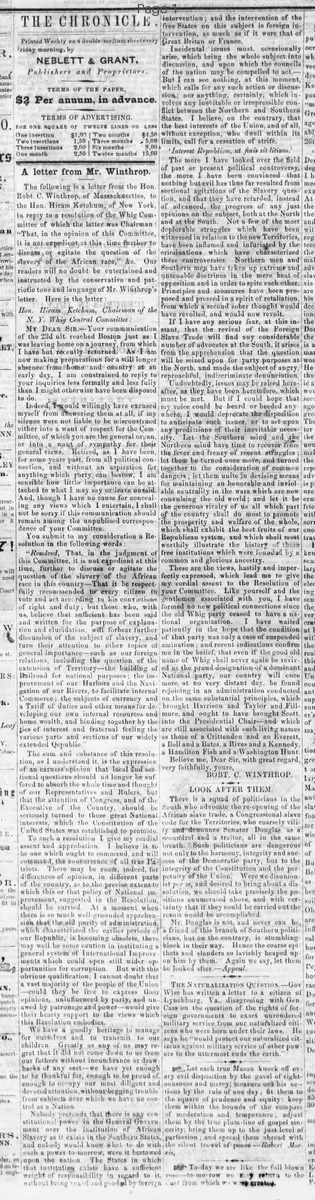
A letter from Mr. Winthrop.
The following is a letter from the Hon.
Robt. C. Winthrop, of Massachusetts, to
the Hon. Hiram Ketchum, of New York,
in reply to a resolution of the Whig Com-
mittee of which the latter was Chairman:
"That, in the opinion of this Committee,
it is not expedient at this time further to
discuss or agitate the question of the
slavery of the African race," &c. Our
readers will no doubt be entertained and
instructed by the conservative and pat-
riotic tone and language of Mr. Winthrop's
letter. Here is the letter:
Hon. Hiram Ketchum, Chairman of the
N. Y. Whig Central Committee:
My Dear Sir.—Your communication
of the 23d ult. reached Boston just as I
was leaving home on a journey, from which
I have but recently returned. As I am
now making preparations for a still longer
absence from home and country at an
early day, I am constrained to reply to
your inquiries less formally and less fully
than I might otherwise have been disposed
to do.
Indeed, I would willingly have excused
myself from answering them at all, if my
silence were not liable to be misconstrued
either into a want of respect for the Com-
mittee, of which you are the general organ,
or into a want of sympathy for their
general views. Retired, as I have been.
for some years past, from all political con-
nection, and without an aspiration for
anything which party can bestow, I am
sensible how little importance can be at-
tached to what I may say or leave unsaid.
And, though I have no cause for conceal-
ing any views which I entertain, I shall
not be sorry if this communication should
remain among the unpublished correspon-
dence of your Committee.
You submit to my consideration a Re-
olution in the following words:
"Resolved, That, in the judgment of
this Committee, it is not expedient at this
time, further to discuss or agitate the
question of the slavery of the African
race in this country—That it be respect-
fully recommended to every citizen to
vote and act according to his convictions
of right and duty; but those who, with
us, believe that sufficient has been said
and written for the purpose of explana-
tion and elucidation, will forbear further
discussion of the subject of slavery, and
turn their attention to other topics of
general importance—such as our foreign
relations, including the question of the
extension of Territory—the building of
Railroad for national purposes; the im-
provement of our Harbors and the Navi-
gation of our Rivers, to facilitate internal
Commerce; the subjects of currency and
a Tariff of duties and other means for de-
veloping our own internal resources and
home wealth, and binding together by the
ties of interest and fraternal feeling the
various parts and sections of our widely
extended Republic."
The sum and substance of this resolu-
tion, as I understand it, is the expression
of an earnest opinion that local and sec-
tional questions should no longer be suf-
fered to absorb the whole time and thought
of our Representatives and Rulers, but
that the attention of Congress, and of the
Executive of the Country, should be
seriously turned to those great National
interests, which the Constitution of the
United States was established to promote.
To such a resolution I give my cordial
assent and approbation. I believe it to
be one which ought to command, and will
command, the concurrence of all true Pa-
triots. There may be room, indeed, for
differences of opinion, in different parts
of the country, as to the precise extent to
which this or that policy of National im-
provement, suggested in the Resolution,
should be carried. At a moment when
there is so much well-grounded apprehen-
sion that the old purity of administration,
which characterized the earlier periods of
our Republic, is becoming obsolete, there
may well be some caution in instituting a
general system of International Improve-
ments which could open still wider op-
portunities for corruption. But with this
obvious qualification, I cannot doubt that
a vast majority of the people of the Union
—could they be free to express their
opinions, uninfluenced by party, and un-
awed by patronage and power—would give
their hearty support to the views which
this Resolution embodies.
We have a goodly heritage to manage
for ourselves and to transmit to our
children. Greatly as any of us may re-
gret that it did not come down to us from
our fathers without incumbrance or draw-
backs of any sort—we have yet enough
to be thankful for, enough to be proud of
enough to occupy our most diligent and
devoted attention, without begging trouble
from subjects over which we have no con-
trol as a Nation
Nobody pretends that there is any con-
stitutional power in the General Government over the institution of African
Slavery as it exists in the Southern States.
and nobody would know what to do with
such a power to-morrow, were it bestowed
upon the nation The States in which
that institution exists have a sufficient
weight of responsibility in regard to it.
without being vexed and goaded by foreign
intervention; and the intervention of the
free States on this subject is foreign in-
tervention, as much as if it were that of
Great Britain or France.
Incidental issues must, occasionally
arise, which bring the whole subject into
discussion, and upon which the councils
of the nation may be compelled to act.—
But I can see nothing, at this moment,
which calls for any such action or discus-
sion: nor anything, certainly, which in-
volves any inevitable or irrepressible con-
flict between the Northern and Southern
States, I believe, on the contrary, that
the best interests of the Union, and of all.
without exception, who dwell within its
limits, call for a cessation of strife.
Interest Republicae, ut finis sit litium.
The more I have looked over the field
of past or present political controversy,
the more I have been convinced that
nothing but evil has thus far resulted from
sectional agitations of the Slavery ques-
tion, and that they have retarded, instead
of advanced, the progress of any just
opinions on the subject, both at the North
and at the South. Not a few of the most
deplorable struggles which have been
witnessed in relation to the new Territories,
have been inflamed and infuriated by the
criminations which have characterized
these controversies. Northern men and
Southern men have taken up extreme and
untenable doctrines in the mere heat of
opposition and in order to spite each other.
Principles and measures have been pro-
posed and pressed in a spirit of retaliation.
from which a second sober thought would
have revolted, and would now revolt.
If I have any serious fear, at this in-
stant, that the revival of the Foreign
Slave Trade will find any considerable
number of advocates at the South, it arises
from the apprehension that the question
will be seized upon for party purposes at
the North, and made the subject of angry,
reproachful, indiscriminate denunciation.
Undoubtedly, issues may be raised here.
after, as they have been heretofore, which
must be met. But if I could hope that
my voice could be heard or heeded any-
where, I would deprecate the disposition
to anticipate such issues, or to act upon
any predictions of their inevitable neces-
sity. Let the Southern mind and the
Northern mind have time to recover from
the fever and frenzy of recent struggles:
let them be turned once more, and turned
together to the consideration of common
dangers; let them unite in devising means
for maintaining an honorable and inviol-
able neutrality in the wars which are now
convulsing the old world; and let it be
the generous rivalry of us all which part
of the country shall do most to promote
the prosperity and welfare of the whole.
which shall exhibit the best fruits of our
Republican system, and which shall most
worthily illustrate the history of those
free institutions which were founded by a
common and glorious ancestry.
These are the views, hastily and imper-
fectly expressed, which lead me to give
my cordial assent to the Resolution of
your Committee. Like yourself and the
gentlemen associated with you, I have
formed no new political connections since
the old Whig party ceased to have a na-
tional organization. I have waited
patiently in the hope that the condition
of that party was only a case of suspended
animation: and recent indications confirm
me in the belief, that even if the good old
name of Whig shall never again be reviv-
ed as the proud designation of a dominant
National party, our country will once
more, at no very distant day, be found
rejoicing in an administration conducted
on the same substantial principles, which
brought Harrison and Taylor and Fill-
more, and ought to have brought Scott
into the Presidential Chair—and which
are still associated with such living names
as those of a Crittenden and an Everett
a Bell and a Bates, a Rives and a Kennedy,
a Hamilton Fish and a Washington Hunt.
Believe me, Dear Sir, with great regard,
very faithfully, yours,
ROBT. C. WINTHROP.
The following is a letter from the Hon.
Robt. C. Winthrop, of Massachusetts, to
the Hon. Hiram Ketchum, of New York,
in reply to a resolution of the Whig Com-
mittee of which the latter was Chairman:
"That, in the opinion of this Committee,
it is not expedient at this time further to
discuss or agitate the question of the
slavery of the African race," &c. Our
readers will no doubt be entertained and
instructed by the conservative and pat-
riotic tone and language of Mr. Winthrop's
letter. Here is the letter:
Hon. Hiram Ketchum, Chairman of the
N. Y. Whig Central Committee:
My Dear Sir.—Your communication
of the 23d ult. reached Boston just as I
was leaving home on a journey, from which
I have but recently returned. As I am
now making preparations for a still longer
absence from home and country at an
early day, I am constrained to reply to
your inquiries less formally and less fully
than I might otherwise have been disposed
to do.
Indeed, I would willingly have excused
myself from answering them at all, if my
silence were not liable to be misconstrued
either into a want of respect for the Com-
mittee, of which you are the general organ,
or into a want of sympathy for their
general views. Retired, as I have been.
for some years past, from all political con-
nection, and without an aspiration for
anything which party can bestow, I am
sensible how little importance can be at-
tached to what I may say or leave unsaid.
And, though I have no cause for conceal-
ing any views which I entertain, I shall
not be sorry if this communication should
remain among the unpublished correspon-
dence of your Committee.
You submit to my consideration a Re-
olution in the following words:
"Resolved, That, in the judgment of
this Committee, it is not expedient at this
time, further to discuss or agitate the
question of the slavery of the African
race in this country—That it be respect-
fully recommended to every citizen to
vote and act according to his convictions
of right and duty; but those who, with
us, believe that sufficient has been said
and written for the purpose of explana-
tion and elucidation, will forbear further
discussion of the subject of slavery, and
turn their attention to other topics of
general importance—such as our foreign
relations, including the question of the
extension of Territory—the building of
Railroad for national purposes; the im-
provement of our Harbors and the Navi-
gation of our Rivers, to facilitate internal
Commerce; the subjects of currency and
a Tariff of duties and other means for de-
veloping our own internal resources and
home wealth, and binding together by the
ties of interest and fraternal feeling the
various parts and sections of our widely
extended Republic."
The sum and substance of this resolu-
tion, as I understand it, is the expression
of an earnest opinion that local and sec-
tional questions should no longer be suf-
fered to absorb the whole time and thought
of our Representatives and Rulers, but
that the attention of Congress, and of the
Executive of the Country, should be
seriously turned to those great National
interests, which the Constitution of the
United States was established to promote.
To such a resolution I give my cordial
assent and approbation. I believe it to
be one which ought to command, and will
command, the concurrence of all true Pa-
triots. There may be room, indeed, for
differences of opinion, in different parts
of the country, as to the precise extent to
which this or that policy of National im-
provement, suggested in the Resolution,
should be carried. At a moment when
there is so much well-grounded apprehen-
sion that the old purity of administration,
which characterized the earlier periods of
our Republic, is becoming obsolete, there
may well be some caution in instituting a
general system of International Improve-
ments which could open still wider op-
portunities for corruption. But with this
obvious qualification, I cannot doubt that
a vast majority of the people of the Union
—could they be free to express their
opinions, uninfluenced by party, and un-
awed by patronage and power—would give
their hearty support to the views which
this Resolution embodies.
We have a goodly heritage to manage
for ourselves and to transmit to our
children. Greatly as any of us may re-
gret that it did not come down to us from
our fathers without incumbrance or draw-
backs of any sort—we have yet enough
to be thankful for, enough to be proud of
enough to occupy our most diligent and
devoted attention, without begging trouble
from subjects over which we have no con-
trol as a Nation
Nobody pretends that there is any con-
stitutional power in the General Government over the institution of African
Slavery as it exists in the Southern States.
and nobody would know what to do with
such a power to-morrow, were it bestowed
upon the nation The States in which
that institution exists have a sufficient
weight of responsibility in regard to it.
without being vexed and goaded by foreign
intervention; and the intervention of the
free States on this subject is foreign in-
tervention, as much as if it were that of
Great Britain or France.
Incidental issues must, occasionally
arise, which bring the whole subject into
discussion, and upon which the councils
of the nation may be compelled to act.—
But I can see nothing, at this moment,
which calls for any such action or discus-
sion: nor anything, certainly, which in-
volves any inevitable or irrepressible con-
flict between the Northern and Southern
States, I believe, on the contrary, that
the best interests of the Union, and of all.
without exception, who dwell within its
limits, call for a cessation of strife.
Interest Republicae, ut finis sit litium.
The more I have looked over the field
of past or present political controversy,
the more I have been convinced that
nothing but evil has thus far resulted from
sectional agitations of the Slavery ques-
tion, and that they have retarded, instead
of advanced, the progress of any just
opinions on the subject, both at the North
and at the South. Not a few of the most
deplorable struggles which have been
witnessed in relation to the new Territories,
have been inflamed and infuriated by the
criminations which have characterized
these controversies. Northern men and
Southern men have taken up extreme and
untenable doctrines in the mere heat of
opposition and in order to spite each other.
Principles and measures have been pro-
posed and pressed in a spirit of retaliation.
from which a second sober thought would
have revolted, and would now revolt.
If I have any serious fear, at this in-
stant, that the revival of the Foreign
Slave Trade will find any considerable
number of advocates at the South, it arises
from the apprehension that the question
will be seized upon for party purposes at
the North, and made the subject of angry,
reproachful, indiscriminate denunciation.
Undoubtedly, issues may be raised here.
after, as they have been heretofore, which
must be met. But if I could hope that
my voice could be heard or heeded any-
where, I would deprecate the disposition
to anticipate such issues, or to act upon
any predictions of their inevitable neces-
sity. Let the Southern mind and the
Northern mind have time to recover from
the fever and frenzy of recent struggles:
let them be turned once more, and turned
together to the consideration of common
dangers; let them unite in devising means
for maintaining an honorable and inviol-
able neutrality in the wars which are now
convulsing the old world; and let it be
the generous rivalry of us all which part
of the country shall do most to promote
the prosperity and welfare of the whole.
which shall exhibit the best fruits of our
Republican system, and which shall most
worthily illustrate the history of those
free institutions which were founded by a
common and glorious ancestry.
These are the views, hastily and imper-
fectly expressed, which lead me to give
my cordial assent to the Resolution of
your Committee. Like yourself and the
gentlemen associated with you, I have
formed no new political connections since
the old Whig party ceased to have a na-
tional organization. I have waited
patiently in the hope that the condition
of that party was only a case of suspended
animation: and recent indications confirm
me in the belief, that even if the good old
name of Whig shall never again be reviv-
ed as the proud designation of a dominant
National party, our country will once
more, at no very distant day, be found
rejoicing in an administration conducted
on the same substantial principles, which
brought Harrison and Taylor and Fill-
more, and ought to have brought Scott
into the Presidential Chair—and which
are still associated with such living names
as those of a Crittenden and an Everett
a Bell and a Bates, a Rives and a Kennedy,
a Hamilton Fish and a Washington Hunt.
Believe me, Dear Sir, with great regard,
very faithfully, yours,
ROBT. C. WINTHROP.
What sub-type of article is it?
Slavery Abolition
Partisan Politics
What keywords are associated?
Slavery Agitation
Whig Committee
National Unity
Internal Improvements
Sectional Strife
Constitutional Limits
Party Principles
What entities or persons were involved?
Robt. C. Winthrop
Hiram Ketchum
N. Y. Whig Central Committee
Harrison
Taylor
Fillmore
Scott
Crittenden
Everett
Bell
Bates
Rives
Kennedy
Hamilton Fish
Washington Hunt
Editorial Details
Primary Topic
Response To Whig Committee Resolution On Avoiding Slavery Agitation
Stance / Tone
Conservative Patriotic Advocacy For National Unity Over Sectional Strife
Key Figures
Robt. C. Winthrop
Hiram Ketchum
N. Y. Whig Central Committee
Harrison
Taylor
Fillmore
Scott
Crittenden
Everett
Bell
Bates
Rives
Kennedy
Hamilton Fish
Washington Hunt
Key Arguments
No Constitutional Power In General Government Over African Slavery In Southern States
Intervention By Free States Is Foreign Intervention
Cessation Of Strife On Slavery Benefits The Union
Focus Attention On National Interests Like Foreign Relations, Territory Extension, Railroads, Harbors, Currency, Tariff
Sectional Agitations Have Resulted Only In Evil And Retarded Progress
Avoid Anticipating Inevitable Conflicts On Slavery
Unite North And South On Common Dangers And Prosperity