Thank you for visiting SNEWPapers!
Sign up free
Literary
May 26, 1888
The Woman's Tribune
Beatrice, Gage County, Nebraska
What is this article about?
Historical essay on St. James' Palace from Queen Anne's reign onward, detailing enlargements, royal ceremonies like touching for king's evil (including young Samuel Johnson), anecdotes of courtiers, fashions, incidents with George I, II, III, Queen Caroline, and others, up to George III's jubilee in 1809.
Clipping
OCR Quality
95%
Excellent
Full Text
"Saint James—The Home and Haunt of
Kings." —(Spenser.)
By Octavia.
"They say there is a Royal Court
Maintained in noble state,
Where every noble man and good
Is certain to be great."
—Hood.
"And now in musing mood I would recall
From ancient Father Time's ancestral hall,
The thoughts and manners of a distant day,
Long in the dark recesses hid away."
NUMBER 4.
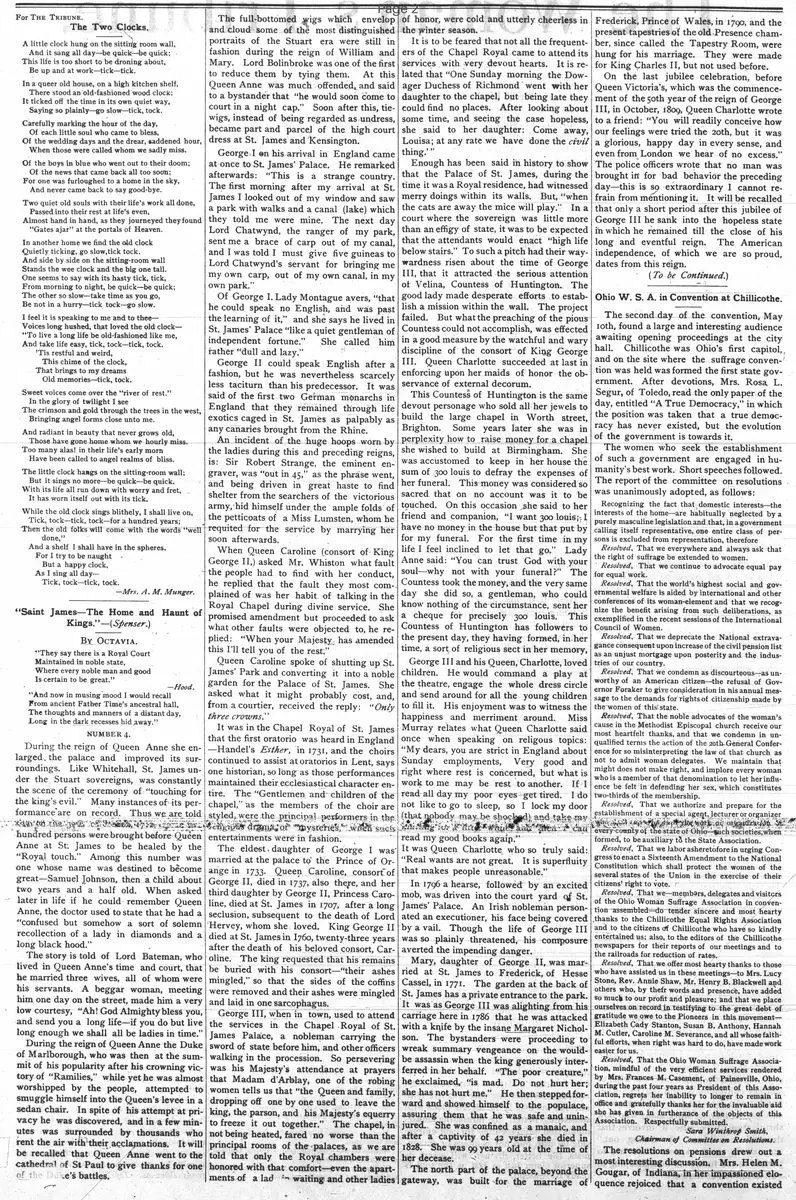
During the reign of Queen Anne she enlarged the palace and improved its surroundings. Like Whitehall, St. James under the Stuart sovereigns, was constantly the scene of the ceremony of "touching for the king's evil." Many instances of its performance are on record. Thus we are told hundred persons were brought before Queen Anne at St. James to be healed by the "Royal touch." Among this number was one whose name was destined to become great—Samuel Johnson, then a child about two years and a half old. When asked later in life if he could remember Queen Anne, the doctor used to state that he had a "confused but somehow a sort of solemn recollection of a lady in diamonds and a long black hood."
The story is told of Lord Bateman, who lived in Queen Anne's time and court, that he married three wives, all of whom were his servants. A beggar woman, meeting him one day on the street, made him a very low courtesy, "Ah! God Almighty bless you, and send you a long life—if you do but live long enough we shall all be ladies in time."
During the reign of Queen Anne the Duke of Marlborough, who was then at the summit of his popularity after his crowning victory of "Ramillies," while yet he was almost worshipped by the people, attempted to smuggle himself into the Queen's levee in a sedan chair. In spite of his attempt at privacy he was discovered, and in a few minutes was surrounded by thousands who rent the air with their acclamations. It will be recalled that Queen Anne went to the cathedral of St. Paul to give thanks for one of the Duke's battles.
The full-bottomed wigs which envelop and cloud some of the most distinguished portraits of the Stuart era were still in fashion during the reign of William and Mary. Lord Bolingbroke was one of the first to reduce them by tying them. At this Queen Anne was much offended, and said to a bystander that "he would soon come to court in a night cap." Soon after this, tie-wigs, instead of being regarded as undress, became part and parcel of the high court dress at St. James and Kensington.
George I on his arrival in England came at once to St. James' Palace. He remarked afterwards: "This is a strange country. The first morning after my arrival at St. James I looked out of my window and saw a park with walks and a canal (lake) which they told me were mine. The next day Lord Townshend, the ranger of my park, sent me a brace of carp out of my canal and I was told I must give five guineas to Lord Townshend's servant for bringing me my own carp, out of my own canal, in my own park."
Of George I. Lady Montague avers, "that he could speak no English, and was past the learning of it." and she says he lived in St. James' Palace "like a quiet gentleman of independent fortune." She called him rather "dull and lazy."
George II could speak English after a fashion, but he was nevertheless scarcely less taciturn than his predecessor. It was said of the first two German monarchs in England that they remained through life exotics caged in St. James as palpably as any canaries brought from the Rhine.
An incident of the huge hoops worn by the ladies during this and preceding reigns, is: Sir Robert Strange, the eminent engraver, was "out in '45," as the phrase went, and being driven in great haste to find shelter from the searchers of the victorious army, hid himself under the ample folds of the petticoats of a Miss Lumsden, whom he requited for the service by marrying her soon afterwards.
When Queen Caroline (consort of King George II.) asked Mr. Whiston what fault the people had to find with her conduct, he replied that the fault they most complained of was her habit of talking in the Royal Chapel during divine service. She promised amendment but proceeded to ask what other faults were objected to, he replied: "When your Majesty has amended this I'll tell you of the rest."
Queen Caroline spoke of shutting up St. James' Park and converting it into a noble garden for the Palace of St. James. She asked what it might probably cost, and, from a courtier, received the reply: "Only three crowns."
It was in the Chapel Royal of St. James that the first oratorio was heard in England—Handel's Esther, in 1731, and the choirs continued to assist at oratorios in Lent, says one historian, so long as those performances maintained their ecclesiastical character entire. The "Gentlemen and children of the chapel," as the members of the choir are styled, were the principal performers in the mystery's drama of "mysteries," when such entertainments were in fashion.
The eldest daughter of George I was married at the palace to the Prince of Orange in 1733. Queen Caroline, consort of George II, died in 1737, also there, and her third daughter by George II. Princess Caroline, died at St. James in 1737, after a long seclusion, subsequent to the death of Lord Hervey, whom she loved. King George II died at St. James in 1760, twenty-three years after the death of his beloved consort, Caroline. The king requested that his remains be buried with his consort "their ashes mingled," so that the sides of the coffins were removed and their ashes were mingled and laid in one sarcophagus.
George III, when in town, used to attend the services in the Chapel Royal of St. James Palace, a nobleman carrying the sword of state before him, and other officers walking in the procession. So persevering was his Majesty's attendance at prayers that Madam d'Arblay, one of the robing women tells us that "the Queen and family, dropping off one by one used to leave the king, the parson, and his Majesty's equerry to freeze it out together." The chapel, in not being heated, fared no worse than the principal rooms of the palaces, as we are told that only the Royal chambers were honored with that comfort even the apartments of a lady waiting and other ladies of honor, were cold and utterly cheerless in the winter season.
It is to be feared that not all the frequenters of the Chapel Royal came to attend its services with very devout hearts. It is related that "One Sunday morning the Dowager Duchess of Richmond went with her daughter to the chapel, but being late they could find no places. After looking about some time, and seeing the case hopeless she said to her daughter: Come away, Louisa; at any rate we have done the civil thing."
Enough has been said in history to show that the Palace of St. James, during the time it was a Royal residence, had witnessed merry doings within its walls. But, "when the cats are away the mice will play." In a court where the sovereign was little more than an effigy of state, it was to be expected that the attendants would enact "high life below stairs." To such a pitch had their waywardness risen about the time of George III. that it attracted the serious attention of Selina, Countess of Huntingdon. The good lady made desperate efforts to establish a mission within the wall. The project failed. But what the preaching of the pious Countess could not accomplish, was effected in a good measure by the watchful and wary discipline of the consort of King George III. Queen Charlotte succeeded at last in enforcing upon her maids of honor the observance of external decorum.
This Countess of Huntingdon is the same devout personage who sold all her jewels to build the large chapel in North street, Brighton. Some years later she was in perplexity how to raise money for a chapel she wished to build at Birmingham. She was accustomed to keep in her house the sum of 299 louis to defray the expenses of her funeral. This money was considered so sacred that on no account was it to be touched. On this occasion she said to her friend and companion, "I want 300 louis; I have no money in the house but that put by for my funeral. For the first time in my life I feel inclined to let that go." Lady Anne said: "You can trust God with your soul—why not with your funeral?" The Countess took the money, and the very same day she did so, a gentleman, who could know nothing of the circumstance, sent her a cheque for precisely 300 louis. This Countess of Huntingdon has followers to the present day, they having formed, in her time, a sort of religious sect in her memory.
George III and his Queen, Charlotte, loved children. He would command a play at the theatre, engage the whole dress circle and send around for all the young children to fill it. His enjoyment was to witness the happiness and merriment around. Miss Burney relates what Queen Charlotte said once when speaking on religious topics: "My dears, you are strict in England about Sunday employments, Very good and right where rest is concerned, but what is work to me may be rest to another. If I read all day my poor eyes get tired. I do not like to go to sleep, so I lock my door (that nobody may be shocked) and take my work and read my good books again."
It was Queen Charlotte who so truly said: "Real wants are not great. It is superfluity that makes people unreasonable."
In 1796 a hearse, followed by an excited mob, was driven into the court yard of St. James' Palace. An Irish nobleman personated an executioner, his face being covered by a veil. Though the life of George III was so plainly threatened, his composure averted the impending danger.
Mary, daughter of George II, was married at St. James to Frederick, of Hesse Cassel, in 1771. The garden at the back of St. James has a private entrance to the park. It was as George III was alighting from his carriage here in 1786 that he was attacked with a knife by the insane Margaret Nicholson. The bystanders were proceeding to wreak summary vengeance on the would-be assassin when the king generously interfered in her behalf. "The poor creature," he exclaimed, "is mad. Do not hurt her; she has not hurt me." He then stepped forward and showed himself to the populace, assuring them that he was safe and uninjured. She was confined as a maniac, and after a captivity of 42 years she died in 1828. She was 99 years old at the time of her decease.
The north part of the palace, beyond the gateway, was built for the marriage of Frederick, Prince of Wales, in 1730, and the present tapestries of the old Presence chamber, since called the Tapestry Room, were hung for his marriage. They were made for King Charles II, but not used before.
On the last jubilee celebration, before Queen Victoria's, which was the commencement of the 50th year of the reign of George III. in October, 1809, Queen Charlotte wrote to a friend: "You will readily conceive how our feelings were tried the 20th, but it was a glorious, happy day in every sense, and even from London we hear of no excess." The police officers wrote that no man was brought in for bad behavior the preceding day—this is so extraordinary I cannot refrain from mentioning it. It will be recalled that only a short period after this jubilee of George III he sank into the hopeless state in which he remained till the close of his long and eventful reign. The American independence, of which we are so proud, dates from this reign.
(To be Continued.)
Kings." —(Spenser.)
By Octavia.
"They say there is a Royal Court
Maintained in noble state,
Where every noble man and good
Is certain to be great."
—Hood.
"And now in musing mood I would recall
From ancient Father Time's ancestral hall,
The thoughts and manners of a distant day,
Long in the dark recesses hid away."
NUMBER 4.
During the reign of Queen Anne she enlarged the palace and improved its surroundings. Like Whitehall, St. James under the Stuart sovereigns, was constantly the scene of the ceremony of "touching for the king's evil." Many instances of its performance are on record. Thus we are told hundred persons were brought before Queen Anne at St. James to be healed by the "Royal touch." Among this number was one whose name was destined to become great—Samuel Johnson, then a child about two years and a half old. When asked later in life if he could remember Queen Anne, the doctor used to state that he had a "confused but somehow a sort of solemn recollection of a lady in diamonds and a long black hood."
The story is told of Lord Bateman, who lived in Queen Anne's time and court, that he married three wives, all of whom were his servants. A beggar woman, meeting him one day on the street, made him a very low courtesy, "Ah! God Almighty bless you, and send you a long life—if you do but live long enough we shall all be ladies in time."
During the reign of Queen Anne the Duke of Marlborough, who was then at the summit of his popularity after his crowning victory of "Ramillies," while yet he was almost worshipped by the people, attempted to smuggle himself into the Queen's levee in a sedan chair. In spite of his attempt at privacy he was discovered, and in a few minutes was surrounded by thousands who rent the air with their acclamations. It will be recalled that Queen Anne went to the cathedral of St. Paul to give thanks for one of the Duke's battles.
The full-bottomed wigs which envelop and cloud some of the most distinguished portraits of the Stuart era were still in fashion during the reign of William and Mary. Lord Bolingbroke was one of the first to reduce them by tying them. At this Queen Anne was much offended, and said to a bystander that "he would soon come to court in a night cap." Soon after this, tie-wigs, instead of being regarded as undress, became part and parcel of the high court dress at St. James and Kensington.
George I on his arrival in England came at once to St. James' Palace. He remarked afterwards: "This is a strange country. The first morning after my arrival at St. James I looked out of my window and saw a park with walks and a canal (lake) which they told me were mine. The next day Lord Townshend, the ranger of my park, sent me a brace of carp out of my canal and I was told I must give five guineas to Lord Townshend's servant for bringing me my own carp, out of my own canal, in my own park."
Of George I. Lady Montague avers, "that he could speak no English, and was past the learning of it." and she says he lived in St. James' Palace "like a quiet gentleman of independent fortune." She called him rather "dull and lazy."
George II could speak English after a fashion, but he was nevertheless scarcely less taciturn than his predecessor. It was said of the first two German monarchs in England that they remained through life exotics caged in St. James as palpably as any canaries brought from the Rhine.
An incident of the huge hoops worn by the ladies during this and preceding reigns, is: Sir Robert Strange, the eminent engraver, was "out in '45," as the phrase went, and being driven in great haste to find shelter from the searchers of the victorious army, hid himself under the ample folds of the petticoats of a Miss Lumsden, whom he requited for the service by marrying her soon afterwards.
When Queen Caroline (consort of King George II.) asked Mr. Whiston what fault the people had to find with her conduct, he replied that the fault they most complained of was her habit of talking in the Royal Chapel during divine service. She promised amendment but proceeded to ask what other faults were objected to, he replied: "When your Majesty has amended this I'll tell you of the rest."
Queen Caroline spoke of shutting up St. James' Park and converting it into a noble garden for the Palace of St. James. She asked what it might probably cost, and, from a courtier, received the reply: "Only three crowns."
It was in the Chapel Royal of St. James that the first oratorio was heard in England—Handel's Esther, in 1731, and the choirs continued to assist at oratorios in Lent, says one historian, so long as those performances maintained their ecclesiastical character entire. The "Gentlemen and children of the chapel," as the members of the choir are styled, were the principal performers in the mystery's drama of "mysteries," when such entertainments were in fashion.
The eldest daughter of George I was married at the palace to the Prince of Orange in 1733. Queen Caroline, consort of George II, died in 1737, also there, and her third daughter by George II. Princess Caroline, died at St. James in 1737, after a long seclusion, subsequent to the death of Lord Hervey, whom she loved. King George II died at St. James in 1760, twenty-three years after the death of his beloved consort, Caroline. The king requested that his remains be buried with his consort "their ashes mingled," so that the sides of the coffins were removed and their ashes were mingled and laid in one sarcophagus.
George III, when in town, used to attend the services in the Chapel Royal of St. James Palace, a nobleman carrying the sword of state before him, and other officers walking in the procession. So persevering was his Majesty's attendance at prayers that Madam d'Arblay, one of the robing women tells us that "the Queen and family, dropping off one by one used to leave the king, the parson, and his Majesty's equerry to freeze it out together." The chapel, in not being heated, fared no worse than the principal rooms of the palaces, as we are told that only the Royal chambers were honored with that comfort even the apartments of a lady waiting and other ladies of honor, were cold and utterly cheerless in the winter season.
It is to be feared that not all the frequenters of the Chapel Royal came to attend its services with very devout hearts. It is related that "One Sunday morning the Dowager Duchess of Richmond went with her daughter to the chapel, but being late they could find no places. After looking about some time, and seeing the case hopeless she said to her daughter: Come away, Louisa; at any rate we have done the civil thing."
Enough has been said in history to show that the Palace of St. James, during the time it was a Royal residence, had witnessed merry doings within its walls. But, "when the cats are away the mice will play." In a court where the sovereign was little more than an effigy of state, it was to be expected that the attendants would enact "high life below stairs." To such a pitch had their waywardness risen about the time of George III. that it attracted the serious attention of Selina, Countess of Huntingdon. The good lady made desperate efforts to establish a mission within the wall. The project failed. But what the preaching of the pious Countess could not accomplish, was effected in a good measure by the watchful and wary discipline of the consort of King George III. Queen Charlotte succeeded at last in enforcing upon her maids of honor the observance of external decorum.
This Countess of Huntingdon is the same devout personage who sold all her jewels to build the large chapel in North street, Brighton. Some years later she was in perplexity how to raise money for a chapel she wished to build at Birmingham. She was accustomed to keep in her house the sum of 299 louis to defray the expenses of her funeral. This money was considered so sacred that on no account was it to be touched. On this occasion she said to her friend and companion, "I want 300 louis; I have no money in the house but that put by for my funeral. For the first time in my life I feel inclined to let that go." Lady Anne said: "You can trust God with your soul—why not with your funeral?" The Countess took the money, and the very same day she did so, a gentleman, who could know nothing of the circumstance, sent her a cheque for precisely 300 louis. This Countess of Huntingdon has followers to the present day, they having formed, in her time, a sort of religious sect in her memory.
George III and his Queen, Charlotte, loved children. He would command a play at the theatre, engage the whole dress circle and send around for all the young children to fill it. His enjoyment was to witness the happiness and merriment around. Miss Burney relates what Queen Charlotte said once when speaking on religious topics: "My dears, you are strict in England about Sunday employments, Very good and right where rest is concerned, but what is work to me may be rest to another. If I read all day my poor eyes get tired. I do not like to go to sleep, so I lock my door (that nobody may be shocked) and take my work and read my good books again."
It was Queen Charlotte who so truly said: "Real wants are not great. It is superfluity that makes people unreasonable."
In 1796 a hearse, followed by an excited mob, was driven into the court yard of St. James' Palace. An Irish nobleman personated an executioner, his face being covered by a veil. Though the life of George III was so plainly threatened, his composure averted the impending danger.
Mary, daughter of George II, was married at St. James to Frederick, of Hesse Cassel, in 1771. The garden at the back of St. James has a private entrance to the park. It was as George III was alighting from his carriage here in 1786 that he was attacked with a knife by the insane Margaret Nicholson. The bystanders were proceeding to wreak summary vengeance on the would-be assassin when the king generously interfered in her behalf. "The poor creature," he exclaimed, "is mad. Do not hurt her; she has not hurt me." He then stepped forward and showed himself to the populace, assuring them that he was safe and uninjured. She was confined as a maniac, and after a captivity of 42 years she died in 1828. She was 99 years old at the time of her decease.
The north part of the palace, beyond the gateway, was built for the marriage of Frederick, Prince of Wales, in 1730, and the present tapestries of the old Presence chamber, since called the Tapestry Room, were hung for his marriage. They were made for King Charles II, but not used before.
On the last jubilee celebration, before Queen Victoria's, which was the commencement of the 50th year of the reign of George III. in October, 1809, Queen Charlotte wrote to a friend: "You will readily conceive how our feelings were tried the 20th, but it was a glorious, happy day in every sense, and even from London we hear of no excess." The police officers wrote that no man was brought in for bad behavior the preceding day—this is so extraordinary I cannot refrain from mentioning it. It will be recalled that only a short period after this jubilee of George III he sank into the hopeless state in which he remained till the close of his long and eventful reign. The American independence, of which we are so proud, dates from this reign.
(To be Continued.)
What sub-type of article is it?
Essay
What themes does it cover?
Political
Social Manners
What keywords are associated?
St James Palace
Queen Anne
George Iii
Royal Court
Historical Anecdotes
Kingly Ceremonies
Court Fashion
Chapel Royal
What entities or persons were involved?
By Octavia.
Literary Details
Title
"Saint James—The Home And Haunt Of Kings."
Author
By Octavia.
Subject
Historical Anecdotes Of St. James' Palace From Queen Anne To George Iii
Form / Style
Historical Prose Essay With Epigraphs And Quotations
Key Lines
"They Say There Is A Royal Court Maintained In Noble State, Where Every Noble Man And Good Is Certain To Be Great." —Hood.
"Confused But Somehow A Sort Of Solemn Recollection Of A Lady In Diamonds And A Long Black Hood."
"This Is A Strange Country. The First Morning After My Arrival At St. James I Looked Out Of My Window And Saw A Park With Walks And A Canal (Lake) Which They Told Me Were Mine."
"The Poor Creature, Is Mad. Do Not Hurt Her; She Has Not Hurt Me."
"Real Wants Are Not Great. It Is Superfluity That Makes People Unreasonable."