Thank you for visiting SNEWPapers!
Sign up free
Commercial
September 5, 1906
The Star
Reynoldsville, Jefferson County, Pennsylvania
What is this article about?
Federal grand juries in Chicago indicted Standard Oil on 6,428 counts for accepting rebates from seven railroads on oil shipments from Whiting, Ind., facing fines up to $128,560,000; combined with Jamestown, N.Y., indictments, total possible fines reach $131,080,000 for monopolizing the oil industry.
Clipping
OCR Quality
98%
Excellent
Full Text
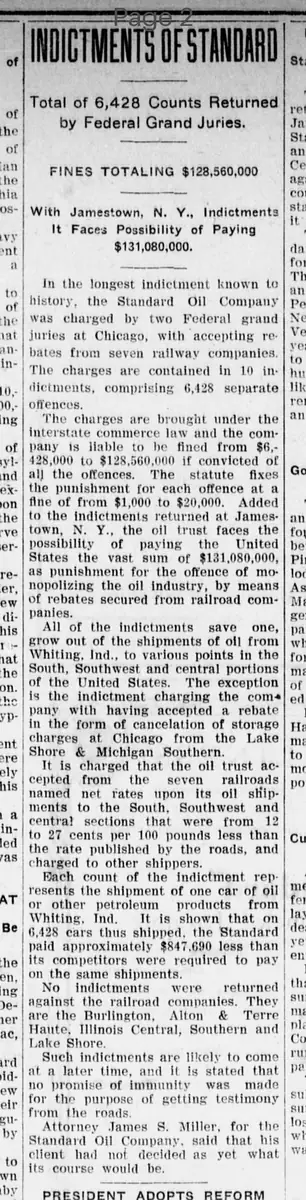
INDICTMENTS OF STANDARD
Total of 6,428 Counts Returned by Federal Grand Juries.
FINES TOTALING $128,560,000
With Jamestown, N. Y., Indictments It Faces Possibility of Paying $131,080,000.
In the longest indictment known to history, the Standard Oil Company was charged by two Federal grand juries at Chicago, with accepting rebates from seven railway companies.
The charges are contained in 10 indictments, comprising 6,428 separate offences.
The charges are brought under the interstate commerce law and the company is liable to be fined from $6,428,000 to $128,560,000 if convicted of all the offences. The statute fixes the punishment for each offence at a fine of from $1,000 to $20,000. Added to the indictments returned at Jamestown, N. Y., the oil trust faces the possibility of paying the United States the vast sum of $131,080,000, as punishment for the offence of monopolizing the oil industry, by means of rebates secured from railroad companies.
All of the indictments save one, grow out of the shipments of oil from Whiting, Ind., to various points in the South, Southwest and central portions of the United States. The exception is the indictment charging the company with having accepted a rebate in the form of cancellation of storage charges at Chicago from the Lake Shore & Michigan Southern.
It is charged that the oil trust accepted from the seven railroads named net rates upon its oil shipments to the South, Southwest and central sections that were from 12 to 27 cents per 100 pounds less than the rate published by the roads, and charged to other shippers.
Each count of the indictment represents the shipment of one car of oil or other petroleum products from Whiting, Ind. It is shown that on 6,428 cars thus shipped, the Standard paid approximately $847,690 less than its competitors were required to pay on the same shipments.
No indictments were returned against the railroad companies. They are the Burlington, Alton & Terre Haute, Illinois Central, Southern and Lake Shore.
Such indictments are likely to come at a later time, and it is stated that no promise of immunity was made for the purpose of getting testimony from the roads.
Attorney James S. Miller, for the Standard Oil Company, said that his client had not decided as yet what its course would be.
Total of 6,428 Counts Returned by Federal Grand Juries.
FINES TOTALING $128,560,000
With Jamestown, N. Y., Indictments It Faces Possibility of Paying $131,080,000.
In the longest indictment known to history, the Standard Oil Company was charged by two Federal grand juries at Chicago, with accepting rebates from seven railway companies.
The charges are contained in 10 indictments, comprising 6,428 separate offences.
The charges are brought under the interstate commerce law and the company is liable to be fined from $6,428,000 to $128,560,000 if convicted of all the offences. The statute fixes the punishment for each offence at a fine of from $1,000 to $20,000. Added to the indictments returned at Jamestown, N. Y., the oil trust faces the possibility of paying the United States the vast sum of $131,080,000, as punishment for the offence of monopolizing the oil industry, by means of rebates secured from railroad companies.
All of the indictments save one, grow out of the shipments of oil from Whiting, Ind., to various points in the South, Southwest and central portions of the United States. The exception is the indictment charging the company with having accepted a rebate in the form of cancellation of storage charges at Chicago from the Lake Shore & Michigan Southern.
It is charged that the oil trust accepted from the seven railroads named net rates upon its oil shipments to the South, Southwest and central sections that were from 12 to 27 cents per 100 pounds less than the rate published by the roads, and charged to other shippers.
Each count of the indictment represents the shipment of one car of oil or other petroleum products from Whiting, Ind. It is shown that on 6,428 cars thus shipped, the Standard paid approximately $847,690 less than its competitors were required to pay on the same shipments.
No indictments were returned against the railroad companies. They are the Burlington, Alton & Terre Haute, Illinois Central, Southern and Lake Shore.
Such indictments are likely to come at a later time, and it is stated that no promise of immunity was made for the purpose of getting testimony from the roads.
Attorney James S. Miller, for the Standard Oil Company, said that his client had not decided as yet what its course would be.
What sub-type of article is it?
Monopoly Or Cartel
Shipping
What keywords are associated?
Standard Oil Indictments
Railroad Rebates
Oil Monopoly
Federal Fines
Interstate Commerce Law
What entities or persons were involved?
Standard Oil Company
Burlington
Alton & Terre Haute
Illinois Central
Southern
Lake Shore & Michigan Southern
Where did it happen?
Chicago
Commercial Details
Location
Chicago
Commodities
Oil
Petroleum Products
Key Figures
Standard Oil Company
Burlington
Alton & Terre Haute
Illinois Central
Southern
Lake Shore & Michigan Southern
Notable Details
6,428 Counts
Fines From $6,428,000 To $128,560,000
Jamestown Indictments Adding $2,520,000
Rebates 12 To 27 Cents Per 100 Pounds Less
$847,690 Less Paid On 6,428 Cars
No Indictments Against Railroads