Thank you for visiting SNEWPapers!
Sign up free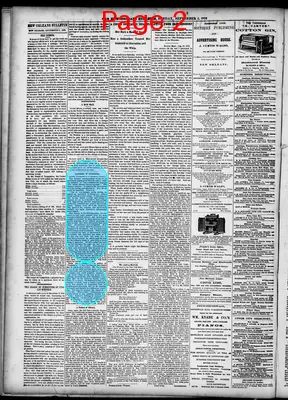
Literary
September 5, 1875
Event 1 of 2
The New Orleans Bulletin
New Orleans, Orleans County, Louisiana
What is this article about?
A brief note praises news depot owner Ed. Marlborough for welcoming crowds in Commercial Alley. The main piece is an anecdote by a London correspondent for Appleton's Journal about poet Algernon Swinburne's eccentric, absent-minded attendance at the wrong dinner party, illustrating his nervous genius, with a personal observation from a poetic reading.
Clipping
OCR Quality
98%
Excellent
Full Text
This is Event 1 of 2. The full text below covers all events in this component.
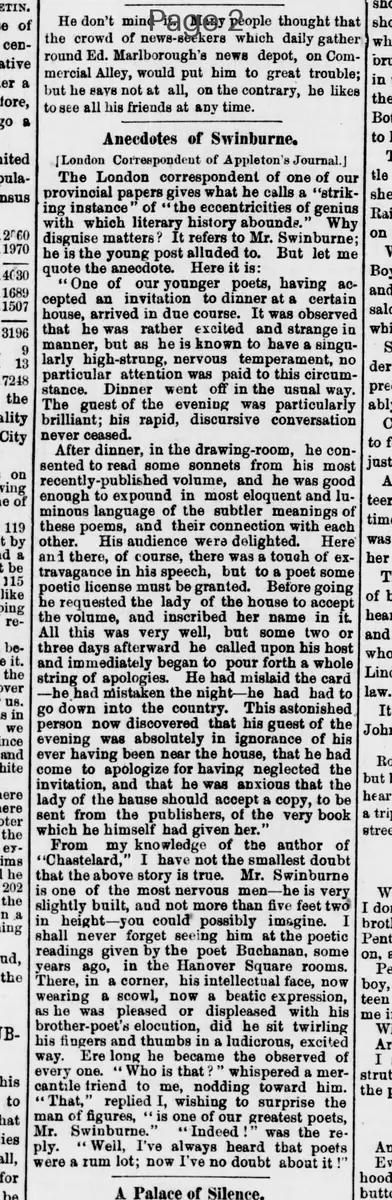
Many people thought that the crowd of news-seekers which daily gather round Ed. Marlborough's news depot, on Commercial Alley, would put him to great trouble; but he says not at all, on the contrary, he likes to see all his friends at any time.
Anecdotes of Swinburne.
[London Correspondent of Appleton's Journal.]
The London correspondent of one of our provincial papers gives what he calls a 'striking instance' of 'the eccentricities of genius with which literary history abounds.' Why disguise matters? It refers to Mr. Swinburne; he is the young poet alluded to. But let me quote the anecdote. Here it is: 'One of our younger poets, having accepted an invitation to dinner at a certain house, arrived in due course. It was observed that he was rather excited and strange in manner, but as he is known to have a singularly high-strung, nervous temperament, no particular attention was paid to this circumstance. Dinner went off in the usual way. The guest of the evening was particularly brilliant; his rapid, discursive conversation never ceased. After dinner, in the drawing-room, he consented to read some sonnets from his most recently-published volume, and he was good enough to expound in most eloquent and luminous language of the subtler meanings of these poems, and their connection with each other. His audience were delighted. Here and there, of course, there was a touch of extravagance in his speech, but to a poet some poetic license must be granted. Before going he requested the lady of the house to accept the volume, and inscribed her name in it. All this was very well, but some two or three days afterward he called upon his host and immediately began to pour forth a whole string of apologies. He had mislaid the card -he had mistaken the night-he had had to go down into the country. This astonished person now discovered that his guest of the evening was absolutely in ignorance of his ever having been near the house, that he had come to apologize for having neglected the invitation, and that he was anxious that the lady of the house should accept a copy, to be sent from the publishers, of the very book which he himself had given her.' From my knowledge of the author of 'Chastelard,' I have not the smallest doubt that the above story is true. Mr. Swinburne is one of the most nervous men-he is very slightly built, and not more than five feet two in height-you could possibly imagine. I shall never forget seeing him at the poetic readings given by the poet Buchanan, some years ago, in the Hanover Square rooms. There, in a corner, his intellectual face, now wearing a scowl, now a beatific expression, as he was pleased or displeased with his brother-poet's elocution, did he sit twirling his fingers and thumbs in a ludicrous, excited way. Ere long he became the observed of every one. 'Who is that?' whispered a mercantile friend to me, nodding toward him. 'That,' replied I, wishing to surprise the man of figures, 'is one of our greatest poets, Mr. Swinburne.' 'Indeed!' was the reply. 'Well, I've always heard that poets were a rum lot; now I've no doubt about it!'
Anecdotes of Swinburne.
[London Correspondent of Appleton's Journal.]
The London correspondent of one of our provincial papers gives what he calls a 'striking instance' of 'the eccentricities of genius with which literary history abounds.' Why disguise matters? It refers to Mr. Swinburne; he is the young poet alluded to. But let me quote the anecdote. Here it is: 'One of our younger poets, having accepted an invitation to dinner at a certain house, arrived in due course. It was observed that he was rather excited and strange in manner, but as he is known to have a singularly high-strung, nervous temperament, no particular attention was paid to this circumstance. Dinner went off in the usual way. The guest of the evening was particularly brilliant; his rapid, discursive conversation never ceased. After dinner, in the drawing-room, he consented to read some sonnets from his most recently-published volume, and he was good enough to expound in most eloquent and luminous language of the subtler meanings of these poems, and their connection with each other. His audience were delighted. Here and there, of course, there was a touch of extravagance in his speech, but to a poet some poetic license must be granted. Before going he requested the lady of the house to accept the volume, and inscribed her name in it. All this was very well, but some two or three days afterward he called upon his host and immediately began to pour forth a whole string of apologies. He had mislaid the card -he had mistaken the night-he had had to go down into the country. This astonished person now discovered that his guest of the evening was absolutely in ignorance of his ever having been near the house, that he had come to apologize for having neglected the invitation, and that he was anxious that the lady of the house should accept a copy, to be sent from the publishers, of the very book which he himself had given her.' From my knowledge of the author of 'Chastelard,' I have not the smallest doubt that the above story is true. Mr. Swinburne is one of the most nervous men-he is very slightly built, and not more than five feet two in height-you could possibly imagine. I shall never forget seeing him at the poetic readings given by the poet Buchanan, some years ago, in the Hanover Square rooms. There, in a corner, his intellectual face, now wearing a scowl, now a beatific expression, as he was pleased or displeased with his brother-poet's elocution, did he sit twirling his fingers and thumbs in a ludicrous, excited way. Ere long he became the observed of every one. 'Who is that?' whispered a mercantile friend to me, nodding toward him. 'That,' replied I, wishing to surprise the man of figures, 'is one of our greatest poets, Mr. Swinburne.' 'Indeed!' was the reply. 'Well, I've always heard that poets were a rum lot; now I've no doubt about it!'
What sub-type of article is it?
Essay
What themes does it cover?
Social Manners
What keywords are associated?
News Depot
Ed Marlborough
Commercial Alley
News Seekers
Literary Details
Key Lines
Many People Thought That The Crowd Of News Seekers Which Daily Gather Round Ed. Marlborough's News Depot, On Commercial Alley, Would Put Him To Great Trouble; But He Says Not At All, On The Contrary, He Likes To See All His Friends At Any Time.