Thank you for visiting SNEWPapers!
Sign up free
Poem
September 5, 1907
The Central Nevadan
Battle Mountain, Lander County, Nevada
What is this article about?
Satirical poem about thrifty John Jones who obsessively saves for a 'rainy day,' only to lose everything in a flood; his wife reminds him of his words amid the disaster.
Clipping
OCR Quality
95%
Excellent
Full Text
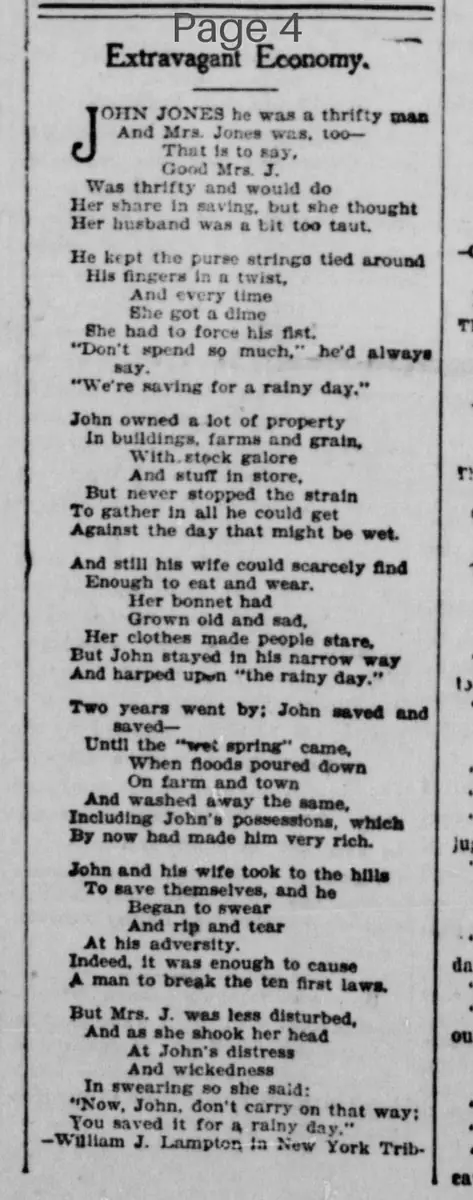
Extravagant
Economy.
JOHN JONES he was a thrifty man
And Mrs. Jones was, too-
That is to say,
Good Mrs. J.
Was thrifty and would do
Her share In saving. but she thought
Her husband was a bit too taut.
He kept the purse strings tied around
His fingers in a twist,
And every time
She got a dime
She had to force his fist.
"Don't spend so much," he'd always
say.
"We're saving for a rainy day."
John owned a lot of property
In buildings, farms and grain,
With stock galore
And stuff in store,
But never stopped the strain
To gather in all he could get
Against the day that might be wet.
And still his wife could scarcely find
Enough to eat and wear.
Her bonnet had
Grown old and sad,
Her clothes made people stare,
But John stayed in his narrow way
And harped upon "the rainy day."
Two years went by: John saved and
saved-
Until the "wet spring" came,
When floods poured down
On farm and town
And washed away the same,
Including John's possessions, which
By now had made him very rich.
John and his wife took to the hills
To save themselves, and he
Began to swear
And rip and tear
At his adversity,
Indeed, it was enough to cause
A man to break the ten command laws
But Mrs. J. was less disturbed
And as she shook her head
At John's distress
And wickedness
In swearing so she said:
"Now, John. don't carry on that way:
You saved it for a rainy day,"
-William J. Lampton in New York Trib-
Economy.
JOHN JONES he was a thrifty man
And Mrs. Jones was, too-
That is to say,
Good Mrs. J.
Was thrifty and would do
Her share In saving. but she thought
Her husband was a bit too taut.
He kept the purse strings tied around
His fingers in a twist,
And every time
She got a dime
She had to force his fist.
"Don't spend so much," he'd always
say.
"We're saving for a rainy day."
John owned a lot of property
In buildings, farms and grain,
With stock galore
And stuff in store,
But never stopped the strain
To gather in all he could get
Against the day that might be wet.
And still his wife could scarcely find
Enough to eat and wear.
Her bonnet had
Grown old and sad,
Her clothes made people stare,
But John stayed in his narrow way
And harped upon "the rainy day."
Two years went by: John saved and
saved-
Until the "wet spring" came,
When floods poured down
On farm and town
And washed away the same,
Including John's possessions, which
By now had made him very rich.
John and his wife took to the hills
To save themselves, and he
Began to swear
And rip and tear
At his adversity,
Indeed, it was enough to cause
A man to break the ten command laws
But Mrs. J. was less disturbed
And as she shook her head
At John's distress
And wickedness
In swearing so she said:
"Now, John. don't carry on that way:
You saved it for a rainy day,"
-William J. Lampton in New York Trib-
What sub-type of article is it?
Satire
Ballad
What themes does it cover?
Satire Society
Moral Virtue
What keywords are associated?
Thrifty Husband
Rainy Day Savings
Flood Disaster
Marital Satire
Extravagant Economy
What entities or persons were involved?
William J. Lampton
Poem Details
Title
Extravagant Economy.
Author
William J. Lampton
Key Lines
"Don't Spend So Much," He'd Always Say.
"We're Saving For A Rainy Day."
"Now, John. Don't Carry On That Way:
You Saved It For A Rainy Day,"