Thank you for visiting SNEWPapers!
Sign up free
Commercial
September 5, 1962
Tabor City Tribune
Tabor City, Columbus County, North Carolina
What is this article about?
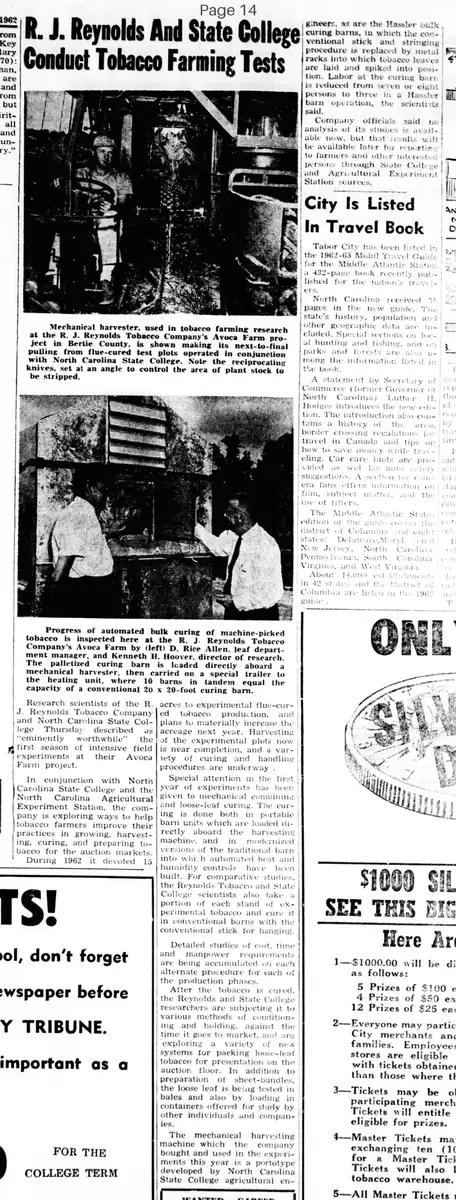
R. J. Reynolds Tobacco Company and North Carolina State College conducted 1962 experiments at Avoca Farm in Bertie County on mechanical harvesting, bulk curing, and handling of flue-cured tobacco to improve farming practices, using 15 acres and planning expansion.
Clipping
OCR Quality
98%
Excellent
Full Text
R. J. Reynolds And State College Conduct Tobacco Farming Tests
Mechanical harvester, used in tobacco farming research at the R. J. Reynolds Tobacco Company's Avoca Farm project in Bertie County, is shown making its next-to-final pulling from flue-cured test plots operated in conjunction with North Carolina State College. Note the reciprocating knives, set at an angle to control the area of plant stock to be stripped.
Progress of automated bulk curing of machine-picked tobacco is inspected here at the R. J. Reynolds Tobacco Company's Avoca Farm by (left) D. Rice Allen, leaf department manager, and Kenneth H. Hoover, director of research. The palletized curing barn is loaded directly aboard a mechanical harvester, then carried on a special trailer to the heating unit, where 10 barns in tandem equal the capacity of a conventional 20 x 20-foot curing barn.
Research scientists of the R. J. Reynolds Tobacco Company and North Carolina State College Thursday described as "eminently worthwhile" the first season of intensive field experiments at their Avoca Farm project. In conjunction with North Carolina State College and the North Carolina Agricultural Experiment Station, the company is exploring ways to help tobacco farmers improve their practices in growing, harvesting, curing, and preparing tobacco for the auction markets. During 1962 it devoted 15 acres to experimental flue-cured tobacco production, and plans to materially increase the acreage next year. Harvesting of the experimental plots now is near completion, and a variety of curing and handling procedures are underway.
Special attention in the first year of experiments has been given to mechanical combining and loose-leaf curing. The curing is done both in portable barn units which are loaded directly aboard the harvesting machine, and in modernized versions of the traditional barn into which automated heat and humidity controls have been built. For comparative studies, the Reynolds Tobacco and State College scientists also take a portion of each stand of experimental tobacco and cure it in conventional barns with the conventional stick for hanging. Detailed studies of cost, time and manpower requirements are being accumulated on each alternate procedure for each of the production phases.
After the tobacco is cured, the Reynolds and State College researchers are subjecting it to various methods of conditioning and holding, against the time it goes to market, and are exploring a variety of new systems for packing loose-leaf tobacco for presentation on the auction floor. In addition to preparation of sheet-bundles, the loose leaf is being tested in bales and also by loading in containers offered for study by other individuals and companies.
The mechanical harvesting machine which the company bought and used in the experiments this year is a prototype developed by North Carolina State College agricultural engineers, as are the Hassler bulk curing barns, in which the conventional stick and stringing procedure is replaced by metal racks into which tobacco leaves are laid and spiked into position. Labor at the curing barn is reduced from seven or eight persons to three in a Hassler barn operation, the scientists said.
Company officials said no analysis of its studies is available now, but that results will be available later for reporting to farmers and other interested persons through State College and Agricultural Experiment Station sources.
Mechanical harvester, used in tobacco farming research at the R. J. Reynolds Tobacco Company's Avoca Farm project in Bertie County, is shown making its next-to-final pulling from flue-cured test plots operated in conjunction with North Carolina State College. Note the reciprocating knives, set at an angle to control the area of plant stock to be stripped.
Progress of automated bulk curing of machine-picked tobacco is inspected here at the R. J. Reynolds Tobacco Company's Avoca Farm by (left) D. Rice Allen, leaf department manager, and Kenneth H. Hoover, director of research. The palletized curing barn is loaded directly aboard a mechanical harvester, then carried on a special trailer to the heating unit, where 10 barns in tandem equal the capacity of a conventional 20 x 20-foot curing barn.
Research scientists of the R. J. Reynolds Tobacco Company and North Carolina State College Thursday described as "eminently worthwhile" the first season of intensive field experiments at their Avoca Farm project. In conjunction with North Carolina State College and the North Carolina Agricultural Experiment Station, the company is exploring ways to help tobacco farmers improve their practices in growing, harvesting, curing, and preparing tobacco for the auction markets. During 1962 it devoted 15 acres to experimental flue-cured tobacco production, and plans to materially increase the acreage next year. Harvesting of the experimental plots now is near completion, and a variety of curing and handling procedures are underway.
Special attention in the first year of experiments has been given to mechanical combining and loose-leaf curing. The curing is done both in portable barn units which are loaded directly aboard the harvesting machine, and in modernized versions of the traditional barn into which automated heat and humidity controls have been built. For comparative studies, the Reynolds Tobacco and State College scientists also take a portion of each stand of experimental tobacco and cure it in conventional barns with the conventional stick for hanging. Detailed studies of cost, time and manpower requirements are being accumulated on each alternate procedure for each of the production phases.
After the tobacco is cured, the Reynolds and State College researchers are subjecting it to various methods of conditioning and holding, against the time it goes to market, and are exploring a variety of new systems for packing loose-leaf tobacco for presentation on the auction floor. In addition to preparation of sheet-bundles, the loose leaf is being tested in bales and also by loading in containers offered for study by other individuals and companies.
The mechanical harvesting machine which the company bought and used in the experiments this year is a prototype developed by North Carolina State College agricultural engineers, as are the Hassler bulk curing barns, in which the conventional stick and stringing procedure is replaced by metal racks into which tobacco leaves are laid and spiked into position. Labor at the curing barn is reduced from seven or eight persons to three in a Hassler barn operation, the scientists said.
Company officials said no analysis of its studies is available now, but that results will be available later for reporting to farmers and other interested persons through State College and Agricultural Experiment Station sources.
What sub-type of article is it?
Agriculture
Manufacturing
What keywords are associated?
Tobacco Farming Research
Mechanical Harvesting
Bulk Curing
Avoca Farm Project
Flue Cured Tobacco Experiments
Labor Reduction
Automated Tobacco Processing
What entities or persons were involved?
R. J. Reynolds Tobacco Company
North Carolina State College
North Carolina Agricultural Experiment Station
D. Rice Allen
Kenneth H. Hoover
Where did it happen?
Avoca Farm, Bertie County, North Carolina
Commercial Details
Location
Avoca Farm, Bertie County, North Carolina
Event Date
1962
Commodities
Flue Cured Tobacco
Tobacco
Key Figures
R. J. Reynolds Tobacco Company
North Carolina State College
North Carolina Agricultural Experiment Station
D. Rice Allen
Kenneth H. Hoover
Notable Details
Mechanical Harvester With Reciprocating Knives
Automated Bulk Curing In Palletized Barns
15 Acres Experimental Production In 1962
Plans To Increase Acreage Next Year
Loose Leaf Curing Methods
Hassler Bulk Curing Barns Reducing Labor From 7 8 To 3 Persons
Studies On Cost, Time, Manpower For Production Phases
Conditioning And Packing Methods Including Sheet Bundles, Bales, Containers