Thank you for visiting SNEWPapers!
Sign up free
Editorial
October 21, 1913
The New Haven Union
New Haven, New Haven County, Connecticut
What is this article about?
Editorial critiques a Cleveland court case where a tango teacher danced before the judge to challenge a city ban, arguing the exhibition proves nothing about improper teaching and fails to address the real issue of what was actually taught.
Clipping
OCR Quality
98%
Excellent
Full Text
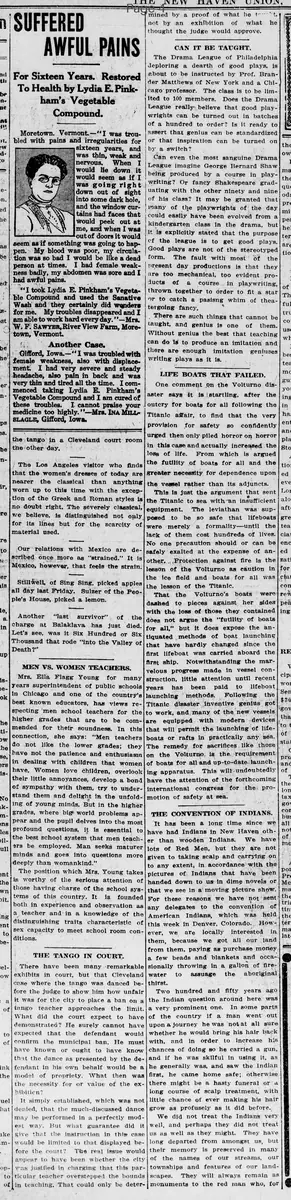
THE TANGO IN COURT.
There have been many remarkable exhibits in court, but that Cleveland case where the tango was danced before the judge to show him how unfair it was for the city to place a ban on a tango teacher approaches the limit. What did the court expect to have demonstrated? He surely cannot have expected that the defendant would confirm the municipal ban. He must have known or ought to have known that the dance as presented by the defendant in his own behalf would be a model of propriety. What then was the necessity for or value of the exhibition?
It simply established, which was not denied, that the much-discussed dance may be performed in a perfectly modest way. But what guarantee did it give that the instruction in this case would be limited to that displayed before the court? The real issue would appear to have been whether the city was justified in charging that this particular teacher overstepped the bounds in teaching. That could only be determined by a proof of what he taught, not by an exhibition of what he thought the judge would approve.
What sub-type of article is it?
Moral Or Religious
Legal Reform
What keywords are associated?
Tango Ban
Court Exhibition
Dance Morality
Cleveland Case
Teaching Propriety
What entities or persons were involved?
Cleveland Court
Tango Teacher
The Judge
The City
Editorial Details
Primary Topic
Critique Of Tango Demonstration In Court
Stance / Tone
Critical Of Court Exhibition's Value
Key Figures
Cleveland Court
Tango Teacher
The Judge
The City
Key Arguments
- court exhibition shows only a model of propriety, not actual teaching
- does not guarantee instruction limits to modest version
- real issue is proof of what teacher actually taught
- demonstration has no necessity or value in determining overstepping bounds