Thank you for visiting SNEWPapers!
Sign up free
Literary
May 26, 1877
Clarksville Weekly Chronicle
Clarksville, Montgomery County, Tennessee
What is this article about?
Personal narrative of a blockade-running voyage from England to Wilmington, NC, in June 1864 aboard the fast steamer Falcon, commanded by Capt. Henry Hobart (later Hobart Pasha). The author travels with Confederate officers, evading Union cruisers, and describes the ship's design, stops at Azores and Bermuda, and a tense chase near Cape Fear River.
Clipping
OCR Quality
98%
Excellent
Full Text
WHAT WE KNOW OF BLOCKADE RUNNING AND HOBART PASHA.
Second Paper---Homeward Bound.
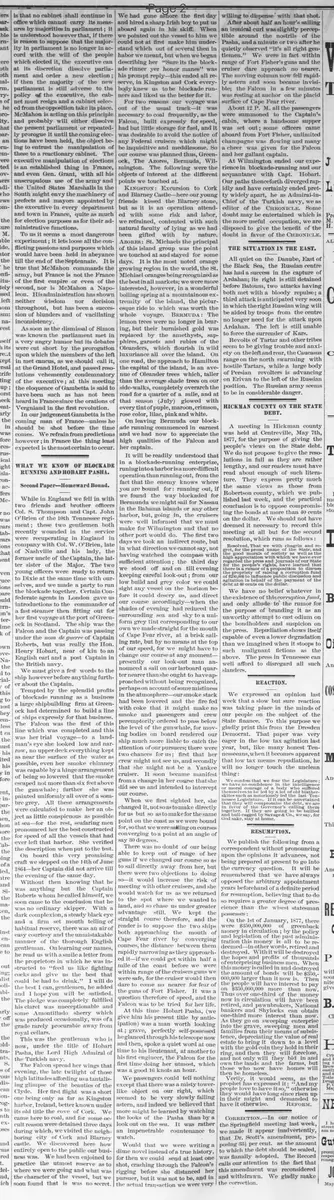
While in England we fell in with two friends and brother officers Col. S. Thompson and Capt. John O'Brien of the 10th Tennessee regiment: these two gentlemen both recently wounded in the service were recuperating in England in company with Col. W. O'Brien, late of Nashville and his lady, the former uncle of the Captain, the latter sister of the Major. The two young officers were ready to return to Dixie at the same time with ourselves, and we made a party to run the blockade together. Certain Confederate agents in London gave us introductions to the commander of a fast steamer then fitting out for her first voyage at the port of Greenock in Scotland. The ship was the Falcon and the Captain was passing under the nom de guerre of Captain Roberts, but was really the Hon. Henry Hobart, near of kin to an English earl and a post Captain in the British navy.
We must give a few words to the ship however before anything further about the Captain. Tempted by the splendid profits of blockade running as a business a large shipbuilding firm at Greenock had determined to build a line of ships expressly for that business. The Falcon was the first of this line which was completed and this was her trial voyage-to a landsman's eye she looked low and narrow, no upper deck everything kept as near the surface of the water as possible, even her smoke chimney was capable by a hinge arrangement of being so lowered that the smoke escaped not more than six feet above the gunwhale; further she was painted uniformly all over of a sombre grey. All these arrangements were calculated to make her an object as little conspicuous as possible at sea-for the rest, seafaring men pronounced her the best constructed for speed of all the vessels that had ever left that harbor. She verified the description when put to the test.
On board this very promising craft we stepped on the 14th of June 1864 her Captain did not arrive till the evening of the same day. Without then knowing that he was anything but the Captain Roberts whom he called himself, we soon came to the conclusion that he was no ordinary skipper. With a dark complexion, a steady black eye and a firm set mouth telling of habitual reserve, there was an air of easy courtesy and the unmistakable manner of the thorough English gentleman. On learning our names he read us with a smile a letter from the proprietors in which he was instructed to "feed us like fighting cocks and give us the best that could be had to drink." "I will do the best I can, gentlemen," he added "and I hope you will be satisfied." The pledge was completely fulfilled his claret was unexceptionable and some Amontillado sherry which was produced occasionally, was of a grade rarely procurable away from royal cellars.
This was the gentleman who is now, under the title of Hobart Pasha, the Lord High Admiral of the Turkish navy.
The Falcon spread her wings that evening, the late twilight of those high latitudes affording us a tantalising glimpse of the beauties of the Clyde. Her first flight was a short one being only as far as Kingston harbor, Ireland, better known under its old title the cove of Cork. We came here to coal, and for some occult reason were detained three days during which, we visited the neighboring city of Cork and Blarney castle. We discovered here how entirely open to the public our business was. We had been enjoined to practice the utmost reserve as to where we were going and what was the character of the vessel, but we soon found that it was no secret. We had gone ashore the first day and hired a sharp Irish boy to put us aboard again in his skiff. When we pointed out the vessel to him we could not at first make him understand which out of several then in harbor we meant, but when we began describing her "Sure its the blockade runner yer honor manes" was his prompt reply-this ended all reserve, in Kingston and Cork everybody knew us to be blockade runners and liked us the better for it.
For two reasons our voyage was out of the usual track-it was necessary to coal frequently, as the Falcon, built expressly for speed, had but little storage for fuel, and it was desirable to avoid the notice of any Federal cruisers which might be inquisitive and meddlesome. So our course was planned thus, Greenock, The Azores, Bermuda, Wilmington. The following were the objects of interest at the different points we touched at.
Kingston: Excursion to Cork and Blarney Castle here our young friends kissed the Blarney stone, but as it is an operation attended with some risk and labor, we refrained, contented with such natural faculty of lying as we had been gifted with by nature.
Azores: St. Michaels the principal of this island group was the point we touched at and stayed for some days. It is the most noted orange growing region in the world, the St. Michael oranges being recognized as the best in all markets: we were more interested, however, in a wonderful boiling spring at a mountainous extremity of the island, the picturesque ride to which was worth the whole voyage.
Bermuda: The lemon trees were no longer in bearing, but their burnished gold was replaced by the amethysts, sapphires, garnets and rubies of the Oleanders, which flourish in wild luxuriance all over the island. On one road, the approach to Hamilton the capital of the island, is an avenue of Oleander trees which, taller than the average shade trees on our side-walks, completely overarch the road for a quarter of a mile, and at that season (July) glowed with every tint of purple, maroon, crimson, rose color, lilac, pink and white.
On leaving Bermuda our blockade running commenced in earnest and we had now to appreciate the high qualities of the Falcon and her captain.
It will be readily understood that in a blockade-running enterprise, running into a harbor is a more difficult operation than running out, from the fact that the enemy knows where you are bound for: running out, if we found the way blockaded for Bermuda we might sail for Nassau in the Bahama islands or any other harbor, but, going in, the cruisers were well informed that we must make for Wilmington and that no other port would do. The first two days we took an indirect route, but in what direction we cannot say, not having watched the compass with sufficient attention; the third day we stood off and on till evening keeping careful look-out: from our low build and grey color we could sight any vessel on the horizon before it could descry us, and direct our course accordingly-when the shades of evening had reduced the surrounding sea and sky to a uniform grey tint corresponding to our own we made straight for the mouth of Cape Fear river, at a brisk sailing rate, but by no means at the top of our speed, for we might have to change our course at any moment—presently our look-out man announced a sail on our larboard quarter nearer than she ought to have approached without being recognized, perhaps on account of some mistiness in the atmosphere our smoke stack had been lowered and the fire fed with coke that it might make no smoke and passengers and crew peremptorily ordered to pass below the level of the gunwhale, for moving bodies on board rendered our ship much more liable to catch the attention of our pursuers; there were two chances for us; first that her crew might not see us, and secondly that she might not be a Yankee cruiser. It soon became manifest from a change in her course that she did see us and intended to intercept our course.
When we first sighted her, she changed it, not so as to make directly for us but so as to make for the same point on the coast as we were bound for, so that we were sailing on courses converging to a point at an angle of say 30 degrees.
There was no doubt of our being able to keep out of range of her guns if we changed our course so as to sail directly away from her, but there were two objections to doing so-it would increase the risk of meeting with other cruisers, and she would watch for us as we returned to the spot where we wanted to land, and so chase us under greater advantage still. We kept the straight course therefore, and the reader is to suppose the two ships both approaching the mouth of Cape Fear river by converging courses, the distance between them rapidly narrowing as they approached it-if we could get within half a mile of the coast before we were within range of the cruisers guns we were safe, for the cruiser would then dare to come no nearer for fear of the guns of Fort Fisher. It was a question therefore of speed, and the Falcon was to be tried for her life.
At this time Hobart Pasha, (we give him his present title by anticipation) was a man worth looking at; grave, perfectly self-possessed he glanced through his telescope now and then, spoke a quiet word at one time to his lieutenant, at another to his first engineer, the Falcon for the first time doing her utmost, which was a good 16 knots an hour.
We passengers could tell nothing except that there was a misty tower-like object on our right, which seemed to be very slowly falling astern, and indeed we believed that more might be learned by watching the looks of the Pasha than by a look out on the sea. It was rather an impenetrable countenance to watch.
Would that we were writing a dime novel instead of a true history, for then we could send at least one shot, crashing through the Falcon's rigging before she distanced her pursuer, but it was not to be, and in the actual transaction we were very willing to dispense with that shot After about half an hour's sailing an ironical curl was slightly perceptible around the nostrils of the Pasha, and a minute or two after he quietly observed "it's all right gentlemen." We were in fact within range of Fort Fisher's guns and the cruiser dare approach no nearer.
The moving column now fell rapidly astern and soon became invisible; the Falcon in a few minutes was resting at anchor on the placid surface of Cape Fear river.
About 12 P. M. all the passengers were summoned to the Captain's cabin, where a handsome supper was set out: some officers came aboard from Fort Fisher, unlimited champagne was flowing and many a cheer was given for the Falcon and her gallant captain.
At Wilmington ended our experience in blockade-running and our acquaintance with Capt. Hobart. Our paths thenceforth diverged rapidly and have certainly ended pretty widely apart, he as Admiral-in-Chief of the Turkish navy, we as editor of the CHRONICLE. Some doubt may be entertained which is the more useful occupation, we are disposed to give the benefit of the doubt in favor of the CHRONICLE.
Second Paper---Homeward Bound.
While in England we fell in with two friends and brother officers Col. S. Thompson and Capt. John O'Brien of the 10th Tennessee regiment: these two gentlemen both recently wounded in the service were recuperating in England in company with Col. W. O'Brien, late of Nashville and his lady, the former uncle of the Captain, the latter sister of the Major. The two young officers were ready to return to Dixie at the same time with ourselves, and we made a party to run the blockade together. Certain Confederate agents in London gave us introductions to the commander of a fast steamer then fitting out for her first voyage at the port of Greenock in Scotland. The ship was the Falcon and the Captain was passing under the nom de guerre of Captain Roberts, but was really the Hon. Henry Hobart, near of kin to an English earl and a post Captain in the British navy.
We must give a few words to the ship however before anything further about the Captain. Tempted by the splendid profits of blockade running as a business a large shipbuilding firm at Greenock had determined to build a line of ships expressly for that business. The Falcon was the first of this line which was completed and this was her trial voyage-to a landsman's eye she looked low and narrow, no upper deck everything kept as near the surface of the water as possible, even her smoke chimney was capable by a hinge arrangement of being so lowered that the smoke escaped not more than six feet above the gunwhale; further she was painted uniformly all over of a sombre grey. All these arrangements were calculated to make her an object as little conspicuous as possible at sea-for the rest, seafaring men pronounced her the best constructed for speed of all the vessels that had ever left that harbor. She verified the description when put to the test.
On board this very promising craft we stepped on the 14th of June 1864 her Captain did not arrive till the evening of the same day. Without then knowing that he was anything but the Captain Roberts whom he called himself, we soon came to the conclusion that he was no ordinary skipper. With a dark complexion, a steady black eye and a firm set mouth telling of habitual reserve, there was an air of easy courtesy and the unmistakable manner of the thorough English gentleman. On learning our names he read us with a smile a letter from the proprietors in which he was instructed to "feed us like fighting cocks and give us the best that could be had to drink." "I will do the best I can, gentlemen," he added "and I hope you will be satisfied." The pledge was completely fulfilled his claret was unexceptionable and some Amontillado sherry which was produced occasionally, was of a grade rarely procurable away from royal cellars.
This was the gentleman who is now, under the title of Hobart Pasha, the Lord High Admiral of the Turkish navy.
The Falcon spread her wings that evening, the late twilight of those high latitudes affording us a tantalising glimpse of the beauties of the Clyde. Her first flight was a short one being only as far as Kingston harbor, Ireland, better known under its old title the cove of Cork. We came here to coal, and for some occult reason were detained three days during which, we visited the neighboring city of Cork and Blarney castle. We discovered here how entirely open to the public our business was. We had been enjoined to practice the utmost reserve as to where we were going and what was the character of the vessel, but we soon found that it was no secret. We had gone ashore the first day and hired a sharp Irish boy to put us aboard again in his skiff. When we pointed out the vessel to him we could not at first make him understand which out of several then in harbor we meant, but when we began describing her "Sure its the blockade runner yer honor manes" was his prompt reply-this ended all reserve, in Kingston and Cork everybody knew us to be blockade runners and liked us the better for it.
For two reasons our voyage was out of the usual track-it was necessary to coal frequently, as the Falcon, built expressly for speed, had but little storage for fuel, and it was desirable to avoid the notice of any Federal cruisers which might be inquisitive and meddlesome. So our course was planned thus, Greenock, The Azores, Bermuda, Wilmington. The following were the objects of interest at the different points we touched at.
Kingston: Excursion to Cork and Blarney Castle here our young friends kissed the Blarney stone, but as it is an operation attended with some risk and labor, we refrained, contented with such natural faculty of lying as we had been gifted with by nature.
Azores: St. Michaels the principal of this island group was the point we touched at and stayed for some days. It is the most noted orange growing region in the world, the St. Michael oranges being recognized as the best in all markets: we were more interested, however, in a wonderful boiling spring at a mountainous extremity of the island, the picturesque ride to which was worth the whole voyage.
Bermuda: The lemon trees were no longer in bearing, but their burnished gold was replaced by the amethysts, sapphires, garnets and rubies of the Oleanders, which flourish in wild luxuriance all over the island. On one road, the approach to Hamilton the capital of the island, is an avenue of Oleander trees which, taller than the average shade trees on our side-walks, completely overarch the road for a quarter of a mile, and at that season (July) glowed with every tint of purple, maroon, crimson, rose color, lilac, pink and white.
On leaving Bermuda our blockade running commenced in earnest and we had now to appreciate the high qualities of the Falcon and her captain.
It will be readily understood that in a blockade-running enterprise, running into a harbor is a more difficult operation than running out, from the fact that the enemy knows where you are bound for: running out, if we found the way blockaded for Bermuda we might sail for Nassau in the Bahama islands or any other harbor, but, going in, the cruisers were well informed that we must make for Wilmington and that no other port would do. The first two days we took an indirect route, but in what direction we cannot say, not having watched the compass with sufficient attention; the third day we stood off and on till evening keeping careful look-out: from our low build and grey color we could sight any vessel on the horizon before it could descry us, and direct our course accordingly-when the shades of evening had reduced the surrounding sea and sky to a uniform grey tint corresponding to our own we made straight for the mouth of Cape Fear river, at a brisk sailing rate, but by no means at the top of our speed, for we might have to change our course at any moment—presently our look-out man announced a sail on our larboard quarter nearer than she ought to have approached without being recognized, perhaps on account of some mistiness in the atmosphere our smoke stack had been lowered and the fire fed with coke that it might make no smoke and passengers and crew peremptorily ordered to pass below the level of the gunwhale, for moving bodies on board rendered our ship much more liable to catch the attention of our pursuers; there were two chances for us; first that her crew might not see us, and secondly that she might not be a Yankee cruiser. It soon became manifest from a change in her course that she did see us and intended to intercept our course.
When we first sighted her, she changed it, not so as to make directly for us but so as to make for the same point on the coast as we were bound for, so that we were sailing on courses converging to a point at an angle of say 30 degrees.
There was no doubt of our being able to keep out of range of her guns if we changed our course so as to sail directly away from her, but there were two objections to doing so-it would increase the risk of meeting with other cruisers, and she would watch for us as we returned to the spot where we wanted to land, and so chase us under greater advantage still. We kept the straight course therefore, and the reader is to suppose the two ships both approaching the mouth of Cape Fear river by converging courses, the distance between them rapidly narrowing as they approached it-if we could get within half a mile of the coast before we were within range of the cruisers guns we were safe, for the cruiser would then dare to come no nearer for fear of the guns of Fort Fisher. It was a question therefore of speed, and the Falcon was to be tried for her life.
At this time Hobart Pasha, (we give him his present title by anticipation) was a man worth looking at; grave, perfectly self-possessed he glanced through his telescope now and then, spoke a quiet word at one time to his lieutenant, at another to his first engineer, the Falcon for the first time doing her utmost, which was a good 16 knots an hour.
We passengers could tell nothing except that there was a misty tower-like object on our right, which seemed to be very slowly falling astern, and indeed we believed that more might be learned by watching the looks of the Pasha than by a look out on the sea. It was rather an impenetrable countenance to watch.
Would that we were writing a dime novel instead of a true history, for then we could send at least one shot, crashing through the Falcon's rigging before she distanced her pursuer, but it was not to be, and in the actual transaction we were very willing to dispense with that shot After about half an hour's sailing an ironical curl was slightly perceptible around the nostrils of the Pasha, and a minute or two after he quietly observed "it's all right gentlemen." We were in fact within range of Fort Fisher's guns and the cruiser dare approach no nearer.
The moving column now fell rapidly astern and soon became invisible; the Falcon in a few minutes was resting at anchor on the placid surface of Cape Fear river.
About 12 P. M. all the passengers were summoned to the Captain's cabin, where a handsome supper was set out: some officers came aboard from Fort Fisher, unlimited champagne was flowing and many a cheer was given for the Falcon and her gallant captain.
At Wilmington ended our experience in blockade-running and our acquaintance with Capt. Hobart. Our paths thenceforth diverged rapidly and have certainly ended pretty widely apart, he as Admiral-in-Chief of the Turkish navy, we as editor of the CHRONICLE. Some doubt may be entertained which is the more useful occupation, we are disposed to give the benefit of the doubt in favor of the CHRONICLE.
What sub-type of article is it?
Journey Narrative
Essay
What themes does it cover?
War Peace
Patriotism
Commerce Trade
What keywords are associated?
Blockade Running
Hobart Pasha
Falcon Ship
Civil War
Confederacy
Cape Fear River
Fort Fisher
Azores
Bermuda
What entities or persons were involved?
Editor Of The Chronicle
Literary Details
Title
What We Know Of Blockade Running And Hobart Pasha. Second Paper Homeward Bound.
Author
Editor Of The Chronicle
Subject
Blockade Running Voyage To The Confederacy
Form / Style
Personal Narrative Memoir In Prose
Key Lines
Tempted By The Splendid Profits Of Blockade Running As A Business A Large Shipbuilding Firm At Greenock Had Determined To Build A Line Of Ships Expressly For That Business.
This Was The Gentleman Who Is Now, Under The Title Of Hobart Pasha, The Lord High Admiral Of The Turkish Navy.
Would That We Were Writing A Dime Novel Instead Of A True History, For Then We Could Send At Least One Shot, Crashing Through The Falcon's Rigging Before She Distanced Her Pursuer, But It Was Not To Be...
"It's All Right Gentlemen." We Were In Fact Within Range Of Fort Fisher's Guns And The Cruiser Dare Approach No Nearer.
At Wilmington Ended Our Experience In Blockade Running And Our Acquaintance With Capt. Hobart.