Thank you for visiting SNEWPapers!
Sign up free
Letter to Editor
July 22, 1851
New York Daily Tribune
New York, New York County, New York
What is this article about?
A civil engineer warns about potential accidents on the new New-Haven Railroad due to rails not being coupled by chairs, which could lead to lateral spreading and derailments. He advocates for public discussion on this cost-saving but risky practice and cites poor maintenance on the Western Railroad as evidence of broader issues.
Clipping
OCR Quality
98%
Excellent
Full Text
Prospective Railroad Accidents.—
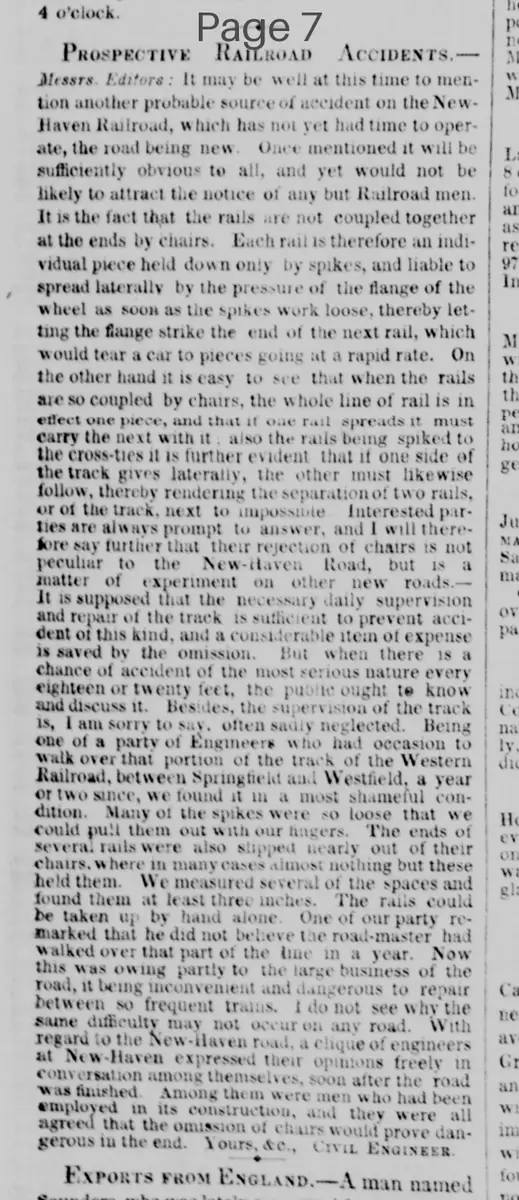
Messrs Editors: It may be well at this time to mention another probable source of accident on the New-Haven Railroad, which has not yet had time to operate, the road being new. Once mentioned it will be sufficiently obvious to all, and yet would not be likely to attract the notice of any but Railroad men. It is the fact that the rails are not coupled together at the ends by chairs. Each rail is therefore an individual piece held down only by spikes, and liable to spread laterally by the pressure of the flange of the wheel as soon as the spikes work loose, thereby letting the flange strike the end of the next rail, which would tear a car to pieces going at a rapid rate. On the other hand it is easy to see that when the rails are so coupled by chairs, the whole line of rail is in effect one piece, and that if one rail spreads it must carry the next with it; also the rails being spiked to the cross-ties it is further evident that if one side of the track gives laterally, the other must likewise follow, thereby rendering the separation of two rails, or of the track, next to impossible. Interested parties are always prompt to answer, and I will therefore say further that their rejection of chairs is not peculiar to the New-Haven Road, but is a matter of experiment on other new roads.—It is supposed that the necessary daily supervision and repair of the track is sufficient to prevent accident of this kind, and a considerable item of expense is saved by the omission. But when there is a chance of accident of the most serious nature every eighteen or twenty feet, the public ought to know and discuss it. Besides, the supervision of the track is, I am sorry to say, often sadly neglected. Being one of a party of Engineers who had occasion to walk over that portion of the track of the Western Railroad, between Springfield and Westfield, a year or two since, we found it in a most shameful condition. Many of the spikes were so loose that we could pull them out with our fingers. The ends of several rails were also slipped nearly out of their chairs, where in many cases almost nothing but these held them. We measured several of the spaces and found them at least three inches. The rails could be taken up by hand alone. One of our party remarked that he did not believe the road-master had walked over that part of the line in a year. Now this was owing partly to the large business of the road, it being inconvenient and dangerous to repair between so frequent trains. I do not see why the same difficulty may not occur on any road. With regard to the New-Haven road, a clique of engineers at New-Haven expressed their opinions freely in conversation among themselves, soon after the road was finished. Among them were men who had been employed in its construction, and they were all agreed that the omission of chairs would prove dangerous in the end. Yours, &c., Civil Engineer
Messrs Editors: It may be well at this time to mention another probable source of accident on the New-Haven Railroad, which has not yet had time to operate, the road being new. Once mentioned it will be sufficiently obvious to all, and yet would not be likely to attract the notice of any but Railroad men. It is the fact that the rails are not coupled together at the ends by chairs. Each rail is therefore an individual piece held down only by spikes, and liable to spread laterally by the pressure of the flange of the wheel as soon as the spikes work loose, thereby letting the flange strike the end of the next rail, which would tear a car to pieces going at a rapid rate. On the other hand it is easy to see that when the rails are so coupled by chairs, the whole line of rail is in effect one piece, and that if one rail spreads it must carry the next with it; also the rails being spiked to the cross-ties it is further evident that if one side of the track gives laterally, the other must likewise follow, thereby rendering the separation of two rails, or of the track, next to impossible. Interested parties are always prompt to answer, and I will therefore say further that their rejection of chairs is not peculiar to the New-Haven Road, but is a matter of experiment on other new roads.—It is supposed that the necessary daily supervision and repair of the track is sufficient to prevent accident of this kind, and a considerable item of expense is saved by the omission. But when there is a chance of accident of the most serious nature every eighteen or twenty feet, the public ought to know and discuss it. Besides, the supervision of the track is, I am sorry to say, often sadly neglected. Being one of a party of Engineers who had occasion to walk over that portion of the track of the Western Railroad, between Springfield and Westfield, a year or two since, we found it in a most shameful condition. Many of the spikes were so loose that we could pull them out with our fingers. The ends of several rails were also slipped nearly out of their chairs, where in many cases almost nothing but these held them. We measured several of the spaces and found them at least three inches. The rails could be taken up by hand alone. One of our party remarked that he did not believe the road-master had walked over that part of the line in a year. Now this was owing partly to the large business of the road, it being inconvenient and dangerous to repair between so frequent trains. I do not see why the same difficulty may not occur on any road. With regard to the New-Haven road, a clique of engineers at New-Haven expressed their opinions freely in conversation among themselves, soon after the road was finished. Among them were men who had been employed in its construction, and they were all agreed that the omission of chairs would prove dangerous in the end. Yours, &c., Civil Engineer
What sub-type of article is it?
Informative
Persuasive
Investigative
What themes does it cover?
Infrastructure
What keywords are associated?
Railroad Safety
New Haven Railroad
Rail Chairs
Track Maintenance
Western Railroad
Civil Engineer
Derailment Risk
What entities or persons were involved?
Civil Engineer
Messrs Editors
Letter to Editor Details
Author
Civil Engineer
Recipient
Messrs Editors
Main Argument
the new-haven railroad's omission of rail chairs increases the risk of lateral spreading and severe accidents; public discussion is needed as track supervision is often neglected, as evidenced by poor conditions on the western railroad.
Notable Details
Rails Not Coupled By Chairs Allow Individual Spreading
Western Railroad Track In Shameful Condition With Loose Spikes And Slipped Rails
Engineers Agreed Omission Of Chairs Dangerous