Thank you for visiting SNEWPapers!
Sign up free
Literary
May 26, 1892
Middletown Transcript
Middletown, New Castle County, Delaware
What is this article about?
After her husband Chello's death in Italy, Desire returns home seemingly grief-stricken but soon revives strangely, engaging in nightly 11 PM rituals. Friends Dorothy and Gretchen shield her from opportunistic relatives. Delayed one night, she falls ill with pneumonia and dies peacefully, revealing Chello's spirit visited her nightly, sustaining her joy until the end. She wills her property to a hospital in his name.
Merged-components note: These components form a single short story titled 'EXPLAINED.' by Alice Brown.
Clipping
OCR Quality
85%
Good
Full Text
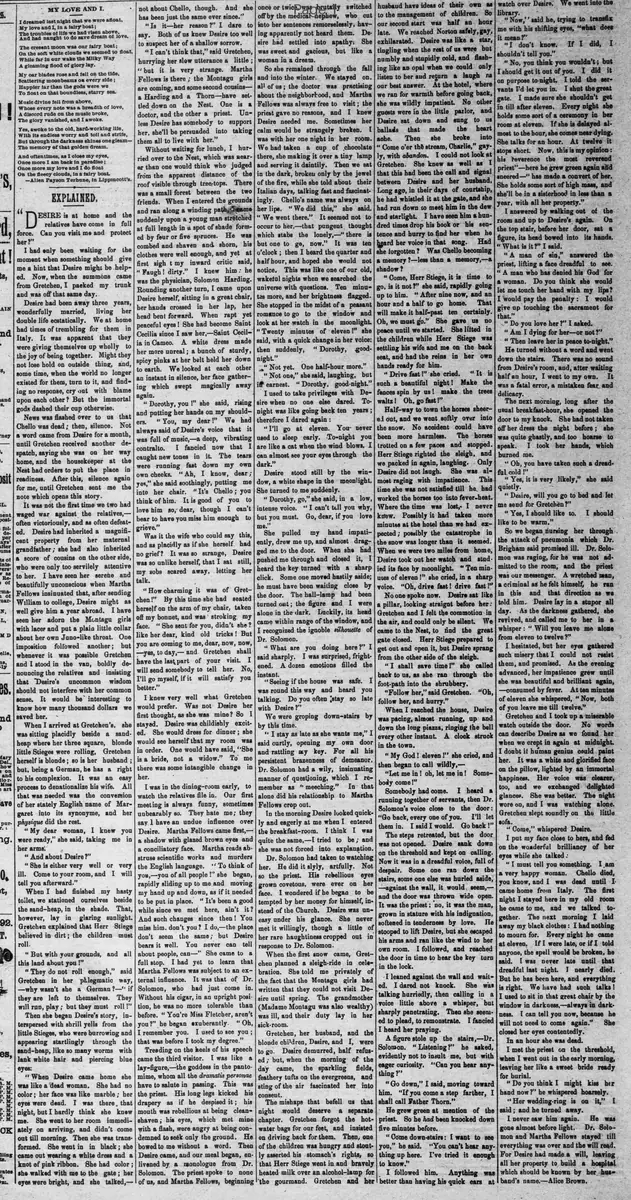
EXPLAINED.
"G D relatives have come in full force. Can you visit me and protect her?"
I had only been waiting for the moment when something should give me a hint that Desire might be helped. Now, when the summons came from Gretchen, I packed my trunk and was off that same day.
Desire had been away three years, wonderfully married, living her double life ecstatically. We at home had times of trembling for them in Italy. It was apparent that they were giving themselves up wholly to the joy of being together. Might they not lose hold on outside things, and, some time, when the world no longer existed for them, turn to it, and finding no response, cry out with blame upon each other? But the immortal gods dashed their cup otherwise.
News was flashed over to us that Chello was dead; then, silence. Not a word came from Desire for a month, until Gretchen received another despatch, saying she was on her way home, and the housekeeper at the Nest had orders to put the place in readiness. After this, silence again for me, until Gretchen sent me the note which opens this story.
It was not the first time we two had waged war against the relatives,—often victoriously, and as often defeated. Desire had inherited a magnificent property from her maternal grandfather; she had also inherited a score of cousins on the other side, who were only too servilely attentive to her. I have seen her serene and beautifully unconscious when Martha Fellows insinuated that, after sending William to college, Desire might as well give him a year abroad. I have seen her adorn the Montagu girls with lace and put a plain little collar about her own Juno-like throat. One imposition followed another; but whenever it was possible Gretchen and I stood in the van, boldly denouncing the relatives and insisting that Desire's uncommon wisdom should not interfere with her common sense. It would be interesting to know how many thousand dollars we saved her.
When I arrived at Gretchen's, she was sitting placidly beside a sand-heap where her three square, blonde little Stieges were rolling. Gretchen herself is blonde; so is her husband; but, being a German, he has a right to his complexion. It was an easy process to denationalize his wife. All that was needed was the conversion of her stately English name of Margaret into its synonyme, and her physique did the rest.
"My dear woman, I knew you were ready," she said, taking me in her arms.
"And about Desire?"
"She is either very well or very ill. Come to your room, and I will tell you afterward."
When I had finished my hasty toilet, we stationed ourselves beside the sand-heap, in the shade. That, however, lay in glaring sunlight. Gretchen explained that Herr Stiege believed in dirt: the children must roll.
"But with your grounds, and all this land about you!"
"They do not roll enough," said Gretchen in her phlegmatic way,—why wasn't she a German?—"if they are left to themselves. They will run, play; but they must roll!"
Then she began Desire's story, interspersed with shrill yells from the little Stieges, who were burrowing and appearing startlingly through the sand-heap, like so many worms with lank white hair and piercing blue eyes:
"When Desire came home she was like a dead woman. She had no color: her face was like marble: her eyes were dead. I was there that night, but I hardly think she knew me. She went to her room immediately on arriving, and didn't come out till morning. Then she was transformed. She went in in black; she came out wearing a white dress and a knot of pink ribbon. She had color; she walked with me to the gate; her eyes were bright, and she talked,—
nas Deel lust. luo Baid vvui biuco.
"Is it—her reason?" I dared to say. Both of us knew Desire too well to suspect her of a shallow sorrow.
"I can't think that," said Gretchen, hurrying her slow utterance a little: "but it is very strange. Martha Fellows is there; the Montagu girls are coming, and some second cousins—a Harding and a Thorn—have settled down on the Nest. One is a doctor, and the other a priest. Unless Desire has somebody to support her, she'll be persuaded into taking them all to live with her."
Without waiting for lunch, I hurried over to the Nest, which was nearer than one would think who judged from the apparent distance of the roof visible through tree-tops. There was a small forest between the two friends. When I entered the grounds and ran along a winding path, I came suddenly upon a young man stretched at full length in a spot of shade formed by four or five spruces. He was combed and shaven and shorn, his clothes were well enough, and yet at first sight my inward critic said, "Faugh! dirty." I knew him: he was the physician, Solomon Harding.
Rounding another turn, I came upon Desire herself, sitting in a great chair, her hands crossed in her lap, her head bent forward. When rapt yet peaceful eyes! She had become Saint Cecilia since I saw her,—Saint Cecilia in Cameo. A white dress made her more unreal; a bunch of sturdy, spicy pinks at her belt held her down to earth. We looked at each other an instant in silence, her face gathering which swept magically away again.
"Dorothy, you!" she said, rising and putting her hands on my shoulders.
"You, my dear!" We had always said of Desire's voice that it was full of music, a deep, vibrating contralto. I fancied now that I caught new tones in it. The tears were running fast down my own cheeks. "Ah, I know, dear; yes," she said soothingly, putting me into her chair. "It's Chello; you think of him. It is good of you to love him so, dear, though I can't bear to have you miss him enough to grieve."
Was it the wife who could say this, and as placidly as if she herself had no grief? It was so strange, Desire was so unlike herself, that I sat still, my sobs scared away, letting her talk.
"How charming it was of Gretchen!" By this time she had seated herself on the arm of my chair, taken off my bonnet, and was stroking my face. "She sent for you, didn't she? Like her dear, kind old tricks! But you are coming to me, dear, now, now, yes, to-day,—and Gretchen shall have the last part of your visit. I will send somebody to tell her. No. I'll go myself, if it will satisfy you better."
I knew very well what Gretchen would prefer. Was not Desire her first thought, as she was mine? So I stayed. Desire was childishly excited. She would dress for dinner; she would see herself that my room was in order. One would have said, "She is a bride, not a widow." To me there was some intangible change in her.
I was in the dining-room early, to watch the relatives file in. Our first meeting is always funny, sometimes unbearably so. They hate me; they say I have an undue influence over Desire. Martha Fellows came first,—a shadow with glazed brown eyes and a conciliatory face. Martha reads abstruse scientific works and murders the English language. "To think of you,—you of all people!" she began, rapidly sliding up to me and moving my hand up and down, as if it needed to be put in place. "It's been a good while since we met here, ain't it? And such changes since then! You miss him, don't you? I do,—the place don't seem the same; but Desire bears it well. You never can tell about people, can—" She came to a full stop. I had yet to learn that Martha Fellows was subject to an external influence. It was that of Dr. Solomon, who had just come in.
Without his cigar, in an upright position, he was no more tolerable than before. "You're Miss Fletcher, aren't you?" he began exuberantly. "Oh, I remember you. I used to see you; that was before I took my degree."
Treading on the heels of his speech came the third visitor. I was like a lay-figure,—the goddess in the pantomime, whom all the dramatis personae have to salute in passing. This was the priest. His long legs kicked his drapery as if he despised it; his mouth was rebellious at being clean-shaven; his eyes, which met mine with a flash, were angry at being condemned to seek only the ground. He bowed to me without a word. Then Desire came, and our meal began, enlivened by a monologue from Dr. Solomon. The priest spoke to none of us, and Martha Fellows, beginning into her sentences remorselessly, having apparently not heard them. Desire had settled into apathy: She was sweet and gracious, but like a woman in a dream.
So she remained through the fall and into the winter. We stayed on, all of us; the doctor was practising about the neighborhood, and Martha Fellows was always free to visit; the priest gave no reasons, and I knew Desire needed me. Sometimes her calm would be strangely broken. I was with her one night in her room. We had taken a cup of chocolate there, she making it over a tiny lamp and serving it daintily. Then we sat in the dark, broken only by the jewel of the fire, while she told about their Italian days, talking fast and fascinatingly. Chello's name was always on her lips. "We did this," she said. "We went there." It seemed not to occur to her, that pungent thought which stabs the lonely. "there is but one to go, now." It was ten o'clock; then I heard the quarter and half hour, and hoped she would not notice. This was like one of our old, wakeful nights when we searched the universe with questions. Ten minutes more, and her brightness flagged. She stopped in the midst of a peasant romance to go to the window and look at her watch in the moonlight.
"Twenty minutes of eleven!" she said, with a quick change in her voice: then suddenly, "Dorothy, good-night."
"Not yet. One half-hour more."
"Not one," she said, laughing, but it earnest. "Dorothy, good-night."
I used to take privileges with Desire when no one else dared. To-night was like going back ten years; therefore I dared again:
"I'll go at eleven. You never used to sleep early. To-night you are like a cat when the wind blows. I can almost see your eyes through the dark."
Desire stood still by the window, a white shape in the moonlight. She turned to me suddenly.
"Dorothy, go," she said, in a low, intense voice. "I can't tell you why, but you must. Go, dear, if you love me."
She pulled my hand impatiently, drew me up, and almost dragged me to the door. When she had pushed me through and closed it, I heard the key turned with a sharp click. Some one moved hastily aside: he must have been waiting close by the door. The hall-lamp had been turned out; the figure and I were alone in the dark. Luckily, its head came within range of the window, and I recognized the ignoble silhouette of Dr. Solomon.
"What are you doing here?" I said sharply. I was surprised, frightened. A dozen emotions filled the instant.
"Seeing if the house was safe. I was round this way and heard you talking. Do you often stay so late with Desire?"
We were groping downstairs by this time.
"I stay as late as she wants me," I said curtly, opening my own door and rattling my key. For all his persistent brazenness of demeanor, Dr. Solomon had a wily, insinuating manner of questioning, which I remember as "meeching." In that alone did his relationship to Martha Fellows crop out.
In the morning Desire looked quickly and eagerly at me when I entered the breakfast-room. I think I was quite the same,—I tried to be; and she was not forced into explanation. Dr. Solomon had taken to watching her. He did it slyly, artfully. Not so the priest. His rebellious eyes grown covetous, were ever on her face. I wondered if he began to be tempted by her money for himself, instead of the Church. Desire was uneasy under his glance. She never met it willingly, though a little of her rare haughtiness cropped out in response to Dr. Solomon.
When the first snow came, Gretchen planned a sleigh-ride in celebration. She told me privately of the fact that the Montagu girls had written that they could not visit Desire until spring. The grandmother (Madame Montagu was also wealthy) was ill, and their duty lay in her sick-room.
Gretchen, her husband, and the blonde children, Desire, and I, were to go. Desire demurred, half refused; but, when the morning of the day came, the sparkling fields, feathery tufts on the evergreens, and sting of the air fascinated her into consent.
The mishaps that befell us that night would deserve a separate chapter. Gretchen forgot the hot-water bags for our feet, and insisted on driving back for them. Then, one of the children was hungry and stoutly asserted his stomach's rights, so that Herr Stiege went in and bravely heated milk over an alcohol-lamp for the gourmand. Gretchen and her husband, our second start was half an hour late. We reached Norton safely, gay, exhilarated. Desire was like a star, tingling when the rest of us were but numbly and stupidly cold, and flashing like an opal when we could only listen to her and return a laugh as our best answer. At the hotel, where we ran for warmth before going back, she was wildly impatient. No other guests were in the little parlor, and Desire sat down and sung to us ballads that made the heart ache.
Then she broke into "Come o'er the stream, Charlie," gayly, with abandon. I could not look at Gretchen. She knew as well as I that this had been the call and signal between Desire and her husband. Long ago, in their days of courtship, he had whistled it at the gate, and she had run down to meet him in the dew and starlight. I have seen him a hundred times drop his book or his sentence and hurry to find her when he heard her voice in that song. Had she forgotten? Was Chello becoming a memory?—less than a memory,—a shadow?
"Come, Herr Stiege, it is time to go, is it not?" she said, rapidly going up to him. "After nine now, and an hour and a half to go home. That will make it half-past ten certainly. Oh, we must go." She gave us no peace until we started. She lifted in the children while Herr Stiege was settling his wife and me on the back seat, and had the reins in her own hands ready for him.
"Drive fast!" she cried. "It is such a beautiful night! Make the fences spin by us! make the trees waltz! Oh, go fast!"
Half-way to town the horses sheered out, and we went softly over into the snow. No accident could have been more harmless. The horses trotted on a few paces and stopped. Herr Stiege righted the sleigh, and we packed in again, laughing. Only Desire did not laugh: She was almost raging with impatience. This time she was not satisfied till he had worked the horses too into fever-heat. Where the time was lost, I never knew. Possibly it had taken more minutes at the hotel than we had expected; possibly the catastrophe in the snow was longer than it seemed.
When we were two miles from home, Desire took out her watch and studied its face by moonlight. "Ten minutes of eleven!" she cried, in a sharp voice. "Oh, drive fast! drive fast!"
No one spoke now. Desire sat like a pillar, looking straight before her: Gretchen and I felt the commotion in the air, and could only be silent. We came to the Nest, to find the great gate closed. Herr Stiege prepared to get out and open it, but Desire sprang from the other side of the sleigh.
"I shall save time!" she called back to us, as she ran through the foot-path into the shrubbery.
"Follow her," said Gretchen. "Oh, follow her, and hurry."
When I reached the house, Desire was pacing, almost running, up and down the long piazza; ringing the bell every other instant. A clock struck in the town.
"My God! eleven!" she cried, and then began to call wildly,—
"Let me in! oh, let me in! Somebody come!"
Somebody had come. I heard a running together of servants, then Dr. Solomon's voice close to the door:
"Go back, every one of you. I'll let them in. I said I would. Go back!"
The steps retreated, but the door was not opened. Desire sank down on the threshold and kept on calling. Now it was in a dreadful voice, full of despair. Some one ran down the stairs, some one else was hurled aside,—against the wall, it would seem,—and the door was thrown wide open.
It was the priest; no, it was the man, grown in stature with his indignation, softened in tenderness by love. He stooped to lift Desire, but she escaped his arms and ran like the wind to her own room. I followed, and reached the door in time to hear the key turn in the lock.
I leaned against the wall and waited. I dared not knock. She was talking hurriedly, then calling in a voice little above a whisper, but sharply penetrating. Then she seemed to plead, to remonstrate. I fancied I heard her praying.
A figure stole up the stairs,—Dr. Solomon. "Listening?" he asked, evidently not to insult me, but with eager curiosity.
"Can you hear anything?"
"Go down," I said, moving toward him. "If you come a step farther, I shall call Father Thorn."
He grew green at mention of the priest. So he had been knocked down five minutes before.
"Come down-stairs: I want to see you," he said.
"You can't hear anything up here. I've tried it enough to know."
I followed him. Anything was better than having his quick ears at near me with his shifting eyes, "what does it mean?"
"I don't know. If I did, I shouldn't tell you."
"No, you think you wouldn't; but I should get it out of you. I did it on purpose to-night. I told the servants I'd let you in. I shut the great gate. I made sure she shouldn't get in till after eleven. Every night she holds some sort of a ceremony in her room at eleven. If she is delayed almost to the hour, she comes near dying. She talks for an hour. At twelve it stops short. Now, this is my opinion: his reverence the most reverend priest"—here he grew green again and sneered—"has made a convert of her. She holds some sort of high mass, and she'll be in a sisterhood in less than a year, with all her property."
I answered by walking out of the room and up to Desire's again. On the top stair, before her door, sat a figure, its head bowed into its hands.
"What is it?" I said.
"A man of sin," answered the priest, lifting a face dreadful to see. "A man who has denied his God for a woman. Do you think she would let me touch her hand with my lips? I would pay the penalty: I would give up touching the sacrament for that."
"Do you love her?"
"Am I dying for her or not?"
"Then leave her in peace to-night."
He turned without a word and went down the stairs. There was no sound from Desire's room, and, after waiting half an hour, I went to my own. It was a fatal error, a mistaken fear and delicacy.
The next morning, long after the usual breakfast-hour, she opened the door to my knock. She had not taken off her dress the night before; she was quite ghastly, and too hoarse to speak. I took her hands, which burned me.
"Oh, you have taken such a dreadful cold!"
"Yes, it is very likely," she said quietly.
"Desire, will you go to bed and let me send for Gretchen?"
"Yes, I should like to. I should like to be warm."
So we began nursing her through the attack of pneumonia which Dr. Brigham said promised ill. Dr. Solomon was raging, for he was not admitted to the room, and the priest was our messenger. A wretched man, a criminal as he felt himself, he ran in this and that direction as we told him. Desire lay in a stupor all day. As the darkness gathered, she revived, and called me to her in a whisper: "Will you leave me alone from eleven to twelve?"
I hesitated, but her eyes gathered such misery that I could not resist them, and promised. As the evening advanced, her impatience grew until she was beautiful and brilliant again.—consumed by fever. At ten minutes of eleven she whispered, "Now, both of you leave me till twelve."
Gretchen and I took up a miserable watch outside the door. No words can describe Desire as we found her when we crept in again at midnight. I doubt if human genius could paint her. It was a white and glorified face on the pillow, lighted by an immortal happiness. Her voice was clearer, too, and we exchanged delighted glances. She was better. The night wore on, and I was watching alone. Gretchen slept soundly on the little sofa.
"Come," whispered Desire.
I put my face close to hers, and fed on the wonderful brilliancy of her eyes while she talked:
"I must tell you something. I am a very happy woman. Chello died, you know, and I was dead until I came home from Italy. The first night I stayed here in my old room he came to me, and we talked together. The next morning I laid away my black clothes: I had nothing to mourn for. Every night he came at eleven. If I were late, or if I told anyone, the spell would be broken, he said. I was never late until that dreadful last night. I nearly died. But he has been here, and everything is right. We have had such talks! I used to sit in that great chair by the window in darkness,—always in darkness. I can tell you now, because he will not need to come again."
She closed her eyes contentedly.
In an hour she was dead.
I met the priest on the threshold, when I went out in the early morning, leaving her like a sweet bride ready for burial.
"Do you think I might kiss her hand now?" he whispered hoarsely.
"Her wedding-ring is on it," I said; and he turned away.
I never saw him again. He was gone almost before light. Dr. Solomon and Martha Fellows stayed till everything was over and the will read. For Desire had made a will, leaving all her property to build a hospital which should be known by her husband's name.—Alice Brown.
"G D relatives have come in full force. Can you visit me and protect her?"
I had only been waiting for the moment when something should give me a hint that Desire might be helped. Now, when the summons came from Gretchen, I packed my trunk and was off that same day.
Desire had been away three years, wonderfully married, living her double life ecstatically. We at home had times of trembling for them in Italy. It was apparent that they were giving themselves up wholly to the joy of being together. Might they not lose hold on outside things, and, some time, when the world no longer existed for them, turn to it, and finding no response, cry out with blame upon each other? But the immortal gods dashed their cup otherwise.
News was flashed over to us that Chello was dead; then, silence. Not a word came from Desire for a month, until Gretchen received another despatch, saying she was on her way home, and the housekeeper at the Nest had orders to put the place in readiness. After this, silence again for me, until Gretchen sent me the note which opens this story.
It was not the first time we two had waged war against the relatives,—often victoriously, and as often defeated. Desire had inherited a magnificent property from her maternal grandfather; she had also inherited a score of cousins on the other side, who were only too servilely attentive to her. I have seen her serene and beautifully unconscious when Martha Fellows insinuated that, after sending William to college, Desire might as well give him a year abroad. I have seen her adorn the Montagu girls with lace and put a plain little collar about her own Juno-like throat. One imposition followed another; but whenever it was possible Gretchen and I stood in the van, boldly denouncing the relatives and insisting that Desire's uncommon wisdom should not interfere with her common sense. It would be interesting to know how many thousand dollars we saved her.
When I arrived at Gretchen's, she was sitting placidly beside a sand-heap where her three square, blonde little Stieges were rolling. Gretchen herself is blonde; so is her husband; but, being a German, he has a right to his complexion. It was an easy process to denationalize his wife. All that was needed was the conversion of her stately English name of Margaret into its synonyme, and her physique did the rest.
"My dear woman, I knew you were ready," she said, taking me in her arms.
"And about Desire?"
"She is either very well or very ill. Come to your room, and I will tell you afterward."
When I had finished my hasty toilet, we stationed ourselves beside the sand-heap, in the shade. That, however, lay in glaring sunlight. Gretchen explained that Herr Stiege believed in dirt: the children must roll.
"But with your grounds, and all this land about you!"
"They do not roll enough," said Gretchen in her phlegmatic way,—why wasn't she a German?—"if they are left to themselves. They will run, play; but they must roll!"
Then she began Desire's story, interspersed with shrill yells from the little Stieges, who were burrowing and appearing startlingly through the sand-heap, like so many worms with lank white hair and piercing blue eyes:
"When Desire came home she was like a dead woman. She had no color: her face was like marble: her eyes were dead. I was there that night, but I hardly think she knew me. She went to her room immediately on arriving, and didn't come out till morning. Then she was transformed. She went in in black; she came out wearing a white dress and a knot of pink ribbon. She had color; she walked with me to the gate; her eyes were bright, and she talked,—
nas Deel lust. luo Baid vvui biuco.
"Is it—her reason?" I dared to say. Both of us knew Desire too well to suspect her of a shallow sorrow.
"I can't think that," said Gretchen, hurrying her slow utterance a little: "but it is very strange. Martha Fellows is there; the Montagu girls are coming, and some second cousins—a Harding and a Thorn—have settled down on the Nest. One is a doctor, and the other a priest. Unless Desire has somebody to support her, she'll be persuaded into taking them all to live with her."
Without waiting for lunch, I hurried over to the Nest, which was nearer than one would think who judged from the apparent distance of the roof visible through tree-tops. There was a small forest between the two friends. When I entered the grounds and ran along a winding path, I came suddenly upon a young man stretched at full length in a spot of shade formed by four or five spruces. He was combed and shaven and shorn, his clothes were well enough, and yet at first sight my inward critic said, "Faugh! dirty." I knew him: he was the physician, Solomon Harding.
Rounding another turn, I came upon Desire herself, sitting in a great chair, her hands crossed in her lap, her head bent forward. When rapt yet peaceful eyes! She had become Saint Cecilia since I saw her,—Saint Cecilia in Cameo. A white dress made her more unreal; a bunch of sturdy, spicy pinks at her belt held her down to earth. We looked at each other an instant in silence, her face gathering which swept magically away again.
"Dorothy, you!" she said, rising and putting her hands on my shoulders.
"You, my dear!" We had always said of Desire's voice that it was full of music, a deep, vibrating contralto. I fancied now that I caught new tones in it. The tears were running fast down my own cheeks. "Ah, I know, dear; yes," she said soothingly, putting me into her chair. "It's Chello; you think of him. It is good of you to love him so, dear, though I can't bear to have you miss him enough to grieve."
Was it the wife who could say this, and as placidly as if she herself had no grief? It was so strange, Desire was so unlike herself, that I sat still, my sobs scared away, letting her talk.
"How charming it was of Gretchen!" By this time she had seated herself on the arm of my chair, taken off my bonnet, and was stroking my face. "She sent for you, didn't she? Like her dear, kind old tricks! But you are coming to me, dear, now, now, yes, to-day,—and Gretchen shall have the last part of your visit. I will send somebody to tell her. No. I'll go myself, if it will satisfy you better."
I knew very well what Gretchen would prefer. Was not Desire her first thought, as she was mine? So I stayed. Desire was childishly excited. She would dress for dinner; she would see herself that my room was in order. One would have said, "She is a bride, not a widow." To me there was some intangible change in her.
I was in the dining-room early, to watch the relatives file in. Our first meeting is always funny, sometimes unbearably so. They hate me; they say I have an undue influence over Desire. Martha Fellows came first,—a shadow with glazed brown eyes and a conciliatory face. Martha reads abstruse scientific works and murders the English language. "To think of you,—you of all people!" she began, rapidly sliding up to me and moving my hand up and down, as if it needed to be put in place. "It's been a good while since we met here, ain't it? And such changes since then! You miss him, don't you? I do,—the place don't seem the same; but Desire bears it well. You never can tell about people, can—" She came to a full stop. I had yet to learn that Martha Fellows was subject to an external influence. It was that of Dr. Solomon, who had just come in.
Without his cigar, in an upright position, he was no more tolerable than before. "You're Miss Fletcher, aren't you?" he began exuberantly. "Oh, I remember you. I used to see you; that was before I took my degree."
Treading on the heels of his speech came the third visitor. I was like a lay-figure,—the goddess in the pantomime, whom all the dramatis personae have to salute in passing. This was the priest. His long legs kicked his drapery as if he despised it; his mouth was rebellious at being clean-shaven; his eyes, which met mine with a flash, were angry at being condemned to seek only the ground. He bowed to me without a word. Then Desire came, and our meal began, enlivened by a monologue from Dr. Solomon. The priest spoke to none of us, and Martha Fellows, beginning into her sentences remorselessly, having apparently not heard them. Desire had settled into apathy: She was sweet and gracious, but like a woman in a dream.
So she remained through the fall and into the winter. We stayed on, all of us; the doctor was practising about the neighborhood, and Martha Fellows was always free to visit; the priest gave no reasons, and I knew Desire needed me. Sometimes her calm would be strangely broken. I was with her one night in her room. We had taken a cup of chocolate there, she making it over a tiny lamp and serving it daintily. Then we sat in the dark, broken only by the jewel of the fire, while she told about their Italian days, talking fast and fascinatingly. Chello's name was always on her lips. "We did this," she said. "We went there." It seemed not to occur to her, that pungent thought which stabs the lonely. "there is but one to go, now." It was ten o'clock; then I heard the quarter and half hour, and hoped she would not notice. This was like one of our old, wakeful nights when we searched the universe with questions. Ten minutes more, and her brightness flagged. She stopped in the midst of a peasant romance to go to the window and look at her watch in the moonlight.
"Twenty minutes of eleven!" she said, with a quick change in her voice: then suddenly, "Dorothy, good-night."
"Not yet. One half-hour more."
"Not one," she said, laughing, but it earnest. "Dorothy, good-night."
I used to take privileges with Desire when no one else dared. To-night was like going back ten years; therefore I dared again:
"I'll go at eleven. You never used to sleep early. To-night you are like a cat when the wind blows. I can almost see your eyes through the dark."
Desire stood still by the window, a white shape in the moonlight. She turned to me suddenly.
"Dorothy, go," she said, in a low, intense voice. "I can't tell you why, but you must. Go, dear, if you love me."
She pulled my hand impatiently, drew me up, and almost dragged me to the door. When she had pushed me through and closed it, I heard the key turned with a sharp click. Some one moved hastily aside: he must have been waiting close by the door. The hall-lamp had been turned out; the figure and I were alone in the dark. Luckily, its head came within range of the window, and I recognized the ignoble silhouette of Dr. Solomon.
"What are you doing here?" I said sharply. I was surprised, frightened. A dozen emotions filled the instant.
"Seeing if the house was safe. I was round this way and heard you talking. Do you often stay so late with Desire?"
We were groping downstairs by this time.
"I stay as late as she wants me," I said curtly, opening my own door and rattling my key. For all his persistent brazenness of demeanor, Dr. Solomon had a wily, insinuating manner of questioning, which I remember as "meeching." In that alone did his relationship to Martha Fellows crop out.
In the morning Desire looked quickly and eagerly at me when I entered the breakfast-room. I think I was quite the same,—I tried to be; and she was not forced into explanation. Dr. Solomon had taken to watching her. He did it slyly, artfully. Not so the priest. His rebellious eyes grown covetous, were ever on her face. I wondered if he began to be tempted by her money for himself, instead of the Church. Desire was uneasy under his glance. She never met it willingly, though a little of her rare haughtiness cropped out in response to Dr. Solomon.
When the first snow came, Gretchen planned a sleigh-ride in celebration. She told me privately of the fact that the Montagu girls had written that they could not visit Desire until spring. The grandmother (Madame Montagu was also wealthy) was ill, and their duty lay in her sick-room.
Gretchen, her husband, and the blonde children, Desire, and I, were to go. Desire demurred, half refused; but, when the morning of the day came, the sparkling fields, feathery tufts on the evergreens, and sting of the air fascinated her into consent.
The mishaps that befell us that night would deserve a separate chapter. Gretchen forgot the hot-water bags for our feet, and insisted on driving back for them. Then, one of the children was hungry and stoutly asserted his stomach's rights, so that Herr Stiege went in and bravely heated milk over an alcohol-lamp for the gourmand. Gretchen and her husband, our second start was half an hour late. We reached Norton safely, gay, exhilarated. Desire was like a star, tingling when the rest of us were but numbly and stupidly cold, and flashing like an opal when we could only listen to her and return a laugh as our best answer. At the hotel, where we ran for warmth before going back, she was wildly impatient. No other guests were in the little parlor, and Desire sat down and sung to us ballads that made the heart ache.
Then she broke into "Come o'er the stream, Charlie," gayly, with abandon. I could not look at Gretchen. She knew as well as I that this had been the call and signal between Desire and her husband. Long ago, in their days of courtship, he had whistled it at the gate, and she had run down to meet him in the dew and starlight. I have seen him a hundred times drop his book or his sentence and hurry to find her when he heard her voice in that song. Had she forgotten? Was Chello becoming a memory?—less than a memory,—a shadow?
"Come, Herr Stiege, it is time to go, is it not?" she said, rapidly going up to him. "After nine now, and an hour and a half to go home. That will make it half-past ten certainly. Oh, we must go." She gave us no peace until we started. She lifted in the children while Herr Stiege was settling his wife and me on the back seat, and had the reins in her own hands ready for him.
"Drive fast!" she cried. "It is such a beautiful night! Make the fences spin by us! make the trees waltz! Oh, go fast!"
Half-way to town the horses sheered out, and we went softly over into the snow. No accident could have been more harmless. The horses trotted on a few paces and stopped. Herr Stiege righted the sleigh, and we packed in again, laughing. Only Desire did not laugh: She was almost raging with impatience. This time she was not satisfied till he had worked the horses too into fever-heat. Where the time was lost, I never knew. Possibly it had taken more minutes at the hotel than we had expected; possibly the catastrophe in the snow was longer than it seemed.
When we were two miles from home, Desire took out her watch and studied its face by moonlight. "Ten minutes of eleven!" she cried, in a sharp voice. "Oh, drive fast! drive fast!"
No one spoke now. Desire sat like a pillar, looking straight before her: Gretchen and I felt the commotion in the air, and could only be silent. We came to the Nest, to find the great gate closed. Herr Stiege prepared to get out and open it, but Desire sprang from the other side of the sleigh.
"I shall save time!" she called back to us, as she ran through the foot-path into the shrubbery.
"Follow her," said Gretchen. "Oh, follow her, and hurry."
When I reached the house, Desire was pacing, almost running, up and down the long piazza; ringing the bell every other instant. A clock struck in the town.
"My God! eleven!" she cried, and then began to call wildly,—
"Let me in! oh, let me in! Somebody come!"
Somebody had come. I heard a running together of servants, then Dr. Solomon's voice close to the door:
"Go back, every one of you. I'll let them in. I said I would. Go back!"
The steps retreated, but the door was not opened. Desire sank down on the threshold and kept on calling. Now it was in a dreadful voice, full of despair. Some one ran down the stairs, some one else was hurled aside,—against the wall, it would seem,—and the door was thrown wide open.
It was the priest; no, it was the man, grown in stature with his indignation, softened in tenderness by love. He stooped to lift Desire, but she escaped his arms and ran like the wind to her own room. I followed, and reached the door in time to hear the key turn in the lock.
I leaned against the wall and waited. I dared not knock. She was talking hurriedly, then calling in a voice little above a whisper, but sharply penetrating. Then she seemed to plead, to remonstrate. I fancied I heard her praying.
A figure stole up the stairs,—Dr. Solomon. "Listening?" he asked, evidently not to insult me, but with eager curiosity.
"Can you hear anything?"
"Go down," I said, moving toward him. "If you come a step farther, I shall call Father Thorn."
He grew green at mention of the priest. So he had been knocked down five minutes before.
"Come down-stairs: I want to see you," he said.
"You can't hear anything up here. I've tried it enough to know."
I followed him. Anything was better than having his quick ears at near me with his shifting eyes, "what does it mean?"
"I don't know. If I did, I shouldn't tell you."
"No, you think you wouldn't; but I should get it out of you. I did it on purpose to-night. I told the servants I'd let you in. I shut the great gate. I made sure she shouldn't get in till after eleven. Every night she holds some sort of a ceremony in her room at eleven. If she is delayed almost to the hour, she comes near dying. She talks for an hour. At twelve it stops short. Now, this is my opinion: his reverence the most reverend priest"—here he grew green again and sneered—"has made a convert of her. She holds some sort of high mass, and she'll be in a sisterhood in less than a year, with all her property."
I answered by walking out of the room and up to Desire's again. On the top stair, before her door, sat a figure, its head bowed into its hands.
"What is it?" I said.
"A man of sin," answered the priest, lifting a face dreadful to see. "A man who has denied his God for a woman. Do you think she would let me touch her hand with my lips? I would pay the penalty: I would give up touching the sacrament for that."
"Do you love her?"
"Am I dying for her or not?"
"Then leave her in peace to-night."
He turned without a word and went down the stairs. There was no sound from Desire's room, and, after waiting half an hour, I went to my own. It was a fatal error, a mistaken fear and delicacy.
The next morning, long after the usual breakfast-hour, she opened the door to my knock. She had not taken off her dress the night before; she was quite ghastly, and too hoarse to speak. I took her hands, which burned me.
"Oh, you have taken such a dreadful cold!"
"Yes, it is very likely," she said quietly.
"Desire, will you go to bed and let me send for Gretchen?"
"Yes, I should like to. I should like to be warm."
So we began nursing her through the attack of pneumonia which Dr. Brigham said promised ill. Dr. Solomon was raging, for he was not admitted to the room, and the priest was our messenger. A wretched man, a criminal as he felt himself, he ran in this and that direction as we told him. Desire lay in a stupor all day. As the darkness gathered, she revived, and called me to her in a whisper: "Will you leave me alone from eleven to twelve?"
I hesitated, but her eyes gathered such misery that I could not resist them, and promised. As the evening advanced, her impatience grew until she was beautiful and brilliant again.—consumed by fever. At ten minutes of eleven she whispered, "Now, both of you leave me till twelve."
Gretchen and I took up a miserable watch outside the door. No words can describe Desire as we found her when we crept in again at midnight. I doubt if human genius could paint her. It was a white and glorified face on the pillow, lighted by an immortal happiness. Her voice was clearer, too, and we exchanged delighted glances. She was better. The night wore on, and I was watching alone. Gretchen slept soundly on the little sofa.
"Come," whispered Desire.
I put my face close to hers, and fed on the wonderful brilliancy of her eyes while she talked:
"I must tell you something. I am a very happy woman. Chello died, you know, and I was dead until I came home from Italy. The first night I stayed here in my old room he came to me, and we talked together. The next morning I laid away my black clothes: I had nothing to mourn for. Every night he came at eleven. If I were late, or if I told anyone, the spell would be broken, he said. I was never late until that dreadful last night. I nearly died. But he has been here, and everything is right. We have had such talks! I used to sit in that great chair by the window in darkness,—always in darkness. I can tell you now, because he will not need to come again."
She closed her eyes contentedly.
In an hour she was dead.
I met the priest on the threshold, when I went out in the early morning, leaving her like a sweet bride ready for burial.
"Do you think I might kiss her hand now?" he whispered hoarsely.
"Her wedding-ring is on it," I said; and he turned away.
I never saw him again. He was gone almost before light. Dr. Solomon and Martha Fellows stayed till everything was over and the will read. For Desire had made a will, leaving all her property to build a hospital which should be known by her husband's name.—Alice Brown.
What sub-type of article is it?
Prose Fiction
What themes does it cover?
Death Mortality
Love Romance
Friendship
What keywords are associated?
Widowhood
Ghostly Visitation
Inheritance
Relatives
Pneumonia
Spiritual Communication
What entities or persons were involved?
Alice Brown
Literary Details
Author
Alice Brown
Key Lines
"I Must Tell You Something. I Am A Very Happy Woman. Chello Died, You Know, And I Was Dead Until I Came Home From Italy. The First Night I Stayed Here In My Old Room He Came To Me, And We Talked Together."
"Every Night He Came At Eleven. If I Were Late, Or If I Told Anyone, The Spell Would Be Broken, He Said. I Was Never Late Until That Dreadful Last Night. I Nearly Died. But He Has Been Here, And Everything Is Right."
"I Can Tell You Now, Because He Will Not Need To Come Again."