Thank you for visiting SNEWPapers!
Sign up free
Letter to Editor
October 21, 1864
The Daily Confederate
Raleigh, Wake County, North Carolina
What is this article about?
Confederate prisoner's letter from Camp Chase, Ohio, dated Aug. 31, 1864, describes harsh past treatment under Lt. Col. Poten including a shooting, improvements under Col. Richardson, religious activities, unexchanged paroles, and concerns over Confederate currency.
Clipping
OCR Quality
88%
Good
Full Text
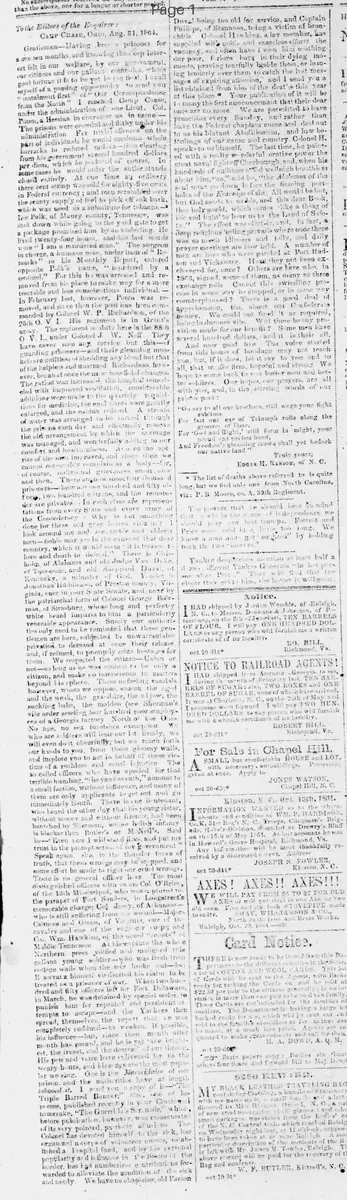
To the Editors of the Enquirer:
Camp Chase, Ohio, Aug. 31, 1864.
Gentlemen—Having been your correspondent for some ten months, and knowing the deep interest felt in our welfare by our government, our citizens, and our gallant country’s men, whose good fortune it is to be yet in the field, I avail myself of a passing opportunity to send you the first installment of “Our Correspondence from the North.” I reached Camp Chase under the administration of one Lieut. Col. Poten, a Hessian in character as in name—a man whose fiendishness in the treatment of individuals he would condemn whole squads for trivial offenses on the barest pretexts to us. In some cases he would order the sutler stands closed entirely. At one time an ordinary three-cent stamp was sold for eighty-five cents in Federal currency; and men scrambled over the scanty supply of fuel to pick off oak bark, which was used as a substitute for tobacco. Lee Polk, of Maury county, Tennessee, was shot down while going to the yard gate to get a package promised him by an unfeeling sentinel. He lived twenty-four hours, and his last words were “I am a murdered man.” The surgeon in charge, a humane man, under item of “Remarks” in his Monthly Report, entered opposite Polk’s name, “murdered by a sentinel.” For this he was arrested and removed from his place to make way for a more tractable and less conscientious individual.
In February last, however, Poten was removed, and since then the post has been commanded by Colonel W. P. Richardson, of the 25th O. V. I. His regiment is in Grant’s army. The 25th O. V. I., under Colonel J. W. Neff. They have never seen any service but this—of guarding prisoners—and their gleaming muskets are guiltless of shedding any blood but that of the helpless and unarmed. Richardson, however, began at once the most beneficial changes. The rations were increased, the hospital remodelled, additions were made to the quarterly requisitions for medicine, the enclosures were greatly enlarged, and the cabins refitted. A stream of water was arranged to be turned through the prisons each day and effectually remove the filth. The old arrangement by which the sewage was managed was wonderfully aided to our comfort and healthiness. A once he spoke to us himself. The last time, he painted with a really wonderful oratorical power the great naval fight off Cherbourg, and when his hundreds of auditors stood well-nigh breathless about him, “So,” said he, “the Alabama must go down before the thundering port holes of the Kearsarge of wood. All would be lost, but God sends to us his word, and this dear Book, this holy yacht, which comes like a thing of life and light to bear us to the Land of Safety.” Deep religious feeling prevails where once there was so much idleness and folly, and daily prayer meetings are now held. A number of men are here who were paroled at Port Hudson and Vicksburg. Have they not been exchanged long ago? Others are here who, in 1863, signed, some of them as many as three exchange rolls. Cannot this swindling process in some way be stopped, or in some way counterplotted? There is a good deal of apprehension, too, about our Confederate money. We could not find it as required, being endurance vile. Will there be any provision made for our benefit? Some men have several hundred dollars, and it is their all.
And now good bye. The voice started from this house of bondage may not reach you, but if it does, let it say to you and to better men and better soldiers: Our hopes, our prayers, are all with you, and, in the stirring words of our hymn note:
“Go say to all our brothers, still wage your fight
For God and Right, still form in might your groves,
And Freedom’s gleaming crown shall yet bedeck
The land we love.”
The list of deaths above referred to is quite long, but we find only one from North Carolina, P. B. Moore, Co. A, 30th Regiment.
What sub-type of article is it?
Informative
Historical
Reflective
What themes does it cover?
Military War
Morality
What keywords are associated?
Camp Chase
Prison Conditions
Confederate Prisoners
Lieut Col Poten
Col Richardson
Parole Exchange
Confederate Money
Civil War Prison
Religious Revival
What entities or persons were involved?
To The Editors Of The Enquirer
Letter to Editor Details
Recipient
To The Editors Of The Enquirer
Main Argument
reports on past harsh conditions and a fatal shooting at camp chase under lt. col. poten, improvements under col. richardson including better rations and religious activities, and raises concerns about unexchanged paroled prisoners and the value of confederate money held by inmates.
Notable Details
- shooting of lee polk by sentinel, declared 'murdered' by surgeon who was then arrested
- description of naval battle off cherbourg and religious speech by col. richardson
- daily prayer meetings and deep religious feeling among prisoners
- paroled prisoners from port hudson and vicksburg not exchanged
- apprehension over confederate currency held by prisoners