Thank you for visiting SNEWPapers!
Sign up free
The Southern Press
Washington, District Of Columbia
What is this article about?
A Southern farmer, John Hardy Jr., writes to Thomas Ritchie criticizing the Washington Union's support for the Compromise of 1850, arguing it betrays Southern rights by excluding slaveholders from territories, buying Texas, and weakening fugitive slave laws. He cancels his subscription and urges resistance to Northern aggression.
Clipping
OCR Quality
Full Text
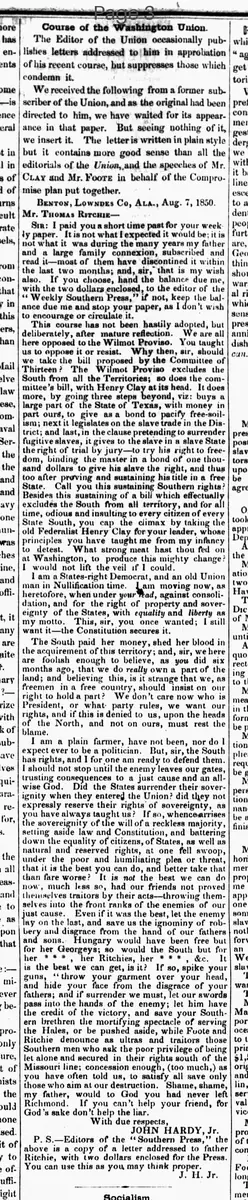
The Editor of the Union occasionally publishes letters addressed to him in approbation of his recent course, but suppresses those which condemn it.
We received the following from a former subscriber of the Union, and as the original had been directed to him, we have waited for its appearance in that paper. But seeing nothing of it, we insert it. The letter is written in plain style but it contains more good sense than all the editorials of the Union, and the speeches of Mr. Clay and Mr. Foote in behalf of the Compromise plan put together.
Benton, Lowndes Co, Ala., Aug. 7, 1850.
Mr. Thomas Ritchie—
Sir: I paid you a short time past for your weekly paper. It is not what I expected it would be; it is not what it was during the many years my father and a large family connexion, subscribed and read it—most of them have discontinued it within the last two months; and, sir, that is my wish also. If you choose, hand the balance due me, with the two dollars enclosed, to the editor of the "Weekly Southern Press," if not, keep the balance due me and stop your paper, as I don't wish to encourage or circulate it.
This course has not been hastily adopted, but deliberately, after mature reflection. We are all here opposed to the Wilmot Proviso. You taught us to oppose it or resist. Why then, sir, should we take the bill proposed by the Committee of Thirteen? The Wilmot Proviso excludes the South from all the Territories; so does the committee's bill, with Henry Clay at its head. It does more, by going three steps beyond, viz: buys a large part of the State of Texas, with money in part ours, to give as a bond to pacify free-soilism; next it legislates on the slave trade in the District; and last, in the clause pretending to surrender fugitive slaves, it gives to the slave in a slave State the right of trial by jury—to try his right to freedom, binding the master in a bond of one thousand dollars to give his slave the right, and thus too after proving and sustaining his title in a free State. Call you this sustaining Southern rights?
Besides this sustaining of a bill which effectually excludes the South from all territory, and for all time, odious and insulting to every citizen of every State South, you cap the climax by taking the old Federalist Henry Clay for your leader, whose principles you have taught me from my infancy to detest. What strong meat hast thou fed on at Washington, to produce this mighty change: I would not lift the veil if I could.
I am a States-right Democrat, and an old Union man in Nullification time. I am moving now, as heretofore, when under your lead, against consolidation, and for the right of property and sovereignty of the States, with equality and liberty as my motto. This, sir, you once wanted; I still want it—the Constitution secures it.
The South paid her money, shed her blood in the acquirement of this territory; and, sir, we here are foolish enough to believe, as you did six months ago, that we do really own a part of the land; and believing this, is it strange that we, as freemen in a free country, should insist on our right to hold a part? We don't care now who is President, or what party rules, we want our rights, and if this is denied to us, upon the heads of the North, and not on ours, must rest the blame.
I am a plain farmer, have not been, nor do I expect ever to be a politician. But, sir, the South has rights, and I for one am ready to defend them. I should not stop until the enemy leaves our gates, trusting consequences to a just cause and an all-wise God. Did the States surrender their sovereignty when they entered the Union? did they not expressly reserve their rights of sovereignty, as you have always taught us? If so, whence arises the sovereignty of the will of a reckless majority, setting aside law and Constitution, and battering down the equality of citizens, of States, as well as natural and reserved rights, at one fell swoop, under the poor and humiliating plea or threat, that it is the best you can do, and better take that than fare worse? It is not the best we can do now, much less so, had our friends not proved themselves traitors by their acts—throwing themselves into the front ranks of the enemies of our just cause. Even if it was the best, let the enemy lay on the last, and save us the ignominy of robbery and disgrace from the hand of our fathers and sons. Hungary would have been free but for her Georgeys; so would the South but for her Clays, her Ritchies, her Websters, &c. It is the best we can get, is it? If so, spike your guns, "throw your garment over your head, and hide your face from the disgrace of your fathers; and if surrender we must, let our swords pass into the hands of the enemy; let him have the credit of the victory, and save your Southern brethren the mortifying spectacle of serving the Hales, or be pushed aside, while Foote and Ritchie denounce as ultras and traitors those Southern men who ask the poor privilege of being let alone and secured in their rights south of the Missouri line; concession enough, (too much,) as you have often told us, to satisfy all save only those who aim at our destruction. Shame, shame, my father, would to God you had never left Richmond. If you can't help your friend, for God's sake don't help the enemy.
With due respects,
JOHN HARDY, Jr.
P. S.—Editors of the "Southern Press," the above is a copy of a letter addressed to father Ritchie, with two dollars enclosed for the Press. You can use this as you may think proper.
J. H. Jr.
What sub-type of article is it?
What themes does it cover?
What keywords are associated?
What entities or persons were involved?
Letter to Editor Details
Author
John Hardy, Jr.
Recipient
Mr. Thomas Ritchie
Main Argument
the compromise of 1850 betrays southern rights by excluding the south from territories like the wilmot proviso, using southern money to buy texas, interfering with the slave trade in d.c., and undermining fugitive slave laws with jury trials and bonds; ritchie should reject henry clay's leadership and support state sovereignty instead of this surrender to northern aggression.
Notable Details