Thank you for visiting SNEWPapers!
Sign up free
Literary
October 21, 1843
Alexandria Gazette
Alexandria, Alexandria County, District Of Columbia
What is this article about?
An essay from Chambers' Edinburgh Journal critiquing 'toadyism' in English society—the servile flattery toward the upper classes. It traces the term's origin to a toad-eating anecdote, its evolution to 'toady,' and examples of sycophantic behavior in social interactions, literature, and press, arguing it's fostered by societal structures.
Clipping
OCR Quality
95%
Excellent
Full Text
From Chambers' Edinburgh Journal.
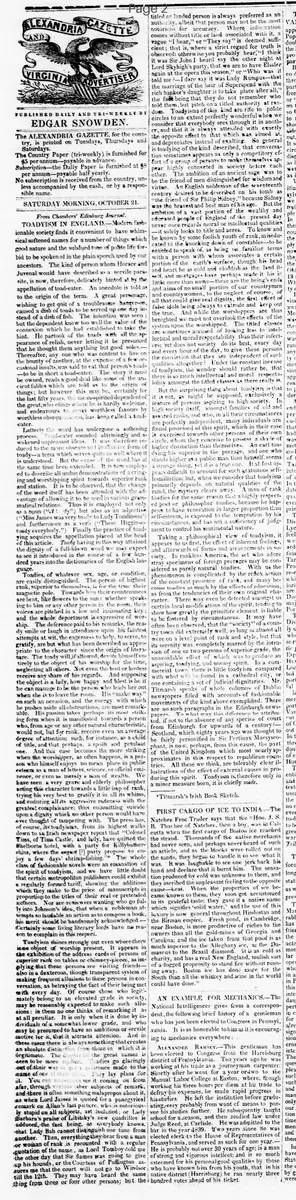
TOADYISM IN ENGLAND.—Modern fashionable society finds it convenient to have whimsical softened names for a number of things which good nature and the subdued tone of polite life forbid to be spoken of in the plain speech used by our ancestors. The kind of person whom Horace and Juvenal would have described as a servile parasite, is now, therefore, delicately hinted at by the appellation of toad-eater. An anecdote is told as to the origin of the term. A great personage, wishing to get quit of a troublesome hanger-on, caused a dish of toads to be served up one day instead of a dish of fish. The intention was seen; but the dependent knew too well the value of the connexion which he had established to take the hint. He partook of the toads with all the appearance of relish, never letting it be presumed that he thought them anything but good soles.—Thereafter, any one who was content to live on the bounty of another, at the expense of a few occasional insults, was said to eat that person's toads—to be in short a toad-eater. The story it must be owned, reads a good deal like some of the ancient fables which are told as to the origin of things; but however this may be, certainly for the last fifty years, the mean-spirited dependent of the great, who clings where he is hardly welcome, and endeavours to repay worthless favours by worthless obsequiousness, has been called a toad eater.
Latterly the word has undergone a softening process. Toad-eater sounded alarmingly and awakened unpleasant ideas. It was therefore reduced to the more obscure and inoffensive form of toady—a term which serves quite as well where it is understood. But the sense of the word has at the same time been extended. It is now employed to describe all undue demonstrations of a cringing and worshipping spirit towards superior rank and station. It is to be observed, that the change of the word itself has been attended with the advantage of allowing it to be used in various grammatical relations. Thus it is employed not only as a noun ("A toady") but also as an adjective ("Miss James was very toady to Lady Tomlinson") and furthermore as a verb ("These Higginses toady everybody.") Finally the practice of toadying acquires the appellation placed at the head of this article. Toady having in this way attained the dignity of a full-blown word we may expect to see it introduced in the course of a few hundred years into the dictionaries of the English language.
Toadies, of whatever sex, age, or condition, are easily distinguished. The person of highest rank, superior to themselves, is for the time their magnetic pole. Towards him their countenances are bent, like flowers to the sun: whether speaking to him or any other person in the room, their voices are pitched in a low and insinuating key; and the whole deportment is expressive of worship. The deference paid to his remarks, the ready smile or laugh in attendance upon his faintest attempts at wit, the eagerness to help, to serve, to gratify, are but what has been described as appropriate to the character since the origin of literature. The toady will, if allowed, devote himself entirely to the object of his worship for the time neglecting all others. Not even the host or hostess receive any share of his regards. And supposing the object is a lady, how happy and blest is he if he can manage to be the person who leads her out when she is to leave the room. His "make way" on such an occasion, and the energy with which he pushes aside all obstructions, are most remarkable. His passion takes perhaps its most striking form when it is manifested towards a person who, from age or any other natural characteristic, would not, but for rank, receive even an average degree of attention; such, for instance, as a child of title, and that perhaps, a spoilt and petulant one. And this case becomes the more striking when the worshipper, as often happens, is a person who himself enjoys no mean place in public esteem as a man of letters, science, or official eminence, or even as merely a man of wealth. We have seen a very grave and elderly philosopher acting this character towards a little imp of rank, trying his very best to gratify it in all its whims, and enduring all its aggressive rudeness with the greatest complaisance; thus committing suicide upon a dignity which no other person would have ever thought of tampering with. The press has, of course, its toadyisms, from its highest walks down to an Irish newspaper report that "Colonel Tims, of Tims Castle, and lady, have quitted the Shelborne hotel, with a party for Killybathershins, where the august party propose to enjoy a few days' shrimp-fishing."* The whole class of fashionable novels were an emanation of the spirit of toadyism, and we have little doubt that certain metropolitan publishers could exhibit a regularly formed tariff; showing the additions which they make to the price of manuscripts in proportion to the titles of their real or pretended authors. Nor are reviewers wanting who go fully into Johnson's idea, that when a nobleman attempts so laudable an action as to compose a book, this merit should be handsomely acknowledged.—Certainly some living literary lords have no reason to complain in this respect.
Toadyism shines strongly out even where there is no object of worship present. It appears in the exhibition of the address cards of persons of superior rank on tables or chimney-pieces, as implying that these persons are visiting friends—also in a dexterous, though transparent system of making frequent allusions to these persons in conversation, as betraying the fact of their being met with every day. Of course those who legitimately belong to an elevated grade in society, may be reasonably expected to make such allusions: in them no one thinks of remarking it as at all peculiar. It is only when it is done by individuals of a somewhat lower grade, and who may be presumed to have an ambitious or servile motive for it, that it attracts attention. And in these cases there is always something that creates an absolute distinction from those in which it is legitimate. The drop of the great names is seen to be more studied.
Ladies go glaringly out of their way to secure a reference made to the name of one of their great ones. They lay plans for it. You can surmise to see it coming on from afar, through various other subjects of remark, and there is often something malapropos about it, as when Lord James is quoted for a panegyrical remark on Allan's last picture, who is notorious by stupid on all subjects, art included; or Lady Barbara's praise of Libitsky's new quadrilles is adduced, the fact being, as everybody knows, that Lady Bab cannot distinguish one tune from another. Then, everything they hear from a man or woman of rank is recounted with a regular quotation of the name, as Lord Tomboy told me the other day that Sir James was going to give up his hounds, or the Countess of Puffington assures me that the court will not go to Windsor till the 12th. They may have heard the same thing from three or four other persons; but the titled or landed person is always preferred as an authority, albeit that person may not be the most notorious for accuracy. Where information comes without title or land associated with it, a vague "I hear," or "They say" is deemed sufficient; that is, where a strict regard for truth is observed: otherwise you probably hear, "I think it was Sir John I heard say the other night at Lord Skyhigh's party, that we are to have Elssler again at the opera this season," or "Who was it told me?—I dare say it was Lady Rumpus—that the marriage of the heir of Superspend with the rich banker's daughter is to take place after all," the fact being that they do not remember who told them, but pitch on a titled authority at random. Toadyisms of this kind are rife in polite circles to an extent perfectly wonderful when we consider that everybody sees through it in another quarter, and that it is always attended with exactly the opposite effect to that which was aimed at, and depreciates instead of exalting. So general is toadying of the kind described, that conversation sometimes appears as only a competitory effort of a group of persons to make themselves appear highly connected in society before each other. The ambition of an ancient sage was to be the friend of men distinguished for wisdom and virtue. An English nobleman of the seventeenth century desired to be described on his tomb as "the friend of Sir Philip Sidney," because Sidney was the bravest and best man of his age. But the ambition of a vast portion of the wealthy and educated people of England of the present day never once regards moral or intellectual qualities—it solely looks to title and acres. To know and be known by some foolish youth of rank, miseducated to the knocking down of constables—to be entitled to speak of, as being on familiar terms with a person with whom associates a certain portion of the earth's surface, though his heart be as cold and cloddish as the land itself, and mortgages have perhaps made it his in little more than name—these are the being's ends and aims of no small portion of our countrymen and countrywomen, to the neglect of course, of all that could give real dignity, the first effect of false idols being always to extrude and keep out the true. And while the worshippers are thus benighted we must not overlook the effects of the system upon the worshipped. The titled classes are sometimes accused of loathing less to intellectual and moral respectability than their inferiors; but does not society do its best, every day and every hour of the day, to give these persons the conviction that they are independent of such qualities altogether? Under the constant incense of toadyism, the wonder should rather be, that there is so much intellectual and moral respectability amongst the titled classes as there really is. But the surprising thing about toadyism is that it is not, as might be supposed, exclusively a feature of persons aspiring to high society. In high society itself, amongst families of old and assured ranks, and who, in all their circumstances are perfectly independent, many individuals are found possessed of this spirit, which in their case is exercised towards other persons of their own circle, whom they conceive to possess a shade of higher distinction than themselves. An earl toadying his superior in the peerage, and one who stands higher as a public man than himself, seems a strange thing, yet it is a true one. It at first appears difficult to account for such gratuitous self-humiliation: but, when we consider that toadyism primarily depends on natural qualities of the mind, the mystery clears away. A man of rank toadies for the same reason that a highly respected poet or philosopher toadies, because he happens to have veneration in larger proportion than self-esteem, is exposed to the temptation by his circumstances, and has not a sufficiency of judgment to control his sentimental nature.
Taking a philosophical view of toadyism, it appears to us first, the effect of inherent feelings, and afterwards of forms and arrangements in society. In rankless America, the set who adore stray specimens of foreign peerages may be considered as purely natural toadies. With us the phenomenon is complicated by the reflex action of the constant presence of rank, and many become toadies as much by the effects of education, as from the tendencies of their own original character. There may even be detected amongst us certain local modifications of the spirit, tending to show how greatly the primitive element is liable to be fostered by circumstances. It may have often been observed, that the "society" of a country town did extremely well, as long as almost all were on a level point of rank and style, but that its serenity was completely marred by the intrusion of one or two persons of superior grade, the unavoidable effect of which was to produce an aspiring, toadying, and uneasy spirit. In a commercial town there is little toadyism compared with what will be found in a cathedral city, or one containing a set of judicial dignitaries. Mr. Titmarsh speaks of whole columns of Dublin newspapers filled with accounts of fashionable movements of the kind above exemplified. There are no such paragraphs in the Edinburgh newspapers. To what may this difference be attributed, if not to the absence of any species of court from Edinburgh for upwards of a century?—Scotland, which eighty years ago was thought to be fairly personified in Sir Pertinax MacSycophant, is now, perhaps, from this cause, the part of the United Kingdom which most nearly approximates in this respect to republican countries. All these we think, are tolerably clear illustrations of the effect of external causes in producing this spirit. Toadyism is therefore only in a minor measure born, it is chiefly made.
What sub-type of article is it?
Essay
Satire
What themes does it cover?
Social Manners
Moral Virtue
What keywords are associated?
Toadyism
Social Flattery
Class Rank
English Society
Servile Parasite
Fashionable Novels
Titled Classes
What entities or persons were involved?
From Chambers' Edinburgh Journal
Literary Details
Title
Toadyism In England.
Author
From Chambers' Edinburgh Journal
Key Lines
A Great Personage, Wishing To Get Quit Of A Troublesome Hanger On, Caused A Dish Of Toads To Be Served Up One Day Instead Of A Dish Of Fish.
The Person Of Highest Rank, Superior To Themselves, Is For The Time Their Magnetic Pole. Towards Him Their Countenances Are Bent, Like Flowers To The Sun:
Toadyism Is Therefore Only In A Minor Measure Born, It Is Chiefly Made.