Thank you for visiting SNEWPapers!
Sign up free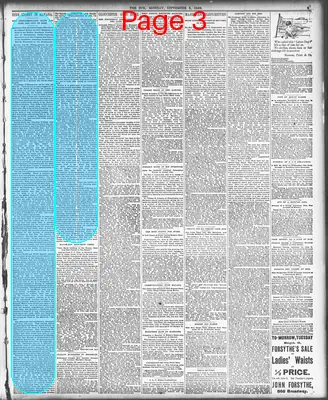
Foreign News
September 5, 1898
The Sun
New York, New York County, New York
What is this article about?
Report from Havana, Aug. 31, on the city's dire post-blockade conditions: widespread starvation, thousands of reconcentrados dead, 30,000 in desperate need of food, commerce stalled by Spanish war duties, and Cubans awaiting American control.
Clipping
OCR Quality
95%
Excellent
Full Text
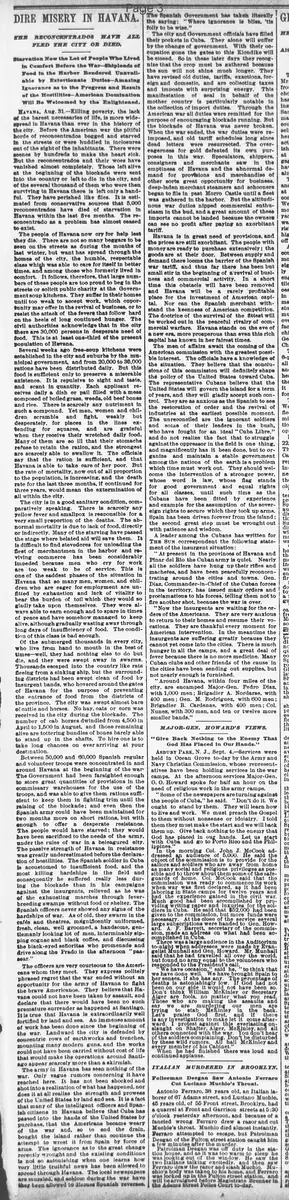
Dire Misery in Havana:
The Reconcentrados All Fled the City or Died.
Starvation Now the Lot of People Who Lived in Comfort Before the War—Ship-Loads of Food in the Harbor Rendered Unavailable by Extortionate Duties—Amazing Ignorance as to the Progress and Result of the Hostilities—American Domination Will Be Welcomed by the Enlightened.
Havana, Aug. 31.—Killing poverty, the lack of the barest necessaries of life, is more widespread in Havana than ever in the history of the city. Before the American war the pitiful horde of reconcentrados begged and starved in the streets or were huddled in enclosures out of the sight of the inhabitants. There were scenes by hundreds to make the heart sick. But the reconcentrados and their woes have vanished almost completely. Those left alive at the beginning of the blockade were sent into the country or left to die in the city, and of the several thousand of them who were then surviving in Havana there is left only a handful. They have perished like flies. It is estimated from conservative sources that 5,000 reconcentrados have died of starvation in Havana within the last five months. The reconcentrado as a problem has almost ceased to exist.
The people of Havana now cry for help lest they die. There are not so many beggars to be seen on the streets as during the months of last winter, but want has spread through the homes of the city, the humble, respectable class which was able to care for itself in better times, and among those who formerly lived in comfort. It follows, therefore, that large numbers of these people are too proud to beg in the streets or solicit public charity at the Government soup kitchens. They suffer in their homes until too weak to accept work, which opportunity may offer in the revival of business, or to resist the attack of the fevers that follow hard on the heels of long continued hunger. The civil authorities acknowledge that in the city there are 30,000 persons in desperate need of food. This is at least one-third of the present population of Havana.
Several weeks ago free-soup kitchens were established in the city and suburbs by the municipal government, and from 20,000 to 30,000 rations have been distributed daily. But this food is sufficient only to preserve a miserable existence. It is repulsive to sight and taste, and scant in quantity. Each applicant receives daily a dish or pail filled with a mess composed of boiled grass, weeds, old beef bones and rice. There is scarcely any nutriment in such a compound. Yet men, women and children scramble and fight, weakly but desperately, for places in the lines extending for squares, and are grateful when they receive their wretched daily food. Many of them are so ill that their stomachs refuse to retain the ration, and the strongest are scarcely able to swallow it. The officials say that the ration is sufficient, and that Havana is able to take care of her poor. But the rate of mortality, now out of all proportion to the population, is increasing, and the death rate for the last three months, if continued for three years, would mean the extermination of all within the city.
The city is in a good sanitary condition, comparatively speaking. There is scarcely any yellow fever and smallpox is responsible for a very small proportion of the deaths. The abnormal mortality is due to lack of food, directly or indirectly. Many of the starving have passed the stage where belated aid will save them. It is difficult to find stevedores for unloading the fleet of merchantmen in the harbor and reviving commerce has been considerably impeded because men who cry for work are too weak to be of service. This is one of the saddest phases of the situation in Havana that so many men, women, and children who are eager for employment are unfitted by exhaustion and lack of vitality to bear the burden of toil which they would so gladly take upon themselves. They were always able to earn enough and to spare in times of peace and have somehow managed to keep alive, although gradually wasting away through long days of insufficiency of food. The condition of this class is bad enough.
Of the submerged thousands in every city, who live from hand to mouth in the best of times—well, they had nothing else to do but die, and they were swept away in swarms. Thousands escaped into the country like rats fleeing from a sinking ship, but the surrounding districts had been swept clean of food by insurgent bands, who hovered around the gates of Havana for the purpose of preventing the entrance of food from the districts of the province. The city was swept almost bare of cattle and horses. No hay, oats or corn was received in the city during the blockade. The number of cab horses dwindled from 4,500 in April to 1,500 in August, and those remaining alive are tottering bundles of bones barely able to stand up in the shafts. To hire one is to take long chances on ever arriving at your destination.
Between 50,000 and 60,000 Spanish regular and volunteer troops were concentrated in and around Havana at the beginning of the war. The Government had been farsighted enough to store great quantities of provisions in the commissary warehouses for the use of the troops, and was able to give them rations sufficient to keep them in fighting trim until the raising of the blockade; and even then the Spanish army could have been maintained for two months more on short rations, but with enough to offer a desperate resistance. The people would have starved; they would have been sacrificed to the needs of the army, under the rules of war in a beleaguered city.
The passive strength of Havana in resistance was greatly underestimated before the declaration of hostilities. The Spanish soldier in Cuba is accustomed to insufficient food, and the most killing hardships in the field and consequently he suffered really less during the blockade than in his campaigns against the insurgents, relieved as he was of the exhausting marches through fever-breeding swamps without food or shelter. The Spanish officers never showed any signs of the hardships of war. As of old, they swarm in the cafés and theatres, magnificently uniformed, fresh, clean, well groomed, a handsome, gentlemanly looking lot of men, interminably sipping cognac and black coffee, and discussing the black-eyed señoritas who promenade and drive along the Prado in the afternoon 'pasear.'
The officers are very courteous to the Americans whom they meet. They express politely phrased regret that the war ended without an opportunity for the army of Havana to fight the brave Americanos. They believe that Havana could not have been taken by assault, and declare that there would have been no such premature surrender as happened at Santiago. It is true that Havana is extraordinarily well fortified by land and sea. An immense amount of work has been done since the beginning of the war. Landward the city is defended by concentric rows of earthworks and trenches, mounting many modern guns, and the works could not have been carried without cost of life that would make the operations around Santiago appear scarcely more than a skirmish.
The army in Havana has seen nothing of the war. Only vague rumors concerning it have reached here. It has not been shocked into a realization of what has happened, nor does it at all realize the strength and prowess of the United States by land and sea. It is a fact that many of the intelligent officers and Spanish citizens in Havana believe that Cuba has passed into the hands of the United States by purchase, that the Americans became weary of the war and, so to end the drain, bought the island rather than continue the attempt to wrest it from Spain by force of arms. The ignorance as to the great change recently wrought and the existing conditions is not so astonishing when one learns how very little truthful news has been allowed to spread through Havana. The local newspapers are muzzled, and seldom during the war have they been allowed to discuss Spanish reverses.
The Spanish Government has taken literally the saying: 'Where ignorance is bliss, 'tis folly to be wise.' The city and Government officials have filled their pockets in Cuba. They alone will suffer by the change of government. With their occupation gone the gates to this Klondike will be closed. So in these later days they recognize that the crop must be gathered because the sun will not shine much longer. They have revised old duties, tariffs, exactions, foreign and domestic, and are collecting taxes and imposts with surprising energy. This manifestation of zeal in behalf of the mother country is particularly notable in the collection of import duties. Through the American war all duties were remitted for the purpose of encouraging blockade running. But the blockade of Havana was never broken. When the war ended, the war duties were reimposed, and old tariff schedules long since dead letters were resurrected. The over-eagerness for gold defeated its own purposes in this way. Speculators, shippers, consigners and merchants saw in the emptiness of Havana and the abnormal demand for provisions and merchandise of other sorts great opportunity for business. Deep-laden merchant steamers and schooners began to file in past Morro Castle until a fleet was gathered in the harbor. But the altitudinous war duties nipped commercial enthusiasm in the bud, and a great amount of these imports cannot be landed because the owners can see no profit after paying an exorbitant tariff.
Havana is in great need of provisions, and the prices are still exorbitant. The people with money are ready to purchase extensively; the goods are at their door. Between supply and demand there looms the barrier of the Spanish war tariff, and thus far there has been but small stir in the beginning of a revival of business and commercial activity. In a short time this obstacle will have been removed and Havana will be a rarely profitable place for the investment of American capital. Nor can the Spanish merchant withstand the keenness of American competition. The doctrine of the survival of the fittest will be worked out in the peaceful rivalry of commercial warfare. Havana stands on the eve of a new era, more prosperous than even this rich capital has known in her fairest times.
The men of affairs await the coming of the American commission with the greatest possible interest. The officials have a knowledge of the situation. They believe that the conclusions of this commission will definitely shape the policy of the United States toward Cuba. The representative Cubans believe that the United States will govern the island for a term of years, and they will gladly accept such control. They are as anxious as the Spanish to see the restoration of order and the revival of industries at the earliest possible moment. The unreconciled are the ignorant soldiers and some of their leaders in the bush, who have fought for an ideal 'Cuba Libre,' and do not realize the fact that to struggle against the oppressor in the field is one thing, and magnificently has it been done, but to organize and maintain a stable government among the nations of the earth is a problem which time must work out. They should welcome the intervention of a stronger power, whose word is law, whose flag stands for good government and equal rights for all classes, until such time as the Cubans have been fitted by experience and example for the assumption of the sovereign rights to secure which they took up arms. Spain has been driven forever from the island; the second great step must be wrought out with patience and wisdom.
A leader among the Cubans has written for The Sun correspondent the following statement of the insurgent situation:
'At present in the provinces of Havana and Pinar del Rio the Cuban army is quiet. Nearly all the soldiers have hung up their rifles and machetes, and have been peacefully reconcentrating around the cities and towns. Gen. Diaz, Commander-in-Chief of the Cuban forces in the territory, has issued many orders and proclamations to his forces, telling them not to fire another shot, because the war is over.
'Now the insurgents are waiting for the orders of the Americans. They are very anxious to return to their homes and resume their vocations. They are thankful every moment for American intervention. In the meantime the insurgents are suffering greatly because they cannot yet come into the cities. There is much hunger in all the camps, and a great deal of fever because there is no more medicine. Many Cuban clubs and other friends of the cause in the cities have been sending out supplies, but not nearly enough is furnished.
'Around Havana, within four miles of the city, are encamped Major-Gen. Pedro Diaz with 1,000 men; Brigadier A. Nordarse, with 400 men; Gen. M. Rodriguez, with 600 men; Brigadier R. Cardenas, with 400 men; Col. Nunez, with 300 men, and ten or twelve more smaller bands.'
The Reconcentrados All Fled the City or Died.
Starvation Now the Lot of People Who Lived in Comfort Before the War—Ship-Loads of Food in the Harbor Rendered Unavailable by Extortionate Duties—Amazing Ignorance as to the Progress and Result of the Hostilities—American Domination Will Be Welcomed by the Enlightened.
Havana, Aug. 31.—Killing poverty, the lack of the barest necessaries of life, is more widespread in Havana than ever in the history of the city. Before the American war the pitiful horde of reconcentrados begged and starved in the streets or were huddled in enclosures out of the sight of the inhabitants. There were scenes by hundreds to make the heart sick. But the reconcentrados and their woes have vanished almost completely. Those left alive at the beginning of the blockade were sent into the country or left to die in the city, and of the several thousand of them who were then surviving in Havana there is left only a handful. They have perished like flies. It is estimated from conservative sources that 5,000 reconcentrados have died of starvation in Havana within the last five months. The reconcentrado as a problem has almost ceased to exist.
The people of Havana now cry for help lest they die. There are not so many beggars to be seen on the streets as during the months of last winter, but want has spread through the homes of the city, the humble, respectable class which was able to care for itself in better times, and among those who formerly lived in comfort. It follows, therefore, that large numbers of these people are too proud to beg in the streets or solicit public charity at the Government soup kitchens. They suffer in their homes until too weak to accept work, which opportunity may offer in the revival of business, or to resist the attack of the fevers that follow hard on the heels of long continued hunger. The civil authorities acknowledge that in the city there are 30,000 persons in desperate need of food. This is at least one-third of the present population of Havana.
Several weeks ago free-soup kitchens were established in the city and suburbs by the municipal government, and from 20,000 to 30,000 rations have been distributed daily. But this food is sufficient only to preserve a miserable existence. It is repulsive to sight and taste, and scant in quantity. Each applicant receives daily a dish or pail filled with a mess composed of boiled grass, weeds, old beef bones and rice. There is scarcely any nutriment in such a compound. Yet men, women and children scramble and fight, weakly but desperately, for places in the lines extending for squares, and are grateful when they receive their wretched daily food. Many of them are so ill that their stomachs refuse to retain the ration, and the strongest are scarcely able to swallow it. The officials say that the ration is sufficient, and that Havana is able to take care of her poor. But the rate of mortality, now out of all proportion to the population, is increasing, and the death rate for the last three months, if continued for three years, would mean the extermination of all within the city.
The city is in a good sanitary condition, comparatively speaking. There is scarcely any yellow fever and smallpox is responsible for a very small proportion of the deaths. The abnormal mortality is due to lack of food, directly or indirectly. Many of the starving have passed the stage where belated aid will save them. It is difficult to find stevedores for unloading the fleet of merchantmen in the harbor and reviving commerce has been considerably impeded because men who cry for work are too weak to be of service. This is one of the saddest phases of the situation in Havana that so many men, women, and children who are eager for employment are unfitted by exhaustion and lack of vitality to bear the burden of toil which they would so gladly take upon themselves. They were always able to earn enough and to spare in times of peace and have somehow managed to keep alive, although gradually wasting away through long days of insufficiency of food. The condition of this class is bad enough.
Of the submerged thousands in every city, who live from hand to mouth in the best of times—well, they had nothing else to do but die, and they were swept away in swarms. Thousands escaped into the country like rats fleeing from a sinking ship, but the surrounding districts had been swept clean of food by insurgent bands, who hovered around the gates of Havana for the purpose of preventing the entrance of food from the districts of the province. The city was swept almost bare of cattle and horses. No hay, oats or corn was received in the city during the blockade. The number of cab horses dwindled from 4,500 in April to 1,500 in August, and those remaining alive are tottering bundles of bones barely able to stand up in the shafts. To hire one is to take long chances on ever arriving at your destination.
Between 50,000 and 60,000 Spanish regular and volunteer troops were concentrated in and around Havana at the beginning of the war. The Government had been farsighted enough to store great quantities of provisions in the commissary warehouses for the use of the troops, and was able to give them rations sufficient to keep them in fighting trim until the raising of the blockade; and even then the Spanish army could have been maintained for two months more on short rations, but with enough to offer a desperate resistance. The people would have starved; they would have been sacrificed to the needs of the army, under the rules of war in a beleaguered city.
The passive strength of Havana in resistance was greatly underestimated before the declaration of hostilities. The Spanish soldier in Cuba is accustomed to insufficient food, and the most killing hardships in the field and consequently he suffered really less during the blockade than in his campaigns against the insurgents, relieved as he was of the exhausting marches through fever-breeding swamps without food or shelter. The Spanish officers never showed any signs of the hardships of war. As of old, they swarm in the cafés and theatres, magnificently uniformed, fresh, clean, well groomed, a handsome, gentlemanly looking lot of men, interminably sipping cognac and black coffee, and discussing the black-eyed señoritas who promenade and drive along the Prado in the afternoon 'pasear.'
The officers are very courteous to the Americans whom they meet. They express politely phrased regret that the war ended without an opportunity for the army of Havana to fight the brave Americanos. They believe that Havana could not have been taken by assault, and declare that there would have been no such premature surrender as happened at Santiago. It is true that Havana is extraordinarily well fortified by land and sea. An immense amount of work has been done since the beginning of the war. Landward the city is defended by concentric rows of earthworks and trenches, mounting many modern guns, and the works could not have been carried without cost of life that would make the operations around Santiago appear scarcely more than a skirmish.
The army in Havana has seen nothing of the war. Only vague rumors concerning it have reached here. It has not been shocked into a realization of what has happened, nor does it at all realize the strength and prowess of the United States by land and sea. It is a fact that many of the intelligent officers and Spanish citizens in Havana believe that Cuba has passed into the hands of the United States by purchase, that the Americans became weary of the war and, so to end the drain, bought the island rather than continue the attempt to wrest it from Spain by force of arms. The ignorance as to the great change recently wrought and the existing conditions is not so astonishing when one learns how very little truthful news has been allowed to spread through Havana. The local newspapers are muzzled, and seldom during the war have they been allowed to discuss Spanish reverses.
The Spanish Government has taken literally the saying: 'Where ignorance is bliss, 'tis folly to be wise.' The city and Government officials have filled their pockets in Cuba. They alone will suffer by the change of government. With their occupation gone the gates to this Klondike will be closed. So in these later days they recognize that the crop must be gathered because the sun will not shine much longer. They have revised old duties, tariffs, exactions, foreign and domestic, and are collecting taxes and imposts with surprising energy. This manifestation of zeal in behalf of the mother country is particularly notable in the collection of import duties. Through the American war all duties were remitted for the purpose of encouraging blockade running. But the blockade of Havana was never broken. When the war ended, the war duties were reimposed, and old tariff schedules long since dead letters were resurrected. The over-eagerness for gold defeated its own purposes in this way. Speculators, shippers, consigners and merchants saw in the emptiness of Havana and the abnormal demand for provisions and merchandise of other sorts great opportunity for business. Deep-laden merchant steamers and schooners began to file in past Morro Castle until a fleet was gathered in the harbor. But the altitudinous war duties nipped commercial enthusiasm in the bud, and a great amount of these imports cannot be landed because the owners can see no profit after paying an exorbitant tariff.
Havana is in great need of provisions, and the prices are still exorbitant. The people with money are ready to purchase extensively; the goods are at their door. Between supply and demand there looms the barrier of the Spanish war tariff, and thus far there has been but small stir in the beginning of a revival of business and commercial activity. In a short time this obstacle will have been removed and Havana will be a rarely profitable place for the investment of American capital. Nor can the Spanish merchant withstand the keenness of American competition. The doctrine of the survival of the fittest will be worked out in the peaceful rivalry of commercial warfare. Havana stands on the eve of a new era, more prosperous than even this rich capital has known in her fairest times.
The men of affairs await the coming of the American commission with the greatest possible interest. The officials have a knowledge of the situation. They believe that the conclusions of this commission will definitely shape the policy of the United States toward Cuba. The representative Cubans believe that the United States will govern the island for a term of years, and they will gladly accept such control. They are as anxious as the Spanish to see the restoration of order and the revival of industries at the earliest possible moment. The unreconciled are the ignorant soldiers and some of their leaders in the bush, who have fought for an ideal 'Cuba Libre,' and do not realize the fact that to struggle against the oppressor in the field is one thing, and magnificently has it been done, but to organize and maintain a stable government among the nations of the earth is a problem which time must work out. They should welcome the intervention of a stronger power, whose word is law, whose flag stands for good government and equal rights for all classes, until such time as the Cubans have been fitted by experience and example for the assumption of the sovereign rights to secure which they took up arms. Spain has been driven forever from the island; the second great step must be wrought out with patience and wisdom.
A leader among the Cubans has written for The Sun correspondent the following statement of the insurgent situation:
'At present in the provinces of Havana and Pinar del Rio the Cuban army is quiet. Nearly all the soldiers have hung up their rifles and machetes, and have been peacefully reconcentrating around the cities and towns. Gen. Diaz, Commander-in-Chief of the Cuban forces in the territory, has issued many orders and proclamations to his forces, telling them not to fire another shot, because the war is over.
'Now the insurgents are waiting for the orders of the Americans. They are very anxious to return to their homes and resume their vocations. They are thankful every moment for American intervention. In the meantime the insurgents are suffering greatly because they cannot yet come into the cities. There is much hunger in all the camps, and a great deal of fever because there is no more medicine. Many Cuban clubs and other friends of the cause in the cities have been sending out supplies, but not nearly enough is furnished.
'Around Havana, within four miles of the city, are encamped Major-Gen. Pedro Diaz with 1,000 men; Brigadier A. Nordarse, with 400 men; Gen. M. Rodriguez, with 600 men; Brigadier R. Cardenas, with 400 men; Col. Nunez, with 300 men, and ten or twelve more smaller bands.'
What sub-type of article is it?
War Report
Disaster
Political
What keywords are associated?
Havana Starvation
Reconcentrados Death
Spanish American War Aftermath
Cuba American Occupation
Havana Blockade
Cuban Insurgents
What entities or persons were involved?
Gen. Diaz
Major Gen. Pedro Diaz
Brigadier A. Nordarse
Gen. M. Rodriguez
Brigadier R. Cardenas
Col. Nunez
Where did it happen?
Havana
Foreign News Details
Primary Location
Havana
Event Date
Aug. 31
Key Persons
Gen. Diaz
Major Gen. Pedro Diaz
Brigadier A. Nordarse
Gen. M. Rodriguez
Brigadier R. Cardenas
Col. Nunez
Outcome
est. 5,000 reconcentrados died of starvation in havana within five months; 30,000 persons in desperate need; blockade raised; spain driven from the island; american control expected.