Thank you for visiting SNEWPapers!
Sign up free
Letter to Editor
September 5, 1963
Minneapolis Spokesman
Minneapolis, Hennepin County, Minnesota
What is this article about?
Cecil Newman laments missing the 1963 March on Washington due to shingles, reflecting on prior Minnesota civil rights delegations to D.C. in 1945 for FEPC legislation and during the Korean War for Army desegregation, highlighting local activism and national impact.
Clipping
OCR Quality
95%
Excellent
Full Text
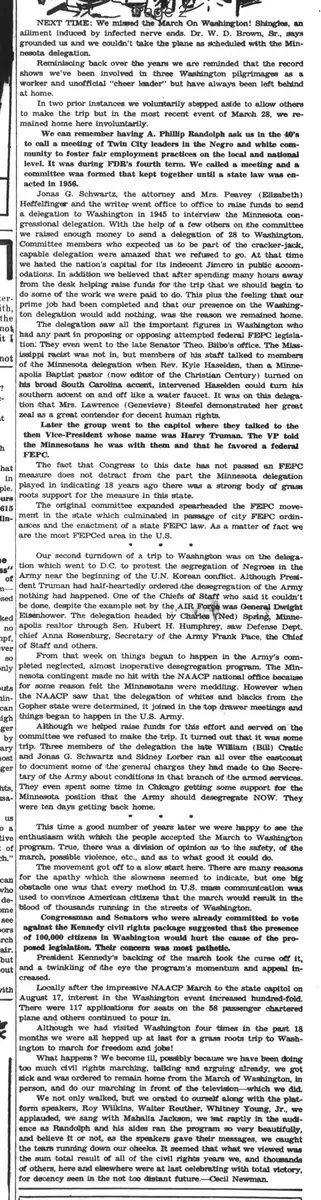
NEXT TIME: We missed the March On Washington! Shingles, an ailment induced by infected nerve ends. Dr. W. D. Brown, Sr., says grounded us and we couldn't take the plane as scheduled with the Minnesota delegation.
Reminiscing back over the years we are reminded that the record shows we've been involved in three Washington pilgrimages as a worker and unofficial "cheer leader" but have always been left behind at home.
In two prior instances we voluntarily stepped aside to allow others to make the trip but in the most recent event of March 28, we remained home here involuntarily.
We can remember having A. Phillip Randolph ask us in the 40's to call a meeting of Twin City leaders in the Negro and white community to foster fair employment practices on the local and national level. It was during FDR's fourth term. We called a meeting and a committee was formed that kept together until a state law was enacted in 1956.
Jonas G. Schwartz, the attorney and Mrs. Peavey (Elizabeth) Heffelfinger and the writer went office to office to raise funds to send a delegation to Washington in 1945 to interview the Minnesota congressional delegation. With the help of a few others on the committee we raised enough money to send a delegation of 28 to Washington.
Committee members who expected us to be part of the cracker-jack, capable delegation were amazed that we refused to go. At that time we hated the nation's capital for its indecent Jim Crow in public accommodations. In addition we believed that after spending many hours away from the desk helping raise funds for the trip that we should begin to do some of the work we were paid to do. This plus the feeling that our prime job had been completed and that our presence on the Washington delegation would add nothing, was the reason we remained home.
The delegation saw all the important figures in Washington who had any part in proposing or opposing attempted federal FEPC legislation. They even went to the late Senator Theo. Bilbo's office. The Mississippi racist was not in, but members of his staff talked to members of the Minnesota delegation when Rev. Kyle Haselden, then a Minneapolis Baptist pastor (now editor of the Christian Century) turned on his broad South Carolina accent, intervened Haselden could turn his southern accent on and off like a water faucet. It was on this delegation that Mrs. Lawrence (Genevieve) Steefel demonstrated her great zeal as a great contender for decent human rights.
Later the group went to the capitol where they talked to the then Vice-President whose name was Harry Truman. The VP told the Minnesotans he was with them and that he favored a federal FEPC.
The fact that Congress to this date has not passed an FEPC measure does not detract from the part the Minnesota delegation played in indicating 18 years ago there was a strong body of grass roots support for the measure in this state.
The original committee expanded spearheaded the FEPC movement in the state which culminated in passage of city FEPC ordinances and the enactment of a state FEPC law. As a matter of fact we are the most FEPCed area in the U.S.
Our second turndown of a trip to Washington was on the delegation which went to D.C. to protest the segregation of Negroes in the Army near the beginning of the U.N. Korean conflict. Although President Truman had half-heartedly ordered the desegregation of the Army nothing had happened. One of the Chiefs of Staff who said it couldn't be done, despite the example set by the Air Force was General Dwight Eisenhower. The delegation headed by Charles (Ned) Spring, Minneapolis realtor through Sen. Hubert H. Humphrey, saw Defense Dept. chief Anna Rosenberg, Secretary of the Army Frank Pace, the Chief of Staff and others.
From that week on things began to happen in the Army's completely neglected, almost inoperative desegregation program. The Minnesota contingent made no hit with the NAACP national office because for some reason felt the Minnesotans were meddling. However when the NAACP saw that the delegation of whites and blacks from the Gopher state were determined, it joined in the top drawer meetings and things began to happen in the U.S. Army.
Although we helped raise funds for this effort and served on the committee we refused to make the trip. It turned out that it was some trip. Three members of the delegation the late William (Bill) Cratic and Jonas G. Schwartz and Sidney Lorber ran all over the east coast to document some of the general charges they had made to the Secretary of the Army about conditions in that branch of the armed services.
They even spent some time in Chicago getting some support for the Minnesota position that the Army should desegregate NOW. They were ten days getting back home.
This time a good number of years later we were happy to see the enthusiasm with which the people accepted the March to Washington program. True, there was a division of opinion as to the safety, of the march, possible violence, etc., and as to what good it could do.
The movement got off to a slow start here. There are many reasons for the apathy which the slowness seemed to indicate, but one big obstacle one was that every method in U.S. mass communication was used to convince American citizens that the march would result in the blood of thousands running in the streets of Washington.
Congressman and Senators who were already committed to vote against the Kennedy civil rights package suggested that the presence of 100,000 citizens in Washington would hurt the cause of the proposed legislation. Their concern was most pathetic.
President Kennedy's backing of the march took the curse off it, and a twinkling of the eye, the program's momentum and appeal increased.
Locally after the impressive NAACP March to the state capitol on August 17, interest in the Washington event increased hundred-fold.
There were 117 applications for seats on the 58 passenger chartered plane and others continued to pour in.
Although we had visited Washington four times in the past 18 months we were all hepped up at last for a grass roots trip to Washington to march for freedom and jobs!
What happens? We become ill, possibly because we have been doing too much civil rights marching, talking and arguing already, we got sick and was ordered to remain home from the March of Washington, in person, and do our marching in front of the television—which we did.
We not only walked, but we orated to ourself along with the platform speakers, Roy Wilkins, Walter Reuther, Whitney Young, Jr., we applauded, we sang with Mahalia Jackson, we sat raptly in the audience as Randolph and his aides ran the program so very beautifully, and believe it or not, as the speakers gave their messages, we caught the tears running down our cheeks. It seemed that what we viewed was the sum total result of all of the civil rights years we, and thousands of others, here and elsewhere were at last celebrating with total victory for decency seen in the not too distant future.—Cecil Newman.
Reminiscing back over the years we are reminded that the record shows we've been involved in three Washington pilgrimages as a worker and unofficial "cheer leader" but have always been left behind at home.
In two prior instances we voluntarily stepped aside to allow others to make the trip but in the most recent event of March 28, we remained home here involuntarily.
We can remember having A. Phillip Randolph ask us in the 40's to call a meeting of Twin City leaders in the Negro and white community to foster fair employment practices on the local and national level. It was during FDR's fourth term. We called a meeting and a committee was formed that kept together until a state law was enacted in 1956.
Jonas G. Schwartz, the attorney and Mrs. Peavey (Elizabeth) Heffelfinger and the writer went office to office to raise funds to send a delegation to Washington in 1945 to interview the Minnesota congressional delegation. With the help of a few others on the committee we raised enough money to send a delegation of 28 to Washington.
Committee members who expected us to be part of the cracker-jack, capable delegation were amazed that we refused to go. At that time we hated the nation's capital for its indecent Jim Crow in public accommodations. In addition we believed that after spending many hours away from the desk helping raise funds for the trip that we should begin to do some of the work we were paid to do. This plus the feeling that our prime job had been completed and that our presence on the Washington delegation would add nothing, was the reason we remained home.
The delegation saw all the important figures in Washington who had any part in proposing or opposing attempted federal FEPC legislation. They even went to the late Senator Theo. Bilbo's office. The Mississippi racist was not in, but members of his staff talked to members of the Minnesota delegation when Rev. Kyle Haselden, then a Minneapolis Baptist pastor (now editor of the Christian Century) turned on his broad South Carolina accent, intervened Haselden could turn his southern accent on and off like a water faucet. It was on this delegation that Mrs. Lawrence (Genevieve) Steefel demonstrated her great zeal as a great contender for decent human rights.
Later the group went to the capitol where they talked to the then Vice-President whose name was Harry Truman. The VP told the Minnesotans he was with them and that he favored a federal FEPC.
The fact that Congress to this date has not passed an FEPC measure does not detract from the part the Minnesota delegation played in indicating 18 years ago there was a strong body of grass roots support for the measure in this state.
The original committee expanded spearheaded the FEPC movement in the state which culminated in passage of city FEPC ordinances and the enactment of a state FEPC law. As a matter of fact we are the most FEPCed area in the U.S.
Our second turndown of a trip to Washington was on the delegation which went to D.C. to protest the segregation of Negroes in the Army near the beginning of the U.N. Korean conflict. Although President Truman had half-heartedly ordered the desegregation of the Army nothing had happened. One of the Chiefs of Staff who said it couldn't be done, despite the example set by the Air Force was General Dwight Eisenhower. The delegation headed by Charles (Ned) Spring, Minneapolis realtor through Sen. Hubert H. Humphrey, saw Defense Dept. chief Anna Rosenberg, Secretary of the Army Frank Pace, the Chief of Staff and others.
From that week on things began to happen in the Army's completely neglected, almost inoperative desegregation program. The Minnesota contingent made no hit with the NAACP national office because for some reason felt the Minnesotans were meddling. However when the NAACP saw that the delegation of whites and blacks from the Gopher state were determined, it joined in the top drawer meetings and things began to happen in the U.S. Army.
Although we helped raise funds for this effort and served on the committee we refused to make the trip. It turned out that it was some trip. Three members of the delegation the late William (Bill) Cratic and Jonas G. Schwartz and Sidney Lorber ran all over the east coast to document some of the general charges they had made to the Secretary of the Army about conditions in that branch of the armed services.
They even spent some time in Chicago getting some support for the Minnesota position that the Army should desegregate NOW. They were ten days getting back home.
This time a good number of years later we were happy to see the enthusiasm with which the people accepted the March to Washington program. True, there was a division of opinion as to the safety, of the march, possible violence, etc., and as to what good it could do.
The movement got off to a slow start here. There are many reasons for the apathy which the slowness seemed to indicate, but one big obstacle one was that every method in U.S. mass communication was used to convince American citizens that the march would result in the blood of thousands running in the streets of Washington.
Congressman and Senators who were already committed to vote against the Kennedy civil rights package suggested that the presence of 100,000 citizens in Washington would hurt the cause of the proposed legislation. Their concern was most pathetic.
President Kennedy's backing of the march took the curse off it, and a twinkling of the eye, the program's momentum and appeal increased.
Locally after the impressive NAACP March to the state capitol on August 17, interest in the Washington event increased hundred-fold.
There were 117 applications for seats on the 58 passenger chartered plane and others continued to pour in.
Although we had visited Washington four times in the past 18 months we were all hepped up at last for a grass roots trip to Washington to march for freedom and jobs!
What happens? We become ill, possibly because we have been doing too much civil rights marching, talking and arguing already, we got sick and was ordered to remain home from the March of Washington, in person, and do our marching in front of the television—which we did.
We not only walked, but we orated to ourself along with the platform speakers, Roy Wilkins, Walter Reuther, Whitney Young, Jr., we applauded, we sang with Mahalia Jackson, we sat raptly in the audience as Randolph and his aides ran the program so very beautifully, and believe it or not, as the speakers gave their messages, we caught the tears running down our cheeks. It seemed that what we viewed was the sum total result of all of the civil rights years we, and thousands of others, here and elsewhere were at last celebrating with total victory for decency seen in the not too distant future.—Cecil Newman.
What sub-type of article is it?
Historical
Reflective
Emotional
What themes does it cover?
Constitutional Rights
Politics
Social Issues
What keywords are associated?
March On Washington
Civil Rights
Fepc
Army Desegregation
Minnesota Delegation
A Philip Randolph
Hubert Humphrey
Harry Truman
What entities or persons were involved?
Cecil Newman
Letter to Editor Details
Author
Cecil Newman
Main Argument
the author reflects on missing the 1963 march on washington due to illness, while recounting voluntary absences from earlier civil rights delegations to d.c. in 1945 for fepc and during the korean war for army desegregation, emphasizing minnesota's pivotal role in advancing racial equality.
Notable Details
A. Phillip Randolph's Request In 1940s
1945 Delegation Met Harry Truman
Senator Theo. Bilbo's Office Visit
Rev. Kyle Haselden's Accent
Mrs. Lawrence Steefel's Zeal
Korean War Delegation Met Hubert H. Humphrey, Anna Rosenberg, Frank Pace
General Dwight Eisenhower's Stance
Naacp Involvement
1963 March Speakers: Roy Wilkins, Walter Reuther, Whitney Young, Mahalia Jackson