Thank you for visiting SNEWPapers!
Sign up free
Editorial
September 5, 1915
The Intelligencer
Anderson, Anderson County, South Carolina
What is this article about?
This editorial highlights the unprecedented prosperity of American labor during World War I, contrasting it with Europe's hardships. It notes economic boom from war orders and exports, improved working conditions, and advises labor leaders to exercise moderation to sustain gains. (248 characters)
Clipping
OCR Quality
98%
Excellent
Full Text
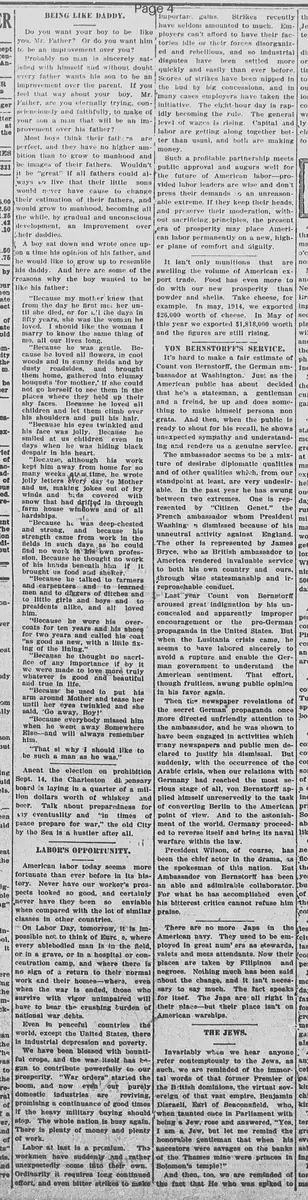
LABOR'S OPPORTUNITY.
American labor today seems more fortunate than ever before in its history. Never have our workers' prospects looked so good, and certainly never have they been so enviable when compared with the lot of similar classes in other countries.
On Labor Day, tomorrow, it is impossible not to think of Europe, where every able-bodied man is in the field, or in a grave, or in a hospital or concentration camp, and where there is no sign of a return to their normal work and their homes - where, even when the war is ended, those who survive with vigor unimpaired will have to bear the crushing burden of national war debts.
Even in peaceful countries the world, except the United States, there is industrial depression and poverty. We have been blessed with bountiful crops, and the war itself has begun to contribute powerfully to our prosperity. "War orders" started the boom, and now even our purely domestic industries are reviving, promising a continuance of good times if the heavy military buying should stop. The whole nation is busy again. There is plenty of money and plenty of work.
Labor at last is a premium. The workmen have suddenly and rather unexpectedly come into their own. Ordinarily it requires long continued effort, and even bitter strikes to make important gains. Strikes recently have seldom amounted to much. Employers can't afford to have their factories idle or their forces disorganized and rebellious, and so industrial disputes have been settled more quickly and easily than ever before. Scores of strikes have been nipped in the bud by big concessions, and in many cases employers have taken the initiative. The eight-hour day is rapidly becoming the rule. The general level of wages is rising. Capital and labor are getting along together better than usual, and both are making money.
Such a profitable partnership meets public approval and augurs well for the future of American labor - provided labor leaders are wise and don't press their demands to an unreasonable extreme. If they keep their heads and preserve their moderation, without sacrificing principles, the present era of prosperity may place American labor permanently on a new, higher plane of comfort and dignity.
It isn't only munitions that are swelling the volume of American export trade. Food has even more to do with our new prosperity than powder and shells. Take cheese, for example. In May, 1914, we exported $26,000 worth of cheese. In May of this year we exported $1,818,000 worth and the figures are still rising.
American labor today seems more fortunate than ever before in its history. Never have our workers' prospects looked so good, and certainly never have they been so enviable when compared with the lot of similar classes in other countries.
On Labor Day, tomorrow, it is impossible not to think of Europe, where every able-bodied man is in the field, or in a grave, or in a hospital or concentration camp, and where there is no sign of a return to their normal work and their homes - where, even when the war is ended, those who survive with vigor unimpaired will have to bear the crushing burden of national war debts.
Even in peaceful countries the world, except the United States, there is industrial depression and poverty. We have been blessed with bountiful crops, and the war itself has begun to contribute powerfully to our prosperity. "War orders" started the boom, and now even our purely domestic industries are reviving, promising a continuance of good times if the heavy military buying should stop. The whole nation is busy again. There is plenty of money and plenty of work.
Labor at last is a premium. The workmen have suddenly and rather unexpectedly come into their own. Ordinarily it requires long continued effort, and even bitter strikes to make important gains. Strikes recently have seldom amounted to much. Employers can't afford to have their factories idle or their forces disorganized and rebellious, and so industrial disputes have been settled more quickly and easily than ever before. Scores of strikes have been nipped in the bud by big concessions, and in many cases employers have taken the initiative. The eight-hour day is rapidly becoming the rule. The general level of wages is rising. Capital and labor are getting along together better than usual, and both are making money.
Such a profitable partnership meets public approval and augurs well for the future of American labor - provided labor leaders are wise and don't press their demands to an unreasonable extreme. If they keep their heads and preserve their moderation, without sacrificing principles, the present era of prosperity may place American labor permanently on a new, higher plane of comfort and dignity.
It isn't only munitions that are swelling the volume of American export trade. Food has even more to do with our new prosperity than powder and shells. Take cheese, for example. In May, 1914, we exported $26,000 worth of cheese. In May of this year we exported $1,818,000 worth and the figures are still rising.
What sub-type of article is it?
Labor
Economic Policy
What keywords are associated?
Labor Prosperity
Wartime Economy
Industrial Disputes
Wage Increases
Export Trade
Labor Moderation
What entities or persons were involved?
American Labor
Labor Leaders
Employers
Editorial Details
Primary Topic
American Labor's Prosperity Amid Wartime Economic Boom
Stance / Tone
Optimistic And Advisory
Key Figures
American Labor
Labor Leaders
Employers
Key Arguments
American Workers' Prospects Are Better Than Ever Compared To Other Countries
War In Europe Contrasts With Us Prosperity And Full Employment
War Orders And Domestic Revival Ensure Plenty Of Work And Money
Labor Gains Through Quick Dispute Settlements, Concessions, Eight Hour Day, And Rising Wages
Capital And Labor Cooperate Profitably With Public Approval
Labor Leaders Should Maintain Moderation To Secure Permanent Gains
Food Exports, Like Cheese, Significantly Contribute To Prosperity