Thank you for visiting SNEWPapers!
Sign up free
Literary
October 21, 1774
The New Hampshire Gazette And Historical Chronicle
Portsmouth, Greenland, Rockingham County, New Hampshire
What is this article about?
Excerpt from John Locke's treatise on government, arguing that legislators who destroy property or impose slavery wage war on the people, absolving obedience and justifying rebellion. Emphasizes consent for taxation and protection of property rights as the end of government.
Clipping
OCR Quality
98%
Excellent
Full Text
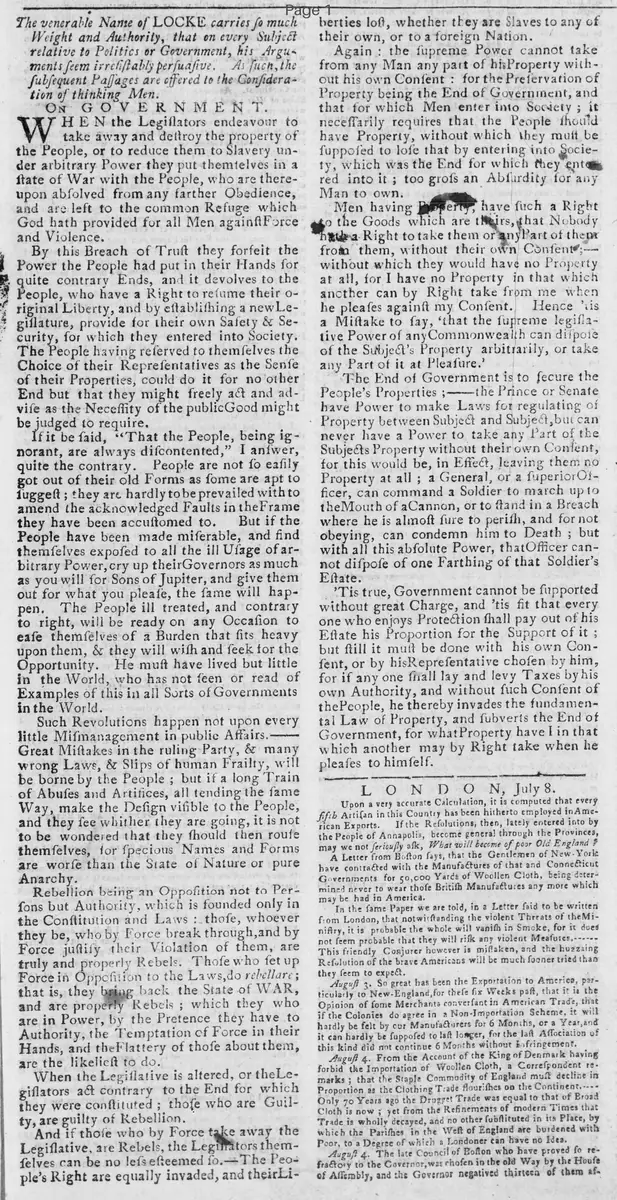
The venerable Name of LOCKE carries so much Weight and Authority, that on every Subject relative to Politics or Government, his Arguments seem irresistibly persuasive. As such, the subsequent Passages are offered to the Consideration of thinking Men.
ON GOVERNMENT.
When the Legislators endeavour to take away and destroy the property of the People, or to reduce them to Slavery under arbitrary Power they put themselves in a state of War with the People, who are thereupon absolved from any farther Obedience, and are left to the common Refuge which God hath provided for all Men against Force and Violence.
By this Breach of Trust they forfeit the Power the People had put in their Hands for quite contrary Ends, and it devolves to the People, who have a Right to resume their original Liberty, and by establishing a new Legislature, provide for their own Safety & Security, for which they entered into Society.
The People having reserved to themselves the Choice of their Representatives as the Sense of their Properties, could do it for no other End but that they might freely act and advise as the Necessity of the public Good might be judged to require.
If it be said, "That the People, being ignorant, are always discontented," I answer, quite the contrary. People are not so easily got out of their old Forms as some are apt to suggest; they are hardly to be prevailed with to amend the acknowledged Faults in the Frame they have been accustomed to. But if the People have been made miserable, and find themselves exposed to all the ill Usage of arbitrary Power, cry up their Governors as much as you will for Sons of Jupiter, and give them out for what you please, the same will happen. The People ill treated, and contrary to right, will be ready on any Occasion to ease themselves of a Burden that sits heavy upon them, & they will wish and seek for the Opportunity. He must have lived but little in the World, who has not seen or read of Examples of this in all Sorts of Governments in the World.
Such Revolutions happen not upon every little Mismanagement in public Affairs. Great Mistakes in the ruling Party, & many wrong Laws, & Slips of human Frailty, will be borne by the People; but if a long Train of Abuses and Artifices, all tending the same Way, make the Design visible to the People, and they see whither they are going, it is not to be wondered that they should then rouse themselves, for precious Names and Forms are worse than the State of Nature or pure Anarchy.
Rebellion being an Opposition not to Persons but Authority, which is founded only in the Constitution and Laws: those, whoever they be, who by Force break through, and by Force justify their Violation of them, are truly and properly Rebels. Those who set up Force in Opposition to the Laws, do rebellare: that is, they bring back the State of WAR, and are properly Rebels; which they who are in Power, by the Pretence they have to Authority, the Temptation of Force in their Hands, and the Flattery of those about them, are the likeliest to do.
When the Legislative is altered, or the Legislators act contrary to the End for which they were constituted; those who are Guilty, are guilty of Rebellion.
And if those who by Force take away the Legislative, are Rebels, the Legislators themselves can be no less esteemed so. The People's Rights are equally invaded, and their Liberties lost, whether they are Slaves to any of their own, or to a foreign Nation.
Again: the supreme Power cannot take from any Man any part of his Property without his own Consent: for the Preservation of Property being the End of Government, and that for which Men enter into Society; it necessarily requires that the People should have Property, without which they must be supposed to lose that by entering into Society, which was the End for which they entered into it; too gross an Absurdity for any Man to own.
Men having Property, have such a Right to the Goods which are theirs, that Nobody hath a Right to take them or any Part of them from them, without their own Consent: without which they would have no Property at all, for I have no Property in that which another can by Right take from me when he pleases against my Consent. Hence 'tis a Mistake to say, 'that the supreme legislative Power of any Commonwealth can dispose of the Subject's Property arbitrarily, or take any Part of it at Pleasure.'
The End of Government is to secure the People's Properties; so the Prince or Senate have Power to make Laws for regulating of Property between Subject and Subject, but can never have a Power to take any Part of the Subjects Property without their own Consent, for this would be, in Effect, leaving them no Property at all; a General, or a superior Officer, can command a Soldier to march up to the Mouth of a Cannon, or to stand in a Breach where he is almost sure to perish, and for not obeying, can condemn him to Death: but with all this absolute Power, that Officer cannot dispose of one Farthing of that Soldier's Estate.
'Tis true, Government cannot be supported without great Charge, and 'tis fit that every one who enjoys Protection shall pay out of his Estate his Proportion for the Support of it; but still it must be done with his own Consent, or by his Representative chosen by him, for if any one shall lay and levy Taxes by his own Authority, and without such Consent of the People, he thereby invades the fundamental Law of Property, and subverts the End of Government, for what Property have I in that which another may by Right take when he pleases to himself.
What sub-type of article is it?
Essay
What themes does it cover?
Political
Liberty Freedom
Taxation Oppression
What keywords are associated?
Locke
Government
Property Rights
Liberty
Rebellion
Taxation
Tyranny
Consent
What entities or persons were involved?
John Locke
Literary Details
Title
On Government.
Author
John Locke
Subject
On The Rights Of Property And Rebellion Against Tyrannical Government
Key Lines
When The Legislators Endeavour To Take Away And Destroy The Property Of The People, Or To Reduce Them To Slavery Under Arbitrary Power They Put Themselves In A State Of War With The People, Who Are Thereupon Absolved From Any Farther Obedience, And Are Left To The Common Refuge Which God Hath Provided For All Men Against Force And Violence.
The End Of Government Is To Secure The People's Properties; So The Prince Or Senate Have Power To Make Laws For Regulating Of Property Between Subject And Subject, But Can Never Have A Power To Take Any Part Of The Subjects Property Without Their Own Consent
For If Any One Shall Lay And Levy Taxes By His Own Authority, And Without Such Consent Of The People, He Thereby Invades The Fundamental Law Of Property, And Subverts The End Of Government