Thank you for visiting SNEWPapers!
Sign up free
Commercial
October 21, 1907
The Madison Daily Leader
Madison, Lake County, South Dakota
What is this article about?
On Oct. 21 in New York, financial excitement subsided with a weak stock market showing minor declines. Interest centered on Mercantile National Bank's issues, including clearinghouse committee deliberations on support, demanded resignations, and F. Augustus Heinze's defense of solvency. Comptroller Ridgely declined presidency.
Clipping
OCR Quality
98%
Excellent
Full Text
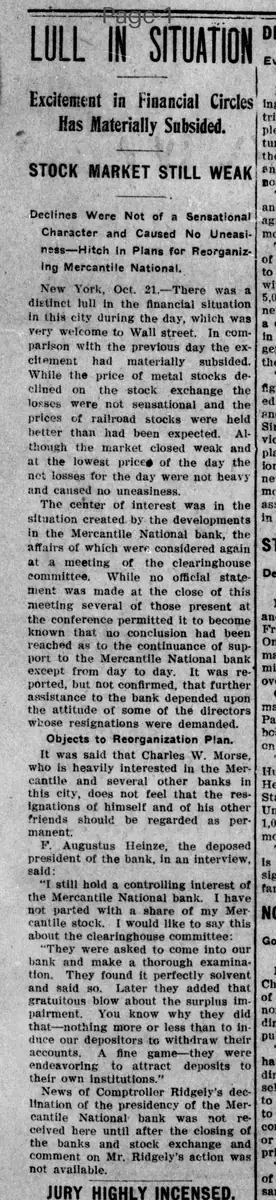
LULL IN SITUATION
Excitement in Financial Circles Has Materially Subsided.
STOCK MARKET STILL WEAK
Declines Were Not of a Sensational Character and Caused No Uneasiness—Hitch In Plans for Reorganizing Mercantile National.
New York, Oct. 21.—There was a distinct lull in the financial situation in this city during the day, which was very welcome to Wall street. In comparison with the previous day the excitement had materially subsided. While the price of metal stocks declined on the stock exchange the losses were not sensational and the prices of railroad stocks were held better than had been expected. Although the market closed weak and at the lowest prices of the day the net losses for the day were not heavy and caused no uneasiness.
The center of interest was in the situation created by the developments in the Mercantile National bank, the affairs of which were considered again at a meeting of the clearinghouse committee. While no official statement was made at the close of this meeting several of those present at the conference permitted it to become known that no conclusion had been reached as to the continuance of support to the Mercantile National bank except from day to day. It was reported, but not confirmed, that further assistance to the bank depended upon the attitude of some of the directors whose resignations were demanded.
Objects to Reorganization Plan.
It was said that Charles W. Morse, who is heavily interested in the Mercantile and several other banks in this city, does not feel that the resignations of himself and of his other friends should be regarded as permanent. F. Augustus Heinze, the deposed president of the bank, in an interview, said:
"I still hold a controlling interest of the Mercantile National bank. I have not parted with a share of my Mercantile stock. I would like to say this about the clearinghouse committee:
"They were asked to come into our bank and make a thorough examination. They found it perfectly solvent and said so. Later they added that gratuitous blow about the surplus impairment. You know why they did that—nothing more or less than to induce our depositors to withdraw their accounts. A fine game—they were endeavoring to attract deposits to their own institutions."
News of Comptroller Ridgely's declination of the presidency of the Mercantile National bank was not received here until after the closing of the banks and stock exchange and comment on Mr. Ridgely's action was not available.
What sub-type of article is it?
Banking
Stock Market
Economic
What keywords are associated?
Financial Lull
Stock Market Weak
Mercantile National Bank
Clearinghouse Committee
Bank Reorganization
Heinz Statement
What entities or persons were involved?
Mercantile National Bank
Charles W. Morse
F. Augustus Heinze
Comptroller Ridgely
Clearinghouse Committee
Where did it happen?
New York
Commercial Details
Location
New York
Event Date
Oct. 21
Key Figures
Mercantile National Bank
Charles W. Morse
F. Augustus Heinze
Comptroller Ridgely
Clearinghouse Committee
Notable Details
- lull in financial excitement
- weak stock market with minor declines
- no conclusion on bank support
- demanded resignations of directors
- heinze claims bank solvent
- ridgely declines presidency