Thank you for visiting SNEWPapers!
Sign up free
Literary
May 26, 1878
Daily Globe
Saint Paul, Ramsey County, Minnesota
What is this article about?
In a New England town, rival farmers Richard Dean and John Marshall feud over land and politics, leading Marshall to build an ugly barn blocking Dean's view. A storm destroys it, and Marshall's accident in rebuilding prompts reconciliation. Their children marry, ending the enmity.
Clipping
OCR Quality
98%
Excellent
Full Text
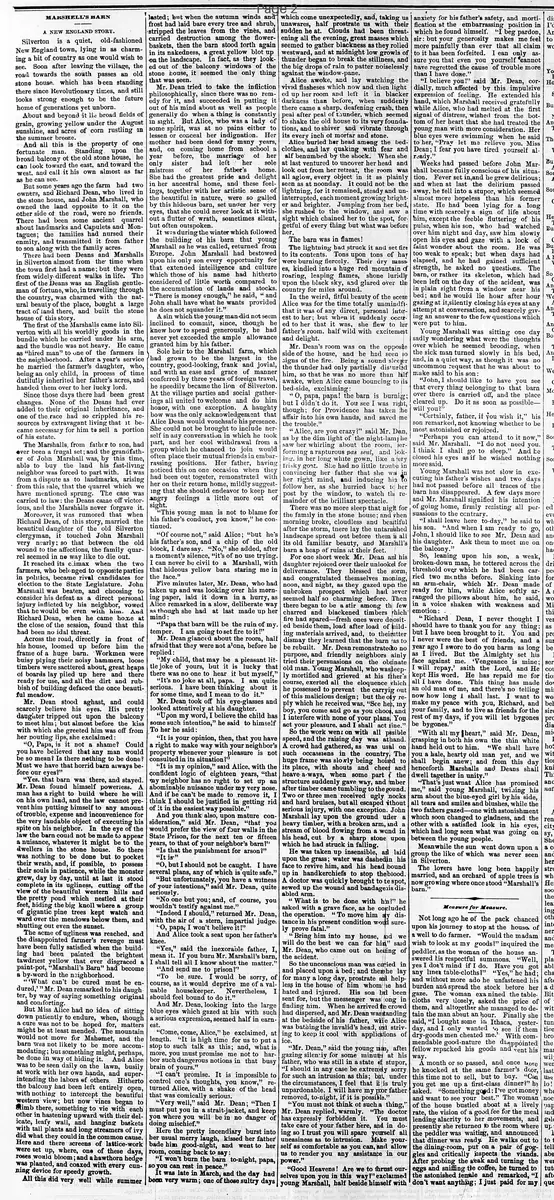
MARSHALL'S Barn
A NEW ENGLAND STORY.
Silverton is a quiet, old-fashioned New England town, lying in as charming a bit of country as one would wish to see. Soon after leaving the village, the road towards the south passes an old stone house, which has been standing there since Revolutionary times, and still looks strong enough to be the future home of generations yet unborn.
About and beyond it lie broad fields of grain, growing yellow under the August sunshine, and acres of corn rustling in the summer breeze.
And all this is the property of one fortunate man. Standing upon the broad balcony of the old stone house, he can look toward the east, and toward the west, and call it his own almost as far as he can see.
But some years ago the farm had two owners, and Richard Dean, who lived in the stone house, and John Marshall, who owned the land opposite to it on the other side of the road, were no friends.
There had been some ancient quarrel about landmarks and Capulets and Montagues; the families had nursed their enmity, and transmitted it from father to son along with the family acres.
There had been Deans and Marshalls in Silverton almost from the time when the town first had a name; but they were from widely different walks in life. The first of the Deans was an English gentleman of fortune, who, in travelling through the country, was charmed with the natural beauty of the place, bought a large tract of land there, and built the stone house of this story.
The first of the Marshalls came into Silverton with all his worldly goods in the bundle which he carried under his arm, and the bundle was not heavy. He came as "hired man" to one of the farmers in the neighborhood. After a year's service he married the farmer's daughter, who, being an only child, in process of time dutifully inherited her father's acres, and handed them over to her lucky lord.
Since those days there had been great changes. None of the Deans had ever added to their original inheritance, and one of the race had so crippled his resources by extravagant living that it became necessary for him to sell a portion of his estate.
The Marshalls, from father to son, had ever been a frugal set; and the grandfather of John Marshall was, by this time, able to buy the land his fast-living neighbor was forced to part with. It was from a dispute as to landmarks, arising from this sale, that the quarrel which we have mentioned sprung. The case was carried to law; the Deans came off victorious, and the Marshalls never forgave it.
Moreover, it was rumored that when Richard Dean, of this story, married the beautiful daughter of the old Silverton clergyman, it touched John Marshall very nearly; so that between the old wound to the affections, the family quarrel seemed in no way like to die out.
It reached its climax when the two farmers, who belonged to opposite parties in politics, became rival candidates for election to the State Legislature. John Marshall was beaten, and choosing to consider his defeat as a direct personal injury inflicted by his neighbor, vowed that he would be even with him. And Richard Dean, when he came home at the close of the session, found that this had been no idle threat.
Across the road, directly in front of his house, loomed up before him the frame of a huge barn. Workmen were busy plying their noisy hammers, loose timbers were scattered about, great heaps of boards lay piled up here and there ready for use, and all the dirt and rubbish of building defaced the once beautiful meadow.
Mr. Dean stood aghast, and could scarcely believe his eyes. His pretty daughter tripped out upon the balcony to meet him; but almost before the kiss with which she greeted him was off from her pouting lips, she exclaimed:
"O, Papa, is it not a shame? Could you have believed that any man would be so mean? Is there nothing to be done? Must we have that horrid barn always before our eyes?"
Yes, that barn was there, and stayed there. Mr. Dean found himself powerless. A man has a right to build where he will on his own land, and the law cannot prevent him putting himself to any amount of trouble, expense and inconvenience for the very laudable object of executing his spite on his neighbor. In the eye of the law the barn could not be made to appear a nuisance, whatever it might be to the dwellers in the stone house. So there was nothing to be done but to pocket their wrath, and, if possible, to possess their souls in patience, while the monster grew, day by day, until at last it stood complete in its ugliness, cutting off the view of the beautiful western hills and the pretty pond which nestled at their feet, hiding the big knoll where a group of gigantic pine trees kept watch and ward over the meadows below them, and shutting out even the sunset.
The acme of ugliness was reached, and the disappointed farmer's revenge must have been fully satisfied when the building had been painted the brightest tawdriest yellow that ever disgraced a paint-pot, "Marshall's Barn" had become a by-word in the neighborhood.
"What can't be cured must be endured," Mr. Dean remarked to his daughter, by way of saying something original and comforting.
But Miss Alice had no idea of sitting down patiently to endure, when, though a cure was not to be hoped for, matters might be at least mended. The mountain would not move for Mahomet, and the barn was not likely to be more accommodating; but something might, perhaps, be done in way of hiding it. And Alice was to be seen daily on the lawn, busily at work with her own hands, and superintending the labors of others. Hitherto the balcony had been left entirely open, with nothing to intercept the beautiful western view; but now vines began to climb there, something to vie with each other in hastening upward with their delicate, leafy wall, and hanging baskets with tall plants and long streamers of ivy did what they could in the common cause.
Here and there screens of lattice-work were set up, where, one of these days, roses would bloom; and a hawthorn hedge was planted, and coaxed with every cunning device for speedy growth.
All this did very well while summer lasted; but when the autumn winds and frost had laid bare every tree and shrub, stripped the leaves from the vines, and carried destruction among the flower-baskets, then the barn stood forth again in its nakedness, a great yellow blot upon the landscape. In fact, as they looked out of the balcony windows of the stone house, it seemed the only thing that was seen.
Mr. Dean tried to take the infliction philosophically, since there was no remedy for it, and succeeded in putting it out of his mind about as well as people generally do when a thing is constantly in sight. But Alice, who was a lady of some spirit, was at no pains either to lessen or conceal her indignation. Her mother had been dead for many years, and, on coming home from school a year before, the marriage of her only sister had left her sole mistress of her father's home.
She had the greatest pride and delight in her ancestral home, and these feelings, together with her artistic sense of the beautiful in nature, were so galled by this hideous barn, set under her very eyes, that she could never look at it without a flutter of wrath, sometimes silent but often outspoken.
It was during the winter which followed the building of his barn that young Marshall, as he was called, returned from Europe. John Marshall had bestowed upon his only son every opportunity for that extended intelligence and culture which those of his name had hitherto considered of little worth compared to the accumulation of lands and stocks.
"There is money enough," he said, "and John shall have what he wants provided he does not squander it."
A sin which the young man did not seem inclined to commit, since, though he knew how to spend generously, he had never yet exceeded the ample allowance granted him by his father.
Sole heir to the Marshall farm, which had grown to be the largest in the country, good-looking, frank and jovial, and with an ease and grace of manner conferred by three years of foreign travel, he speedily became the lion of Silverton.
At the village parties and social gatherings all united to welcome and do him honor, with one exception. A haughty bow was the only acknowledgement that Alice Dean would vouchsafe his presence.
She could not be brought to include herself in any conversation in which he took part, and her cool withdrawal from a group which he chanced to join would often place their mutual friends in embarrassing positions. Her father, having noticed this on one occasion when they had been out together, remonstrated with her on their return home, mildly suggesting that she should endeavor to keep her angry feelings a little more out of sight.
"This young man is not to blame for his father's conduct, you know," he continued.
"Of course not," said Alice; "but he's his father's son, and a chip of the old block, I dare say." "No," she added, after a moment's silence, "it's of no use trying. I can never be civil to a Marshall, with that hideous yellow barn staring me in the face."
Five minutes later, Mr. Dean, who had taken up and was looking over his morning paper, laid it down in a hurry, as Alice remarked in a slow, deliberate way, as though she had at last made up her mind:
"Papa, that barn will be the ruin of my temper. I am going to set fire to it!"
Mr. Dean glanced about the room, half afraid that they were not alone, before he replied:
"My child, that may be a pleasant little joke of yours, but it is lucky that there was no one to hear it but myself."
"It's no joke at all, papa. I am quite serious. I have been thinking about it for some time, and I mean to do it."
Mr. Dean took off his eye-glasses and looked attentively at his daughter.
"Upon my word, I believe the child has some such intention," he said to himself. To her he said:
"It is your opinion, then, that you have a right to make way with your neighbor's property whenever your pleasure is not consulted in its situation?"
"It is my opinion," said Alice, with the confident logic of eighteen years, "that my neighbor has no right to set up an abominable nuisance under my very nose. And if he can't be made to remove it, I think I should be justified in getting rid of it in the easiest way possible."
"And you think also, upon mature consideration," said Mr. Dean, "that you would prefer the view of four walls in the State Prison, for the next ten or fifteen years, to that of your neighbor's barn?"
"Is that the punishment for arson?"
"It is."
"O, but I should not be caught. I have several plans, any of which is quite safe."
"But unfortunately, you have a witness of your intentions," said Mr. Dean, quite seriously.
"No one but you; and, of course, you wouldn't testify against me."
"Indeed I should," returned Mr. Dean, with the air of a stern, impartial judge.
"O, papa; I won't believe it!"
And Alice took a seat upon her father's knee.
"Yes," said the inexorable father, "I mean it. If you burn Mr. Marshall's barn, I shall tell all I know about the matter."
"And send me to prison?"
"To be sure. I would be sorry, of course, as it would deprive me of a valuable housekeeper. Nevertheless, I should feel bound to do it."
And Mr. Dean, looking into the large blue eyes which gazed at him with such a serious expression, seemed half in earnest.
"Come, come, Alice," he exclaimed, at length. "It is high time for us to put a stop to such talk as this; and, what is more, you must promise me not to harbor such dangerous notions in that busy brain of yours."
"I can't promise. It is impossible to control one's thoughts, you know," returned Alice, with a shake of the head that was comically serious.
"Very well," said Mr. Dean; "Then I must put you in a strait-jacket, and keep you where you will be in no danger of doing mischief."
Here the pretty incendiary burst into her usual merry laugh, kissed her father, bade him good-night, and went to her room, coming back to say:
"I won't burn the barn to-night, papa, so you can rest in peace."
It was late in March, and the day had been very warm; one of those sultry days which come unexpectedly, and, taking us unawares, half prostrate us with their sudden heat. Clouds had been threatening all the evening, great masses which seemed to gather blackness as they rolled westward, and at midnight low growls of thunder began to break the stillness, and the big drops of rain to patter noiselessly against the window-pane.
Alice awoke, and lay watching the vivid flashes which now and then lighted up her room and left it in blacker darkness than before, when suddenly there came a sharp, deafening crash, then peal after peal of thunder, which seemed to shake the old house to its very foundations, and to shiver and vibrate through its every inch of mortar and stone.
Alice buried her head among the bed-clothes, and lay quaking with fear and half benumbed by the shock. When she at last ventured to uncover her head and look out from her retreat, the room was all aglow, every object in it as plainly seen as at noonday. It could not be the lightning, for it remained, steady and uninterrupted, each moment growing brighter and brighter. Jumping from her bed, she rushed to the window, and saw a sight which chained her to the spot, forgetful of everything but what was before her.
The barn was in flames!
The lightning had struck it and set fire to its contents. Tons upon tons of hay were burning fiercely. Their dry mass, kindled into a huge red mountain of roaring, leaping flames, shone luridly upon the black sky, and glared over the country for miles around.
In the weird, fitful beauty of the scene Alice was for the time totally unmindful that it was of any direct, personal interest to her; but when it suddenly occurred to her that it was, she flew to her father's room, half wild with excitement and delight.
Mr. Dean's room was on the opposite side of the house, and he had seen no signs of the fire. Being a sound sleeper the thunder had only partially disturbed him, so that he was no more than half awake, when Alice came bouncing to his bed-side, exclaiming:
"O, papa, papa! the barn is burning, but I didn't do it. You see I was right though; for Providence has taken the affair into his own hands, and saved me the trouble."
"Alice, are you crazy?" said Mr. Dean, as by the dim light of the night-lamp he saw her whirling about the room, performing a rapturous pas seul, and looking, in her long white gown, like a very frisky ghost. She had no little trouble in convincing her father that she was in her right mind, and inducing him to follow her, as she hurried back to her post by the window, to watch the remainder of the brilliant spectacle.
There was no more sleep that night for the family in the stone house; and when morning broke, cloudless and beautiful after the storm, there lay the untinged landscape spread out before them in all its old familiar beauty, and Marshall's barn a heap of ruins at their feet.
For one short week Mr. Dean and his daughter rejoiced over their unlooked for deliverance. They blessed the storm, and congratulated themselves morning, noon, and night, as they gazed upon the unbroken prospect which had never seemed half so charming before. Then there began to be a stir among the few charred and blackened timbers which fire had spared—fresh ones were deposited beside them, load after load of building materials arrived, and, to their utter dismay they learned that the barn was to be rebuilt. Mr. Dean remonstrated to no purpose, and friendly neighbors vainly tried their persuasions on the obstinate old man. Young Marshall, who was deeply mortified and grieved at his father's course, exerted all the eloquence which he possessed to prevent the carrying out of this malicious design; but the only reply which he received was, "See here, my boy, you come and go as you choose, and I interfere with none of your plans. You act your pleasure, and I shall act mine."
So the work went on with all possible speed, and the raising day was at hand.
A crowd had gathered, as was usual on such occasions in the country. The huge frame was slowly being hoisted to its place, with shouts and cheers and heave-a-ways, when some part of the structure suddenly gave way, and timber after timber came tumbling to the ground.
Two or three men received ugly knocks and hard bruises, but all escaped without serious injury, with one exception. John Marshall lay upon the ground under a heavy timber, with a broken arm, and a stream of blood flowing from a wound in his head, cut by a sharp stone, upon which he had struck in falling.
He was taken up insensible, and laid upon the grass; water was dashed in his face to revive him, and his head bound up in handkerchiefs to stop the blood.
A doctor was quickly brought to the spot, sewed up the wound and bandaged his disabled arm.
"What is to be done with him?" he asked with a grave face, as he concluded the operation. "To move him any distance in his present condition would surely prove fatal."
"Bring him into my house, and we will do the best we can for him," said Mr. Dean, who came out on hearing of the accident.
So the unconscious man was carried in and placed upon a bed; and there he lay for many a long day, prostrate and helpless in the house of him whom he had hated and injured. His son had been sent for, but the messenger was long in finding him. When he arrived the crowd had dispersed, and Mr. Dean was standing at the bedside of his father, while Alice was bathing the invalid's head, and striving to keep it cool with applications of ice.
"Mr. Dean," said the young man, after gazing silently for some minutes at his father, who was still in a state of stupor, "I should in any case be extremely sorry for such an intrusion as this; but, under the circumstances, I feel that it is truly unpardonable. I will have my poor father removed, to-night, if it is possible."
"You must not think of such a thing," Mr. Dean replied, warmly. "The doctor has expressly forbidden it. You must take care of your father here, and in doing so I trust you will spare yourself all uneasiness as to intrusion. Make yourself as comfortable as you can, and allow us to render you any assistance in our power."
"Good Heavens! Are we to thrust ourselves upon you in this way?" exclaimed young Marshall, half beside himself with anxiety for his father's safety, and mortification at the embarrassing position in which he found himself. "I beg pardon, sir; but your generosity makes me feel more painfully than ever that all claim to it has been forfeited. I can only assure you that even you yourself cannot have regretted the cause of trouble more than I have done."
"I believe you!" said Mr. Dean, cordially, much affected by this impulsive expression of feeling. He extended his hand, which Marshall received gratefully, while Alice, who had melted at the first signal of distress, wished from the bottom of her heart that she had treated the young man with more consideration. Her blue eyes were swimming when he said to her, "Pray let me relieve you, Miss Dean; I fear you have tired yourself already."
Weeks had passed before John Marshall became fully conscious of his situation. Fever set in, and he grew delirious; and when at last the delirium passed away, he fell into a stupor, which seemed almost more hopeless than his former state. He had been lying for a long time with scarcely a sign of life about him, except the feeble fluttering of his pulse, when his son, who had watched over him night and day, saw him slowly open his eyes and gaze with a look of faint wonder about the room. He was too weak to speak; but when days had elapsed, and he had gained sufficient strength, he asked no questions. The barn, or rather its skeleton, which had been left on the day of the accident, was in plain sight from a window near his bed; and he would lie hour after hour gazing at it, silently closing his eyes at any attempt at conversation, and scarcely giving an answer to the few questions which were put to him.
Young Marshall was sitting one day sadly wondering what were the thoughts over which he seemed brooding, when the sick man turned slowly in his bed, and, in a quiet way, as though it was no uncommon request that he was about to make, said to his son:
"John, I should like to have you see that every thing belonging to that barn over there is carried off, and the place cleared up. Do it as soon as possible, will you?"
"Certainly, father, if you wish it," his son remarked, not knowing whether to be most astonished or rejoiced.
"Perhaps you can attend to it now," said Mr. Marshall. "I do not need you. I think I shall go to sleep." And he closed his eyes as if he wished nothing more said.
Young Marshall was not slow in executing his father's wishes and two days had not passed before all traces of the barn had disappeared. A few days more and Mr. Marshall signified his intention of going home, firmly resisting all persuasions to the contrary.
"I shall leave here to-day," he said to his son. "And when I am ready to go, John, I should like to see Mr. Dean and his daughter. Ask them to meet me on the balcony."
So, leaning upon his son, a weak, broken-down man, he tottered across the threshold over which he had been carried two months before. Sinking into an arm-chair, which Mr. Dean made ready for him, while Alice softly arranged the pillows about him, he said, in a voice shaken with weakness and emotion:
"Richard Dean, I never thought I should have to thank you for any thing; but I have been brought to it. You and I never were the best of friends, and a year ago I swore to do you harm as long as I lived. But the Almighty set his face against me. Vengeance is mine; I will repay, saith the Lord, and He kept His word. He has repaid me for all I have done. This thing has made an old man of me, and there's no telling now how long I shall last. I want to make my peace with you, Richard, and your family, and to live as friends for the rest of my days, if you will let bygones be bygones."
"With all my heart," said Mr. Dean, grasping in both his own the thin white hand held out to him. "We shall have you a hale, hearty old man yet, and we shall begin anew; and from this day henceforth Marshalls and Deans shall dwell together in unity."
"That's just what Alice has promised me," said young Marshall, twining his arm about the blue-eyed girl by his side, all tears and smiles and blushes, while the two fathers gazed—one with astonishment which soon changed to gladness, and the other with a satisfied look in his eyes, which had long seen what was going on between the young people.
Meanwhile the sun went down upon a group the like of which was never seen in Silverton.
The lovers have long been happily married, and an orchard of apple trees is now growing where once stood "Marshall's barn."
A NEW ENGLAND STORY.
Silverton is a quiet, old-fashioned New England town, lying in as charming a bit of country as one would wish to see. Soon after leaving the village, the road towards the south passes an old stone house, which has been standing there since Revolutionary times, and still looks strong enough to be the future home of generations yet unborn.
About and beyond it lie broad fields of grain, growing yellow under the August sunshine, and acres of corn rustling in the summer breeze.
And all this is the property of one fortunate man. Standing upon the broad balcony of the old stone house, he can look toward the east, and toward the west, and call it his own almost as far as he can see.
But some years ago the farm had two owners, and Richard Dean, who lived in the stone house, and John Marshall, who owned the land opposite to it on the other side of the road, were no friends.
There had been some ancient quarrel about landmarks and Capulets and Montagues; the families had nursed their enmity, and transmitted it from father to son along with the family acres.
There had been Deans and Marshalls in Silverton almost from the time when the town first had a name; but they were from widely different walks in life. The first of the Deans was an English gentleman of fortune, who, in travelling through the country, was charmed with the natural beauty of the place, bought a large tract of land there, and built the stone house of this story.
The first of the Marshalls came into Silverton with all his worldly goods in the bundle which he carried under his arm, and the bundle was not heavy. He came as "hired man" to one of the farmers in the neighborhood. After a year's service he married the farmer's daughter, who, being an only child, in process of time dutifully inherited her father's acres, and handed them over to her lucky lord.
Since those days there had been great changes. None of the Deans had ever added to their original inheritance, and one of the race had so crippled his resources by extravagant living that it became necessary for him to sell a portion of his estate.
The Marshalls, from father to son, had ever been a frugal set; and the grandfather of John Marshall was, by this time, able to buy the land his fast-living neighbor was forced to part with. It was from a dispute as to landmarks, arising from this sale, that the quarrel which we have mentioned sprung. The case was carried to law; the Deans came off victorious, and the Marshalls never forgave it.
Moreover, it was rumored that when Richard Dean, of this story, married the beautiful daughter of the old Silverton clergyman, it touched John Marshall very nearly; so that between the old wound to the affections, the family quarrel seemed in no way like to die out.
It reached its climax when the two farmers, who belonged to opposite parties in politics, became rival candidates for election to the State Legislature. John Marshall was beaten, and choosing to consider his defeat as a direct personal injury inflicted by his neighbor, vowed that he would be even with him. And Richard Dean, when he came home at the close of the session, found that this had been no idle threat.
Across the road, directly in front of his house, loomed up before him the frame of a huge barn. Workmen were busy plying their noisy hammers, loose timbers were scattered about, great heaps of boards lay piled up here and there ready for use, and all the dirt and rubbish of building defaced the once beautiful meadow.
Mr. Dean stood aghast, and could scarcely believe his eyes. His pretty daughter tripped out upon the balcony to meet him; but almost before the kiss with which she greeted him was off from her pouting lips, she exclaimed:
"O, Papa, is it not a shame? Could you have believed that any man would be so mean? Is there nothing to be done? Must we have that horrid barn always before our eyes?"
Yes, that barn was there, and stayed there. Mr. Dean found himself powerless. A man has a right to build where he will on his own land, and the law cannot prevent him putting himself to any amount of trouble, expense and inconvenience for the very laudable object of executing his spite on his neighbor. In the eye of the law the barn could not be made to appear a nuisance, whatever it might be to the dwellers in the stone house. So there was nothing to be done but to pocket their wrath, and, if possible, to possess their souls in patience, while the monster grew, day by day, until at last it stood complete in its ugliness, cutting off the view of the beautiful western hills and the pretty pond which nestled at their feet, hiding the big knoll where a group of gigantic pine trees kept watch and ward over the meadows below them, and shutting out even the sunset.
The acme of ugliness was reached, and the disappointed farmer's revenge must have been fully satisfied when the building had been painted the brightest tawdriest yellow that ever disgraced a paint-pot, "Marshall's Barn" had become a by-word in the neighborhood.
"What can't be cured must be endured," Mr. Dean remarked to his daughter, by way of saying something original and comforting.
But Miss Alice had no idea of sitting down patiently to endure, when, though a cure was not to be hoped for, matters might be at least mended. The mountain would not move for Mahomet, and the barn was not likely to be more accommodating; but something might, perhaps, be done in way of hiding it. And Alice was to be seen daily on the lawn, busily at work with her own hands, and superintending the labors of others. Hitherto the balcony had been left entirely open, with nothing to intercept the beautiful western view; but now vines began to climb there, something to vie with each other in hastening upward with their delicate, leafy wall, and hanging baskets with tall plants and long streamers of ivy did what they could in the common cause.
Here and there screens of lattice-work were set up, where, one of these days, roses would bloom; and a hawthorn hedge was planted, and coaxed with every cunning device for speedy growth.
All this did very well while summer lasted; but when the autumn winds and frost had laid bare every tree and shrub, stripped the leaves from the vines, and carried destruction among the flower-baskets, then the barn stood forth again in its nakedness, a great yellow blot upon the landscape. In fact, as they looked out of the balcony windows of the stone house, it seemed the only thing that was seen.
Mr. Dean tried to take the infliction philosophically, since there was no remedy for it, and succeeded in putting it out of his mind about as well as people generally do when a thing is constantly in sight. But Alice, who was a lady of some spirit, was at no pains either to lessen or conceal her indignation. Her mother had been dead for many years, and, on coming home from school a year before, the marriage of her only sister had left her sole mistress of her father's home.
She had the greatest pride and delight in her ancestral home, and these feelings, together with her artistic sense of the beautiful in nature, were so galled by this hideous barn, set under her very eyes, that she could never look at it without a flutter of wrath, sometimes silent but often outspoken.
It was during the winter which followed the building of his barn that young Marshall, as he was called, returned from Europe. John Marshall had bestowed upon his only son every opportunity for that extended intelligence and culture which those of his name had hitherto considered of little worth compared to the accumulation of lands and stocks.
"There is money enough," he said, "and John shall have what he wants provided he does not squander it."
A sin which the young man did not seem inclined to commit, since, though he knew how to spend generously, he had never yet exceeded the ample allowance granted him by his father.
Sole heir to the Marshall farm, which had grown to be the largest in the country, good-looking, frank and jovial, and with an ease and grace of manner conferred by three years of foreign travel, he speedily became the lion of Silverton.
At the village parties and social gatherings all united to welcome and do him honor, with one exception. A haughty bow was the only acknowledgement that Alice Dean would vouchsafe his presence.
She could not be brought to include herself in any conversation in which he took part, and her cool withdrawal from a group which he chanced to join would often place their mutual friends in embarrassing positions. Her father, having noticed this on one occasion when they had been out together, remonstrated with her on their return home, mildly suggesting that she should endeavor to keep her angry feelings a little more out of sight.
"This young man is not to blame for his father's conduct, you know," he continued.
"Of course not," said Alice; "but he's his father's son, and a chip of the old block, I dare say." "No," she added, after a moment's silence, "it's of no use trying. I can never be civil to a Marshall, with that hideous yellow barn staring me in the face."
Five minutes later, Mr. Dean, who had taken up and was looking over his morning paper, laid it down in a hurry, as Alice remarked in a slow, deliberate way, as though she had at last made up her mind:
"Papa, that barn will be the ruin of my temper. I am going to set fire to it!"
Mr. Dean glanced about the room, half afraid that they were not alone, before he replied:
"My child, that may be a pleasant little joke of yours, but it is lucky that there was no one to hear it but myself."
"It's no joke at all, papa. I am quite serious. I have been thinking about it for some time, and I mean to do it."
Mr. Dean took off his eye-glasses and looked attentively at his daughter.
"Upon my word, I believe the child has some such intention," he said to himself. To her he said:
"It is your opinion, then, that you have a right to make way with your neighbor's property whenever your pleasure is not consulted in its situation?"
"It is my opinion," said Alice, with the confident logic of eighteen years, "that my neighbor has no right to set up an abominable nuisance under my very nose. And if he can't be made to remove it, I think I should be justified in getting rid of it in the easiest way possible."
"And you think also, upon mature consideration," said Mr. Dean, "that you would prefer the view of four walls in the State Prison, for the next ten or fifteen years, to that of your neighbor's barn?"
"Is that the punishment for arson?"
"It is."
"O, but I should not be caught. I have several plans, any of which is quite safe."
"But unfortunately, you have a witness of your intentions," said Mr. Dean, quite seriously.
"No one but you; and, of course, you wouldn't testify against me."
"Indeed I should," returned Mr. Dean, with the air of a stern, impartial judge.
"O, papa; I won't believe it!"
And Alice took a seat upon her father's knee.
"Yes," said the inexorable father, "I mean it. If you burn Mr. Marshall's barn, I shall tell all I know about the matter."
"And send me to prison?"
"To be sure. I would be sorry, of course, as it would deprive me of a valuable housekeeper. Nevertheless, I should feel bound to do it."
And Mr. Dean, looking into the large blue eyes which gazed at him with such a serious expression, seemed half in earnest.
"Come, come, Alice," he exclaimed, at length. "It is high time for us to put a stop to such talk as this; and, what is more, you must promise me not to harbor such dangerous notions in that busy brain of yours."
"I can't promise. It is impossible to control one's thoughts, you know," returned Alice, with a shake of the head that was comically serious.
"Very well," said Mr. Dean; "Then I must put you in a strait-jacket, and keep you where you will be in no danger of doing mischief."
Here the pretty incendiary burst into her usual merry laugh, kissed her father, bade him good-night, and went to her room, coming back to say:
"I won't burn the barn to-night, papa, so you can rest in peace."
It was late in March, and the day had been very warm; one of those sultry days which come unexpectedly, and, taking us unawares, half prostrate us with their sudden heat. Clouds had been threatening all the evening, great masses which seemed to gather blackness as they rolled westward, and at midnight low growls of thunder began to break the stillness, and the big drops of rain to patter noiselessly against the window-pane.
Alice awoke, and lay watching the vivid flashes which now and then lighted up her room and left it in blacker darkness than before, when suddenly there came a sharp, deafening crash, then peal after peal of thunder, which seemed to shake the old house to its very foundations, and to shiver and vibrate through its every inch of mortar and stone.
Alice buried her head among the bed-clothes, and lay quaking with fear and half benumbed by the shock. When she at last ventured to uncover her head and look out from her retreat, the room was all aglow, every object in it as plainly seen as at noonday. It could not be the lightning, for it remained, steady and uninterrupted, each moment growing brighter and brighter. Jumping from her bed, she rushed to the window, and saw a sight which chained her to the spot, forgetful of everything but what was before her.
The barn was in flames!
The lightning had struck it and set fire to its contents. Tons upon tons of hay were burning fiercely. Their dry mass, kindled into a huge red mountain of roaring, leaping flames, shone luridly upon the black sky, and glared over the country for miles around.
In the weird, fitful beauty of the scene Alice was for the time totally unmindful that it was of any direct, personal interest to her; but when it suddenly occurred to her that it was, she flew to her father's room, half wild with excitement and delight.
Mr. Dean's room was on the opposite side of the house, and he had seen no signs of the fire. Being a sound sleeper the thunder had only partially disturbed him, so that he was no more than half awake, when Alice came bouncing to his bed-side, exclaiming:
"O, papa, papa! the barn is burning, but I didn't do it. You see I was right though; for Providence has taken the affair into his own hands, and saved me the trouble."
"Alice, are you crazy?" said Mr. Dean, as by the dim light of the night-lamp he saw her whirling about the room, performing a rapturous pas seul, and looking, in her long white gown, like a very frisky ghost. She had no little trouble in convincing her father that she was in her right mind, and inducing him to follow her, as she hurried back to her post by the window, to watch the remainder of the brilliant spectacle.
There was no more sleep that night for the family in the stone house; and when morning broke, cloudless and beautiful after the storm, there lay the untinged landscape spread out before them in all its old familiar beauty, and Marshall's barn a heap of ruins at their feet.
For one short week Mr. Dean and his daughter rejoiced over their unlooked for deliverance. They blessed the storm, and congratulated themselves morning, noon, and night, as they gazed upon the unbroken prospect which had never seemed half so charming before. Then there began to be a stir among the few charred and blackened timbers which fire had spared—fresh ones were deposited beside them, load after load of building materials arrived, and, to their utter dismay they learned that the barn was to be rebuilt. Mr. Dean remonstrated to no purpose, and friendly neighbors vainly tried their persuasions on the obstinate old man. Young Marshall, who was deeply mortified and grieved at his father's course, exerted all the eloquence which he possessed to prevent the carrying out of this malicious design; but the only reply which he received was, "See here, my boy, you come and go as you choose, and I interfere with none of your plans. You act your pleasure, and I shall act mine."
So the work went on with all possible speed, and the raising day was at hand.
A crowd had gathered, as was usual on such occasions in the country. The huge frame was slowly being hoisted to its place, with shouts and cheers and heave-a-ways, when some part of the structure suddenly gave way, and timber after timber came tumbling to the ground.
Two or three men received ugly knocks and hard bruises, but all escaped without serious injury, with one exception. John Marshall lay upon the ground under a heavy timber, with a broken arm, and a stream of blood flowing from a wound in his head, cut by a sharp stone, upon which he had struck in falling.
He was taken up insensible, and laid upon the grass; water was dashed in his face to revive him, and his head bound up in handkerchiefs to stop the blood.
A doctor was quickly brought to the spot, sewed up the wound and bandaged his disabled arm.
"What is to be done with him?" he asked with a grave face, as he concluded the operation. "To move him any distance in his present condition would surely prove fatal."
"Bring him into my house, and we will do the best we can for him," said Mr. Dean, who came out on hearing of the accident.
So the unconscious man was carried in and placed upon a bed; and there he lay for many a long day, prostrate and helpless in the house of him whom he had hated and injured. His son had been sent for, but the messenger was long in finding him. When he arrived the crowd had dispersed, and Mr. Dean was standing at the bedside of his father, while Alice was bathing the invalid's head, and striving to keep it cool with applications of ice.
"Mr. Dean," said the young man, after gazing silently for some minutes at his father, who was still in a state of stupor, "I should in any case be extremely sorry for such an intrusion as this; but, under the circumstances, I feel that it is truly unpardonable. I will have my poor father removed, to-night, if it is possible."
"You must not think of such a thing," Mr. Dean replied, warmly. "The doctor has expressly forbidden it. You must take care of your father here, and in doing so I trust you will spare yourself all uneasiness as to intrusion. Make yourself as comfortable as you can, and allow us to render you any assistance in our power."
"Good Heavens! Are we to thrust ourselves upon you in this way?" exclaimed young Marshall, half beside himself with anxiety for his father's safety, and mortification at the embarrassing position in which he found himself. "I beg pardon, sir; but your generosity makes me feel more painfully than ever that all claim to it has been forfeited. I can only assure you that even you yourself cannot have regretted the cause of trouble more than I have done."
"I believe you!" said Mr. Dean, cordially, much affected by this impulsive expression of feeling. He extended his hand, which Marshall received gratefully, while Alice, who had melted at the first signal of distress, wished from the bottom of her heart that she had treated the young man with more consideration. Her blue eyes were swimming when he said to her, "Pray let me relieve you, Miss Dean; I fear you have tired yourself already."
Weeks had passed before John Marshall became fully conscious of his situation. Fever set in, and he grew delirious; and when at last the delirium passed away, he fell into a stupor, which seemed almost more hopeless than his former state. He had been lying for a long time with scarcely a sign of life about him, except the feeble fluttering of his pulse, when his son, who had watched over him night and day, saw him slowly open his eyes and gaze with a look of faint wonder about the room. He was too weak to speak; but when days had elapsed, and he had gained sufficient strength, he asked no questions. The barn, or rather its skeleton, which had been left on the day of the accident, was in plain sight from a window near his bed; and he would lie hour after hour gazing at it, silently closing his eyes at any attempt at conversation, and scarcely giving an answer to the few questions which were put to him.
Young Marshall was sitting one day sadly wondering what were the thoughts over which he seemed brooding, when the sick man turned slowly in his bed, and, in a quiet way, as though it was no uncommon request that he was about to make, said to his son:
"John, I should like to have you see that every thing belonging to that barn over there is carried off, and the place cleared up. Do it as soon as possible, will you?"
"Certainly, father, if you wish it," his son remarked, not knowing whether to be most astonished or rejoiced.
"Perhaps you can attend to it now," said Mr. Marshall. "I do not need you. I think I shall go to sleep." And he closed his eyes as if he wished nothing more said.
Young Marshall was not slow in executing his father's wishes and two days had not passed before all traces of the barn had disappeared. A few days more and Mr. Marshall signified his intention of going home, firmly resisting all persuasions to the contrary.
"I shall leave here to-day," he said to his son. "And when I am ready to go, John, I should like to see Mr. Dean and his daughter. Ask them to meet me on the balcony."
So, leaning upon his son, a weak, broken-down man, he tottered across the threshold over which he had been carried two months before. Sinking into an arm-chair, which Mr. Dean made ready for him, while Alice softly arranged the pillows about him, he said, in a voice shaken with weakness and emotion:
"Richard Dean, I never thought I should have to thank you for any thing; but I have been brought to it. You and I never were the best of friends, and a year ago I swore to do you harm as long as I lived. But the Almighty set his face against me. Vengeance is mine; I will repay, saith the Lord, and He kept His word. He has repaid me for all I have done. This thing has made an old man of me, and there's no telling now how long I shall last. I want to make my peace with you, Richard, and your family, and to live as friends for the rest of my days, if you will let bygones be bygones."
"With all my heart," said Mr. Dean, grasping in both his own the thin white hand held out to him. "We shall have you a hale, hearty old man yet, and we shall begin anew; and from this day henceforth Marshalls and Deans shall dwell together in unity."
"That's just what Alice has promised me," said young Marshall, twining his arm about the blue-eyed girl by his side, all tears and smiles and blushes, while the two fathers gazed—one with astonishment which soon changed to gladness, and the other with a satisfied look in his eyes, which had long seen what was going on between the young people.
Meanwhile the sun went down upon a group the like of which was never seen in Silverton.
The lovers have long been happily married, and an orchard of apple trees is now growing where once stood "Marshall's barn."
What sub-type of article is it?
Prose Fiction
What themes does it cover?
Agriculture Rural
Moral Virtue
Friendship
What keywords are associated?
New England Story
Family Feud
Rival Farmers
Spiteful Barn
Reconciliation
Providence
Marriage
Literary Details
Title
Marshall's Barn A New England Story.
Key Lines
"Papa, That Barn Will Be The Ruin Of My Temper. I Am Going To Set Fire To It!"
"O, Papa, Papa! The Barn Is Burning, But I Didn't Do It. You See I Was Right Though; For Providence Has Taken The Affair Into His Own Hands, And Saved Me The Trouble."
"Vengeance Is Mine; I Will Repay, Saith The Lord, And He Kept His Word."
"That's Just What Alice Has Promised Me," Said Young Marshall, Twining His Arm About The Blue Eyed Girl By His Side, All Tears And Smiles And Blushes,