Thank you for visiting SNEWPapers!
Sign up free
Atlanta Daily World
Atlanta, Fulton County, Georgia
What is this article about?
Henry Porter, born possibly as a slave, attended Hampton Institute and became a successful farmer in Sand Hill, Georgia, inspiring community cooperation, school building, and economic stability under economic hardships.
Clipping
OCR Quality
Full Text
This is Event 1 of 2. The full text below covers all events in this component.
ATLANTA DAILY WORLD, ATLANTA, GEORGIA
Story Of Hard Work And Cooperation In Success Of Sand Hill Community
Rural Enterprise Soloists Prepare For Exposition
Is Model To Others
By W. A. HAGINS
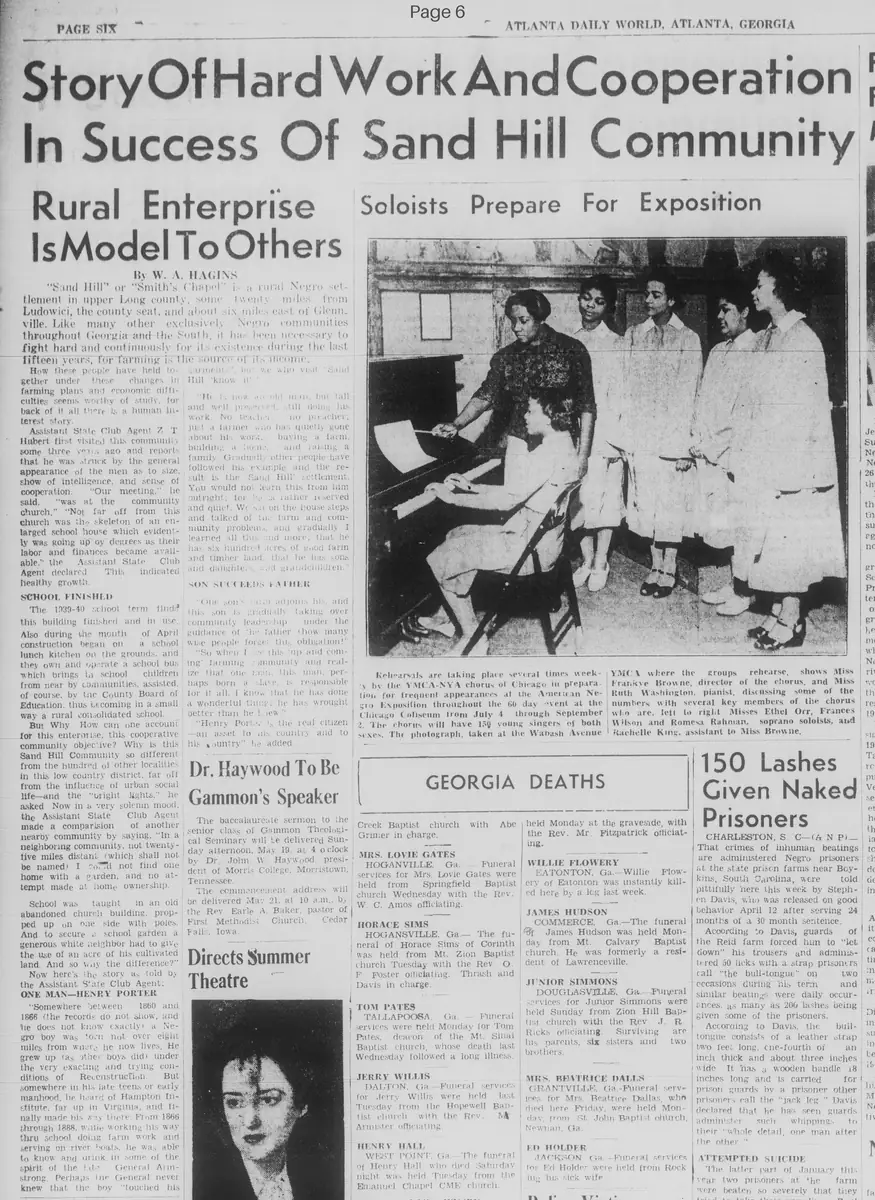
"Sand Hill" or "Smith's Chapel" is a rural Negro settlement in upper Long county, some twenty miles from Ludowici, the county seat, and about six miles east of Glennville. Like many other exclusively Negro communities throughout Georgia and the South, it has been necessary to fight hard and continuously for its existence during the last fifteen years, for farming is the source of its income.
How these people have held together under these changes in farming plans and economic difficulties seems worthy of study, for back of it all there is a human interest story.
Assistant State Club Agent J. T. Hubert first visited this community some three years ago and reports that he was struck by the general appearance of the men as to size, show of intelligence, and sense of cooperation. "Our meeting," he said, "was at the community church." "Not far off from this church was the skeleton of an enlarged school house which evidently was going up by degrees as their labor and finances became available." The Assistant State Club Agent declared this indicated healthy growth.
SCHOOL FINISHED
The 1939-40 school term finds this building finished and in use. Also during the month of April construction began on a school lunch kitchen on the grounds, and they own and operate a school bus which brings in school children from near by communities, assisted of course, by the County Board of Education, thus becoming in a small way a rural consolidated school.
But Why How can one account for this enterprise, this cooperative community objective? Why is this Sand Hill Community so different from the hundreds of other localities in this low country district, far off from the influence of urban social life-and the "bright lights," he asked now in a very solemn mood.
The Assistant State Club Agent made a comparison of another nearby community by saying, "In a neighboring community, not twenty-five miles distant (which shall not be named) I could not find one home with a garden, and no attempt made at home ownership. School was taught in an old abandoned church building, propped up on one side with poles. And to secure a school garden a generous white neighbor had to give the use of an acre of his cultivated land. And so widely the difference?"
Now here's the story as told by the Assistant State Club Agent.
ONE MAN-HENRY PORTER
"Somewhere between 1860 and 1866 (the records do not show, and he does not know exactly) a Negro boy was born not over eight miles from where he now lives. He grew up (as other boys did under the very exacting and trying conditions of Reconstruction) But somewhere in his late teens or early manhood, he heard of Hampton Institute, far up in Virginia, and finally made his way there. From 1866 through 1888, while working his way through school doing farm work and serving on river boats, he was able to know and drink in some of the spirit of its General Armstrong. Perhaps the General never knew that the boy touched his life."
Content, but we who visit Sand Hill know it.
He is an old man but tall and well preserved still doing his work. No teacher, no preacher, just a farmer who has quietly gone about his work, buying a farm, building it up and raising a family. Gradually other people have followed his example and the result is the Sand Hill settlement.
You would not learn this from him outright, for he is a rather reserved and quiet. We sit on the house steps and talked of the farm and community problems, and gradually I learned all this and more, that he has six hundred acres of good farm and timber land that he has sons and daughters and grandchildren.
SON SUCCEEDS FATHER
One of his sons is gradually taking over community leadership under the guidance of his father. How many wise people forget this obligation!
"So when I think up and coming farming community and realize that one little this man, perhaps born a slave is responsible for it all, I know that he has done a wonderful thing he has wrought better than he knew."
"Henry Porter, the ideal citizen -an asset to his country and to his country" he added.
What sub-type of article is it?
What themes does it cover?
What keywords are associated?
What entities or persons were involved?
Where did it happen?
Story Details
Key Persons
Location
Sand Hill Or Smith's Chapel, Upper Long County, Georgia, Near Ludowici And Glennville
Event Date
Born Between 1860 And 1866; School Term 1939 40
Story Details
Henry Porter, born possibly as a slave, attended Hampton Institute and became a successful farmer in Sand Hill, Georgia, inspiring community cooperation, school building, and economic stability under economic hardships.