Thank you for visiting SNEWPapers!
Sign up free
Editorial
October 21, 1908
The Star And Newark Advertiser
Newark, Essex County, New Jersey
What is this article about?
The Evening Star's 15-mile marathon race in Newark, involving 166 youths, captivates the public, started by champion John J. Hayes. Editorial links it to ancient Greek Olympics and the Marathon run of 490 B.C., urging America to emulate that heroic spirit.
Clipping
OCR Quality
98%
Excellent
Full Text
THE STAR'S MARATHON RACE.
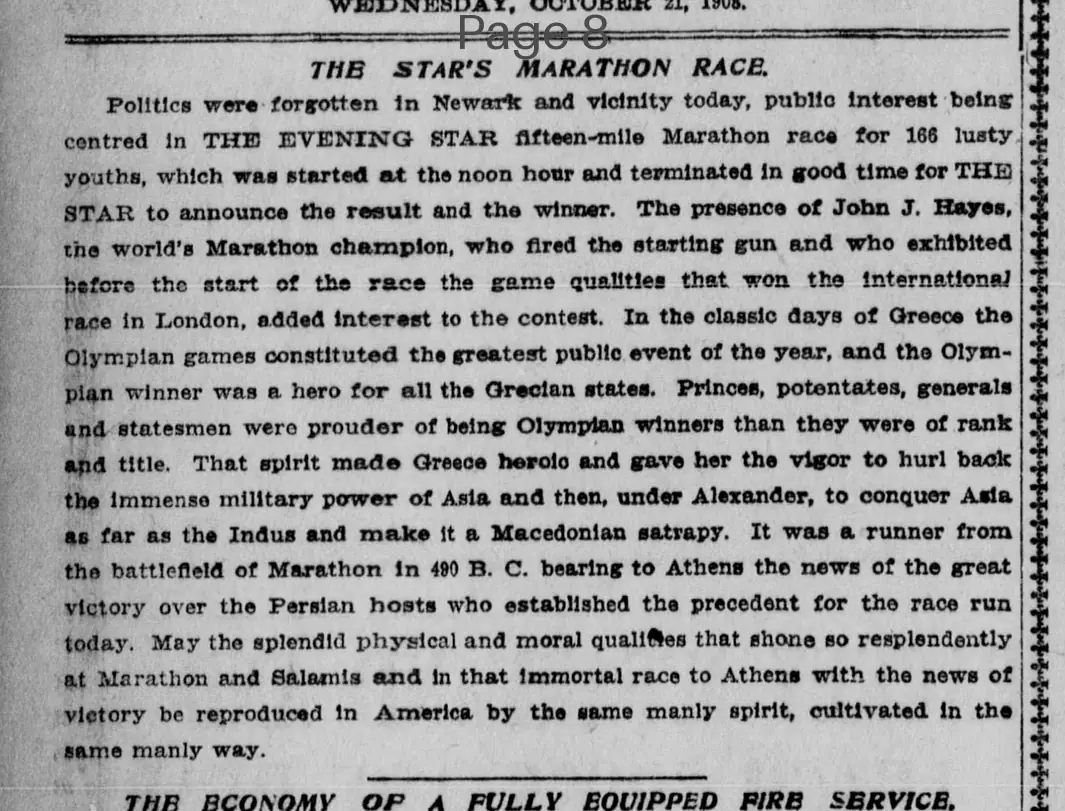
Politics were forgotten in Newark and vicinity today, public interest being centred in THE EVENING STAR fifteen-mile Marathon race for 166 lusty youths, which was started at the noon hour and terminated in good time for THE STAR to announce the result and the winner. The presence of John J. Hayes, the world's Marathon champion, who fired the starting gun and who exhibited before the start of the race the game qualities that won the international race in London, added interest to the contest. In the classic days of Greece the Olympian games constituted the greatest public event of the year, and the Olympian winner was a hero for all the Grecian states. Princes, potentates, generals and statesmen were prouder of being Olympian winners than they were of rank and title. That spirit made Greece heroic and gave her the vigor to hurl back the immense military power of Asia and then, under Alexander, to conquer Asia as far as the Indus and make it a Macedonian satrapy. It was a runner from the battlefield of Marathon in 490 B. C. bearing to Athens the news of the great victory over the Persian hosts who established the precedent for the race run today. May the splendid physical and moral qualities that shone so resplendently at Marathon and Salamis and in that immortal race to Athens with the news of victory be reproduced in America by the same manly spirit, cultivated in the same manly way.
Politics were forgotten in Newark and vicinity today, public interest being centred in THE EVENING STAR fifteen-mile Marathon race for 166 lusty youths, which was started at the noon hour and terminated in good time for THE STAR to announce the result and the winner. The presence of John J. Hayes, the world's Marathon champion, who fired the starting gun and who exhibited before the start of the race the game qualities that won the international race in London, added interest to the contest. In the classic days of Greece the Olympian games constituted the greatest public event of the year, and the Olympian winner was a hero for all the Grecian states. Princes, potentates, generals and statesmen were prouder of being Olympian winners than they were of rank and title. That spirit made Greece heroic and gave her the vigor to hurl back the immense military power of Asia and then, under Alexander, to conquer Asia as far as the Indus and make it a Macedonian satrapy. It was a runner from the battlefield of Marathon in 490 B. C. bearing to Athens the news of the great victory over the Persian hosts who established the precedent for the race run today. May the splendid physical and moral qualities that shone so resplendently at Marathon and Salamis and in that immortal race to Athens with the news of victory be reproduced in America by the same manly spirit, cultivated in the same manly way.
What sub-type of article is it?
Sports Event
Historical Inspiration
What keywords are associated?
Marathon Race
Newark
John J. Hayes
Olympian Games
Marathon Battle
Greek Heroism
What entities or persons were involved?
John J. Hayes
The Evening Star
Greek Olympians
Alexander
Editorial Details
Primary Topic
Evening Star's Marathon Race In Newark
Stance / Tone
Celebratory And Inspirational
Key Figures
John J. Hayes
The Evening Star
Greek Olympians
Alexander
Key Arguments
- politics forgotten amid public interest in the race
- race started by world champion john j. hayes
- historical parallel to ancient greek olympic games and marathon runner
- call to reproduce physical and moral qualities of greek heroes in america