Thank you for visiting SNEWPapers!
Sign up free
Poem
May 26, 1872
New York Dispatch
New York, New York County, New York
What is this article about?
Satirical narrative by Alice E. Cary exaggerating the Pilgrims' sufferings in Massachusetts, including persecution, harsh winter, Indian attacks, and economic woes, with humorous asides on their economy and music.
Clipping
OCR Quality
95%
Excellent
Full Text
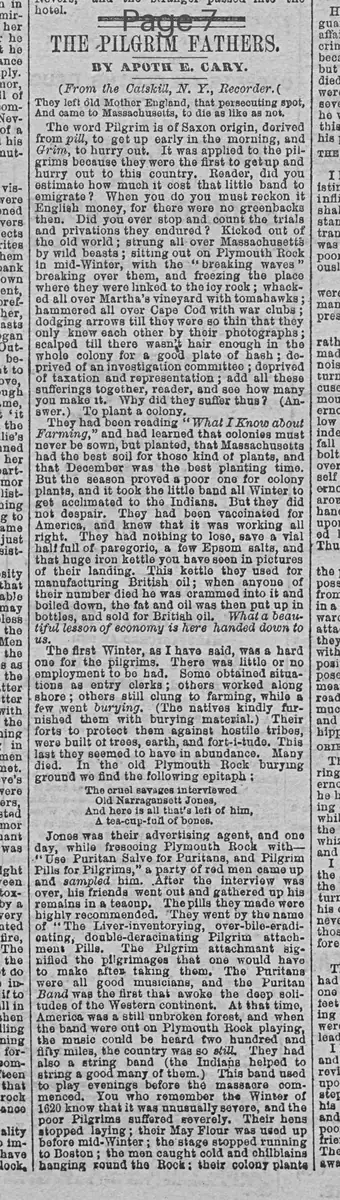
THE PILGRIM FATHERS
BY ALICE E. CARY.
(From the Catskill, N. Y., Recorder.)
They left old Mother England, that persecuting spot,
And came to Massachusetts, to die as like as not,
The word Pilgrim is of Saxon origin, derived
from pill, to get up early in the morning, and
Grim, to hurry out. It was applied to the pil-
grimg because they were the first to get up and
hurry out to this country. Reader, did you
estimate how much it cost that little band to
emigrate? When you do you must reckon it
English money, for there were no greenbacks
then. Did you ever stop and count the trials
and privations they endured? Kicked out of
the old world: strung all over Massachusetts
by wild beasts: sitting out on Plymouth Rock
in mid-Winter, with the "breaking waves"
breaking over them, and freezing the place
where they were linked to the icy rock; whack-
ed all over Martha's vineyard with tomahawks:
hammered all over Cape Cod with war clubs:
dodging arrows till they were so thin that they
only knew each other by their photographs;
scalped till there wasn't hair enough in the
whole colony for a good plate of hash; de-
prived of an investigation committee; deprived
of taxation and representation; add all these
sufferings together, reader, and see how many
you make it. Why did they suffer thus? (An-
swer.) To plant a colony.
They had been reading "What I Know about
Farming," and had learned that colonies must
never be sown, but planted, that Massachusetts
had the best soil for those kind of plants, and
that December was the best planting time.
But the season proved a poor one for colony
plants, and it took the little band all Winter to
get acclimated to the Indians. But they did
not despair. They had been vaccinated for
America, and knew that it was working all
right. They had nothing to lose, save a vial
half full of paregoric, a few Epsom salts, and
that huge iron kettle you have seen in pictures
of their landing. This kettle they used for
manufacturing British oil; when anyone of
their number died he was crammed into it and
boiled down, the fat and oil was then put up in
bottles, and sold for British oil. What a beau-
tiful lesson of economy is here handed down to
us!
The first Winter, as I have said, was a hard
one for the pilgrims. There was little or no
employment to be had. Some obtained situa-
tions as entry clerks; others worked along
shore; others still clung to farming, while a
few went burying. (The natives kindly fur-
nished them with burying material.) Their
forts to protect them against hostile tribes,
were built of trees, earth, and fort-i-tude. This
last they seemed to have in abundance. Many
died. In the old Plymouth Rock burying
ground we find the following epitaph:
The cruel savages interviewed
Old Narragansett Jones,
And here is all that's left of him,
A tea-cup-full of bones.
Jones was their advertising agent, and one
day, while frescoing Plymouth Rock with—
"Use Puritan Salve for Puritans, and Pilgrim
Pills for Pilgrims," a party of red men came up
and sampled him. After the interview was
over, his friends went out and gathered up his
remains in a teacup. The pills they made were
highly recommended. They went by the name
of "The Liver-inventorying, over-bile-eradi-
eating, double-deracinating Pilgrim attach-
ment Pills." The Pilgrim attachment sig-
nified the pilgrimages that one would have
to make after taking them. The Puritans
were all good musicians, and the Puritan
Band was the first that awoke the deep soli-
tudes of the Western continent. At that time,
America was a still unbroken forest, and when
the band were out on Plymouth Rock playing,
the music could be heard two hundred and
fifty miles, the country was so still. They had
also a string band (the Indians helped to
string a good many of them.) This band used
to play evenings before the massacre com-
menced. You who remember the Winter of
1620 know that it was unusually severe, and the
poor Pilgrims suffered severely. Their hens
stopped laying; their May Flour was used up
before mid-Winter; the stage stopped running
to Boston; the men caught cold and chilblains
hanging round the Rock: their colony plant
died: coal went up to ten dollars per ton, short
weight. All this, together with the Wintry
storms howling through their log huts; the In-
dians howling through the forest; the children
howling for bread; all this, I say, made a ra-
ther howling time of it.
'Twas a sad and sorry welcome
Massachusetts flung to them.
And, oh! wasn't it thundering mean
To starve those Pilgrim men?
As Spring advanced, the ague visited them.
With the exception of the Indians, this was
their first visitor, and being cramped for room,
and short of supplies, they were poorly pre-
parad to entertain company. There was no
room in the settlement, and it was a pitiful
sight to see those aged and agued Pilgrims
marching out on Plymouth Rock to take their
daily shake. From these shaking Pilgrims
sprang the sect called Shakers.
BY ALICE E. CARY.
(From the Catskill, N. Y., Recorder.)
They left old Mother England, that persecuting spot,
And came to Massachusetts, to die as like as not,
The word Pilgrim is of Saxon origin, derived
from pill, to get up early in the morning, and
Grim, to hurry out. It was applied to the pil-
grimg because they were the first to get up and
hurry out to this country. Reader, did you
estimate how much it cost that little band to
emigrate? When you do you must reckon it
English money, for there were no greenbacks
then. Did you ever stop and count the trials
and privations they endured? Kicked out of
the old world: strung all over Massachusetts
by wild beasts: sitting out on Plymouth Rock
in mid-Winter, with the "breaking waves"
breaking over them, and freezing the place
where they were linked to the icy rock; whack-
ed all over Martha's vineyard with tomahawks:
hammered all over Cape Cod with war clubs:
dodging arrows till they were so thin that they
only knew each other by their photographs;
scalped till there wasn't hair enough in the
whole colony for a good plate of hash; de-
prived of an investigation committee; deprived
of taxation and representation; add all these
sufferings together, reader, and see how many
you make it. Why did they suffer thus? (An-
swer.) To plant a colony.
They had been reading "What I Know about
Farming," and had learned that colonies must
never be sown, but planted, that Massachusetts
had the best soil for those kind of plants, and
that December was the best planting time.
But the season proved a poor one for colony
plants, and it took the little band all Winter to
get acclimated to the Indians. But they did
not despair. They had been vaccinated for
America, and knew that it was working all
right. They had nothing to lose, save a vial
half full of paregoric, a few Epsom salts, and
that huge iron kettle you have seen in pictures
of their landing. This kettle they used for
manufacturing British oil; when anyone of
their number died he was crammed into it and
boiled down, the fat and oil was then put up in
bottles, and sold for British oil. What a beau-
tiful lesson of economy is here handed down to
us!
The first Winter, as I have said, was a hard
one for the pilgrims. There was little or no
employment to be had. Some obtained situa-
tions as entry clerks; others worked along
shore; others still clung to farming, while a
few went burying. (The natives kindly fur-
nished them with burying material.) Their
forts to protect them against hostile tribes,
were built of trees, earth, and fort-i-tude. This
last they seemed to have in abundance. Many
died. In the old Plymouth Rock burying
ground we find the following epitaph:
The cruel savages interviewed
Old Narragansett Jones,
And here is all that's left of him,
A tea-cup-full of bones.
Jones was their advertising agent, and one
day, while frescoing Plymouth Rock with—
"Use Puritan Salve for Puritans, and Pilgrim
Pills for Pilgrims," a party of red men came up
and sampled him. After the interview was
over, his friends went out and gathered up his
remains in a teacup. The pills they made were
highly recommended. They went by the name
of "The Liver-inventorying, over-bile-eradi-
eating, double-deracinating Pilgrim attach-
ment Pills." The Pilgrim attachment sig-
nified the pilgrimages that one would have
to make after taking them. The Puritans
were all good musicians, and the Puritan
Band was the first that awoke the deep soli-
tudes of the Western continent. At that time,
America was a still unbroken forest, and when
the band were out on Plymouth Rock playing,
the music could be heard two hundred and
fifty miles, the country was so still. They had
also a string band (the Indians helped to
string a good many of them.) This band used
to play evenings before the massacre com-
menced. You who remember the Winter of
1620 know that it was unusually severe, and the
poor Pilgrims suffered severely. Their hens
stopped laying; their May Flour was used up
before mid-Winter; the stage stopped running
to Boston; the men caught cold and chilblains
hanging round the Rock: their colony plant
died: coal went up to ten dollars per ton, short
weight. All this, together with the Wintry
storms howling through their log huts; the In-
dians howling through the forest; the children
howling for bread; all this, I say, made a ra-
ther howling time of it.
'Twas a sad and sorry welcome
Massachusetts flung to them.
And, oh! wasn't it thundering mean
To starve those Pilgrim men?
As Spring advanced, the ague visited them.
With the exception of the Indians, this was
their first visitor, and being cramped for room,
and short of supplies, they were poorly pre-
parad to entertain company. There was no
room in the settlement, and it was a pitiful
sight to see those aged and agued Pilgrims
marching out on Plymouth Rock to take their
daily shake. From these shaking Pilgrims
sprang the sect called Shakers.
What sub-type of article is it?
Satire
What themes does it cover?
Satire Society
Political
What keywords are associated?
Pilgrim Fathers
Massachusetts
Indians
Hardships
Satire
Plymouth Rock
Colony Planting
What entities or persons were involved?
By Alice E. Cary.
Poem Details
Title
The Pilgrim Fathers
Author
By Alice E. Cary.
Subject
Satirical Account Of Pilgrim Hardships In Massachusetts
Form / Style
Humorous Narrative With Rhymed Verses
Key Lines
The Cruel Savages Interviewed
Old Narragansett Jones,
And Here Is All That's Left Of Him,
A Tea Cup Full Of Bones.
'Twas A Sad And Sorry Welcome
Massachusetts Flung To Them.
And, Oh! Wasn't It Thundering Mean
To Starve Those Pilgrim Men?