Thank you for visiting SNEWPapers!
Sign up free
Story
October 21, 1843
The North Carolinian
Fayetteville, Cumberland County, North Carolina
What is this article about?
Hiram Hock recounts his upbringing, legal studies under a strict preceptor, and disastrous first courtroom speech in a criminal trial, ruined by a one-eyed juryman's sneeze, resulting in his client's conviction and his disillusionment with law.
Clipping
OCR Quality
92%
Excellent
Full Text
Miscellaneous.
From the Pennsylvanian.
MY FIRST AND LAST SPEECH
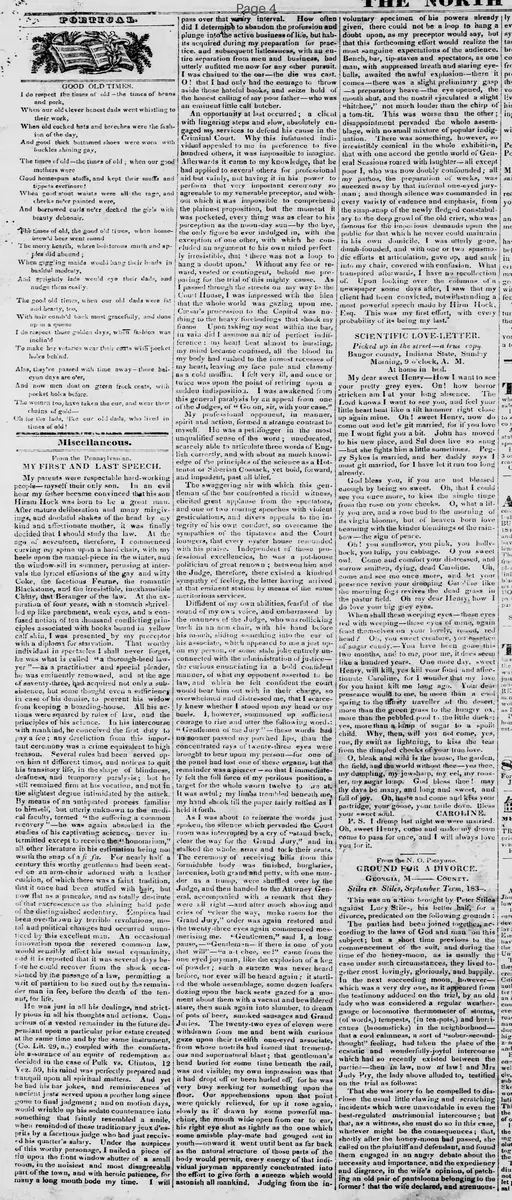
My parents were respectable hard-working people—myself their only son. In an evil hour my father became convinced that his son Hiram Hock was born to be a great man. After mature deliberation and many misgivings, and doubtful shakes of the head by my kind and affectionate mother, it was finally decided that I should study the law. At the age of seventeen, therefore, I commenced curving my spine upon a hard chair, with my heels upon the mantel-piece in the winter, and the window-sill in summer, perusing at intervals the lyrical effusions of the gay and witty Coke, the facetious Fearne, the romantic Blackstone, and the irresistible, inexhaustible Chitty, that Beranger of the law. At the expiration of four years, with a stomach shrivelled up like parchment, weak eyes, and a confused notion of ten thousand conflicting principles associated with books bound in yellow calf skin, I was presented by my preceptor with a diploma for starvation. That worthy individual in spectacles I shall never forget, he was what is called "a thorough-bred lawyer"—as a practitioner and special pleader, he was eminently renowned, and at the age of seventy-three, had acquired not only a subsistence, but some thought even a sufficiency in case of his demise, to prevent his widow from keeping a boarding-house. All his actions were squared by rules of law, and the principles of his science. In his intercourse with mankind, he conceived the first duty to pay a fee; any dereliction from this important ceremony was a crime equivalent to high treason. Several rules had been served upon him at different times, and notices to quit his transitory life, in the shape of blindness, deafness, and temporary paralysis; but he still remained firm at his vocation, and not in the slightest degree intimidated by the attack. By means of an antiquated process familiar to himself, but utterly unknown to the medical faculty, termed "the suffering a common recovery" he was again absorbed in the studies of his captivating science, never intermitted except to receive the "honorarium," all other literature in his estimation being not worth the snap of a fi fa. For nearly half a century this worthy gentleman had been seated on an arm-chair adorned with a leather cushion, of which there was a faint tradition, that it once had been stuffed with hair, but now flat as a pancake, and as totally destitute of that excrescence as the shining bald pate of the distinguished sedentary. Empires had been overthrown by terrible revolutions, moral and political changes had occurred unnoticed by this excellent man. An occasional innovation upon the revered common law would sensibly affect his usual equanimity, and it is reported that it was several days before he could recover from the shock occasioned by the passage of a law, permitting a writ of partition to be sued out by the remainderman in fee, before the death of the tenant for life.
He was just in all his dealings, and strictly pious in all his thoughts and actions. Conscious of a vested remainder in the future dependant upon a particular prior estate created at the same time and by the same instrument, (Co. Lit. 29, a.) coupled with the comfortable assurance of an equity of redemption as decided in the case of Pulk vs. Clinton, 12 Vez. 59, his mind was perfectly prepared and tranquil upon all spiritual matters. And yet he had his bar jokes, and reminiscences of ancient jests served upon a brother long since gone to final judgment; and on motion days, would wrinkle up his sedate countenance into something that faintly resembled a smile, when reminded of these traditionary jeux d'esprit by a facetious judge who had just received his quarter's salary. Under the auspices of this worthy personage, I nailed a piece of tin upon the front window shutter of a small room, in the noisiest and most disagreeable part of the town, and with heroic patience, for many a long month bade my time. I will pass over that weary interval. How often did I determine to abandon the profession and plunge into the active business of life, but habits acquired during my preparation for practice, and subsequent listlessness, with an entire separation from men and business, had utterly unfitted me now for any other pursuit. I was chained to the oar—the die was cast. O! that I had only had the courage to throw aside those hateful books, and seize hold of the honest calling of my poor father—who was an eminent little calf butcher.
An opportunity at last occurred; a client with lingering steps and slow, absolutely engaged my services to defend his cause in the Criminal Court. Why this infatuated individual appealed to me in preference to five hundred others, it was impossible to imagine. Afterwards it came to my knowledge, that he had applied to several others for professional aid but vainly, not having it in his power to perform that very important ceremony so agreeable to my venerable preceptor, and without which it was impossible to comprehend the plainest proposition, but the moment it was pocketed, every thing was as clear to his perception as the noon-day sun—by the bye, the only figure he ever indulged in, with the exception of one other, with which he concluded an argument to his own mind perfectly irresistible, that there was not a loop to hang a doubt upon. Without any fee or reward, vested or contingent, behold me preparing for the trial of this mighty cause. As I passed through the streets on my way to the Court House, I was impressed with the idea that the whole world was gazing upon me. Caesar's procession to the Capitol was nothing to the heavy forebodings that shook my frame. Upon taking my seat within the bar; in vain did I assume an air of perfect indifference: my heart beat almost to bursting, my mind became confused, all the blood in my body had rushed to the inmost recesses of my heart, leaving my face pale and clammy as a cold muffin. I felt very ill, and once or twice was upon the point of retiring upon a sudden indisposition. I was awakened from this general paralysis by an appeal from one of the Judges, of "Go on, sir, with your case."
My professional opponent, in manner, spirit and action, formed a strange contrast to myself. He was a pettifogger in the most unqualified sense of the word; uneducated, scarcely able to articulate three words of English correctly, and with about as much knowledge of the principles of the science as a Hottentot or Siberian Cossack, yet bold, forward, and impudent, past all belief.
The swaggering air with which this gentleman of the bar confronted a timid witness, elicited great applause from the spectators, and one or two roaring speeches with violent gesticulations, and divers appeals to the integrity of his own conduct, so overcame the sympathies of the tipstaves and the Court loungers, that every oyster house resounded with his praise. Independent of those professional excellencies, he was a pot-house politician of great renown; between him and the Judge, therefore, there existed a kindred sympathy of feeling, the latter having arrived at that eminent station by means of the same meritorious services.
Diffident of my own abilities, fearful of the sound of my own voice, and embarrassed by the manners of the Judge, who was rollicking back in an arm chair, with his hand before his mouth, sliding something into the ear of his associate, which appeared to me a jest upon my person, or some stale joke entirely unconnected with the administration of justice—the curious enunciating in a bold confident manner, of what my opponent asserted to be law, and which he felt confident the court would bear him out with in their charge, so overwhelmed and distressed me, that I scarcely knew whether I stood upon my head or my heels. I, however, summoned up sufficient courage to rise and utter the following words: "Gentlemen of the Jury"—these words had no sooner passed my parched lips, than the concentrated rays of twenty-three eyes were brought to bear upon my person—for one of the panel had lost one of these organs, but the remainder was a piercer—so that I immediately felt the full force of my perilous position, a target for the whole sworn twelve to fire at. It was awful; my limbs trembled beneath me, my hand shook till the paper fairly rattled as I held it forth.
As I was about to reiterate the words just spoken, the silence which pervaded the Court room was interrupted by a cry of "stand back, clear the way for the Grand Jury," and in stalked the whole array and took their seats. The ceremony of receiving bills from this formidable body was finished, burglaries, larcenies, both grand and petty, with one murder as a trump, were shuffled over by the Judge, and then handed to the Attorney General, accompanied with a remark that they were all right—and after much shoving and cries of "clear the way, make room for the Grand Jury," order was again restored and the twenty-three eyes again commenced mesmerising me. "Gentlemen," said I, a long pause,—"Gentlemen—if there is one of you that will"—"a a-t chee, ee!" came from the one eyed juryman, like the explosion of a keg of powder; such a sneeze was never heard before, nor ever will be heard again; it startled the whole assemblage, some dozen loafers dozing upon the back seats gazed for a moment about them with a vacant and bewildered stare, then sunk again into slumber, to dream of pots of beer, smoked sausages and Grand Juries. The twenty-two eyes of eleven were withdrawn from me and bent with curious gaze upon their twelfth one-eyed associate, from whose nostrils had issued that tremendous and supernatural blast; that gentleman's head buried for some time beneath the rail, was not visible; my own impression was that it had dropt off or been hurled off, for he was very busy seeking for something upon the floor. Our apprehensions upon that point were quickly relieved, for up it rose again, slowly as if drawn by some powerful machine, the mouth wide open from ear to ear, his right eye shut as tightly as the one which some amiable play-mate had gouged out in youth—onward it went until bent as far back as the natural structure of those parts of the body would permit, every energy of that individual juryman apparently concentrated into the effort to give forth a sneeze which would astonish all mankind. Judging from the involuntary specimen of his powers already given, there could not be a loop to hang a doubt upon, as my preceptor would say, but that this forthcoming effort would realize the most sanguine expectations of the audience. Bench, bar, tip-staves and spectators, as one man, with suppressed breath and staring eye-balls, awaited the awful explosion—there it comes—there was a slight preliminary gasp—a preparatory heave—the eye opened, the mouth shut, and the nostril ejaculated a slight "hitchee," not much louder than the chirp of a tom-tit. This was worse than the other: disappointment pervaded the whole assemblage, with no small mixture of popular indignation. There was something, however, so irresistibly comical in the whole exhibition, that with one accord the gentle world of General Sessions roared with laughter—all except poor I, who was now doubly confounded; all my pathos, the preparation of weeks, was squeezed away by that infernal one-eyed juryman; and though silence was commanded in every variety of cadence and emphasis, from the snap-snap of the newly fledged constabulary to the deep growl of the old crier, who was famous for the imperious demands upon the public for that which he never could maintain in his own domicile, I was utterly gone, dumb-founded, and with one or two spasmodic efforts at articulation, gave up, and sank into my chair, covered with confusion. What transpired afterwards, I have no recollection of. Upon looking over the columns of a newspaper some days after, I saw that my client had been convicted, notwithstanding a most powerful speech made by Hiram Hock, Esq. This was my first effort, with every probability of its being my last.
What sub-type of article is it?
Biography
Curiosity
What themes does it cover?
Misfortune
Social Manners
What keywords are associated?
First Speech
Courtroom Failure
Juryman Sneeze
Law Practice
Legal Anecdote
Humorous Mishap
What entities or persons were involved?
Hiram Hock
Preceptor
Client
Professional Opponent
Judge
One Eyed Juryman
Where did it happen?
Criminal Court, Noisiest Part Of The Town
Story Details
Key Persons
Hiram Hock
Preceptor
Client
Professional Opponent
Judge
One Eyed Juryman
Location
Criminal Court, Noisiest Part Of The Town
Story Details
Young lawyer Hiram Hock, after studying law and setting up practice, gets his first case in criminal court without a fee; his speech is interrupted by a grand jury entrance and a dramatic sneeze from a one-eyed juryman, causing laughter and his failure, leading to client's conviction.