Thank you for visiting SNEWPapers!
Sign up free
Literary
May 26, 1845
The Caledonian
Saint Johnsbury, Caledonia County, Vermont
What is this article about?
During the American Revolution, a young wife in Chichester warns her patriot husband of Refugee outlaws seeking him. He escapes as she deflects a shot and is struck down. He rallies neighbors, ambushes the gang, and in a final duel at a crag, the outlaw leader falls to his death, saving the husband.
Merged-components note: Continuation of the story 'The Outlaw's Crag' from page 1 to page 2, forming a single coherent literary piece.
Clippings
1 of 2
OCR Quality
95%
Excellent
Full Text
From the Lady's National Magazine for May.
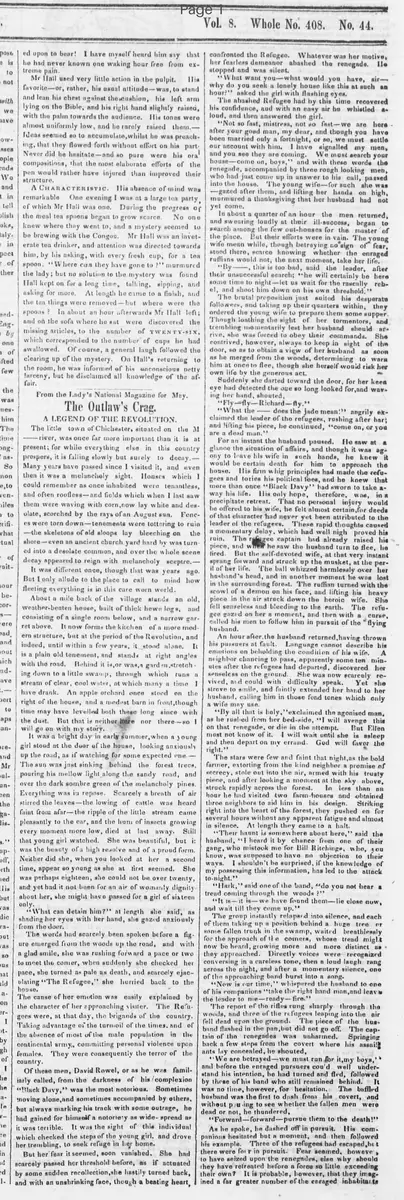
The Outlaw's Crag.
A LEGEND OF THE REVOLUTION.
The little town of Chichester, situated on the M river, was once far more important than it is at present; for while everything else in this country prospers, it is falling slowly but surely to decay.— Many years have passed since I visited it, and even then it was a melancholy sight. Houses which I could remember as once inhabited were tenantless, and often roofless—and fields which when I last saw them were waving with corn, now lay white and desolate, scorched by the rays of an August sun. Fences were torn down—tenements were tottering to ruin—the skeletons of old sloops lay bleaching on the shore—even an ancient church yard hard by was turned into a desolate common, and over the whole scene decay appeared to reign with melancholy sceptre.—
It was different once, though that was years ago. But I only allude to the place to call to mind how fleeting everything is in this care worn world.
About a mile back of the village stands an old, weather-beaten house, built of thick hewn logs, and consisting of a single room below, and a narrow garret above. It now forms the kitchen of a more modern structure, but at the period of the Revolution, and indeed, until within a few years, it stood alone. It is a plain old tenement, and stands at right angles with the road. Behind it is, or was, a garden, stretching down to a little swamp, through which runs a stream of clear, cool water, at which many a time I have drank. An apple orchard once stood on the right of the house, and a modest barn in front, though time may have levelled both these long since with the dust. But that is neither here nor there—so I will go on with my story.
It was a bright day in early summer, when a young girl stood at the door of the house, looking anxiously up the road, as if watching for some expected one—
The sun was just sinking behind the forest trees, pouring his mellow light along the sandy road, and over the dark sombre green of the melancholy pines.
Everything was in repose. Scarcely a breath of air stirred the leaves—the lowing of cattle was heard faint from afar—the ripple of the little stream came pleasantly to the ear, and the hum of insects growing every moment more low, died at last away. Still that young girl watched. She was beautiful, but it was the beauty of a high resolve and of a proud form.
Neither did she, when you looked at her a second time, appear so young as she at first seemed. She was perhaps eighteen, she could not be over twenty, and yet had it not been for an air of womanly dignity about her, she might have passed for a girl of sixteen only.
"What can detain him?" at length she said, as shading her eyes with her hand, she gazed anxiously from the door.
The words had scarcely been spoken before a figure emerged from the woods up the road, and with a glad smile, she was rushing forward a pace or two to meet the comer, when suddenly she checked her pace, she turned as pale as death, and scarcely ejaculating "The Refugee," she hurried back to the house.
The cause of her emotion was easily explained by the character of her approaching visitor. The Refugees were, at that day, the brigands of the country. Taking advantage of the turmoil of the times, and of the absence of most of the male population in the continental army, committing personal violence upon females. They were consequently the terror of the country.
Of these men, David Rowel, or as he was familiarly called, from the darkness of his complexion "Black Davy," was the most notorious. Sometimes moving alone, and sometimes accompanied by others, but always marking his track with some outrage, he had gained for himself a notoriety as wide-spread as it was terrible. It was the sight of this individual which checked the steps of the young girl, and drove her trembling, to seek refuge in her home.
But her fear it seemed, soon vanished. She had scarcely passed her threshold before, as if actuated by some sudden recollection, she hastily turned back, and with an unshrinking face, though a beating heart, confronted the Refugee. Whatever was her motive her fearless demeanor abashed the renegade. He stopped and was silent.
"What want you—what would you have, sir— why do you seek a lonely house like this at such an hour?" asked the girl with flashing eyes.
The abashed Refugee had by this time recovered his confidence, and with an easy air he whistled a loud, and then answered the girl.
"Not so fast, mistress, not so fast—we are here after your good man, my dear, and though you have been married only a fortnight, or so, we must settle our account with him. I have signalled my men, and you see they are coming. We must search your house—come on, boys," and with these words the renegade, accompanied by three rough looking men, who had just come up in answer to his call, passed into the house. The young wife—for such she was—gazed after them, and lifting her hands on high, murmured a thanksgiving that her husband had not yet come.
In about a quarter of an hour the men returned, and swearing loudly at their ill-success, began to search among the few out-houses for the master of the place. But their efforts were in vain. The young wife mean while, though betraying no sign of fear, stood there, scarce knowing whether the enraged ruffians would not, the next moment, take her life.
"By—, this is too bad," said the leader, after their unsuccessful search; "he will certainly be here some time to night—let us wait for the rascally rebel, and shoot him down on his own threshold."
The brutal proposition just suited his desperate followers, and taking up their quarters within, they ordered the young wife to prepare them some supper.
Though loathing the sight of her tormentors, and trembling momentarily lest her husband should arrive, she was forced to obey their commands. She contrived, however, always to keep in sight of the door, so as to obtain a view of her husband as soon as he emerged from the woods, determining to warn him at once to flee, though she herself would risk her own life by the generous act.
Suddenly she darted toward the door, for her keen eye had detected the one so long looked for, and waving her hand, shouted,
"Fly—fly—Richard—fly."
"What the — does the jade mean!" angrily exclaimed the leader of the refugees, rushing after her; and lifting his piece, he continued, "come on, or you are a dead man."
For an instant the husband paused. He saw at a glance the situation of affairs, and though it was agony to leave his wife in such hands, he knew it would be certain death for him to approach the house. His firm high principles had made the refugees and tories his political foes, and he knew that more than once "Black Davy" had sworn to take away his life. His only hope, therefore, was, in a precipitate retreat. That no personal injury would be offered to his wife, he felt almost certain, for deeds of that character had never yet been attributed to the leader of the refugees. These rapid thoughts caused a momentary delay, which had well nigh proved his ruin. The refugee captain had already raised his piece, and when he saw the husband turn to flee, he fired. But the self-devoted wife, at that very instant sprang forward and struck up the musket, at the peril of her life. The ball whizzed harmlessly over her husband's head, and in another moment he was lost in the surrounding forest. The ruffian turned with the scowl of a demon on his face, and lifting his heavy piece in the air struck down the heroic wife. She fell senseless and bleeding to the earth. The refugee gazed on her a moment, and then with a curse, called his men to follow him in pursuit of the "flying husband."
An hour after the husband returned, having thrown his pursuers at fault. Language cannot describe his emotions on beholding the condition of his wife. A neighbor chancing to pass, apparently some ten minutes after the refugees had departed, discovered her senseless on the ground. She was now scarcely revived, and could with difficulty speak. Yet she strove to smile, and faintly extended her hand to her husband, calling him in those fond tones which only a wife may use.
"By all that is holy," exclaimed the agonised man, as he rushed from her bed-side, "I will avenge this on that renegade, or die in the attempt. But Ellen must not know of it. I will wait until she is asleep and then depart on my errand. God will favor the right."
The stars were few and faint that night, as the bold farmer, extorting from the kind neighbor a promise of secrecy, stole out into the air, armed with his trusty piece, and after looking a moment at the sky above, struck rapidly across the forest.
In less than an hour he had visited two farm-houses and obtained three neighbors to aid him in his design. Striking right into the heart of the forest, they pushed on for several hours without any apparent fatigue and almost in silence. At length they came to a halt.
"Their haunt is somewhere about here," said the husband, "I heard it by chance from one of their gang, who mistook me for Bill Ritchinge, who, you know, was supposed to have no objection to their ways. I shouldn't be surprised, if the knowledge of my possessing this information, has led to the attack to-night."
"Hark," said one of the band, "do you not hear tread coming through the woods?"
"It is—it is—we have found them—lie close now, and wait till they come up."
The group instantly relapsed into silence, and each of them taking up a position behind a huge tree or some fallen trunk in the swamp, waited breathlessly for the approach of the comers, whose tread might now be heard, growing more and more distinct as they approached. Directly voices were recognized conversing in a careless tone, then a loud laugh rang across the night, and after a momentary silence, one of the approaching band burst into a song.
"Now is our time," whispered the husband to one of his companions "take the right hand man, and leave the leader to me—ready—fire."
The report of the rifles rung sharply through the woods, and three of the refugees leaping into the air fell dead upon the ground. The piece of the husband flashed in the pan, but did not go off. The captain of the renegades was unharmed. Springing back a few steps from the covert where his assailants lay concealed, he shouted,
"We are betrayed—we must run for it, my boys," and before the enraged pursuers could well understand his intention, he had turned and fled, followed by those of his band who still remained behind. It was no time, however, for hesitation. The baffled husband was the first to dash from his covert, and without pausing to see whether the fallen men were dead or not, he thundered,
"Forward—forward—pursue them to the death!"
As he spoke, he dashed off in pursuit. His companions hesitated but a moment, and then followed his example. Three of the refugees had escaped, but there were four in pursuit. Fear seemed, however, to have seized upon the renegades, else why should they have retreated before a force so little exceeding their own? It is probable, however, that they imagined a far greater number of the enraged inhabitants.
were on their track, for they could scarcely suppose that four men would have the hardihood to penetrate to their fastness, when their full number was known to equal a dozen. Whatever was their motive, however, they continued their flight, their pursuers the while pressing hotly in their rear.
It was toward morning when two individuals emerged upon the edge of an abrupt hill, many miles from the fastness of the refugees. One of them was the captain of the refugees—his pursuer was the injured husband. Both the companions of the outlaw had already been overtaken and slain. The eagerness of the husband had outstripped the pace of his companions, and after a pursuit of hours, he was now on the point of coming up with the refugee.
The rapid pace of the two men, pursuing and pursued, brought the latter to the edge of the abrupt hill before he was aware of it, and he saw at a glance that further flight was impossible. He could hear the shouts of the others far behind in the forest, and he resolved to grapple with the foremost pursuer, and by destroying him effect his escape before the others came up. He turned at bay. The rifles of both the combatants had been discharged in the pursuit, and they now stood face to face, with no weapons but their hunting-knives. A moment they gazed at each other with all their mutual hate sparkling in their eyes.
"Villain—murderer—traitor!" hoarsely ejaculated the husband, pale with passion, as he darted at the refugee.
The outlaw made no answer, but he scowled a mortal defiance at his foe, and drawing his knife, awaited the onset of his antagonist. And it was terrible. For a few moments so incessant were their thrusts at each other, and so rapidly were these thrusts mutually parried that the eye could not follow the motions of the combatants: Now one—now the other seemed to have the advantage. The dry leaves flew in showers around the contending foes, and the dust rose in clouds hiding them often from sight. Not a word was spoken by either combatant. At length, after one or two slight wounds on either side, a desperate thrust made by the husband, his knife struck against the iron buckle of his antagonist's belt, and was shivered into pieces. The refugee saw his advantage, and raised his knife to strike. As a last hope his pursuer grasped his wrist. A desperate struggle ensued. Both were men of great personal prowess, but the outlaw having already received a wound in his right arm, was perhaps the weaker of the two. After a protracted contest he yielded, and in a fierce effort made by the husband to obtain the knife, it flew from the refugee's hand to the distance of some yards.
By this time they had imperceptibly been drawn to the very edge of the hill, where a rugged precipice of some fifty feet, shot perpendicularly downward beneath them. Gathering every energy for the last endeavor, the pursuing husband strove to force the outlaw over the precipice, and he had partially succeeded in it when he felt the gravelly bank giving away beneath them. With one hand he hastily grasped a twig, and with the other, making a gigantic effort, he thrust his antagonist over the precipice, so that the outlaw dangled in the air, having no support but the hold he kept upon the left arm of his antagonist. All hope for the refugee was over, but he determined that his foe should perish with him. Moments passed away, at every one of which the bank gave away more and more. The utmost efforts of the victor to shake off the dying man were in vain, and he felt that his last hour was come. He heard no more, even the shouts of his friends; and with a sickening sensation he felt they had either lost their way, or deserted him. Could they only have come up he might have been saved. He felt the twig begin to yield—he had already slipped half off the bank—and the struggles of the dying man were becoming more desperate every moment. He gazed at the gulf below. Broken limbs of trees, and uprooted pines lay mingled promiscuously together, so that to fall into the abyss would be certain destruction. The countenance of the outlaw already wore a demoniacal smile in contemplation of the ruin to which he was dragging the young man. And that bridegroom—was there hope for him? Alas! all was gone. He gave one thought of his bride—one look toward heaven—one prayer to his God, and then shut his eyes against the awful catastrophe he felt had come. Suddenly, however, a sharp report as of a rifle, rung wildly in his ears, and at the instant he felt the hold of the outlaw relax from his arm. He opened his eyes only to behold the dying man shooting like an arrow down the abyss—only to see his mangled body lying shattered on the trunks of the trees below. In a moment he was drawn away from the bank, and clasped in the arms of his companions, who, coming up at the very last moment, had, by shooting the outlaw in the heart, rescued their friend from a horrid death.
It was a glad night, that one at the little farm house, after the return of the hardy adventurers from their expedition. Mary was by this time completely recovered, and a happier evening never was spent by two fond young hearts than by the young bridegroom and his bride.
The refugees were from that time extirpated in the vicinity. But their memory yet survives, and though the incidents of this tale, depending hitherto on tradition for preservation, are now known to few, yet there are still living, or were some time ago, one or two tottering patriarchs, whose eyes would kindle, and whose breath would come quick as they told of the outlaw's fate.
The spot where the fastness of the refugees was located, is deep in one of those tangled swamps which skirt the shores of M—river, and which are almost impervious to the sunshine, and impenetrable to the foot of man. It is many a long day since the writer of this little sketch penetrated to it under the guidance of an old woodsman; and he will never forget the refreshing draught he took at the little spring of cedar water, hard by the site of the tenement. The rude cabin which the outlaws had constructed, had for ten years lain rotting on the earth; the wild deer had trotted gaily over the spot where it once stood; young saplings, and then rugged trees had sprung up within the circuit of its fallen walls, and only a few decayed timbers, crumbling with age, and covered with moss, betokened the position of the dreaded habitation.
The hill on which the final encounter of the combatants took place is, to this day, shown, not far from a little creek, emptying into the M— river, some miles from Chichester. It is still a bold, rugged, broken precipice, though within the last forty years it has fallen away considerably, through the action of the snow and rain. The little ravine into which the outlaw fell is now half filled up with slides of earth from the precipice above. Tradition, however, still preserves the exact spot where the last conflict occurred; and well do we remember the eagerness with which in our boyish days we listened, as we stood on the very brow of the hill, to an old veteran's thrilling account of the outlaw's death struggle.
The Outlaw's Crag.
A LEGEND OF THE REVOLUTION.
The little town of Chichester, situated on the M river, was once far more important than it is at present; for while everything else in this country prospers, it is falling slowly but surely to decay.— Many years have passed since I visited it, and even then it was a melancholy sight. Houses which I could remember as once inhabited were tenantless, and often roofless—and fields which when I last saw them were waving with corn, now lay white and desolate, scorched by the rays of an August sun. Fences were torn down—tenements were tottering to ruin—the skeletons of old sloops lay bleaching on the shore—even an ancient church yard hard by was turned into a desolate common, and over the whole scene decay appeared to reign with melancholy sceptre.—
It was different once, though that was years ago. But I only allude to the place to call to mind how fleeting everything is in this care worn world.
About a mile back of the village stands an old, weather-beaten house, built of thick hewn logs, and consisting of a single room below, and a narrow garret above. It now forms the kitchen of a more modern structure, but at the period of the Revolution, and indeed, until within a few years, it stood alone. It is a plain old tenement, and stands at right angles with the road. Behind it is, or was, a garden, stretching down to a little swamp, through which runs a stream of clear, cool water, at which many a time I have drank. An apple orchard once stood on the right of the house, and a modest barn in front, though time may have levelled both these long since with the dust. But that is neither here nor there—so I will go on with my story.
It was a bright day in early summer, when a young girl stood at the door of the house, looking anxiously up the road, as if watching for some expected one—
The sun was just sinking behind the forest trees, pouring his mellow light along the sandy road, and over the dark sombre green of the melancholy pines.
Everything was in repose. Scarcely a breath of air stirred the leaves—the lowing of cattle was heard faint from afar—the ripple of the little stream came pleasantly to the ear, and the hum of insects growing every moment more low, died at last away. Still that young girl watched. She was beautiful, but it was the beauty of a high resolve and of a proud form.
Neither did she, when you looked at her a second time, appear so young as she at first seemed. She was perhaps eighteen, she could not be over twenty, and yet had it not been for an air of womanly dignity about her, she might have passed for a girl of sixteen only.
"What can detain him?" at length she said, as shading her eyes with her hand, she gazed anxiously from the door.
The words had scarcely been spoken before a figure emerged from the woods up the road, and with a glad smile, she was rushing forward a pace or two to meet the comer, when suddenly she checked her pace, she turned as pale as death, and scarcely ejaculating "The Refugee," she hurried back to the house.
The cause of her emotion was easily explained by the character of her approaching visitor. The Refugees were, at that day, the brigands of the country. Taking advantage of the turmoil of the times, and of the absence of most of the male population in the continental army, committing personal violence upon females. They were consequently the terror of the country.
Of these men, David Rowel, or as he was familiarly called, from the darkness of his complexion "Black Davy," was the most notorious. Sometimes moving alone, and sometimes accompanied by others, but always marking his track with some outrage, he had gained for himself a notoriety as wide-spread as it was terrible. It was the sight of this individual which checked the steps of the young girl, and drove her trembling, to seek refuge in her home.
But her fear it seemed, soon vanished. She had scarcely passed her threshold before, as if actuated by some sudden recollection, she hastily turned back, and with an unshrinking face, though a beating heart, confronted the Refugee. Whatever was her motive her fearless demeanor abashed the renegade. He stopped and was silent.
"What want you—what would you have, sir— why do you seek a lonely house like this at such an hour?" asked the girl with flashing eyes.
The abashed Refugee had by this time recovered his confidence, and with an easy air he whistled a loud, and then answered the girl.
"Not so fast, mistress, not so fast—we are here after your good man, my dear, and though you have been married only a fortnight, or so, we must settle our account with him. I have signalled my men, and you see they are coming. We must search your house—come on, boys," and with these words the renegade, accompanied by three rough looking men, who had just come up in answer to his call, passed into the house. The young wife—for such she was—gazed after them, and lifting her hands on high, murmured a thanksgiving that her husband had not yet come.
In about a quarter of an hour the men returned, and swearing loudly at their ill-success, began to search among the few out-houses for the master of the place. But their efforts were in vain. The young wife mean while, though betraying no sign of fear, stood there, scarce knowing whether the enraged ruffians would not, the next moment, take her life.
"By—, this is too bad," said the leader, after their unsuccessful search; "he will certainly be here some time to night—let us wait for the rascally rebel, and shoot him down on his own threshold."
The brutal proposition just suited his desperate followers, and taking up their quarters within, they ordered the young wife to prepare them some supper.
Though loathing the sight of her tormentors, and trembling momentarily lest her husband should arrive, she was forced to obey their commands. She contrived, however, always to keep in sight of the door, so as to obtain a view of her husband as soon as he emerged from the woods, determining to warn him at once to flee, though she herself would risk her own life by the generous act.
Suddenly she darted toward the door, for her keen eye had detected the one so long looked for, and waving her hand, shouted,
"Fly—fly—Richard—fly."
"What the — does the jade mean!" angrily exclaimed the leader of the refugees, rushing after her; and lifting his piece, he continued, "come on, or you are a dead man."
For an instant the husband paused. He saw at a glance the situation of affairs, and though it was agony to leave his wife in such hands, he knew it would be certain death for him to approach the house. His firm high principles had made the refugees and tories his political foes, and he knew that more than once "Black Davy" had sworn to take away his life. His only hope, therefore, was, in a precipitate retreat. That no personal injury would be offered to his wife, he felt almost certain, for deeds of that character had never yet been attributed to the leader of the refugees. These rapid thoughts caused a momentary delay, which had well nigh proved his ruin. The refugee captain had already raised his piece, and when he saw the husband turn to flee, he fired. But the self-devoted wife, at that very instant sprang forward and struck up the musket, at the peril of her life. The ball whizzed harmlessly over her husband's head, and in another moment he was lost in the surrounding forest. The ruffian turned with the scowl of a demon on his face, and lifting his heavy piece in the air struck down the heroic wife. She fell senseless and bleeding to the earth. The refugee gazed on her a moment, and then with a curse, called his men to follow him in pursuit of the "flying husband."
An hour after the husband returned, having thrown his pursuers at fault. Language cannot describe his emotions on beholding the condition of his wife. A neighbor chancing to pass, apparently some ten minutes after the refugees had departed, discovered her senseless on the ground. She was now scarcely revived, and could with difficulty speak. Yet she strove to smile, and faintly extended her hand to her husband, calling him in those fond tones which only a wife may use.
"By all that is holy," exclaimed the agonised man, as he rushed from her bed-side, "I will avenge this on that renegade, or die in the attempt. But Ellen must not know of it. I will wait until she is asleep and then depart on my errand. God will favor the right."
The stars were few and faint that night, as the bold farmer, extorting from the kind neighbor a promise of secrecy, stole out into the air, armed with his trusty piece, and after looking a moment at the sky above, struck rapidly across the forest.
In less than an hour he had visited two farm-houses and obtained three neighbors to aid him in his design. Striking right into the heart of the forest, they pushed on for several hours without any apparent fatigue and almost in silence. At length they came to a halt.
"Their haunt is somewhere about here," said the husband, "I heard it by chance from one of their gang, who mistook me for Bill Ritchinge, who, you know, was supposed to have no objection to their ways. I shouldn't be surprised, if the knowledge of my possessing this information, has led to the attack to-night."
"Hark," said one of the band, "do you not hear tread coming through the woods?"
"It is—it is—we have found them—lie close now, and wait till they come up."
The group instantly relapsed into silence, and each of them taking up a position behind a huge tree or some fallen trunk in the swamp, waited breathlessly for the approach of the comers, whose tread might now be heard, growing more and more distinct as they approached. Directly voices were recognized conversing in a careless tone, then a loud laugh rang across the night, and after a momentary silence, one of the approaching band burst into a song.
"Now is our time," whispered the husband to one of his companions "take the right hand man, and leave the leader to me—ready—fire."
The report of the rifles rung sharply through the woods, and three of the refugees leaping into the air fell dead upon the ground. The piece of the husband flashed in the pan, but did not go off. The captain of the renegades was unharmed. Springing back a few steps from the covert where his assailants lay concealed, he shouted,
"We are betrayed—we must run for it, my boys," and before the enraged pursuers could well understand his intention, he had turned and fled, followed by those of his band who still remained behind. It was no time, however, for hesitation. The baffled husband was the first to dash from his covert, and without pausing to see whether the fallen men were dead or not, he thundered,
"Forward—forward—pursue them to the death!"
As he spoke, he dashed off in pursuit. His companions hesitated but a moment, and then followed his example. Three of the refugees had escaped, but there were four in pursuit. Fear seemed, however, to have seized upon the renegades, else why should they have retreated before a force so little exceeding their own? It is probable, however, that they imagined a far greater number of the enraged inhabitants.
were on their track, for they could scarcely suppose that four men would have the hardihood to penetrate to their fastness, when their full number was known to equal a dozen. Whatever was their motive, however, they continued their flight, their pursuers the while pressing hotly in their rear.
It was toward morning when two individuals emerged upon the edge of an abrupt hill, many miles from the fastness of the refugees. One of them was the captain of the refugees—his pursuer was the injured husband. Both the companions of the outlaw had already been overtaken and slain. The eagerness of the husband had outstripped the pace of his companions, and after a pursuit of hours, he was now on the point of coming up with the refugee.
The rapid pace of the two men, pursuing and pursued, brought the latter to the edge of the abrupt hill before he was aware of it, and he saw at a glance that further flight was impossible. He could hear the shouts of the others far behind in the forest, and he resolved to grapple with the foremost pursuer, and by destroying him effect his escape before the others came up. He turned at bay. The rifles of both the combatants had been discharged in the pursuit, and they now stood face to face, with no weapons but their hunting-knives. A moment they gazed at each other with all their mutual hate sparkling in their eyes.
"Villain—murderer—traitor!" hoarsely ejaculated the husband, pale with passion, as he darted at the refugee.
The outlaw made no answer, but he scowled a mortal defiance at his foe, and drawing his knife, awaited the onset of his antagonist. And it was terrible. For a few moments so incessant were their thrusts at each other, and so rapidly were these thrusts mutually parried that the eye could not follow the motions of the combatants: Now one—now the other seemed to have the advantage. The dry leaves flew in showers around the contending foes, and the dust rose in clouds hiding them often from sight. Not a word was spoken by either combatant. At length, after one or two slight wounds on either side, a desperate thrust made by the husband, his knife struck against the iron buckle of his antagonist's belt, and was shivered into pieces. The refugee saw his advantage, and raised his knife to strike. As a last hope his pursuer grasped his wrist. A desperate struggle ensued. Both were men of great personal prowess, but the outlaw having already received a wound in his right arm, was perhaps the weaker of the two. After a protracted contest he yielded, and in a fierce effort made by the husband to obtain the knife, it flew from the refugee's hand to the distance of some yards.
By this time they had imperceptibly been drawn to the very edge of the hill, where a rugged precipice of some fifty feet, shot perpendicularly downward beneath them. Gathering every energy for the last endeavor, the pursuing husband strove to force the outlaw over the precipice, and he had partially succeeded in it when he felt the gravelly bank giving away beneath them. With one hand he hastily grasped a twig, and with the other, making a gigantic effort, he thrust his antagonist over the precipice, so that the outlaw dangled in the air, having no support but the hold he kept upon the left arm of his antagonist. All hope for the refugee was over, but he determined that his foe should perish with him. Moments passed away, at every one of which the bank gave away more and more. The utmost efforts of the victor to shake off the dying man were in vain, and he felt that his last hour was come. He heard no more, even the shouts of his friends; and with a sickening sensation he felt they had either lost their way, or deserted him. Could they only have come up he might have been saved. He felt the twig begin to yield—he had already slipped half off the bank—and the struggles of the dying man were becoming more desperate every moment. He gazed at the gulf below. Broken limbs of trees, and uprooted pines lay mingled promiscuously together, so that to fall into the abyss would be certain destruction. The countenance of the outlaw already wore a demoniacal smile in contemplation of the ruin to which he was dragging the young man. And that bridegroom—was there hope for him? Alas! all was gone. He gave one thought of his bride—one look toward heaven—one prayer to his God, and then shut his eyes against the awful catastrophe he felt had come. Suddenly, however, a sharp report as of a rifle, rung wildly in his ears, and at the instant he felt the hold of the outlaw relax from his arm. He opened his eyes only to behold the dying man shooting like an arrow down the abyss—only to see his mangled body lying shattered on the trunks of the trees below. In a moment he was drawn away from the bank, and clasped in the arms of his companions, who, coming up at the very last moment, had, by shooting the outlaw in the heart, rescued their friend from a horrid death.
It was a glad night, that one at the little farm house, after the return of the hardy adventurers from their expedition. Mary was by this time completely recovered, and a happier evening never was spent by two fond young hearts than by the young bridegroom and his bride.
The refugees were from that time extirpated in the vicinity. But their memory yet survives, and though the incidents of this tale, depending hitherto on tradition for preservation, are now known to few, yet there are still living, or were some time ago, one or two tottering patriarchs, whose eyes would kindle, and whose breath would come quick as they told of the outlaw's fate.
The spot where the fastness of the refugees was located, is deep in one of those tangled swamps which skirt the shores of M—river, and which are almost impervious to the sunshine, and impenetrable to the foot of man. It is many a long day since the writer of this little sketch penetrated to it under the guidance of an old woodsman; and he will never forget the refreshing draught he took at the little spring of cedar water, hard by the site of the tenement. The rude cabin which the outlaws had constructed, had for ten years lain rotting on the earth; the wild deer had trotted gaily over the spot where it once stood; young saplings, and then rugged trees had sprung up within the circuit of its fallen walls, and only a few decayed timbers, crumbling with age, and covered with moss, betokened the position of the dreaded habitation.
The hill on which the final encounter of the combatants took place is, to this day, shown, not far from a little creek, emptying into the M— river, some miles from Chichester. It is still a bold, rugged, broken precipice, though within the last forty years it has fallen away considerably, through the action of the snow and rain. The little ravine into which the outlaw fell is now half filled up with slides of earth from the precipice above. Tradition, however, still preserves the exact spot where the last conflict occurred; and well do we remember the eagerness with which in our boyish days we listened, as we stood on the very brow of the hill, to an old veteran's thrilling account of the outlaw's death struggle.
What sub-type of article is it?
Prose Fiction
What themes does it cover?
War Peace
Political
Liberty Freedom
What keywords are associated?
American Revolution
Refugees
Outlaws
Heroic Wife
Pursuit
Duel
Crag
Chichester
Black Davy
Literary Details
Title
The Outlaw's Crag. A Legend Of The Revolution.
Subject
A Legend Of The Revolution Involving Refugees And Patriots
Form / Style
Narrative Legend In Prose
Key Lines
"Fly—Fly—Richard—Fly."
"Villain—Murderer—Traitor!" Hoarsely Ejaculated The Husband, Pale With Passion, As He Darted At The Refugee.
He Gave One Thought Of His Bride—One Look Toward Heaven—One Prayer To His God, And Then Shut His Eyes Against The Awful Catastrophe He Felt Had Come.