Thank you for visiting SNEWPapers!
Sign up free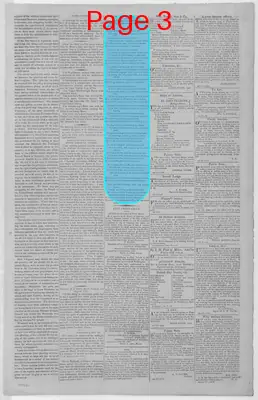
Poem
October 21, 1817
Daily National Intelligencer
Washington, District Of Columbia
What is this article about?
Satirical poem attributed to Lord Byron defending his divorce, arguing that a poet's genius rejects marital happiness and social norms, portraying genius as a wild, destructive force incompatible with domestic life.
Clipping
OCR Quality
98%
Excellent
Full Text
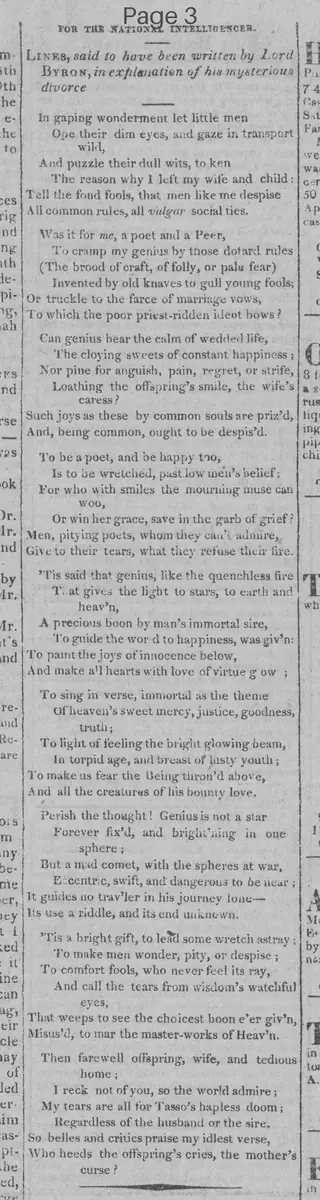
FOR THE NATIONAL INTELLIGENCER.
Lines, said to have been written by Lord Byron, in explanation of his mysterious divorce
In gaping wonderment let little men
Ope their dim eyes, and gaze in transport wild,
And puzzle their dull wits, to ken
The reason why I left my wife and child:
Tell the fond fools, that men like me despise
All common rules, all vulgar social ties
Was it for me, a poet and a Peer,
To cramp my genius by those dotard rules
(The brood of craft, of folly, or pale fear)
Invented by old knaves to gull young fools;
Or truckle to the farce of marriage vows,
To which the poor priest-ridden idiot bows?
Can genius bear the calm of wedded life.
The cloying sweets of constant happiness;
Nor pine for anguish, pain, regret, or strife.
Loathing the offspring's smile, the wife's caress?
Such joys as these by common souls are priz'd
And, being common, ought to be despis'd
To be a poet, and be happy too,
Is to be wretched, past low men's belief;
For who with smiles the mourning muse can woo,
Or win her grace, save in the garb of grief?
Men, pitying poets, whom they can't admire,
Give to their tears, what they refuse their fire
Tis said that genius, like the quenchless fire
That gives the light to stars, to earth and heav'n,
A precious boon by man's immortal sire
To guide the world to happiness, was giv'n:
To paint the joys of innocence below.
And make all hearts with love of virtue glow ;
To sing in verse, immortal as the theme
Of heaven's sweet mercy, justice, goodness, truth;
To light of feeling the bright glowing beam,
In torpid age, and breast of lusty youth;
To make us fear the Being thron'd above,
And all the creatures of his bounty love.
Perish the thought! Genius is not a star
Forever fix'd, and bright'ning in one sphere;
But a mad comet, with the spheres at war,
E-centric, swift, and dangerous to be near;
It guides no trav'ler in his journey lone-
Its use a riddle, and its end unknown.
Tis a bright gift, to lead some wretch astray
To make men wonder, pity, or despise;
To comfort fools, who never feel its ray,
And call the tears from wisdom's watchful eyes,
That weeps to see the choicest boon e'er giv'n,
Misus'd, to mar the master-works of Heav'n.
Then farewell offspring, wife, and tedious home;
I reck not of you, so the world admire;
My tears are all for Tasso's hapless doom;
Regardless of the husband or the sire.
So belles and critics praise my idlest verse,
Who heeds the offspring's cries, the mother's curse?
What sub-type of article is it?
Satire
What themes does it cover?
Satire Society
Moral Virtue
What keywords are associated?
Byron Divorce
Poet Genius
Marriage Critique
Satirical Verse
Domestic Life
Muse Grief
What entities or persons were involved?
Lord Byron
Poem Details
Title
Lines, Said To Have Been Written By Lord Byron, In Explanation Of His Mysterious Divorce
Author
Lord Byron
Subject
In Explanation Of His Mysterious Divorce
Form / Style
Rhymed Couplets
Key Lines
Can Genius Bear The Calm Of Wedded Life.
The Cloying Sweets Of Constant Happiness;
Genius Is Not A Star Forever Fix'd, And Bright'ning In One Sphere;
But A Mad Comet, With The Spheres At War,
E Centric, Swift, And Dangerous To Be Near;