Thank you for visiting SNEWPapers!
Sign up free
Literary
July 22, 1857
Grand River Times
Eastmanville, Grand Haven, Ottawa County, Michigan
What is this article about?
A legend of the prosperous Dutch city of Stavoren, where wealthy merchant Richberta's pride leads her to order a cargo of wheat thrown into the sea, forming a sandbar that blocks the harbor, causes economic decline, and ultimately results in the city's submersion by the Zuyder Zee.
Clipping
OCR Quality
95%
Excellent
Full Text
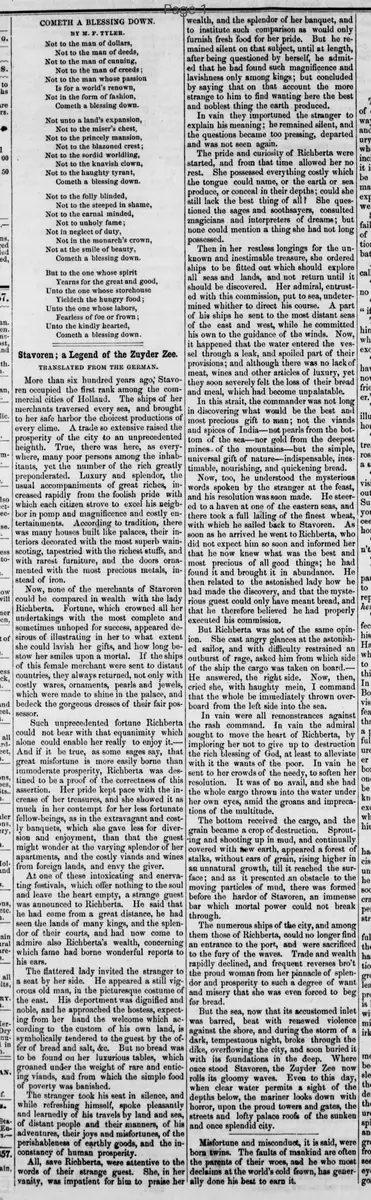
Stavoren; a Legend of the Zuyder Zee.
TRANSLATED FROM THE GERMAN.
More than six hundred years ago, Stavoren occupied the first rank among the commercial cities of Holland. The ships of her merchants traversed every sea, and brought to her safe harbor the choicest productions of every clime. A trade so extensive raised the prosperity of the city to an unprecedented height. True, there was here, as everywhere, many poor persons among the inhabitants, yet the number of the rich greatly preponderated. Luxury and splendor, the usual accompaniments of great riches, increased rapidly from the foolish pride with which each citizen strove to excel his neighbor in pomp and magnificence and costly entertainments. According to tradition, there was many houses built like palaces, their interiors decorated with the most superb wainscoting, tapestried with the richest stuffs, and with rarest furniture, and the doors ornamented with the most precious metals, instead of iron.
Now, none of the merchants of Stavoren could be compared in wealth with the lady Richberta. Fortune, which crowned all her undertakings with the most complete and sometimes unhoped for success, appeared desirous of illustrating in her to what extent she could lavish her gifts, and how long bestow her smiles upon a mortal. If the ships of this female merchant were sent to distant countries, they always returned, not only with costly wares, ornaments, pearls and jewels, which were made to shine in the palace, and bedeck the gorgeous dresses of their fair possessor.
Such unprecedented fortune Richberta could not bear with that equanimity which alone could enable her really to enjoy it. And if it be true, as some sages say, that great misfortune is more easily borne than immoderate prosperity, Richberta was destined to be a proof of the correctness of this assertion. Her pride kept pace with the increase of her treasures, and she showed it as much in her contempt for her less fortunate fellow-beings, as in the extravagant and costly banquets, which she gave less for diversion and enjoyment, than that the guest might wonder at the varying splendor of her apartments, and the costly viands and wines from foreign lands, and envy the giver.
At one of these intoxicating and enervating festivals, which offer nothing to the soul and leave the heart empty, a strange guest was announced to Richberta. He said that he had come from a great distance, he had seen the lands of many kings, and the splendor of their courts, and had now come to admire also Richberta's wealth, concerning which fame had borne wonderful reports to his ears.
The flattered lady invited the stranger to a seat by her side. He appeared a still vigorous old man, in the picturesque costume of the east. His deportment was dignified and noble, and he approached the hostess, expecting from her hand the welcome which according to the custom of his own land, is symbolically tendered to the guest by the offer of bread and salt, &c. But no bread was to be found on her luxurious tables, which groaned under the weight of rare and enticing viands, and from which the simple food of poverty was banished.
The stranger took his seat in silence, and while refreshing himself, spoke pleasantly and learnedly of his travels by land and sea, of distant people and their manners, of his adventures, their joys and misfortunes, of the perishableness of earthly goods, and the inconstancy of human prosperity.
All, save Richberta, were attentive to the words of their strange guest. She, in her vanity, was impatient for him to praise her wealth, and the splendor of her banquet, and to institute such comparison as would only furnish fresh food for her pride. But he remained silent on that subject, until at length, after being questioned by herself, he admitted that he had found such magnificence and lavishness only among kings; but concluded by saying that on that account the more strange to him to find wanting here the best and noblest thing the earth produced.
In vain they importuned the stranger to explain his meaning; he remained silent, and when the questions became too pressing, departed and was not seen again.
The pride and curiosity of Richberta were started, and from that time allowed her no rest. She possessed everything costly which the tongue could name, or the earth or sea produce, or conceal in their depths; could she still lack the best thing of all? She questioned the sages and soothsayers, consulted magicians and interpreters of dreams; but none could mention a thing she had not long possessed.
Then in her restless longings for the unknown and inestimable treasure, she ordered ships to be fitted out which should explore all seas and lands, and not return until it should be discovered. Her admiral, entrusted with this commission, put to sea, undetermined whither to direct his course. A part of his ships he sent to the most distant seas of the east and west, while he committed his own to the guidance of the winds. Now, it happened that the water entered the vessel through a leak, and spoiled part of their provisions; and although there was no lack of meat, wines and other articles of luxury, yet they soon severely felt the loss of their bread and meal, which had become unpalatable.
In this strait, the commander was not long in discovering what would be the best and most precious gift to man; not the viands and spices of India-not pearls from the bottom of the sea-nor gold from the deepest mines-of the mountains-but the simple universal gift of nature--indispensable, inestimable, nourishing, and quickening bread.
Now, too, he understood the mysterious words spoken by the stranger at the feast, and his resolution was soon made. He steered to a haven at one of the eastern seas, and there took a full lading of the finest wheat, with which he sailed back to Stavoren. As soon as he arrived he went to Richberta, who did not expect him so soon and informed her that he now knew what was the best and most precious of all good things: he had found it and brought it in abundance. He then related to the astonished lady how he had made the discovery, and that the mysterious guest could only have meant bread, and that he therefore believed he had properly executed his commission.
But Richberta was not of the same opinion. She cast angry glances at the astonished sailor, and with difficulty restrained an outburst of rage, asked him from which side of the ship the cargo was taken on board. He answered, the right side. Now, then, cried she, with haughty mien, I command that the whole be immediately thrown overboard from the left side into the sea.
In vain were all remonstrances against the rash command. In vain the admiral sought to move the heart of Richberta, by imploring her not to give up to destruction the rich blessing of God, at least to alleviate with it the wants of the poor. In vain he sent to her crowds of the needy, to soften her resolution. It was of no avail, and she had the whole cargo thrown into the water under her own eyes, amid the groans and imprecations of the multitude.
The bottom received the cargo, and the grain became a crop of destruction. Sprouting and shooting up in mud, and continually covered with new earth, appeared a forest of stalks, without ears of grain, rising higher in an unnatural growth, till it reached the surface; and as it presented an obstacle to the moving particles of mud, there was formed before the harbor of Stavoren, an immense bar which mortal power could not break through.
The numerous ships of the city, and among them those of Richberta, could no longer find an entrance to the port, and were sacrificed to the fury of the waves. Trade and wealth rapidly declined, and frequent reverses bro't the proud woman from her pinnacle of splendor and prosperity to such a degree of want and misery that she was even forced to beg for bread.
But the sea, now that its accustomed inlet was barred, beat with renewed violence against the shore, and during the storm of a dark, tempestuous night, broke through the dike, overflowing the city, and soon buried it with its foundations in the deep. Where once stood Stavoren, the Zuyder Zee now rolls its gloomy waves. Even to this day, when clear water permits a sight of the depths below, the mariner looks down with horror, upon the proud towers and gates, the streets and lofty palace roofs of the sunken and once splendid city.
Misfortune and misconduct, it is said, were born twins. The faults of mankind are often the parents of their woes, and he who most declaims at the world's cold frown, has generally done his best to earn it.
TRANSLATED FROM THE GERMAN.
More than six hundred years ago, Stavoren occupied the first rank among the commercial cities of Holland. The ships of her merchants traversed every sea, and brought to her safe harbor the choicest productions of every clime. A trade so extensive raised the prosperity of the city to an unprecedented height. True, there was here, as everywhere, many poor persons among the inhabitants, yet the number of the rich greatly preponderated. Luxury and splendor, the usual accompaniments of great riches, increased rapidly from the foolish pride with which each citizen strove to excel his neighbor in pomp and magnificence and costly entertainments. According to tradition, there was many houses built like palaces, their interiors decorated with the most superb wainscoting, tapestried with the richest stuffs, and with rarest furniture, and the doors ornamented with the most precious metals, instead of iron.
Now, none of the merchants of Stavoren could be compared in wealth with the lady Richberta. Fortune, which crowned all her undertakings with the most complete and sometimes unhoped for success, appeared desirous of illustrating in her to what extent she could lavish her gifts, and how long bestow her smiles upon a mortal. If the ships of this female merchant were sent to distant countries, they always returned, not only with costly wares, ornaments, pearls and jewels, which were made to shine in the palace, and bedeck the gorgeous dresses of their fair possessor.
Such unprecedented fortune Richberta could not bear with that equanimity which alone could enable her really to enjoy it. And if it be true, as some sages say, that great misfortune is more easily borne than immoderate prosperity, Richberta was destined to be a proof of the correctness of this assertion. Her pride kept pace with the increase of her treasures, and she showed it as much in her contempt for her less fortunate fellow-beings, as in the extravagant and costly banquets, which she gave less for diversion and enjoyment, than that the guest might wonder at the varying splendor of her apartments, and the costly viands and wines from foreign lands, and envy the giver.
At one of these intoxicating and enervating festivals, which offer nothing to the soul and leave the heart empty, a strange guest was announced to Richberta. He said that he had come from a great distance, he had seen the lands of many kings, and the splendor of their courts, and had now come to admire also Richberta's wealth, concerning which fame had borne wonderful reports to his ears.
The flattered lady invited the stranger to a seat by her side. He appeared a still vigorous old man, in the picturesque costume of the east. His deportment was dignified and noble, and he approached the hostess, expecting from her hand the welcome which according to the custom of his own land, is symbolically tendered to the guest by the offer of bread and salt, &c. But no bread was to be found on her luxurious tables, which groaned under the weight of rare and enticing viands, and from which the simple food of poverty was banished.
The stranger took his seat in silence, and while refreshing himself, spoke pleasantly and learnedly of his travels by land and sea, of distant people and their manners, of his adventures, their joys and misfortunes, of the perishableness of earthly goods, and the inconstancy of human prosperity.
All, save Richberta, were attentive to the words of their strange guest. She, in her vanity, was impatient for him to praise her wealth, and the splendor of her banquet, and to institute such comparison as would only furnish fresh food for her pride. But he remained silent on that subject, until at length, after being questioned by herself, he admitted that he had found such magnificence and lavishness only among kings; but concluded by saying that on that account the more strange to him to find wanting here the best and noblest thing the earth produced.
In vain they importuned the stranger to explain his meaning; he remained silent, and when the questions became too pressing, departed and was not seen again.
The pride and curiosity of Richberta were started, and from that time allowed her no rest. She possessed everything costly which the tongue could name, or the earth or sea produce, or conceal in their depths; could she still lack the best thing of all? She questioned the sages and soothsayers, consulted magicians and interpreters of dreams; but none could mention a thing she had not long possessed.
Then in her restless longings for the unknown and inestimable treasure, she ordered ships to be fitted out which should explore all seas and lands, and not return until it should be discovered. Her admiral, entrusted with this commission, put to sea, undetermined whither to direct his course. A part of his ships he sent to the most distant seas of the east and west, while he committed his own to the guidance of the winds. Now, it happened that the water entered the vessel through a leak, and spoiled part of their provisions; and although there was no lack of meat, wines and other articles of luxury, yet they soon severely felt the loss of their bread and meal, which had become unpalatable.
In this strait, the commander was not long in discovering what would be the best and most precious gift to man; not the viands and spices of India-not pearls from the bottom of the sea-nor gold from the deepest mines-of the mountains-but the simple universal gift of nature--indispensable, inestimable, nourishing, and quickening bread.
Now, too, he understood the mysterious words spoken by the stranger at the feast, and his resolution was soon made. He steered to a haven at one of the eastern seas, and there took a full lading of the finest wheat, with which he sailed back to Stavoren. As soon as he arrived he went to Richberta, who did not expect him so soon and informed her that he now knew what was the best and most precious of all good things: he had found it and brought it in abundance. He then related to the astonished lady how he had made the discovery, and that the mysterious guest could only have meant bread, and that he therefore believed he had properly executed his commission.
But Richberta was not of the same opinion. She cast angry glances at the astonished sailor, and with difficulty restrained an outburst of rage, asked him from which side of the ship the cargo was taken on board. He answered, the right side. Now, then, cried she, with haughty mien, I command that the whole be immediately thrown overboard from the left side into the sea.
In vain were all remonstrances against the rash command. In vain the admiral sought to move the heart of Richberta, by imploring her not to give up to destruction the rich blessing of God, at least to alleviate with it the wants of the poor. In vain he sent to her crowds of the needy, to soften her resolution. It was of no avail, and she had the whole cargo thrown into the water under her own eyes, amid the groans and imprecations of the multitude.
The bottom received the cargo, and the grain became a crop of destruction. Sprouting and shooting up in mud, and continually covered with new earth, appeared a forest of stalks, without ears of grain, rising higher in an unnatural growth, till it reached the surface; and as it presented an obstacle to the moving particles of mud, there was formed before the harbor of Stavoren, an immense bar which mortal power could not break through.
The numerous ships of the city, and among them those of Richberta, could no longer find an entrance to the port, and were sacrificed to the fury of the waves. Trade and wealth rapidly declined, and frequent reverses bro't the proud woman from her pinnacle of splendor and prosperity to such a degree of want and misery that she was even forced to beg for bread.
But the sea, now that its accustomed inlet was barred, beat with renewed violence against the shore, and during the storm of a dark, tempestuous night, broke through the dike, overflowing the city, and soon buried it with its foundations in the deep. Where once stood Stavoren, the Zuyder Zee now rolls its gloomy waves. Even to this day, when clear water permits a sight of the depths below, the mariner looks down with horror, upon the proud towers and gates, the streets and lofty palace roofs of the sunken and once splendid city.
Misfortune and misconduct, it is said, were born twins. The faults of mankind are often the parents of their woes, and he who most declaims at the world's cold frown, has generally done his best to earn it.
What sub-type of article is it?
Prose Fiction
Fable
Allegory
What themes does it cover?
Commerce Trade
Moral Virtue
Social Manners
What keywords are associated?
Stavoren
Zuyder Zee
Legend
Richberta
Pride
Wealth
Bread
Commerce
Moral Lesson
City Destruction
What entities or persons were involved?
Translated From The German.
Literary Details
Title
Stavoren; A Legend Of The Zuyder Zee.
Author
Translated From The German.
Subject
A Legend Of Pride And The Fall Of Stavoren.
Key Lines
But No Bread Was To Be Found On Her Luxurious Tables, Which Groaned Under The Weight Of Rare And Enticing Viands, And From Which The Simple Food Of Poverty Was Banished.
In This Strait, The Commander Was Not Long In Discovering What Would Be The Best And Most Precious Gift To Man; Not The Viands And Spices Of India Not Pearls From The Bottom Of The Sea Nor Gold From The Deepest Mines Of The Mountains But The Simple Universal Gift Of Nature Indispensable, Inestimable, Nourishing, And Quickening Bread.
Now, Then, Cried She, With Haughty Mien, I Command That The Whole Be Immediately Thrown Overboard From The Left Side Into The Sea.
The Faults Of Mankind Are Often The Parents Of Their Woes, And He Who Most Declaims At The World's Cold Frown, Has Generally Done His Best To Earn It.