Thank you for visiting SNEWPapers!
Sign up free
The Virginia Gazette
Richmond, Williamsburg, Richmond County, Virginia
What is this article about?
A young clergyman defends himself against Richard Bland's accusations of slanderously claiming Bland sought a British appointment to collect tea duties in exchange for supporting measures against American liberties. He denies the charge, recounts a misinterpreted conversation in England, and upholds his integrity as a clergyman.
Merged-components note: Merged image with letter_to_editor due to spatial overlap in bounding boxes and sequential reading order.
Clipping
OCR Quality
Full Text
RICHARD BLAND.
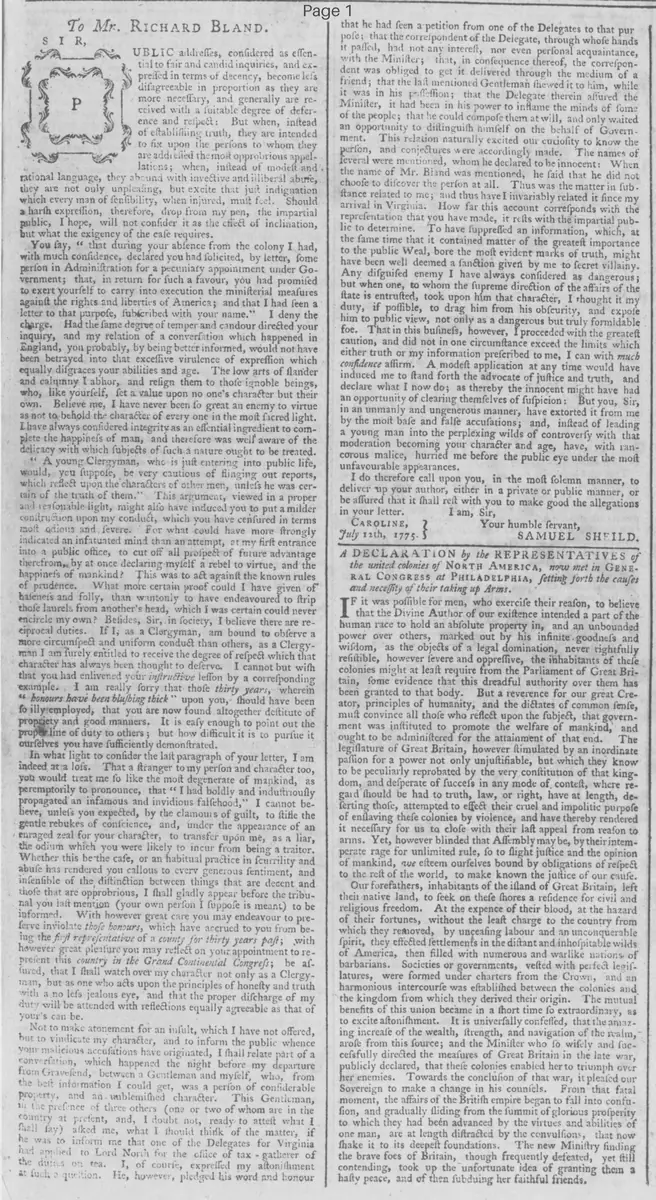
PUBLIC addresses, considered as one of the most essential to fair and candid inquiries, and expressed in terms of decency, become less disagreeable in proportion as they are more necessary, and generally are received with a suitable degree of deference and respect: But when, instead of establishing truth, they are intended to fix upon the persons to whom they are addressed the most opprobrious appellations; when, instead of modest and rational language, they abound with invective and illiberal abuse, they are not only unpleasing, but excite that just indignation which every man of sensibility, when injured, must feel. Should a harsh expression, therefore, drop from my pen, the impartial public, I hope, will not consider it as the effect of inclination, but what the exigency of the case requires.
You say, "that during your absence from the colony I had, with much confidence, declared you had solicited, by letter, some person in Administration for a pecuniary appointment under Government; that, in return for such a favour, you had promised to exert yourself to carry into execution the ministerial measures against the rights and liberties of America; and that I had seen a letter to that purpose, subscribed with your name." I deny the charge. Had the same degree of temper and candour directed your inquiry, and my relation of a conversation which happened in England, you probably, by being better informed, would not have been betrayed into that excessive virulence of expression which equally disgraces your abilities and age. The low arts of slander and calumny I abhor, and resign them to those ignoble beings, who, like yourself, set a value upon no one's character but their own. Believe me, I have never been so great an enemy to virtue as not to behold the character of every one in the most sacred light. I have always considered integrity as an essential ingredient to complete the happiness of man, and therefore was well aware of the delicacy with which subjects of such a nature ought to be treated.
"A young Clergyman, who is just entering into public life, would, you suppose, be very cautious of flinging out reports, which reflect upon the characters of other men, unless he was certain of the truth of them." This argument, viewed in a proper and reasonable light, might also have induced you to put a milder construction upon my conduct, which you have censured in terms most odious and severe. For what could have more strongly indicated an infatuated mind than an attempt, at my first entrance into a public office, to cut off all prospect of future advantage therefrom, by at once declaring myself a rebel to virtue, and the happiness of mankind? This was to act against the known rules of prudence. What more certain proof could I have given of baseness and folly, than wantonly to have endeavoured to trip those laurels from another's head, which I was certain could never encircle my own? Besides, Sir, in society, I believe there are reciprocal duties. If I, as a Clergyman, am bound to observe a more circumspect and uniform conduct than others, as a Clergyman I am surely entitled to receive the degree of respect which that character has always been thought to deserve. I cannot but wish that you had enlivened your instructive lesson by a corresponding example. I am really sorry that those thirty years, wherein "honours have been blushing thick" upon you, should have been so ill employed, that you are now found altogether destitute of propriety and good manners. It is easy enough to point out the proper line of duty to others; but how difficult it is to pursue it ourselves you have sufficiently demonstrated.
In what light to consider the last paragraph of your letter, I am indeed at a loss. That a stranger to my person and character too, who would treat me so like the most degenerate of mankind, as peremptorily to pronounce, that "I had boldly and industriously propagated an infamous and invidious falsehood," I cannot believe, unless you expected, by the clamour of guilt, to stifle the gentle rebukes of conscience, and, under the appearance of an enraged zeal for your character, to transfer upon me, as a liar, the odium which you were likely to incur from being a traitor. Whether this be the case, or an habitual practice in currility and abuse has rendered you callous to every generous sentiment, and insensible of the distinction between things that are decent and those that are opprobrious, I shall gladly appear before the tribunal you last mention (your own person I suppose is meant) to be informed. With however great care you may endeavour to preserve inviolate those honours, which have accrued to you from being the first representative of a county for thirty years past; with however great pleasure you may reflect on your appointment to represent this country in the Grand Continental Congress; be assured, that I shall watch over my character not only as a Clergyman, but as one who acts upon the principles of honesty and truth with a no less jealous eye, and that the proper discharge of my duty will be attended with reflections equally agreeable as that of yours can be.
Not to make atonement for an insult, which I have not offered, but to vindicate my character, and to inform the public whence your malicious accusations have originated, I shall relate part of a conversation, which happened the night before my departure from Gravesend, between a Gentleman and myself, who, from the best information I could get, was a person of considerable property, and an unblemished character. This Gentleman, in the presence of three others (one or two of whom are in the country at present, and, I doubt not, ready to attest what I shall say) asked me, what I should think of the matter, if he was to inform me that one of the Delegates for Virginia had applied to Lord North for the office of tax-gatherer of the duties on tea. I, of course, expressed my astonishment at such a question. He, however, pledged his word and honour
What sub-type of article is it?
What themes does it cover?
What keywords are associated?
What entities or persons were involved?
Letter to Editor Details
Recipient
Richard Bland
Main Argument
the writer, a young clergyman, denies accusing richard bland of soliciting a british government position to enforce tea duties against american liberties, attributing the rumor to a misinterpreted conversation in england and defending his own integrity.
Notable Details