Thank you for visiting SNEWPapers!
Sign up free
Editorial
July 22, 1952
The Daily Record
Dunn, Harnett County, North Carolina
What is this article about?
Drew Pearson exposes corruption in Chicago's Democratic Party via Commissioner Arthur Elrod, whose hoodlum ties and unexplained wealth fuel opposition to Kefauver's presidential bid despite his Illinois primary win, highlighting party paradoxes ahead of the 1952 convention.
Clipping
OCR Quality
98%
Excellent
Full Text
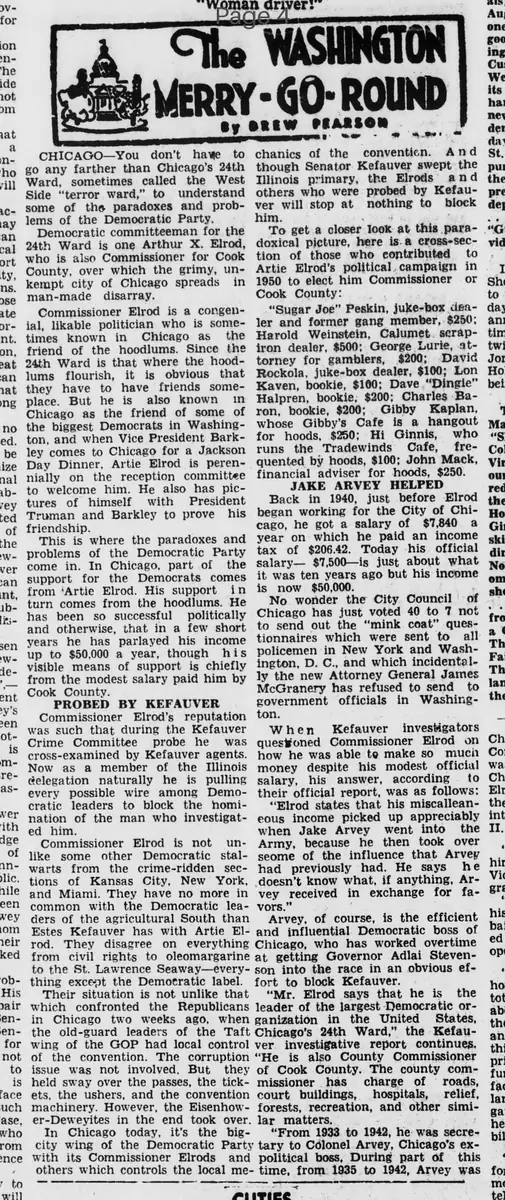
WASHINGTON MERRY-GO-ROUND
By Drew Pearson
CHICAGO—You don't have to go any farther than Chicago's 24th Ward, sometimes called the West Side "terror ward," to understand some of the paradoxes and problems of the Democratic Party.
Democratic committeeman for the 24th Ward is one Arthur X. Elrod, who is also Commissioner for Cook County, over which the grimy, unkempt city of Chicago spreads in man-made disarray.
Commissioner Elrod is a congenial, likable politician who is sometimes known in Chicago as the friend of the hoodlums. Since the 24th Ward is that where the hoodlums flourish, it is obvious that they have to have friends someplace. But he is also known in Chicago as the friend of some of the biggest Democrats in Washington, and when Vice President Barkley comes to Chicago for a Jackson Day Dinner, Artie Elrod is perennially on the reception committee to welcome him. He also has pictures of himself with President Truman and Barkley to prove his friendship.
This is where the paradoxes and problems of the Democratic Party come in. In Chicago, part of the support for the Democrats comes from Artie Elrod. His support in turn comes from the hoodlums. He has been so successful politically and otherwise, that in a few short years he has parlayed his income up to $50,000 a year, though his visible means of support is chiefly from the modest salary paid him by Cook County.
PROBED BY KEFAUVER
Commissioner Elrod's reputation was such that during the Kefauver Crime Committee probe he was cross-examined by Kefauver agents.
Now as a member of the Illinois delegation naturally he is pulling every possible wire among Democratic leaders to block the nomination of the man who investigated him.
Commissioner Elrod is not unlike some other Democratic stalwarts from the crime-ridden sections of Kansas City, New York, and Miami. They have no more in common with the Democratic leaders of the agricultural South than Estes Kefauver has with Artie Elrod. They disagree on everything from civil rights to oleomargarine to the St. Lawrence Seaway—everything except the Democratic label.
Their situation is not unlike that which confronted the Republicans in Chicago two weeks ago, when the old-guard leaders of the Taft wing of the GOP had local control of the convention. The corruption issue was not involved. But they held sway over the passes, the tickets, the ushers, and the convention machinery. However, the Eisenhower-Deweyites in the end took over.
In Chicago today, it's the big-city wing of the Democratic Party with its Commissioner Elrods and others which controls the local mechanics of the convention. And though Senator Kefauver swept the Illinois primary, the Elrods and others who were probed by Kefauver will stop at nothing to block him.
To get a closer look at this paradoxical picture, here is a cross-section of those who contributed to Artie Elrod's political campaign in 1950 to elect him Commissioner of Cook County:
"Sugar Joe" Peskin, juke-box dealer and former gang member, $250; Harold Weinstein, Calumet scrap-iron dealer, $500; George Lurie, attorney for gamblers, $200; David Rockola, juke-box dealer, $100; Lon Kaven, bookie, $100; Dave "Dingie" Halpren, bookie; $200; Charles Baron, bookie, $200; Gibby Kaplan, whose Gibby's Cafe is a hangout for hoods, $250; Hi Ginnis, who runs the Tradewinds Cafe, frequented by hoods, $100; John Mack, financial adviser for hoods, $250.
JAKE ARVEY HELPED
Back in 1940, just before Elrod began working for the City of Chicago, he got a salary of $7,840 a year on which he paid an income tax of $206.42. Today his official salary—$7,500—is just about what it was ten years ago but his income is now $50,000.
No wonder the City Council of Chicago has just voted 40 to 7 not to send out the "mink coat" questionnaires which were sent to all policemen in New York and Washington, D. C., and which incidentally the new Attorney General James McGranery has refused to send to government officials in Washington.
When Kefauver investigators questioned Commissioner Elrod on how he was able to make so much money despite his modest official salary, his answer, according to their official report, was as follows:
"Elrod states that his miscellaneous income picked up appreciably when Jake Arvey went into the Army, because he then took over some of the influence that Arvey had previously had. He says he doesn't know what, if anything, Arvey received in exchange for favors."
Arvey, of course, is the efficient and influential Democratic boss of Chicago, who has worked overtime at getting Governor Adlai Stevenson into the race in an obvious effort to block Kefauver.
"Mr. Elrod says that he is the leader of the largest Democratic organization in the United States, Chicago's 24th Ward," the Kefauver investigative report continues.
"He is also County Commissioner of Cook County. The county commissioner has charge of roads, court buildings, hospitals, relief, forests, recreation, and other similar matters.
"From 1933 to 1942, he was secretary to Colonel Arvey, Chicago's ex-political boss. During part of this time, from 1935 to 1942, Arvey was Chairman of the City Finance Committee. In 1941 to 1945, Elrod was chief deputy bailiff of the Chicago courts at $6,000 per year.
Elrod took over the leadership of the 24th Ward when Arvey went into the Army during World War II.
"Elrod showed us pictures of himself and Harry Truman and Vice President Barkley, and telegrams from Truman and Barkley.
"Elrod explained the fact that his name had appeared on certain bail bonds which had been executed on behalf of a reputed brothel operator named Zuta."
"Elrod recently completed a home in Michigan. He says that the total cost of land and house was about $35,000. On the elevator, after the interview, he told Mr. Robinson and myself that he got various things done on this house at cost price and that some things were furnished free. He mentioned the fact that Henry Crown (who is a large real-estate holder in Chicago) gave him certain stones and that he did not ever expect to get a bill for this."
"Henry Crown, who gave $1,000 for the 1950 campaign fund is the money man behind the Hilton Hotels. (Some local investigation might be interested in seeing how Crown makes out on his tax assessments.)"
HILTON HOTEL CHAIN
It might be added that Crown has also been one of the big supporters of the Democratic Party in Chicago, secured a lucrative sand and gravel contract with the city when the PWA in Washington helped Chicago build its new subway; Also helped finance the purchase of the Waldorf-Astoria Hotel. The Hilton Hotel which he owns in part has been headquarters for leading candidates at both political conventions.
The Kefauver report also contains an interesting sidelight on how Commissioner Elrod used his own political campaign funds for stock speculation.
Elrod admits borrowing about $12,000 from his campaign fund in order to buy stock and then putting the $12,000 back after he sold the stock the report stated. "He hoped to make a short time gain but he lost on the stock. He felt that it was okay to use these campaign funds in this manner because the money came from people for whom he had done favors."
This is just one cross-section of how politics and corruption is intermingled in the City of Chicago and why there is such bitter opposition to any Democratic candidate who might clean it out.
By Drew Pearson
CHICAGO—You don't have to go any farther than Chicago's 24th Ward, sometimes called the West Side "terror ward," to understand some of the paradoxes and problems of the Democratic Party.
Democratic committeeman for the 24th Ward is one Arthur X. Elrod, who is also Commissioner for Cook County, over which the grimy, unkempt city of Chicago spreads in man-made disarray.
Commissioner Elrod is a congenial, likable politician who is sometimes known in Chicago as the friend of the hoodlums. Since the 24th Ward is that where the hoodlums flourish, it is obvious that they have to have friends someplace. But he is also known in Chicago as the friend of some of the biggest Democrats in Washington, and when Vice President Barkley comes to Chicago for a Jackson Day Dinner, Artie Elrod is perennially on the reception committee to welcome him. He also has pictures of himself with President Truman and Barkley to prove his friendship.
This is where the paradoxes and problems of the Democratic Party come in. In Chicago, part of the support for the Democrats comes from Artie Elrod. His support in turn comes from the hoodlums. He has been so successful politically and otherwise, that in a few short years he has parlayed his income up to $50,000 a year, though his visible means of support is chiefly from the modest salary paid him by Cook County.
PROBED BY KEFAUVER
Commissioner Elrod's reputation was such that during the Kefauver Crime Committee probe he was cross-examined by Kefauver agents.
Now as a member of the Illinois delegation naturally he is pulling every possible wire among Democratic leaders to block the nomination of the man who investigated him.
Commissioner Elrod is not unlike some other Democratic stalwarts from the crime-ridden sections of Kansas City, New York, and Miami. They have no more in common with the Democratic leaders of the agricultural South than Estes Kefauver has with Artie Elrod. They disagree on everything from civil rights to oleomargarine to the St. Lawrence Seaway—everything except the Democratic label.
Their situation is not unlike that which confronted the Republicans in Chicago two weeks ago, when the old-guard leaders of the Taft wing of the GOP had local control of the convention. The corruption issue was not involved. But they held sway over the passes, the tickets, the ushers, and the convention machinery. However, the Eisenhower-Deweyites in the end took over.
In Chicago today, it's the big-city wing of the Democratic Party with its Commissioner Elrods and others which controls the local mechanics of the convention. And though Senator Kefauver swept the Illinois primary, the Elrods and others who were probed by Kefauver will stop at nothing to block him.
To get a closer look at this paradoxical picture, here is a cross-section of those who contributed to Artie Elrod's political campaign in 1950 to elect him Commissioner of Cook County:
"Sugar Joe" Peskin, juke-box dealer and former gang member, $250; Harold Weinstein, Calumet scrap-iron dealer, $500; George Lurie, attorney for gamblers, $200; David Rockola, juke-box dealer, $100; Lon Kaven, bookie, $100; Dave "Dingie" Halpren, bookie; $200; Charles Baron, bookie, $200; Gibby Kaplan, whose Gibby's Cafe is a hangout for hoods, $250; Hi Ginnis, who runs the Tradewinds Cafe, frequented by hoods, $100; John Mack, financial adviser for hoods, $250.
JAKE ARVEY HELPED
Back in 1940, just before Elrod began working for the City of Chicago, he got a salary of $7,840 a year on which he paid an income tax of $206.42. Today his official salary—$7,500—is just about what it was ten years ago but his income is now $50,000.
No wonder the City Council of Chicago has just voted 40 to 7 not to send out the "mink coat" questionnaires which were sent to all policemen in New York and Washington, D. C., and which incidentally the new Attorney General James McGranery has refused to send to government officials in Washington.
When Kefauver investigators questioned Commissioner Elrod on how he was able to make so much money despite his modest official salary, his answer, according to their official report, was as follows:
"Elrod states that his miscellaneous income picked up appreciably when Jake Arvey went into the Army, because he then took over some of the influence that Arvey had previously had. He says he doesn't know what, if anything, Arvey received in exchange for favors."
Arvey, of course, is the efficient and influential Democratic boss of Chicago, who has worked overtime at getting Governor Adlai Stevenson into the race in an obvious effort to block Kefauver.
"Mr. Elrod says that he is the leader of the largest Democratic organization in the United States, Chicago's 24th Ward," the Kefauver investigative report continues.
"He is also County Commissioner of Cook County. The county commissioner has charge of roads, court buildings, hospitals, relief, forests, recreation, and other similar matters.
"From 1933 to 1942, he was secretary to Colonel Arvey, Chicago's ex-political boss. During part of this time, from 1935 to 1942, Arvey was Chairman of the City Finance Committee. In 1941 to 1945, Elrod was chief deputy bailiff of the Chicago courts at $6,000 per year.
Elrod took over the leadership of the 24th Ward when Arvey went into the Army during World War II.
"Elrod showed us pictures of himself and Harry Truman and Vice President Barkley, and telegrams from Truman and Barkley.
"Elrod explained the fact that his name had appeared on certain bail bonds which had been executed on behalf of a reputed brothel operator named Zuta."
"Elrod recently completed a home in Michigan. He says that the total cost of land and house was about $35,000. On the elevator, after the interview, he told Mr. Robinson and myself that he got various things done on this house at cost price and that some things were furnished free. He mentioned the fact that Henry Crown (who is a large real-estate holder in Chicago) gave him certain stones and that he did not ever expect to get a bill for this."
"Henry Crown, who gave $1,000 for the 1950 campaign fund is the money man behind the Hilton Hotels. (Some local investigation might be interested in seeing how Crown makes out on his tax assessments.)"
HILTON HOTEL CHAIN
It might be added that Crown has also been one of the big supporters of the Democratic Party in Chicago, secured a lucrative sand and gravel contract with the city when the PWA in Washington helped Chicago build its new subway; Also helped finance the purchase of the Waldorf-Astoria Hotel. The Hilton Hotel which he owns in part has been headquarters for leading candidates at both political conventions.
The Kefauver report also contains an interesting sidelight on how Commissioner Elrod used his own political campaign funds for stock speculation.
Elrod admits borrowing about $12,000 from his campaign fund in order to buy stock and then putting the $12,000 back after he sold the stock the report stated. "He hoped to make a short time gain but he lost on the stock. He felt that it was okay to use these campaign funds in this manner because the money came from people for whom he had done favors."
This is just one cross-section of how politics and corruption is intermingled in the City of Chicago and why there is such bitter opposition to any Democratic candidate who might clean it out.
What sub-type of article is it?
Partisan Politics
Crime Or Punishment
What keywords are associated?
Chicago Corruption
Democratic Machine
Kefauver Probe
Arthur Elrod
Political Hoodlums
Convention Opposition
What entities or persons were involved?
Arthur X. Elrod
Estes Kefauver
Jake Arvey
Alben Barkley
Harry Truman
Henry Crown
Editorial Details
Primary Topic
Corruption In Chicago Democratic Party And Opposition To Kefauver
Stance / Tone
Critical Of Political Corruption And Machine Politics
Key Figures
Arthur X. Elrod
Estes Kefauver
Jake Arvey
Alben Barkley
Harry Truman
Henry Crown
Key Arguments
Democratic Support In Chicago's 24th Ward Relies On Figures Like Elrod Connected To Hoodlums
Elrod's Unexplained Income Rise From $7,840 To $50,000 Despite Modest Salary
Kefauver Probe Examined Elrod's Finances And Ties
Illinois Democrats Block Kefauver Nomination Despite His Primary Win
Campaign Contributors Include Gamblers And Hoodlum Associates
Elrod Used Campaign Funds For Personal Stock Speculation
Chicago Machine Politics Mirrors Republican Issues But With Corruption Central