Thank you for visiting SNEWPapers!
Sign up free
Story
September 5, 1875
The New Orleans Bulletin
New Orleans, Orleans County, Louisiana
What is this article about?
Historical account of the 1815 contempt of court case against Gen. Andrew Jackson in New Orleans for defying a habeas corpus writ, arresting Judge Hall, and asserting martial law supremacy, resulting in a $1000 fine later reimbursed by Congress.
Clipping
OCR Quality
98%
Excellent
Full Text
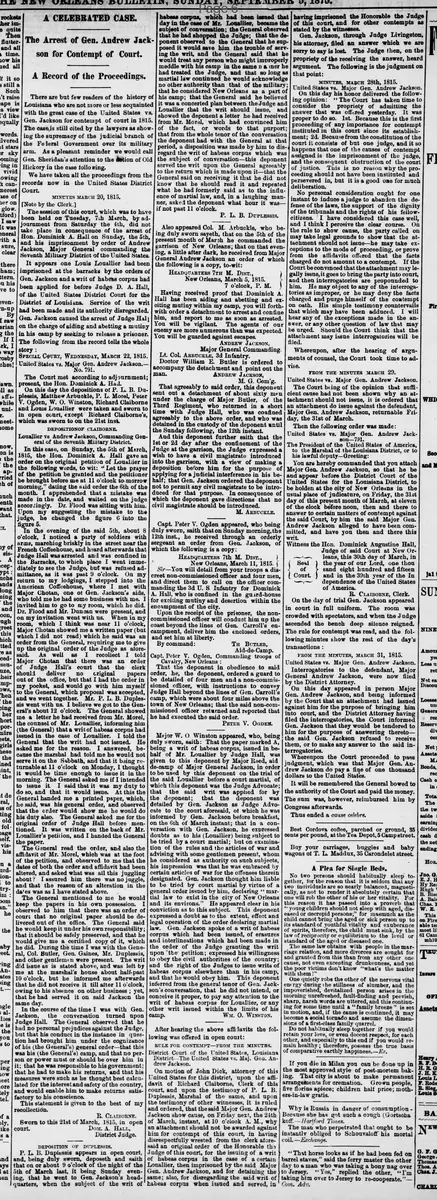
There are but few readers of the history of Louisiana who are not more or less acquainted with the great case of the United States vs. Gen. Jackson for contempt of court in 1815. The case is still cited by the lawyers as showing the supremacy of the judicial branch of the Federal Government over its military arm. As a pleasant reminder we would call Gen. Sheridan's attention to the action of Old Hickory in the case following.
We have taken all the proceedings from the records now in the United States District Court.
MINUTES MARCH 20, 1815.
[Note by the Clerk.]
The session of this court, which was to have been held on Tuesday, 7th March, by adjournment from Saturday the 4th, did not take place in consequence of the arrest of Hon. Dominick A. Hall on Sunday, the 5th, and his imprisonment by order of Andrew Jackson, Major General commanding the Seventh Military District of the United States. It appears one Louis Louallier had been imprisoned at the barracks by the orders of Gen. Jackson and a writ of habeas corpus had been applied for before Judge D. A. Hall, of the United States District Court for the District of Louisiana. Service of the writ had been made and its authority disregarded. Gen. Jackson caused the arrest of Judge Hall on the charge of aiding and abetting a mutiny in his camp by seeking to release a prisoner. The following from the record tells the whole story:
SPECIAL COURT, WEDNESDAY, MARCH 22, 1815.
United States vs. Major Gen. Andrew Jackson.—No. 791.
The Court met according to adjournment: present, the Hon. Dominick A. Hall.
On this day the depositions of P. L. B. Duplessis, Matthew Arbuckle, P. L. Morel, Peter V. Ogden, W. O. Winston, Richard Claiborne and Louis Louallier were taken and sworn to in open court, except Richard Claiborne's, which was sworn to on the 21st inst.
DEPOSITION OF CLAIBORNE
Louallier vs Andrew Jackson, Commanding General of the Seventh Military District.
In this case, on Sunday, the 5th of March, 1815, the Hon. Dominick A. Hall gave an order on the original petition of Louallier in the following words, to wit: "Let the prayer of the petition be granted and the petitioner be brought before me at 11 o'clock to-morrow morning." dating the said order the 6th of the month. I apprehended that a mistake was made in the date, and waited on the judge accordingly. Dr. Flood was sitting with him. Upon my suggesting the mistake to the judge, he changed the figure 6 into the figure 5.
In the evening of the said 5th, about 8 o'clock, I noticed a party of soldiers with arms, marching briskly in the street near the French Coffeehouse, and heard afterwards that Judge Hall was arrested and was confined in the Barracks, to which place I went immediately to see the Judge, but was refused admittance, as it was past 9 o'clock. On my return to my lodgings, I stepped into the American Coffeehouse, where I met with Major Chotard, one of Gen. Jackson's aids, who told me he had some business with me. I invited him to go to my room, which he did. Dr. Flood and Mr. Duncan were present, and on my invitation went with us. When in my room, which I think was near 11 o'clock, Major Chotard showed me a written paper (but which I did not read) which he said was an order from the General, requiring me to give up the original order of the Judge as aforesaid. As well as I recollect I told Major Chotard that there was an order of Judge Hall's court that the clerk should deliver no original papers out of the office, but that I had the order in my pocket, and would go with him myself to the General, which proposal was accepted, and we went together. Mr. P. L. B. Duplessis went with us. I believe we got to the Gen. eral's about 12 o'clock. The General showed me a letter he had received from Mr. Morel, the counsel of Mr. Louallier, informing him (the General) that a writ of habeas corpus had issued in the case of Louallier. I told the General that the writ had not issued. He asked me for the reason. I answered, because the marshal had told me he would not serve it on the Sabbath, and that it being returnable at 11 o'clock on Monday, I thought it would be time enough to issue it in the morning. The General asked me if I intended to issue it. I said that it was my duty to do so, and that it would issue. At this the General handed me a printed paper, which, he said, was his general order, and observed that the order would show me he would do his duty also. The General asked me for the original order of Judge Hall before mentioned. It was written on the back of Mr. Louallier's petition, and I handed the General the paper.
The General read the order, and also the affidavit of Mr. Morel, which was at the foot of the petition, and observed to me that the dates of both the order and affidavit had been altered, and asked what was all this juggling about? I assured him there was no juggle, and that the reason of an alteration in the dates was as I have stated above.
The General mentioned to me he would keep the papers in his own possession. I observed to him that there was an order of court that no original paper should be delivered out of the office. The General said he would keep it under his own responsibility; that it should be safely preserved, and that he would give me a certified copy of it, which he did. During the time I was with the General, Col. Butler, Gen. Gaines, Mr. Duplessis, and other gentlemen were present. The writ did issue as is stated above, and was left by me at the marshal's house about half-past 10 o'clock, but he informed me afterwards that he did not receive it till after 11 o'clock, owing to his absence on other business; yet, that he had served it on said Jackson the same day.
In the course of the time I was with Gen. Jackson, the conversation turned upon Judge Hall. The General observed that he had no personal prejudices against the Judge, but that his conduct in the instance in question had brought him under the cognizance of his (the General's) general order—that this was his (the General's) camp, and that no person or power must or should be over him in it: that he was responsible to his government: that he had to make his returns, and that his measures were such as he thought best calculated for the interest and safety of the country, and would enable him to make returns satisfactory to his conscience.
This statement is given to the best of my recollection.
R. CLAIBORNE.
Sworn to this 21st of March, 1815, in open court.
DOM. A. HALL,
District Judge.
DEPOSITION OF DUPLESSIS.
P. L. B. Duplessis appears in open court, and, being duly sworn, deposeth and saith that on or about 9 o'clock of the night of the 5th of March last, it being Sunday evening, that he went to Gen. Jackson's headquarters, when the subject of the writ of habeas corpus, which had been issued that day in the case of Mr. Louallier, became the subject of conversation; the General observed that he had stopped the Judge; that the deponent observed to the General that he supposed it would save him the trouble of serving the writ, and the General said that he would treat any person who might improperly meddle with his camp in the same manner he had treated the Judge, and that so long as martial law continued he would acknowledge no other authority than that of the military; that he considered New Orleans as a part of his camp; that the General said he believed it was a concerted plan between the Judge and Louallier that the writ should issue, and showed the deponent a letter he had received from Mr. Morel, which had convinced him of the fact, or words to that purport; that from the whole tenor of the conversation the deponent had with the General at that period, a disposition was made by him to disregard the writ of habeas corpus which was the subject of conversation—this deponent served the writ upon the General agreeably to the return which is made upon it—that the General said on receiving it that he did not know that he should read it and repeated what he had formerly said as to the influence of martial law, and, in a laughing manner, asked the deponent what hour it was—if not past 11 o'clock.
P. L. B. DUPLESSIS.
Also appeared Col. M. Arbuckle, who being duly sworn sayeth, that on the 5th of the present month of March he commanded the garrison of New Orleans; that on that evening, a little after dark, he received from Major General Andrew Jackson an order of which the following is a copy, to-wit:
HEADQUARTERS 7TH M. DIST.
New Orleans, March 5, 1815.
7 o'clock, P. M.
Having received proof that Dominick A. Hall has been aiding and abetting and exciting mutiny within my camp, you will forthwith order a detachment to arrest and confine him, and report to me as soon as arrested. You will be vigilant. The agents of our enemy are more numerous than was expected. You will be guarded against escapes.
ANDREW JACKSON,
Major General Commanding
Lt. Col. ARBUCKLE, 3d Infantry.
Doctor William E. Butler is ordered to accompany the detachment and point out the man.
ANDREW JACKSON,
Major General Commanding.
That agreeably to said order, this deponent sent out a detachment of about sixty men under the charge of Major Butler, of the Third Regiment, who returned in a short time with Judge Hall, who was confined agreeably to the above order, and who was detained in the custody of the deponent until the Sunday following, the 12th instant.
And this deponent further saith that the 1st or 2d day after the confinement of the Judge at the garrison, the Judge expressed a wish to have a civil magistrate introduced into the garrison, with a view of making a deposition before him for the purpose of applying for a judicial interference in his behalf; that Gen. Jackson ordered the deponent not to permit any civil magistrate to be introduced for that purpose. In consequence of which the deponent gave directions that no civil magistrate should be introduced.
M. ARBUCKLE.
Capt. Peter V. Ogden appeared, who being duly sworn, saith that on Sunday morning, the 12th inst., he received through an orderly sergeant an order from Gen. Jackson, of which the following is a copy:
HEADQUARTERS 7th M. DIST.
New Orleans, March 11, 1815.
Sir—You will detail from your troops a discreet non-commissioned officer and four men, and direct them to call on the officer commanding the 3d U. S. Infantry for Dominick A. Hall, who is confined in the guard-house for exciting mutiny and desertion within the encampment of the city.
Upon the receipt of the prisoner, the non-commissioned officer will conduct him up the coast beyond the lines of Gen. Carroll's encampment, deliver him the enclosed orders, and set him at liberty.
By command:
TH. BUTLER,
Aid-de-Camp.
Capt. Peter V. Ogden, Commanding troops of Cavalry, New Orleans:
That the deponent in obedience to said order, he, the deponent, ordered a guard to be detailed of four men and a non-commissioned officer, with instructions to convey Judge Hall beyond the lines of Gen. Carroll's camp, which were about four miles above the town of New Orleans; that the said non-commissioned officer returned and reported that he had executed the said order.
PETER V. OGDEN.
Major W. O. Winston appeared, who, being duly sworn, saith: That the paper marked A, being a writ of habeas corpus, issued in behalf of Mr. Louallier by Judge Hall, was given to this deponent by Major Reed, aid de-camp of Major General Jackson, in order to be used by this deponent on the trial of the said Louallier before a court martial, of which this deponent was the Judge Advocate; that the said writ was applied for by the deponent; that the deponent was detailed by Gen. Jackson as Judge Advocate to the court aforesaid, of which he was informed by Gen. Jackson before breakfast, on the 6th of March instant; that in a conversation with Gen. Jackson, he expressed doubts as to his (Louallier) being subject to be tried by a court martial; but on examination of the rules and the articles of war and advising with some gentlemen present, whom he considered as authority on such subjects, his impression was that he was embraced by certain articles of war for the offenses therein designated. Gen. Jackson thought him liable to be tried by court martial by virtue of a general order issued by him, declaring 'martial law to exist in the city of New Orleans and its environs.' He appeared clear in his conviction as to this subject. This deponent expressed a doubt as to the extent, effect and legal operation of the order declaring martial law. Gen. Jackson spoke of a writ of habeas corpus which had been issued, of erasures and interlineations which had been made in the order of the Judge granting the writ upon the petition; expressed his willingness to obey the civil authorities of the country; and the right of the Judges to issue writs of habeas corpus elsewhere than in his camp, and that he would obey him. This deponent inferred from the general tenor of Gen. Jackson's conversation, that he did not intend, or conceive it proper, to pay any attention to the writ of habeas corpus for Louallier, or any other writ issued within the limits of his camp.
WM. O. WINSTON.
After hearing the above affidavits the following was offered in open court:
RULE FOR CONTEMPT—FROM THE MINUTES.
District Court of the United States, Louisiana District—The United States vs. Maj. Gen. Andrew Jackson.
On motion of John Dick, attorney of this United States for this district, upon the affidavit of Richard Claiborne, Clerk of this court, and upon the testimony of P. L. B. Duplessis, Marshal of the same, and upon the testimony of other witnesses, it is ruled and ordered, that the said Major Gen. Andrew Jackson show cause, on Friday next, the 24th of March, instant, at 10 o'clock A. M., why an attachment should not be awarded against him for contempt of this court, in having disrespectfully wrested from the clerk aforesaid an original order of the Honorable the Judge of this court, for the issuing of a writ of habeas corpus in the case of a certain Louallier, then imprisoned by the said Major Gen. Andrew Jackson, and for detaining the same; also, for disregarding the said writ of habeas corpus when issued and served, in having imprisoned the Honorable the Judge of this court, and for other contempts as stated by the witnesses.
Gen. Jackson, through Judge Livingston, his attorney, filed an answer which we are sorry to say is lost. The Judge then, on the propriety of the receiving the answer, heard argument. The following is the judgment on that point:
MINUTES, MARCH 28th, 1815.
United States vs. Major Gen. Andrew Jackson.
On this day his honor delivered the following opinion: "The Court has taken time to consider the propriety of admitting the answer that was offered yesterday. It was proper to do so. 1st. Because this is the first proceeding of any importance for contempt instituted in this court since its establishment; 2d. Because from the constitution of the court it consists of but one judge, and it so happens that one of the causes of contempt assigned is the imprisonment of the judge, and the consequent obstruction of the court of justice. This is no reason why the proceeding should not have been instituted and persevered in, but it is a good one for much deliberation.
No personal consideration ought for one instant to induce a judge to abandon the defense of the laws, the support of the dignity of the tribunals and the rights of his fellow-citizens. I have considered this case well, and I think I perceive the clear course. On the rule to show cause, the party called on may take legal grounds to show that the attachment should not issue—he may take exceptions to the mode of proceeding, or prove from the affidavits offered that the facts charged do not amount to a contempt. If the Court be convinced that the attachment may legally issue, it goes to bring the party into court, and then interrogatories are propounded to him. He may object to any of the interrogatories as improper, or he may deny the facts charged and purge himself of the contempt on oath. His simple testimony countervails that which may have been adduced. I will hear any of the exceptions made in the answer, or any other question of law that may be urged. Should the Court think that the attachment may issue interrogatories will be filed."
Whereupon, after the hearing of arguments of counsel, the Court took time to advise.
FROM THE MINUTES MARCH 29.
United States vs. Major Gen. Andrew Jackson.
The Court being of the opinion that sufficient cause had not been shown why an attachment should not issue, it is ordered that an attachment do issue against the defendant, Major Gen. Andrew Jackson, returnable Friday, the 31st of March.
Then the following order was made:
United States vs. Major Gen. Andrew Jackson—791.
The President of the United States of America, to the Marshal of the Louisiana District, or to his lawful deputy—Greeting:
You are hereby commanded that you attach Major Gen. Andrew Jackson, so that he be and appear before the District Court of the United States for the Louisiana District, to be holden at the city of New Orleans in the usual place of judicature, on Friday, the 31st day of this present month of March, at eleven of the clock before noon, then and there to answer to certain matters of contempt against the said Court, by him the said Major Gen. Andrew Jackson alleged to have been committed, and have you then and there this writ.
Witness the Hon. Dominick Augustine Hall, Judge of said Court at New Orleans, this 30th day of March, in the year of our Lord, one thousand eight hundred and fifteen and in the 39th year of the Independence of the United States of America.
[Seal of the Court.]
On the day of trial Gen. Jackson appeared in court in full uniform. The room was crowded with spectators, and when the Judge ascended the bench deep silence reigned. The rule for contempt was read, and the following minutes show the rest of the day's transactions:
FROM THE MINUTES, MARCH 31, 1815.
United States vs. Major Gen. Andrew Jackson.
Interrogatories to the defendant, Major General Andrew Jackson, were now filed by the District Attorney.
On this day appeared in person Major Gen. Andrew Jackson, and being informed by the Court that an attachment had issued against him for the purpose of bringing him into court, and the District Attorney having filed the interrogatories, the Court informed Gen. Jackson that they would be tendered to him for the purpose of answering thereto—the said Gen. Jackson refused to receive them, or to make any answer to the said interrogatories.
Whereupon the Court proceeded to pass judgment, which was that Major Gen. Andrew Jackson do pay a fine of one thousand dollars to the United States.
It will be remembered the General bowed to the authority of the Court and paid the money. The sum was, however, reimbursed him by Congress afterwards.
Thus ended a cause celebre.
We have taken all the proceedings from the records now in the United States District Court.
MINUTES MARCH 20, 1815.
[Note by the Clerk.]
The session of this court, which was to have been held on Tuesday, 7th March, by adjournment from Saturday the 4th, did not take place in consequence of the arrest of Hon. Dominick A. Hall on Sunday, the 5th, and his imprisonment by order of Andrew Jackson, Major General commanding the Seventh Military District of the United States. It appears one Louis Louallier had been imprisoned at the barracks by the orders of Gen. Jackson and a writ of habeas corpus had been applied for before Judge D. A. Hall, of the United States District Court for the District of Louisiana. Service of the writ had been made and its authority disregarded. Gen. Jackson caused the arrest of Judge Hall on the charge of aiding and abetting a mutiny in his camp by seeking to release a prisoner. The following from the record tells the whole story:
SPECIAL COURT, WEDNESDAY, MARCH 22, 1815.
United States vs. Major Gen. Andrew Jackson.—No. 791.
The Court met according to adjournment: present, the Hon. Dominick A. Hall.
On this day the depositions of P. L. B. Duplessis, Matthew Arbuckle, P. L. Morel, Peter V. Ogden, W. O. Winston, Richard Claiborne and Louis Louallier were taken and sworn to in open court, except Richard Claiborne's, which was sworn to on the 21st inst.
DEPOSITION OF CLAIBORNE
Louallier vs Andrew Jackson, Commanding General of the Seventh Military District.
In this case, on Sunday, the 5th of March, 1815, the Hon. Dominick A. Hall gave an order on the original petition of Louallier in the following words, to wit: "Let the prayer of the petition be granted and the petitioner be brought before me at 11 o'clock to-morrow morning." dating the said order the 6th of the month. I apprehended that a mistake was made in the date, and waited on the judge accordingly. Dr. Flood was sitting with him. Upon my suggesting the mistake to the judge, he changed the figure 6 into the figure 5.
In the evening of the said 5th, about 8 o'clock, I noticed a party of soldiers with arms, marching briskly in the street near the French Coffeehouse, and heard afterwards that Judge Hall was arrested and was confined in the Barracks, to which place I went immediately to see the Judge, but was refused admittance, as it was past 9 o'clock. On my return to my lodgings, I stepped into the American Coffeehouse, where I met with Major Chotard, one of Gen. Jackson's aids, who told me he had some business with me. I invited him to go to my room, which he did. Dr. Flood and Mr. Duncan were present, and on my invitation went with us. When in my room, which I think was near 11 o'clock, Major Chotard showed me a written paper (but which I did not read) which he said was an order from the General, requiring me to give up the original order of the Judge as aforesaid. As well as I recollect I told Major Chotard that there was an order of Judge Hall's court that the clerk should deliver no original papers out of the office, but that I had the order in my pocket, and would go with him myself to the General, which proposal was accepted, and we went together. Mr. P. L. B. Duplessis went with us. I believe we got to the Gen. eral's about 12 o'clock. The General showed me a letter he had received from Mr. Morel, the counsel of Mr. Louallier, informing him (the General) that a writ of habeas corpus had issued in the case of Louallier. I told the General that the writ had not issued. He asked me for the reason. I answered, because the marshal had told me he would not serve it on the Sabbath, and that it being returnable at 11 o'clock on Monday, I thought it would be time enough to issue it in the morning. The General asked me if I intended to issue it. I said that it was my duty to do so, and that it would issue. At this the General handed me a printed paper, which, he said, was his general order, and observed that the order would show me he would do his duty also. The General asked me for the original order of Judge Hall before mentioned. It was written on the back of Mr. Louallier's petition, and I handed the General the paper.
The General read the order, and also the affidavit of Mr. Morel, which was at the foot of the petition, and observed to me that the dates of both the order and affidavit had been altered, and asked what was all this juggling about? I assured him there was no juggle, and that the reason of an alteration in the dates was as I have stated above.
The General mentioned to me he would keep the papers in his own possession. I observed to him that there was an order of court that no original paper should be delivered out of the office. The General said he would keep it under his own responsibility; that it should be safely preserved, and that he would give me a certified copy of it, which he did. During the time I was with the General, Col. Butler, Gen. Gaines, Mr. Duplessis, and other gentlemen were present. The writ did issue as is stated above, and was left by me at the marshal's house about half-past 10 o'clock, but he informed me afterwards that he did not receive it till after 11 o'clock, owing to his absence on other business; yet, that he had served it on said Jackson the same day.
In the course of the time I was with Gen. Jackson, the conversation turned upon Judge Hall. The General observed that he had no personal prejudices against the Judge, but that his conduct in the instance in question had brought him under the cognizance of his (the General's) general order—that this was his (the General's) camp, and that no person or power must or should be over him in it: that he was responsible to his government: that he had to make his returns, and that his measures were such as he thought best calculated for the interest and safety of the country, and would enable him to make returns satisfactory to his conscience.
This statement is given to the best of my recollection.
R. CLAIBORNE.
Sworn to this 21st of March, 1815, in open court.
DOM. A. HALL,
District Judge.
DEPOSITION OF DUPLESSIS.
P. L. B. Duplessis appears in open court, and, being duly sworn, deposeth and saith that on or about 9 o'clock of the night of the 5th of March last, it being Sunday evening, that he went to Gen. Jackson's headquarters, when the subject of the writ of habeas corpus, which had been issued that day in the case of Mr. Louallier, became the subject of conversation; the General observed that he had stopped the Judge; that the deponent observed to the General that he supposed it would save him the trouble of serving the writ, and the General said that he would treat any person who might improperly meddle with his camp in the same manner he had treated the Judge, and that so long as martial law continued he would acknowledge no other authority than that of the military; that he considered New Orleans as a part of his camp; that the General said he believed it was a concerted plan between the Judge and Louallier that the writ should issue, and showed the deponent a letter he had received from Mr. Morel, which had convinced him of the fact, or words to that purport; that from the whole tenor of the conversation the deponent had with the General at that period, a disposition was made by him to disregard the writ of habeas corpus which was the subject of conversation—this deponent served the writ upon the General agreeably to the return which is made upon it—that the General said on receiving it that he did not know that he should read it and repeated what he had formerly said as to the influence of martial law, and, in a laughing manner, asked the deponent what hour it was—if not past 11 o'clock.
P. L. B. DUPLESSIS.
Also appeared Col. M. Arbuckle, who being duly sworn sayeth, that on the 5th of the present month of March he commanded the garrison of New Orleans; that on that evening, a little after dark, he received from Major General Andrew Jackson an order of which the following is a copy, to-wit:
HEADQUARTERS 7TH M. DIST.
New Orleans, March 5, 1815.
7 o'clock, P. M.
Having received proof that Dominick A. Hall has been aiding and abetting and exciting mutiny within my camp, you will forthwith order a detachment to arrest and confine him, and report to me as soon as arrested. You will be vigilant. The agents of our enemy are more numerous than was expected. You will be guarded against escapes.
ANDREW JACKSON,
Major General Commanding
Lt. Col. ARBUCKLE, 3d Infantry.
Doctor William E. Butler is ordered to accompany the detachment and point out the man.
ANDREW JACKSON,
Major General Commanding.
That agreeably to said order, this deponent sent out a detachment of about sixty men under the charge of Major Butler, of the Third Regiment, who returned in a short time with Judge Hall, who was confined agreeably to the above order, and who was detained in the custody of the deponent until the Sunday following, the 12th instant.
And this deponent further saith that the 1st or 2d day after the confinement of the Judge at the garrison, the Judge expressed a wish to have a civil magistrate introduced into the garrison, with a view of making a deposition before him for the purpose of applying for a judicial interference in his behalf; that Gen. Jackson ordered the deponent not to permit any civil magistrate to be introduced for that purpose. In consequence of which the deponent gave directions that no civil magistrate should be introduced.
M. ARBUCKLE.
Capt. Peter V. Ogden appeared, who being duly sworn, saith that on Sunday morning, the 12th inst., he received through an orderly sergeant an order from Gen. Jackson, of which the following is a copy:
HEADQUARTERS 7th M. DIST.
New Orleans, March 11, 1815.
Sir—You will detail from your troops a discreet non-commissioned officer and four men, and direct them to call on the officer commanding the 3d U. S. Infantry for Dominick A. Hall, who is confined in the guard-house for exciting mutiny and desertion within the encampment of the city.
Upon the receipt of the prisoner, the non-commissioned officer will conduct him up the coast beyond the lines of Gen. Carroll's encampment, deliver him the enclosed orders, and set him at liberty.
By command:
TH. BUTLER,
Aid-de-Camp.
Capt. Peter V. Ogden, Commanding troops of Cavalry, New Orleans:
That the deponent in obedience to said order, he, the deponent, ordered a guard to be detailed of four men and a non-commissioned officer, with instructions to convey Judge Hall beyond the lines of Gen. Carroll's camp, which were about four miles above the town of New Orleans; that the said non-commissioned officer returned and reported that he had executed the said order.
PETER V. OGDEN.
Major W. O. Winston appeared, who, being duly sworn, saith: That the paper marked A, being a writ of habeas corpus, issued in behalf of Mr. Louallier by Judge Hall, was given to this deponent by Major Reed, aid de-camp of Major General Jackson, in order to be used by this deponent on the trial of the said Louallier before a court martial, of which this deponent was the Judge Advocate; that the said writ was applied for by the deponent; that the deponent was detailed by Gen. Jackson as Judge Advocate to the court aforesaid, of which he was informed by Gen. Jackson before breakfast, on the 6th of March instant; that in a conversation with Gen. Jackson, he expressed doubts as to his (Louallier) being subject to be tried by a court martial; but on examination of the rules and the articles of war and advising with some gentlemen present, whom he considered as authority on such subjects, his impression was that he was embraced by certain articles of war for the offenses therein designated. Gen. Jackson thought him liable to be tried by court martial by virtue of a general order issued by him, declaring 'martial law to exist in the city of New Orleans and its environs.' He appeared clear in his conviction as to this subject. This deponent expressed a doubt as to the extent, effect and legal operation of the order declaring martial law. Gen. Jackson spoke of a writ of habeas corpus which had been issued, of erasures and interlineations which had been made in the order of the Judge granting the writ upon the petition; expressed his willingness to obey the civil authorities of the country; and the right of the Judges to issue writs of habeas corpus elsewhere than in his camp, and that he would obey him. This deponent inferred from the general tenor of Gen. Jackson's conversation, that he did not intend, or conceive it proper, to pay any attention to the writ of habeas corpus for Louallier, or any other writ issued within the limits of his camp.
WM. O. WINSTON.
After hearing the above affidavits the following was offered in open court:
RULE FOR CONTEMPT—FROM THE MINUTES.
District Court of the United States, Louisiana District—The United States vs. Maj. Gen. Andrew Jackson.
On motion of John Dick, attorney of this United States for this district, upon the affidavit of Richard Claiborne, Clerk of this court, and upon the testimony of P. L. B. Duplessis, Marshal of the same, and upon the testimony of other witnesses, it is ruled and ordered, that the said Major Gen. Andrew Jackson show cause, on Friday next, the 24th of March, instant, at 10 o'clock A. M., why an attachment should not be awarded against him for contempt of this court, in having disrespectfully wrested from the clerk aforesaid an original order of the Honorable the Judge of this court, for the issuing of a writ of habeas corpus in the case of a certain Louallier, then imprisoned by the said Major Gen. Andrew Jackson, and for detaining the same; also, for disregarding the said writ of habeas corpus when issued and served, in having imprisoned the Honorable the Judge of this court, and for other contempts as stated by the witnesses.
Gen. Jackson, through Judge Livingston, his attorney, filed an answer which we are sorry to say is lost. The Judge then, on the propriety of the receiving the answer, heard argument. The following is the judgment on that point:
MINUTES, MARCH 28th, 1815.
United States vs. Major Gen. Andrew Jackson.
On this day his honor delivered the following opinion: "The Court has taken time to consider the propriety of admitting the answer that was offered yesterday. It was proper to do so. 1st. Because this is the first proceeding of any importance for contempt instituted in this court since its establishment; 2d. Because from the constitution of the court it consists of but one judge, and it so happens that one of the causes of contempt assigned is the imprisonment of the judge, and the consequent obstruction of the court of justice. This is no reason why the proceeding should not have been instituted and persevered in, but it is a good one for much deliberation.
No personal consideration ought for one instant to induce a judge to abandon the defense of the laws, the support of the dignity of the tribunals and the rights of his fellow-citizens. I have considered this case well, and I think I perceive the clear course. On the rule to show cause, the party called on may take legal grounds to show that the attachment should not issue—he may take exceptions to the mode of proceeding, or prove from the affidavits offered that the facts charged do not amount to a contempt. If the Court be convinced that the attachment may legally issue, it goes to bring the party into court, and then interrogatories are propounded to him. He may object to any of the interrogatories as improper, or he may deny the facts charged and purge himself of the contempt on oath. His simple testimony countervails that which may have been adduced. I will hear any of the exceptions made in the answer, or any other question of law that may be urged. Should the Court think that the attachment may issue interrogatories will be filed."
Whereupon, after the hearing of arguments of counsel, the Court took time to advise.
FROM THE MINUTES MARCH 29.
United States vs. Major Gen. Andrew Jackson.
The Court being of the opinion that sufficient cause had not been shown why an attachment should not issue, it is ordered that an attachment do issue against the defendant, Major Gen. Andrew Jackson, returnable Friday, the 31st of March.
Then the following order was made:
United States vs. Major Gen. Andrew Jackson—791.
The President of the United States of America, to the Marshal of the Louisiana District, or to his lawful deputy—Greeting:
You are hereby commanded that you attach Major Gen. Andrew Jackson, so that he be and appear before the District Court of the United States for the Louisiana District, to be holden at the city of New Orleans in the usual place of judicature, on Friday, the 31st day of this present month of March, at eleven of the clock before noon, then and there to answer to certain matters of contempt against the said Court, by him the said Major Gen. Andrew Jackson alleged to have been committed, and have you then and there this writ.
Witness the Hon. Dominick Augustine Hall, Judge of said Court at New Orleans, this 30th day of March, in the year of our Lord, one thousand eight hundred and fifteen and in the 39th year of the Independence of the United States of America.
[Seal of the Court.]
On the day of trial Gen. Jackson appeared in court in full uniform. The room was crowded with spectators, and when the Judge ascended the bench deep silence reigned. The rule for contempt was read, and the following minutes show the rest of the day's transactions:
FROM THE MINUTES, MARCH 31, 1815.
United States vs. Major Gen. Andrew Jackson.
Interrogatories to the defendant, Major General Andrew Jackson, were now filed by the District Attorney.
On this day appeared in person Major Gen. Andrew Jackson, and being informed by the Court that an attachment had issued against him for the purpose of bringing him into court, and the District Attorney having filed the interrogatories, the Court informed Gen. Jackson that they would be tendered to him for the purpose of answering thereto—the said Gen. Jackson refused to receive them, or to make any answer to the said interrogatories.
Whereupon the Court proceeded to pass judgment, which was that Major Gen. Andrew Jackson do pay a fine of one thousand dollars to the United States.
It will be remembered the General bowed to the authority of the Court and paid the money. The sum was, however, reimbursed him by Congress afterwards.
Thus ended a cause celebre.
What sub-type of article is it?
Historical Event
Biography
Crime Story
What themes does it cover?
Justice
Crime Punishment
Moral Virtue
What keywords are associated?
Andrew Jackson
Contempt Of Court
Habeas Corpus
Martial Law
Judge Arrest
New Orleans
Judicial Supremacy
What entities or persons were involved?
Andrew Jackson
Dominick A. Hall
Louis Louallier
Richard Claiborne
P. L. B. Duplessis
Matthew Arbuckle
Peter V. Ogden
W. O. Winston
Where did it happen?
New Orleans, Louisiana
Story Details
Key Persons
Andrew Jackson
Dominick A. Hall
Louis Louallier
Richard Claiborne
P. L. B. Duplessis
Matthew Arbuckle
Peter V. Ogden
W. O. Winston
Location
New Orleans, Louisiana
Event Date
March 1815
Story Details
Gen. Andrew Jackson imprisons Louis Louallier under martial law, defies a habeas corpus writ issued by Judge Dominick A. Hall, arrests the judge for aiding mutiny, seizes court papers, and is tried for contempt, fined $1000, later reimbursed by Congress, affirming judicial supremacy.