Thank you for visiting SNEWPapers!
Sign up free
Literary
September 5, 1826
The National Republican And Ohio Political Register
Cincinnati, Hamilton County, Ohio
What is this article about?
A young Englishwoman, dying of consumption in America, longs for home and her absent lover and brother. She shares poignant reflections on exile and death with a visitor, entrusts letters and a portrait, and expires peacefully. Her lover, arriving too late, soon joins her in death.
Merged-components note: Continuation of the story 'EARLY DEATH' across sequential reading orders.
Clipping
OCR Quality
98%
Excellent
Full Text
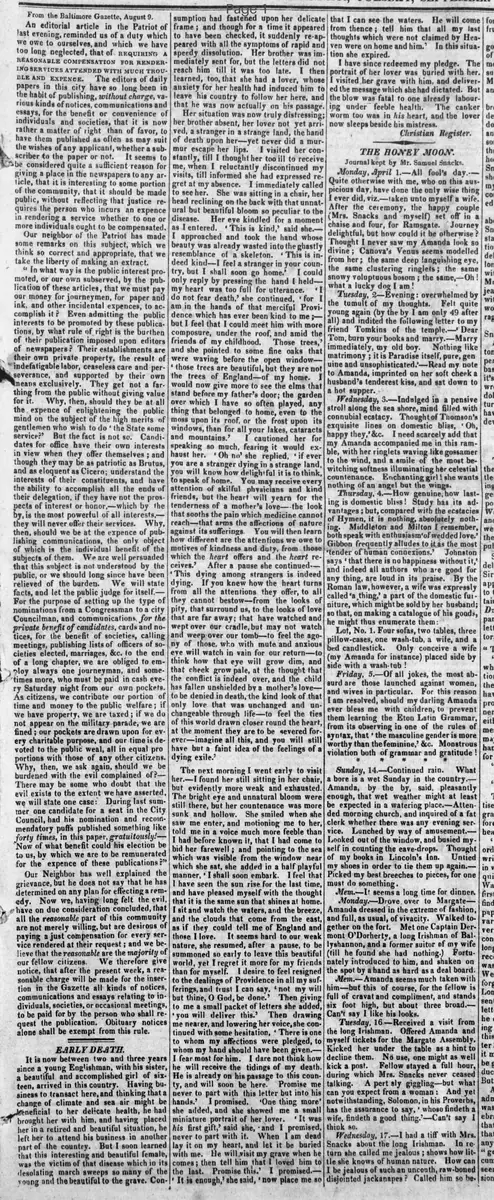
EARLY DEATH
It is now between two and three years since a young Englishman, with his sister, a beautiful and accomplished girl of sixteen, arrived in this country. Having business to transact here, and thinking that a change of climate and sea air might be beneficial to her delicate health, he had brought her with him, and having placed her in a retired and beautiful situation, he left her to attend his business in another part of the country. But I soon learned that this interesting and beautiful female, was the victim of that disease which in its desolating march sweeps so many of the young and the beautiful to the grave. Consumption had fastened upon her delicate frame; and though for a time it appeared to have been checked, it suddenly re-appeared with all the symptoms of rapid and speedy dissolution. Her brother was immediately sent for, but the letters did not reach him till it was too late. I then learned, too, that she had a lover, whose anxiety for her health had induced him to leave his country to follow her here, and that he was now actually on his passage.
Her situation was now truly distressing; her brother absent, her lover not yet arrived, a stranger in a strange land, the hand of death upon her--yet never did a murmur escape her lips. I visited her constantly, till I thought her too ill to receive me, when I reluctantly discontinued my visits, till informed she had expressed regret at my absence. I immediately called to see her. She was sitting in a chair, her head reclining on the back with that unnatural but beautiful bloom so peculiar to the disease. Her eye kindled for a moment as I entered. "This is kind," said she.
I approached and took the hand whose beauty was already wasted into the ghastly resemblance of a skeleton. "This is indeed kind--I feel a stranger in your country, but I shall soon go home." I could only reply by pressing the hand I held--my heart was too full for utterance. "I do not fear death," she continued, "for I am in the hands of that merciful Providence which has ever been kind to me;--but I feel that I could meet him with more composure, under the roof, and amid the friends of my childhood. Those trees," and she pointed to some fine oaks that were waving before the open window--"those trees are beautiful, but they are not the trees of England--of my home. I would now give more to see the elms that stand before my father's door; the garden over which I have so often played, anything that belonged to home, even to the moss upon its roof, or the frost upon its windows, than for all your lakes, cataracts and mountains." I cautioned her for speaking so much, fearing it would exhaust her. "Oh no" she replied, "if ever you are a stranger dying in a strange land, you will know how delightful it is to think, to speak of home. You may receive every attention of skilful physicians and kind friends, but the heart will yearn for the tenderness of a mother's love--the look that soothes the pain which medicine cannot reach--that arms the affections of nature against its sufferings. You will then learn how different are the attentions we owe to motives of kindness and duty, from those which the heart offers and the heart receives." After a pause she continued---"This dying among strangers is indeed dying. If you knew how the heart turns from all the attentions they offer, to all they cannot bestow--from the looks of pity, that surround us, to the looks of love that are far away; that have watched and wept over our cradle, but may not watch and weep over our tomb--to feel the agony of those, who with mute and anxious eye will watch in vain for our return--to think how that eye will grow dim, and that cheek grow pale, at the thought that the conflict is indeed over, and the child has fallen unshielded by a mother's love—to be denied in death, the kind look of that only love that was unchanged and unchangeable through life--to feel the ties of this world drawn closer round the heart, at the moment they are to be severed forever--imagine all this, and you will still have but a faint idea of the feelings of a dying exile."
The next morning I went early to visit her.--I found her still sitting in her chair, but evidently more weak and exhausted. The bright eye and unnatural bloom were still there, but her countenance was more sunk and hollow. She smiled when she saw me enter, and motioning me to her, told me in a voice much more feeble than I had before known it, that I had come to bid her farewell; and pointing to the sea which was visible from the window near which she sat, she added in a half playful manner, "I shall soon embark. I feel that I have seen the sun rise for the last time, and have pleased myself with the thought that it is the same sun that shines at home. I sit and watch the waters, and the breeze and the clouds that come from the east, as if they could tell me of England and those I love. It seems hard to our weak nature," she resumed, after a pause, "to be summoned so early to leave this beautiful world, yet I regret it more for my friends than for myself. I desire to feel resigned to the dealings of Providence in all my sufferings, and trust I can say, 'not my will but thine, O God, be done.'" Then giving to me a small packet of letters she added, "you will deliver this." Then drawing me nearer, and lowering her voice, she continued with some hesitation, "There is one to whom my affections were pledged, to whom my hand should have been given.--I fear most for him. I dare not think how he will receive the tidings of my death. He is already on his passage to this country, and will soon be here. Promise me never to part with this letter but into his hands." I promised. "One thing more" she added, and she showed me a small miniature portrait of her lover. "It was his first gift," said she, "and I promised never to part with it. When I am dead lay it on my heart, and let it be buried with me. He will visit my grave when he comes; then tell him that I loved him to the last. Promise this." I promised.--"It is enough," she said, "now place me so
that I can see the waters. He will come from thence: tell him that all my last thoughts which were not claimed by Heaven were on home and him.' In this situation she expired.
I have since redeemed my pledge. The portrait of her lover was buried with her. I visited her grave with him, and delivered the message which she had dictated. But the blow was fatal to one already labouring under feeble health. The canker worm too was in his heart, and the lover now sleeps beside his mistress.
Christian Register.
It is now between two and three years since a young Englishman, with his sister, a beautiful and accomplished girl of sixteen, arrived in this country. Having business to transact here, and thinking that a change of climate and sea air might be beneficial to her delicate health, he had brought her with him, and having placed her in a retired and beautiful situation, he left her to attend his business in another part of the country. But I soon learned that this interesting and beautiful female, was the victim of that disease which in its desolating march sweeps so many of the young and the beautiful to the grave. Consumption had fastened upon her delicate frame; and though for a time it appeared to have been checked, it suddenly re-appeared with all the symptoms of rapid and speedy dissolution. Her brother was immediately sent for, but the letters did not reach him till it was too late. I then learned, too, that she had a lover, whose anxiety for her health had induced him to leave his country to follow her here, and that he was now actually on his passage.
Her situation was now truly distressing; her brother absent, her lover not yet arrived, a stranger in a strange land, the hand of death upon her--yet never did a murmur escape her lips. I visited her constantly, till I thought her too ill to receive me, when I reluctantly discontinued my visits, till informed she had expressed regret at my absence. I immediately called to see her. She was sitting in a chair, her head reclining on the back with that unnatural but beautiful bloom so peculiar to the disease. Her eye kindled for a moment as I entered. "This is kind," said she.
I approached and took the hand whose beauty was already wasted into the ghastly resemblance of a skeleton. "This is indeed kind--I feel a stranger in your country, but I shall soon go home." I could only reply by pressing the hand I held--my heart was too full for utterance. "I do not fear death," she continued, "for I am in the hands of that merciful Providence which has ever been kind to me;--but I feel that I could meet him with more composure, under the roof, and amid the friends of my childhood. Those trees," and she pointed to some fine oaks that were waving before the open window--"those trees are beautiful, but they are not the trees of England--of my home. I would now give more to see the elms that stand before my father's door; the garden over which I have so often played, anything that belonged to home, even to the moss upon its roof, or the frost upon its windows, than for all your lakes, cataracts and mountains." I cautioned her for speaking so much, fearing it would exhaust her. "Oh no" she replied, "if ever you are a stranger dying in a strange land, you will know how delightful it is to think, to speak of home. You may receive every attention of skilful physicians and kind friends, but the heart will yearn for the tenderness of a mother's love--the look that soothes the pain which medicine cannot reach--that arms the affections of nature against its sufferings. You will then learn how different are the attentions we owe to motives of kindness and duty, from those which the heart offers and the heart receives." After a pause she continued---"This dying among strangers is indeed dying. If you knew how the heart turns from all the attentions they offer, to all they cannot bestow--from the looks of pity, that surround us, to the looks of love that are far away; that have watched and wept over our cradle, but may not watch and weep over our tomb--to feel the agony of those, who with mute and anxious eye will watch in vain for our return--to think how that eye will grow dim, and that cheek grow pale, at the thought that the conflict is indeed over, and the child has fallen unshielded by a mother's love—to be denied in death, the kind look of that only love that was unchanged and unchangeable through life--to feel the ties of this world drawn closer round the heart, at the moment they are to be severed forever--imagine all this, and you will still have but a faint idea of the feelings of a dying exile."
The next morning I went early to visit her.--I found her still sitting in her chair, but evidently more weak and exhausted. The bright eye and unnatural bloom were still there, but her countenance was more sunk and hollow. She smiled when she saw me enter, and motioning me to her, told me in a voice much more feeble than I had before known it, that I had come to bid her farewell; and pointing to the sea which was visible from the window near which she sat, she added in a half playful manner, "I shall soon embark. I feel that I have seen the sun rise for the last time, and have pleased myself with the thought that it is the same sun that shines at home. I sit and watch the waters, and the breeze and the clouds that come from the east, as if they could tell me of England and those I love. It seems hard to our weak nature," she resumed, after a pause, "to be summoned so early to leave this beautiful world, yet I regret it more for my friends than for myself. I desire to feel resigned to the dealings of Providence in all my sufferings, and trust I can say, 'not my will but thine, O God, be done.'" Then giving to me a small packet of letters she added, "you will deliver this." Then drawing me nearer, and lowering her voice, she continued with some hesitation, "There is one to whom my affections were pledged, to whom my hand should have been given.--I fear most for him. I dare not think how he will receive the tidings of my death. He is already on his passage to this country, and will soon be here. Promise me never to part with this letter but into his hands." I promised. "One thing more" she added, and she showed me a small miniature portrait of her lover. "It was his first gift," said she, "and I promised never to part with it. When I am dead lay it on my heart, and let it be buried with me. He will visit my grave when he comes; then tell him that I loved him to the last. Promise this." I promised.--"It is enough," she said, "now place me so
that I can see the waters. He will come from thence: tell him that all my last thoughts which were not claimed by Heaven were on home and him.' In this situation she expired.
I have since redeemed my pledge. The portrait of her lover was buried with her. I visited her grave with him, and delivered the message which she had dictated. But the blow was fatal to one already labouring under feeble health. The canker worm too was in his heart, and the lover now sleeps beside his mistress.
Christian Register.
What sub-type of article is it?
Prose Fiction
What themes does it cover?
Death Mortality
Love Romance
Religious
What keywords are associated?
Consumption
Dying Exile
Home Longing
Lover
Providence
Deathbed Reflections
Literary Details
Title
Early Death
Subject
Death Of A Young Englishwoman Abroad
Key Lines
"This Dying Among Strangers Is Indeed Dying. If You Knew How The Heart Turns From All The Attentions They Offer, To All They Cannot Bestow From The Looks Of Pity, That Surround Us, To The Looks Of Love That Are Far Away;"
"I Do Not Fear Death," She Continued, "For I Am In The Hands Of That Merciful Providence Which Has Ever Been Kind To Me;"
"I Shall Soon Embark. I Feel That I Have Seen The Sun Rise For The Last Time, And Have Pleased Myself With The Thought That It Is The Same Sun That Shines At Home."