Thank you for visiting SNEWPapers!
Sign up free
Springfield Weekly Republican
Springfield, Hampden County, Massachusetts
What is this article about?
Polygamy degrades women and society, is submitted to under religious fanaticism, and will fade with influences like soldiers, education reform, and government pressure; Mormons need better schooling and the practice should be ended to improve the territory.
Merged-components note: Sequential parts of 'LETTERS FROM MR. BOWLES' series.
Clipping
OCR Quality
Full Text
This is Event 2 of 2. The full text below covers all events in this component.
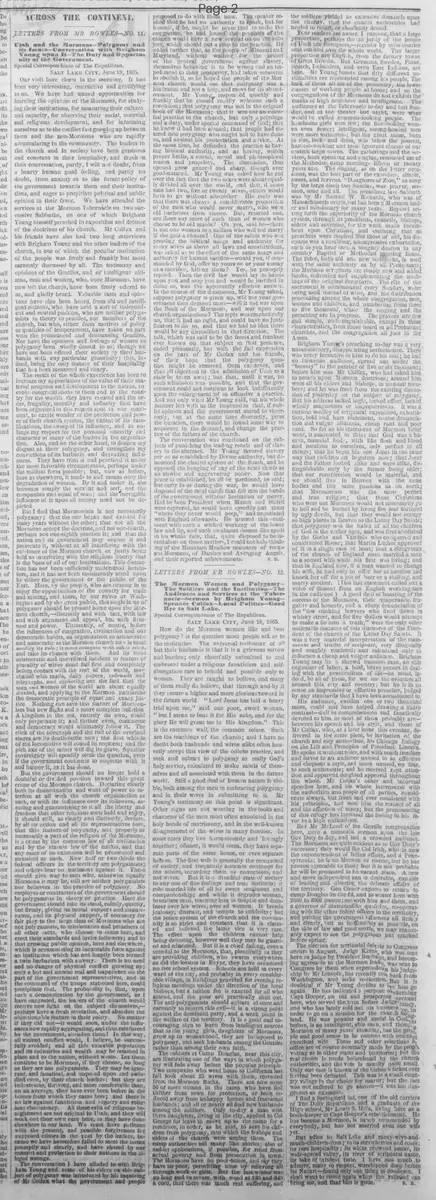
LETTERS FROM MR. BOWLES—NO. 11.
Utah and the Mormons—Polygamy and its Issues—Conversation with Brigham Young upon It—The Duty and Opportunity of the Government.
Special Correspondence of The Republican.
SALT LAKE CITY, June 18, 1865.
Our visit here closes in the morning. It has been very interesting, instructive and gratifying to us. We have had unusual opportunities for learning the opinions of the Mormons, for studying their institutions, for measuring their culture and capacity, for observing their social, material and religious development, and for informing ourselves as to the conflict fast growing up between them and the non-Mormons who are rapidly accumulating in the community. The leaders in the church and in society have been generous and constant in their hospitality, and frank in their conversation, partly, I will not doubt, from a hearty human good feeling, and partly no doubt, from anxiety as to the future policy of the government towards them and their institutions, and eager to propitiate political and public opinion in their favor. We have attended the services at the Mormon Tabernacle on two successive Sabbaths, on one of which Brigham Young himself preached in exposition and defense of the doctrines of his church. Mr. Colfax and his friends have also had two long interviews with Brigham Young and the other leaders of the church, in one of which the peculiar institution of the people was freely and frankly but most earnestly discussed by all. The testimony and opinions of the Gentiles, and of intelligent citizens, men and women, who, once Mormons, have now left the church, have been freely offered to us, and gladly heard. Valuable facts and opinions have also been heard, from old and intelligent citizens, who have held a sort of independent and neutral position, who are neither polygamists in theory or practice, nor members of the church, but who, either from motives of policy or qualities of temperament, have taken no part with the pronounced and denouncing Gentiles.
Nor have the opinions and feelings of women in polygamy been wholly denied to us; though we have not been offered their society by their husbands with any particular generosity; this, indeed, being the only feature of their hospitality that has been measured and chary.
The result of the whole experience has been to increase my appreciation of the value of their material progress and development to the nation, to evoke congratulations to them and to the country for the wealth they have created and the order, frugality, morality and industry that have been organized in this remote spot in our continent, to excite wonder at the perfection and power of their church system, the extent of its ramifications, the sweep of its influence, and to enlarge my respect for the personal sincerity and character of many of the leaders in the organization. Also, and on the other hand, to deepen my disgust at their polygamy, and strengthen my convictions of its barbaric and degrading influences. They have tried it and practiced it under the most favorable circumstances, perhaps under the mildest form possible; but, now as before, here as elsewhere, it tends to and means only the degradation of woman. By it and under it, she becomes simply the servant and serf, not the companion and equal of man; and the inevitable influence of it upon all society need not be depicted.
But I find that Mormonism is not necessarily polygamy; that the one began and existed for many years without the other; that not all the Mormons accept the doctrine, and not one-fourth, perhaps not one-eighth practice it; and that the nation and its government may oppose it and persecute it, without at all interfering with the existence of the Mormon church or justly being held as interfering with the religious liberty that is the basis of all of our institutions. This distinction has not been sufficiently understood heretofore, and it has not been consistently acted upon by either the government or the public of the East. Here, by the people, who are coming in to enjoy the opportunities of the country for trade and mining, and there, by our rulers at Washington and by the great public, this single issue of polygamy should be pressed home upon the Mormon church,—discreetly and with tact, with law and with argument and appeal, but with firmness and power. Ultimately, of course, before the influences of emigration, civilization and our democratic habits, an organization so aristocratic and autocratic as the Mormon church now is must modify its rule; it must compete with other sects, and take its chance with them. And its most aristocratic and uncivilized incident or feature of plurality of wives must fall first and completely before contact with the rest of the world, marshalled with mails, daily papers, railroads and telegraphs, and ciphering out the fact that the men and women of the world are about equally divided, and applying to the Mormon patriarchs the democratic principle of equal and exact justice. Nothing can save this feature of Mormonism but new flight and a more complete isolation. A kingdom in the sea, entirely its own, could only perpetuate it; and thither even, commerce and democracy would ultimately follow it. The click of the telegraph and the roll of the overland stages are its death-rattle now; the first whistle of the locomotive will sound its requiem; and the pick axe of the miner will dig its grave. "Squatter sovereignty will speedily settle the question, even if the government continues to coquette with it and humor it, as it has done.
But the government should no longer hold a doubtful or divided position toward this great crime of the Mormon church. Declaring clearly both its disinclination and want of power to interfere at all with the church organization as such, or with its influence over its followers, assuring and guaranteeing to it all the liberty and freedom that other religious sects hold and enjoy, it should still, as clearly and distinctly, declare, by all its action and all its representatives here, that this feature of polygamy, not properly or necessarily a part of the religion of the Mormons, is a crime by the common law of all civilization and by the statute law of the nation, and that any cases of its extension will be prosecuted and punished as such. Now half or two thirds the federal officers in the territory are polygamists; and others bear no testimony against it. These should give way to men who, otherwise equally Mormons it may be, still are neither polygamists nor believers in the practice of polygamy. No employees or contractors of the government should be polygamists in theory or practice. Here the government should take its stand, calmly, quietly, but firmly, giving its moral support and countenance, and its physical support, if necessary for fair play to the large class of Mormons who are not polygamists, to missionaries and preachers of all other sects, who choose to come here, and erect their standards and invite followers; and to that growing public opinion, here and elsewhere, which is accumulating its inexorable force against an institution which has not inaptly been termed a twin barbarism with slavery. There is no need and no danger of physical conflict growing up; only a hot and unwise zeal and impatience on the part of the government representatives, and in the command of the troops stationed here, could precipitate that. The probability is, that, upon such a demonstration by the government, as I have suggested, the leaders of the church would receive new light on the subject themselves,—perhaps have a fresh revelation, and abandon the objectionable feature in their polity. No matter if they did not—it would soon, under the influences now rapidly aggregating, and thus reinforced by the government, abandon them! In this way, all violent conflict would, I believe, be successfully avoided; and all this valuable population and its industries and wealth may be retained in place and to the nation, without waste. Let them continue to be Mormons, if they choose, so long as they are not polygamists. They may be ignorant, and fanatical, and imposed upon and swindled even, by their church leaders; but they are industrious, thriving, and more comfortable than, on an average, they have ever been before in the homes from which they came here; and there is no law against fanaticism and bigotry and religious charlatanry. All these evils of religious benightment are not original in Utah, and they will work out their own cure here, as they have done elsewhere in our land. We must have patience with the present, and possible forgiveness for supposed crimes in the past by the leaders, because we have heretofore failed to meet the issues promptly and clearly, and have shared by our consent and protection to their authors in the alleged wrongs.
The conversation I have alluded to with Brigham Young and some of his elders on this subject of polygamy was introduced by his inquiring of Mr. Colfax what the government and people proposed to do with them now. The speaker replied that he had no authority to speak, but for himself, if he might be permitted "to make the suggestion, he had hoped the prophets of the church would have a new revelation on the subject, which should put a stop to the practice. He added further that, as the people of Missouri and Maryland, without waiting for the action of the general government against slavery, themselves believing it to be wrong and an impediment to their prosperity, had taken measures to abolish it, so he hoped the people of the Mormon church would see that polygamy was a hindrance and not a help, and move for its abandonment. Mr. Young responded quickly and frankly that he should readily welcome such a revelation; that polygamy was not in the original book of the Mormons; that it was not an essential practice in the church, but only a privilege and a duty, under special command of God; that he knew it had been abused; that people had entered into polygamy who ought not to have done so, and against his protestation and advice. At the same time, he defended the practice as having biblical authority, and as having, within proper limits, a sound, moral and philosophical reason and propriety.
The discussion, thus opened grew general and sharp though ever good-natured. Mr. Young was asked how he got over the fact that the two sexes were about equally divided all over the world, and that, if some men had two, five or twenty wives, others would have to go without altogether. His reply was that there was always a considerable proportion of the men who would never marry, who were old bachelors from choice. But, retorted one, are there any more of such than of women who choose to be old maids? Oh yes, said he—there is not one woman in a million who will not marry if she gets a chance. One of the saints who was pressing the biblical usage and authority for many wives as above all laws and constitutions, was asked as to the effect of the same usage and authority for human sacrifice—would you, if commanded by God, offer up your son or your enemy as a sacrifice, killing them? Yes, he promptly replied. Then the civil law would lay its hands upon you and stop you and would be justified in doing so, was the apparently effective answer.
In the course of the discussion, Mr. Young asked, suppose polygamy is given up, will not your government then demand more—will it not war upon the Book of the Mormons, and war upon our church organizations? The reply was emphatically no, that it had no right, and could have no justification to do so, and that we had no idea there would be any disposition in that direction. The talk, which was said to be the freest and frankest ever known on that subject in that presence, ended pleasantly, but with the full expression on the part of Mr. Colfax and his friends, of their hope that the polygamy question might be removed from existence, and thus all obstacle to the admission of Utah as a state be taken away; but that, until it was, no such admission was possible, and that the government could not continue to look indifferently upon the enlargement of so offensive a practice. And not only what Mr. Young said, but his whole manner left with us the impression that, if public opinion and the government united to vigorously, but at the same time discreetly, press the question, there would be found some way to acquiesce in the demand, and change the practice of the fathers of the church.
The conversation was continued on the subjects of punishing the leading rebels and of slavery in the abstract. Mr. Young favored slavery per se as established by Divine authority, but denounced the chattel system of the South, and he opposed the hanging of any of the rebel chiefs as an unwise and aggravating policy. Now that peace is established, let all be pardoned, he said; but early in or during the war, he would have disposed of the rebel chiefs that fell into the hands of the government without hesitation or mercy. Had he been President when Mason and Slidell were captured, he would have speedily put them "where they never would peep," and negotiated with England afterwards. He uttered this sentiment with such a wicked working of the lower jaw and lip, and such an almost demon-like spirit in his whole face, that, quite disposed to be incredulous on those matters, I could not help thinking of the Mountain Meadow massacre of recusant Mormons, of Danites and Avenging Angels, and their reported achievements.
S. B.
LETTERS FROM MR. BOWLES—NO. 12.
The Mormon Women and Polygamy—The Soldiers and the Institution—The Audiences and Services at the Tabernacle—Sermon by Brigham Young—Speaker Colfax—Local Politics—Good Bye to Salt Lake.
Special Correspondence of The Republican.
SALT LAKE CITY, June 18, 1865.
How do the Mormon women like and bear polygamy? is the question most people ask as to the institution. The universal testimony of all but their husbands is that it is a grievous sorrow and burden; only cheerfully submitted to and embraced under a religious fanaticism and self-abnegation rare to behold and possible only to women. They are taught to believe, and many of them really do believe, that through and by it they secure a higher and more glorious reward in the future world. "Lord Jesus has laid a heavy trial upon me," said one poor, sweet woman, "but I mean to bear it for His sake, and for the glory He will grant me in His kingdom." This is the common wail, the common solace. Such are the teachings of the church; and I have no doubt both husbands and wives alike often honestly accept this view of the odious practice, and seek and submit to polygamy as really God's holy service, calculated to make saints of themselves and all associated with them in the future world. Still a good deal of human nature is visible, both among the men in embracing polygamy and in their wives in submitting to it. Mr. Young's testimony on this point is significant. Other signs are not wanting in the looks and character of the men most often anointed in the holy bonds of matrimony, and in the well-known disagreement of the wives in many families. In some cases they live harmoniously and lovingly together; oftener, it would seem, they have separate parts of the same house, or even separate houses. The first wife is generally the recognized head of society, and frequently assumes contempt for the others, regarding them as concubines, and not wives. But it is a dreadful state of society to any one of fine feelings and true instincts; it robs married life of all its sweet sentiment and companionship; and while it degrades woman, brutalizes man, teaching him to despise and domineer over his wives, over all women. It breeds jealousy, distrust, and tempts to infidelity; but the police system of the church and the community is so strict and constant that it is claimed and believed the latter vice is very rare.
The effect upon the children cannot help being debasing, however well they may be guarded and educated. But it is a chief failing, even a scandal to the Mormons, that, plentifully as they are providing children, who swarm everywhere as did the locusts in Egypt, they have organized no free school system. Schools are held in every ward of the city, and probably in every considerable village, in buildings provided for evening religious meetings under the direction of the local bishops, but a tuition fee is exacted for all who attend, and the poor are practically shut out. The anti-polygamists should agitate at once and earnestly to reform this evil—it is a strong point against the dominant party, and a weak point in the welfare of the territory. It is a good and encouraging sign to learn from intelligent sources that as the young girls, daughters of Mormons, grow up to womanhood, they are disposed to polygamy, and seek husbands among the Gentiles rather than among their own faith.
The soldiers at Camp Douglas, near this city, are illustrating one of the ways in which polygamy will fade away before the popular principle. Two companies who went home to California last fall took about 25 wives with them, recruited from the Mormon flocks. There are now some 50 or more women in the camp who have fled thither from town for protection, or been seduced away from unhappy homes and fractional husbands; and all or nearly all find new husbands among the soldiers. Only to-day a man with three daughters, living in the city, applied to Col. George for leave to move up to the camp for a residence, in order, as he said, to save his children from polygamy, into which the bishops and elders of the church were urging them. The camp authorities tell many like stories; also of sadder applications, if possible, for relief from actual poverty and from persecution in town. The Mormons have no poor-house, and say they have no poor, permitting none by relieving all through work or gifts. But the last winter was so long and so severe with wood at $80 and $40 a cord, that there was much real suffering, and the soldiers yielded to extensive demands upon their charity, that the church authorities had neglected to fulfill, or absolutely denied.
Your readers are aware I suppose, that a large proportion, perhaps the majority of the people of Utah are foreigners,—recruits by missionaries sent out and over the whole world. The larger proportion are English, from the factory towns of Great Britain. But Germans, Swedes, Finns, Scotch, Icelanders, and even East Indians, are here. Mr. Young boasts that fifty different nationalities are represented among his people. The bulk of them all are of the peasantry, the lower classes of working people at home; and so the congregations of the Mormons do not exhibit the marks of high acuteness and intelligence. The audiences at the Tabernacle to-day and last Sunday, and at the theater last night, were what would be called common-looking people. The handsome girls were few; the fine-looking women even fewer; intelligent, strong-headed men were more numerous; but the great mass, both in size, looks and dress, was below the poorest, hardest-working and most ignorant classes of our western large towns. The gatherings and the services, both speaking and singing, reminded me of the Methodist camp meetings fifteen or twenty years ago. The singing, as on the latter occasions, was the best part of the exercises, simple, sweet, and fervent. "Daughters of Zion," as sung by the large choir last Sunday, was prayer, sermon, song and all. The preaching last Sabbath was by Mr. Samuel W. Richards, who was of Massachusetts origin, but has been a Mormon leader and missionary for many years. Beyond setting forth the superiority of the Mormon church system, through its presidents, councils, bishops, elders and seventies, for the work made incumbent upon Christians, and claiming that its preachers were inspired like those of old, his discourse was a rambling, unimpressive exhortation, such as you hear from a tonguey deacon in any country Baptist or Methodist meeting house.
The Bible, both old and new testament, is used with the same authority as by all Protestants: the Mormon scriptures are simply new and added books, confirming and supplementing the teachings of the original Scriptures. The rite of the sacrament is administered every Sunday, water being used instead of wine, and the distribution proceeding among the whole congregation, men, women and children, and numbering from three to five thousand, while the singing and the preaching are in progress. The prayers are few and simple, indistinguishable, except in these characteristics, from those heard in all Protestant churches, and the congregation all join in the Amen.
Brigham Young's preaching to-day was a very unsatisfactory, disappointing performance. There was every incentive to him to do his best; he had an immense audience, spread out under the "bowery" to the number of five or six thousand; before him was Mr. Colfax, who had asked him to preach upon Mormon doctrines; around him were all his elders and bishops, in unusual numbers; and he was fresh from the exciting discussion of yesterday on the subject of polygamy. But his address lacked logic, lacked effect, lacked wholly magnetism or impressiveness; it was a curious medley of scriptural exposition, exhortation, bold and bare statement, coarse denunciation and vulgar allusions, cheap rant and poor cant. So far as his statement of Mormon belief went, it amounted to this: that God was a human, material body, with like flesh and blood and passions to ourselves, only perfect in all things; that he begot his son Jesus in the same way that children are begotten now; that Jesus and the Father looked alike and were alike, distinguishable only by the former being older; that our resurrection would be material, and we should live in Heaven with the same bodies and the same passions as on earth; that Mormonism was the most perfect and true religion; that those Christians who were not Mormons would not necessarily go to hell and be burned by living fire and tortured by ugly devils, but that they would not occupy so high places in Heaven as the Latter Day Saints; that polygamy was the habit of all the children of God in the earlier ages, and was first abolished by the Goths and Vandals who conquered and reconstructed Rome; that Martin Luther approved of it in a single case at least; that a clergyman of the church of England once married a man to a second wife while his first was living; and that in England now, if a man wanted to change his wife, he had only to offer her at auction and knock her off for a pot of beer or a shilling, and marry another. (This last statement called out a voice of dissent from an English working-face in the audience.) A good deal of boasting of the success of the Mormons, their temperance, frugality and honesty, and a sharp denunciation of the "few stinking lawyers who lived down in whisky street, and for five dollars would attempt to make a lie into a truth," were the only other noticeable features of this discourse of the President of the church of the Latter Day Saints. It was a very material interpretation of the statements and truths of scripture, very illogically and roughly rendered; and calculated only to influence a cheap and vulgar audience. Brigham Young may be a shrewd business man, an able organizer of labor, a bold, brave person in dealing with the practicalities of life—he must, indeed, be all of these, for we see the evidence all around this city and country; but he is in no sense an impressive or effective preacher, judged by any standards that I have been accustomed to. His audience, swollen one or two thousand more, could not have helped drawing a sharp contrast—dull in comprehension and fanatically devoted to him as most of them probably are—between his speech and his style, and those of Mr. Colfax, who, at a later hour this evening, delivered in the same place, by invitation of the church and city authorities, his Chicago Eulogy on the Life and Principles of President Lincoln.
He spoke it without notes, and with much freedom and fervor to an audience unaccustomed to so effective and eloquent a style, and more unused, we fear, to such sentiments; and he received rapt attention and apparent delighted approval throughout the whole. Mr. Colfax's other and informal speeches here, and his whole intercourse with the authorities and people of all parties, considerate always, but frank and ever consistent with his principles, had won him the respect of all and the affection of many; but the pronouncing of this eulogy has increased the feeling in his favor to a high enthusiasm.
Rev. Mr. McLeod of the Gentile congregation here, gave a memorial sermon upon the late Gov. Doty to-day, and had a crowded audience. The Mormons are quite anxious as to Gov. Doty's successor; they would like Col. Irish, who is now the superintendent of Indian affairs, and a Pennsylvanian; he is no Mormon of course, but he has proven agreeable to them; but it is not probable he will be promoted to the vacant place. A new and more independent man is desirable, capable of leading and directing the delicate affairs of the territory. Gen. Connor expects to return to Camp Douglas in the fall, and to winter here with 2000 to 3000 troops; and with him and them, and a governor of statesmanship-like qualities, co-operating with the other federal officers in the territory, and putting the government influences all firmly and clearly, but as inoffensively as possible, on the side of law and good morals, we may reasonably expect to see the polygamous nut cracked before spring.
The election for territorial delegate to Congress occurs in August. Judge Kinney, who was sent here as judge by President Buchanan, and becoming agreeable to the Mormon leaders, was superseded in his judgeship by Mr. Lincoln, has recently come back from Washington, and seeks re-election. But it is doubtful if Mr. Young decides to let him go again. He has indicated a purpose of returning Capt. Hooper, an old resident here, who served the term before Judge Kinney, and who has lately pointed out in a letter to the church, the importance of having an intelligent, able man and Mormon of many years' standing, but who has the simple and good sense to be content with one excellent wife. These and other selections for office are of course nominally made by the people voting as in other states and territories; but the real choice is made beforehand by the church authorities, and the vote is usually quite small. Only one case is known of the bishop's ticket ever having been defeated. This was in a small country village in the choice for mayor; but the fact was not suffered to go abroad—it was too dangerous an example.
I find a Springfield lad, one of the old carriers of The Daily Republican and a graduate of the High school, Mr. Lewis S. Hills, living here as a book-keeper in Capt. Hooper's establishment. He has become a Mormon, is much commended by everybody, but has not married even one wife yet.
But adieu to Salt Lake and many-wive-and much-children-dom; to its strawberries and roses; its rare hospitality; its white crowned peaks, its wide-spread valley, its river of scriptural name, its lake of briniest taste. I have met much to admire, many to respect, worshipped deep before its Nature—found only one thing to condemn. I shall want to come again when the railroad can bring me, and that blot is gone.
B. B.
What sub-type of article is it?
What themes does it cover?
What keywords are associated?
What entities or persons were involved?
Letter to Editor Details
Author
B. B.
Recipient
Special Correspondence Of The Republican
Main Argument
polygamy degrades women and society, is submitted to under religious fanaticism, and will fade with influences like soldiers, education reform, and government pressure; mormons need better schooling and the practice should be ended to improve the territory.
Notable Details