Thank you for visiting SNEWPapers!
Sign up free
Literary
July 22, 1818
Alexandria Gazette & Daily Advertiser
Alexandria, Virginia
What is this article about?
Critical essay continuing discussion of Lord Byron's Childe Harold Canto IV, praising his original genius in vivid depictions of Italian landscapes, history, and figures. Includes excerpts on Italy's ruins, beauty, evening on the Brenta, solitude, and indignation at Alphonso's tyranny against Tasso, plus notes on Ariosto and ancient superstitions.
Clipping
OCR Quality
95%
Excellent
Full Text
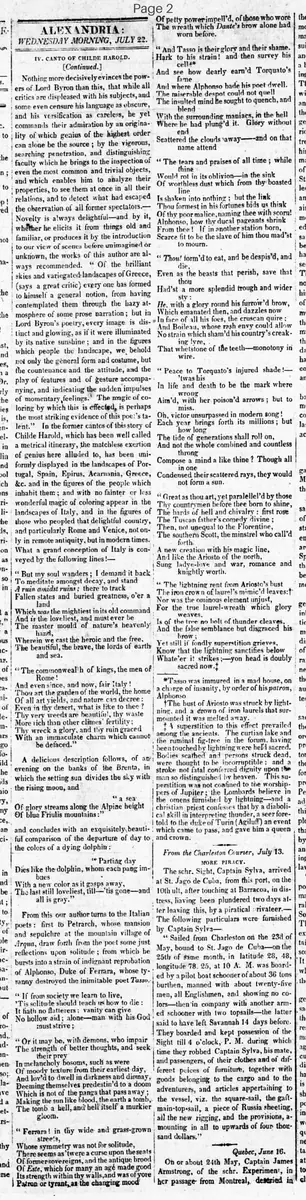
IV. CANTO OF CHILDE HAROLD.
[Continued.]
Nothing more decisively evinces the powers of Lord Byron than this, that while all critics are displeased with his subjects, and some even censure his language as obscure, and his versification as careless, he yet commands their admiration by an originality of which genius of the highest order can alone be the source; by the vigorous, searching penetration, and distinguishing faculty which he brings to the inspection of even the most common and trivial objects, and which enables him to analyze their properties, to see them at once in all their relations, and to detect what had escaped the observation of all former spectators.— Novelty is always delightful—and by it, whether he elicits it from things old and familiar, or produces it by the introduction to our view of scenes before unimagined or unknown, the works of this author are always recommended. "Of the brilliant skies and variegated landscapes of Greece, (says a great critic) every one has formed to himself a general notion, from having contemplated them through the hazy atmosphere of some prose narration; but in Lord Byron's poetry, every image is distinct and glowing, as if it were illuminated by its native sunshine; and in the figures which people the landscape, we behold not only the general form and costume, but the countenance and the attitude, and the play of features and of gesture accompanying, and indicating the sudden impulses of momentary feelings.' The magic of coloring by which this is effected, is perhaps the most striking evidence of this poet's talent." In the former cantos of this story of Childe Harold, which has been well called a metrical itinerary, the matchless exertion of genius here alluded to, has been uniformly displayed in the landscapes of Portugal, Spain, Epirus, Acarnania, Greece, &c. and in the figures of the people which inhabit them; and with no fainter or less wonderful magic of coloring appear in the landscapes of Italy, and in the figures of those who peopled that delightful country, and particularly Rome and Venice, not only in remote antiquity, but in modern times. What a grand conception of Italy is conveyed by the following lines!
"But my soul wanders; I demand it back
To meditate amongst decay, and stand
A ruin amidst ruins: there to track
Fallen states and buried greatness, o'er a land
Which was the mightiest in its old command
And is the loveliest, and must ever be
The master mould of nature's heavenly hand,
Wherein we cast the heroic and the free,
The beautiful, the brave, the lords of earth and sea.
"The commonwealth of kings, the men of Rome!
And even since, and now, fair Italy!
Thou art the garden of the world, the home
Of all art yields, and nature can decree:
Even in thy desert, what is like to thee?
Thy very weeds are beautiful, thy waste
More rich than other climes' fertility:
Thy wreck a glory, and thy ruin graced
With an immaculate charm which cannot be defaced."
A delicious description follows, of an evening on the banks of the Brenta, in which the setting sun divides the sky with the rising moon, and
Y
a sea
Of glory streams along the Alpine height
Of blue Friuli's mountains:
and concludes with an exquisitely beautiful comparison of the departure of day to the colors of a dying dolphin:
"Parting day
Dies like the dolphin, whom each pang imbues
With a new color as it gasps away,
The last still loveliest, till—'tis gone—and all is gray."
From this our author turns to the Italian poets: first to Petrarch, whose mansion and sepulchre at the mountain village of Arqua, draw forth from the poet some just reflections upon solitude; from which he bursts into a strain of indignant reprobation of Alphonso, Duke of Ferrara, whose tyranny destroyed the inimitable poet Tasso.
"If from society we learn to live,
'Tis solitude should teach us how to die:
It hath no flatterers: vanity can give
No hollow aid; alone—man with his God
Must strive:"
"Or it may be, with demons, who impair
The strength of better thoughts, and seek their prey
In melancholy bosoms, such as were
Of moody texture from their earliest day,
And lov'd to dwell in darkness and dismay,
Deeming themselves predestin'd to a doom
Which is not of the pangs that pass away;
Making the sun like blood, the earth a tomb,
The tomb a hell, and hell itself a murkier gloom.
"Ferrara! in thy wide and grass-grown streets,
Whose symmetry was not for solitude,
There seems as 'twere a curse upon the seats
Of former sovereigns, and the antique brood
Of Este, which for many an age made good
Its strength within thy walls, and was of yore
Patron or tyrant, as the changing mood
Of petty power impell'd, of those who wore
The wreath which Dante's brow alone had worn before.
"And Tasso is their glory and their shame.
Hark to his strain! and then survey his cell!*
And see how dearly earn'd Torquato's fame,
And where Alphonso bade his poet dwell.
The miserable despot could not quell
The insulted mind he sought to quench, and blend
With the surrounding maniacs, in the hell
Where he had plung'd it. Glory without end
Scatter'd the clouds away—and on that name attend
"The tears and praises of all time; while thine
Would rot in its oblivion—in the sink
Of worthless dust which from thy boasted line
Is shaken into nothing: but the link
Thou formest in his fortunes bids us think
Of thy poor malice, naming thee with scorn!
Alphonso! how thy ducal pageants shrink
From thee! If in another station born,
Scarce fit to be the slave of him thou mad'st to mourn.
"Thou! form'd to eat, and be despis'd, and die,
Even as the beasts that perish, save that thou
Had'st a more splendid trough and wider sty:
He, with a glory round his furrow'd brow,
Which emanated then, and dazzles now
In face of all his foes, the cruscan quire:
And Boileau, whose rash envy could allow
No strain which sham'd his country's creaking lyre,
That whetstone of the teeth—monotony in wire.
"Peace to Torquato's injured shade!—'twas his
In life and death to be the mark where wrong
Aim'd, with her poison'd arrows; but to miss.
Oh, victor unsurpassed in modern song!
Each year brings forth its millions; but how long
The tide of generations shall roll on,
And not the whole combined and countless throng
Compose a mind like thine? Though all in one
Condensed their scattered rays, they would not form a sun.
"Great as thou art, yet parallel'd by those
Thy countrymen before thee born to shine,
The bards of hell and chivalry: first rose
The Tuscan father's comedy divine:
Then, not unequal to the Florentine,
The southern Scott, the minstrel who call'd forth
A new creation with his magic line,
And like the Ariosto of the north,
Sung lady-love and war, romance and knightly worth.
"The lightning rent from Ariosto's bust
The iron crown of laurel's mimick'd leaves:
Nor was the ominous element unjust,
For the true laurel-wreath which glory weaves
Is of the tree no bolt of thunder cleaves,
And the false semblance but disgrac'd his brow;
Yet still if fondly superstition grieves,
Know that the lightning sanctifies below
Whate'er it strikes;—yon head is doubly sacred now.
*Tasso was immured in a mad house, on a charge of insanity, by order of his patron, Alphonso.
†The bust of Ariosto was struck by lightning, and a crown of iron laurels that surmounted it was melted away.
Among the ancients. The curtan lake and ruminal fig-tree in the forum, having been touched by lightning were held sacred. Bodies scathed and persons struck dead, were thought to be incorruptible: and a stroke not fatal conferred dignity upon the man so distinguished by heaven. This superstition was not confined to the worshippers of Jupiter: the Lombards believe in the omens furnished by lightning—and a christian priest confesses that by a diabolical skill in interpreting thunder, a seer foretold to the duke of Turin (Agiluff) an event which came to pass, and gave him a queen and crown.
[Continued.]
Nothing more decisively evinces the powers of Lord Byron than this, that while all critics are displeased with his subjects, and some even censure his language as obscure, and his versification as careless, he yet commands their admiration by an originality of which genius of the highest order can alone be the source; by the vigorous, searching penetration, and distinguishing faculty which he brings to the inspection of even the most common and trivial objects, and which enables him to analyze their properties, to see them at once in all their relations, and to detect what had escaped the observation of all former spectators.— Novelty is always delightful—and by it, whether he elicits it from things old and familiar, or produces it by the introduction to our view of scenes before unimagined or unknown, the works of this author are always recommended. "Of the brilliant skies and variegated landscapes of Greece, (says a great critic) every one has formed to himself a general notion, from having contemplated them through the hazy atmosphere of some prose narration; but in Lord Byron's poetry, every image is distinct and glowing, as if it were illuminated by its native sunshine; and in the figures which people the landscape, we behold not only the general form and costume, but the countenance and the attitude, and the play of features and of gesture accompanying, and indicating the sudden impulses of momentary feelings.' The magic of coloring by which this is effected, is perhaps the most striking evidence of this poet's talent." In the former cantos of this story of Childe Harold, which has been well called a metrical itinerary, the matchless exertion of genius here alluded to, has been uniformly displayed in the landscapes of Portugal, Spain, Epirus, Acarnania, Greece, &c. and in the figures of the people which inhabit them; and with no fainter or less wonderful magic of coloring appear in the landscapes of Italy, and in the figures of those who peopled that delightful country, and particularly Rome and Venice, not only in remote antiquity, but in modern times. What a grand conception of Italy is conveyed by the following lines!
"But my soul wanders; I demand it back
To meditate amongst decay, and stand
A ruin amidst ruins: there to track
Fallen states and buried greatness, o'er a land
Which was the mightiest in its old command
And is the loveliest, and must ever be
The master mould of nature's heavenly hand,
Wherein we cast the heroic and the free,
The beautiful, the brave, the lords of earth and sea.
"The commonwealth of kings, the men of Rome!
And even since, and now, fair Italy!
Thou art the garden of the world, the home
Of all art yields, and nature can decree:
Even in thy desert, what is like to thee?
Thy very weeds are beautiful, thy waste
More rich than other climes' fertility:
Thy wreck a glory, and thy ruin graced
With an immaculate charm which cannot be defaced."
A delicious description follows, of an evening on the banks of the Brenta, in which the setting sun divides the sky with the rising moon, and
Y
a sea
Of glory streams along the Alpine height
Of blue Friuli's mountains:
and concludes with an exquisitely beautiful comparison of the departure of day to the colors of a dying dolphin:
"Parting day
Dies like the dolphin, whom each pang imbues
With a new color as it gasps away,
The last still loveliest, till—'tis gone—and all is gray."
From this our author turns to the Italian poets: first to Petrarch, whose mansion and sepulchre at the mountain village of Arqua, draw forth from the poet some just reflections upon solitude; from which he bursts into a strain of indignant reprobation of Alphonso, Duke of Ferrara, whose tyranny destroyed the inimitable poet Tasso.
"If from society we learn to live,
'Tis solitude should teach us how to die:
It hath no flatterers: vanity can give
No hollow aid; alone—man with his God
Must strive:"
"Or it may be, with demons, who impair
The strength of better thoughts, and seek their prey
In melancholy bosoms, such as were
Of moody texture from their earliest day,
And lov'd to dwell in darkness and dismay,
Deeming themselves predestin'd to a doom
Which is not of the pangs that pass away;
Making the sun like blood, the earth a tomb,
The tomb a hell, and hell itself a murkier gloom.
"Ferrara! in thy wide and grass-grown streets,
Whose symmetry was not for solitude,
There seems as 'twere a curse upon the seats
Of former sovereigns, and the antique brood
Of Este, which for many an age made good
Its strength within thy walls, and was of yore
Patron or tyrant, as the changing mood
Of petty power impell'd, of those who wore
The wreath which Dante's brow alone had worn before.
"And Tasso is their glory and their shame.
Hark to his strain! and then survey his cell!*
And see how dearly earn'd Torquato's fame,
And where Alphonso bade his poet dwell.
The miserable despot could not quell
The insulted mind he sought to quench, and blend
With the surrounding maniacs, in the hell
Where he had plung'd it. Glory without end
Scatter'd the clouds away—and on that name attend
"The tears and praises of all time; while thine
Would rot in its oblivion—in the sink
Of worthless dust which from thy boasted line
Is shaken into nothing: but the link
Thou formest in his fortunes bids us think
Of thy poor malice, naming thee with scorn!
Alphonso! how thy ducal pageants shrink
From thee! If in another station born,
Scarce fit to be the slave of him thou mad'st to mourn.
"Thou! form'd to eat, and be despis'd, and die,
Even as the beasts that perish, save that thou
Had'st a more splendid trough and wider sty:
He, with a glory round his furrow'd brow,
Which emanated then, and dazzles now
In face of all his foes, the cruscan quire:
And Boileau, whose rash envy could allow
No strain which sham'd his country's creaking lyre,
That whetstone of the teeth—monotony in wire.
"Peace to Torquato's injured shade!—'twas his
In life and death to be the mark where wrong
Aim'd, with her poison'd arrows; but to miss.
Oh, victor unsurpassed in modern song!
Each year brings forth its millions; but how long
The tide of generations shall roll on,
And not the whole combined and countless throng
Compose a mind like thine? Though all in one
Condensed their scattered rays, they would not form a sun.
"Great as thou art, yet parallel'd by those
Thy countrymen before thee born to shine,
The bards of hell and chivalry: first rose
The Tuscan father's comedy divine:
Then, not unequal to the Florentine,
The southern Scott, the minstrel who call'd forth
A new creation with his magic line,
And like the Ariosto of the north,
Sung lady-love and war, romance and knightly worth.
"The lightning rent from Ariosto's bust
The iron crown of laurel's mimick'd leaves:
Nor was the ominous element unjust,
For the true laurel-wreath which glory weaves
Is of the tree no bolt of thunder cleaves,
And the false semblance but disgrac'd his brow;
Yet still if fondly superstition grieves,
Know that the lightning sanctifies below
Whate'er it strikes;—yon head is doubly sacred now.
*Tasso was immured in a mad house, on a charge of insanity, by order of his patron, Alphonso.
†The bust of Ariosto was struck by lightning, and a crown of iron laurels that surmounted it was melted away.
Among the ancients. The curtan lake and ruminal fig-tree in the forum, having been touched by lightning were held sacred. Bodies scathed and persons struck dead, were thought to be incorruptible: and a stroke not fatal conferred dignity upon the man so distinguished by heaven. This superstition was not confined to the worshippers of Jupiter: the Lombards believe in the omens furnished by lightning—and a christian priest confesses that by a diabolical skill in interpreting thunder, a seer foretold to the duke of Turin (Agiluff) an event which came to pass, and gave him a queen and crown.
What sub-type of article is it?
Essay
Poem
What themes does it cover?
Political
Moral Virtue
Nature
What keywords are associated?
Byron
Childe Harold
Italy
Tasso
Ariosto
Ferrara
Solitude
Tyranny
Landscapes
Literary Details
Title
Iv. Canto Of Childe Harold. [Continued.]
Subject
Critical Appreciation Of Lord Byron's Depictions Of Italy And Italian Poets In Childe Harold
Form / Style
Prose Criticism With Extensive Verse Excerpts
Key Lines
But My Soul Wanders; I Demand It Back
To Meditate Amongst Decay, And Stand
A Ruin Amidst Ruins: There To Track
Fallen States And Buried Greatness, O'er A Land
Which Was The Mightiest In Its Old Command
And Is The Loveliest, And Must Ever Be
The Master Mould Of Nature's Heavenly Hand,
Wherein We Cast The Heroic And The Free,
The Beautiful, The Brave, The Lords Of Earth And Sea.
The Commonwealth Of Kings, The Men Of Rome!
And Even Since, And Now, Fair Italy!
Thou Art The Garden Of The World, The Home
Of All Art Yields, And Nature Can Decree:
Even In Thy Desert, What Is Like To Thee?
Thy Very Weeds Are Beautiful, Thy Waste
More Rich Than Other Climes' Fertility:
Thy Wreck A Glory, And Thy Ruin Graced
With An Immaculate Charm Which Cannot Be Defaced.
Parting Day
Dies Like The Dolphin, Whom Each Pang Imbues
With A New Color As It Gasps Away,
The Last Still Loveliest, Till—'Tis Gone—And All Is Gray.
If From Society We Learn To Live,
'Tis Solitude Should Teach Us How To Die:
It Hath No Flatterers: Vanity Can Give
No Hollow Aid; Alone—Man With His God
Must Strive:
And Tasso Is Their Glory And Their Shame.
Hark To His Strain! And Then Survey His Cell!*