Thank you for visiting SNEWPapers!
Sign up free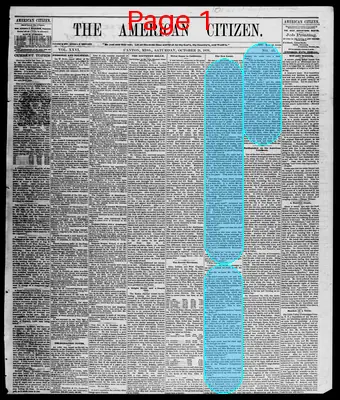
Filler
October 21, 1876
American Citizen
Canton, Madison County, Mississippi
What is this article about?
Humorous account of an enthusiastic young reporter's one-day stint at the Burlington Hawk-eye, where his eagerness leads to numerous factual errors in stories about local figures, resulting in his dismissal by the chief editor.
Clipping
OCR Quality
95%
Excellent
Full Text
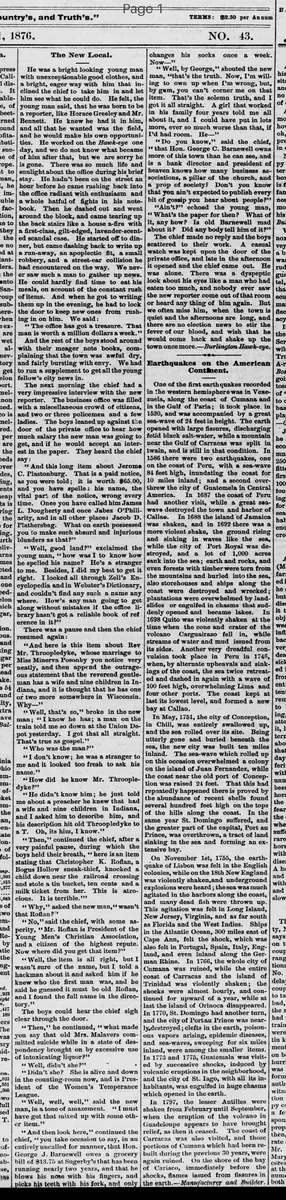
He was a bright looking young man with unexceptionable good clothes, and a bright, eager way with him that inclined the chief to take him in and let him see what he could do. He felt, the young man said, that he was born to be a reporter, like Horace Greeley and Mr. Bennett. He knew he had it in him, and all that he wanted was the field, and he would make his own opportunities.
He worked on the Hawk-eye one day, and we do not know what became of him after that, but we are sorry he is gone. There was so much life and sunlight about the office during his brief stay. He hadn't been on the street an hour before he came rushing back into the office radiant with enthusiasm and a whole hatful of items in his note-book. Then he dashed out and went around the block, and came tearing up the back stairs like a house afire with a first-class, gilt-edged, lavender-scented scandal case. He started off to dinner, but came dashing back to write up a run-away, an apoplectic fit, a small robbery, and a street-car collision he had encountered on the way. We never saw such a man to gather up news. He could hardly find time to eat his meals, on account of the constant rush of items. And when he got to writing them up in the evening, he had to lock the door to keep new ones from rushing in on him. We said: "The office has got a treasure. That man is worth a million dollars a week." And the rest of the boys stood around with their meager note books, complaining that the town was awful dry, and fairly bursting with envy. We had to run a supplement to get all the young fellow's city news in.
The next morning the chief had a very impressive interview with the new reporter. The business office was filled with a miscellaneous crowd of citizens, and two or three policemen and a few ladies. The boys leaned up against the door of the private office to hear how much salary the new man was going to get, and if he would accept an interest in the paper. They heard the chief say: "And this long item about Jerome C. Plastonburg. That is a paid notice, as you were told; it is worth $65.00, and you have spelled his name, the vital part of the notice, wrong every time. Once you have called him James L. Dougherty and once Jabez O'Philipsarity, and in all other places Jacob D. Plathersbag. What on earth possessed you to make such absurd and injurious blunders as that?"
"Well, good land?" exclaimed the young man, "how was I to know how he spelled his name? He's a stranger to me. Besides, I did my best to get it right. I looked all through Zell's Encyclopedia and in Webster's Dictionary, and couldn't find any such a name anywhere. How's any man going to get along without mistakes if the office library hasn't got a reliable book of reference in it?"
There was a pause and then the chief resumed again: "And here is this item about Rev. Mr. Throopledyke, whose marriage to Miss Minerva Posonby you notice very neatly, and then append the outrageous statement that the reverend gentleman has a wife and nine children in Indiana, and it is thought that he has one or two more somewhere in Wisconsin. Why-"
"Well, that's so," broke in the new man; "I know he has; a man on the train told me so down at the Union Depot yesterday. I got that all straight. That's true as gospel."
"Who was the man?"
"I don't know; he was a stranger to me and it looked too fresh to ask his name."
"How did he know Mr. Throopledyke?"
"He didn't know him; he just told me about a preacher he knew that had a wife and nine children in Indiana, and I asked him to describe him, and his description hit old Throopledyke to a T. Oh, it's him, I know."
"Then," continued the chief, after a very painful pause, during which the boys held their breath, "here is an item stating that Christopher K. Roflan, a Bogus Hollow sneak-thief, knocked a child down near the railroad crossing and stole a tin bucket, ten cents and a milk ticket from her. This is atrocious. It is terrible."
"Why," asked the new man, "wasn't that Roflan?"
"No," said the chief, with some asperity, "Mr. Roflan is President of the Young Men's Christian Association, and a citizen of the highest repute. Now where did you get that item?"
"Well, the item is all right, but I wasn't sure of the name, but I told a hackman about it and asked him if he knew who the first man was, and he said he guessed it must be old Roflan, and I found the full name in the directory."
The boys could hear the chief sigh clear through the door.
"Then," he continued, "what made you say that old Mrs. Malavers committed suicide while in a state of despondency brought on by excessive use of intoxicating liquor?"
"Well, didn't she?"
"Didn't she? She is alive and down in the counting-room now, and is President of the Women's Temperance League."
"Well, well, well," said the new man, in a tone of amazement. "I must have got that mixed up with some other item."
"And then look here," continued the chief, "you take occasion to say, in an entirely uncalled for manner, that Hon. George J. Barnewell owes a grocery bill of $13.75 at Sugerby's that has been running nearly two years, and that he blows his nose with his fingers, and picks his teeth with his fork, and only bathes once a week."
"Well, by George," shouted the new man, "that's the truth. Now, I'm willing to own up when I'm wrong, but, by gum, you can't corner me on that item. That's the solemn truth, and I got it all straight. A girl that worked in his family four years told me all about it, and I could have put in lots more, ever so much worse than that, if I'd had room. He-"
"Do you know," said the chief, "that Hon. George C. Barnewell owns more of this town than he can see, and is a bank director and president of heaven knows how many business associations, a pillar of the church, and a prop of society? Don't you know that you ain't expected to publish every bit of gossip you hear about people?"
"Ain't?" echoed the young man, "What's the paper for then? What of it, anyhow? Is old Barnewell mad about it? Did anybody tell him of it?"
The chief made no reply and the boys scattered to their work. A casual watch was kept upon the door of the private office, and late in the afternoon it opened and the chief came out. He was alone. There was a dyspeptic look about his eyes like a man who had eaten too much, and nobody ever saw the new reporter come out of that room or heard anything of him again. But we often miss him, when the town is quiet and the afternoons are long, and there are no election news to stir the fever of our blood, and wish that he would come back and shake up the town once more.-Burlington Hawk-eye.
What sub-type of article is it?
Human Interest
Witty Remark
What keywords are associated?
Young Reporter
Newspaper Errors
Humorous Anecdote
Burlington Hawk Eye
Editorial Mistakes
Local Gossip
Reporter Dismissal
What entities or persons were involved?
Young Reporter
Chief
Jerome C. Plastonburg
Rev. Mr. Throopledyke
Miss Minerva Posonby
Christopher K. Roflan
Mrs. Malavers
Hon. George J. Barnewell
Where did it happen?
Burlington
Filler Details
Topic
Enthusiastic Young Reporter's Mistakes Leading To Dismissal
Location
Burlington
Key Persons
Young Reporter
Chief
Jerome C. Plastonburg
Rev. Mr. Throopledyke
Miss Minerva Posonby
Christopher K. Roflan
Mrs. Malavers
Hon. George J. Barnewell
Event Details
A young man joins the Hawk-eye as a reporter, gathers news energetically but makes errors like misspelling names, falsely accusing a reverend of bigamy, misidentifying a thief, reporting a living woman's suicide, and publishing gossip about a prominent citizen, leading to his firing after a confrontation with the chief.