Thank you for visiting SNEWPapers!
Sign up free
The Virginia Gazette
Richmond, Williamsburg, Richmond County, Virginia
What is this article about?
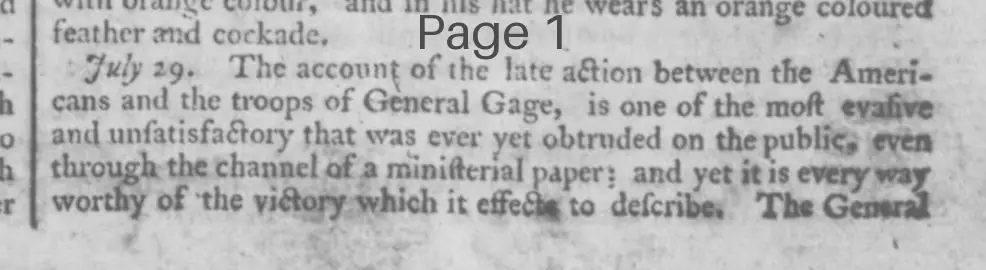
An editorial from July 29 criticizes a ministerial newspaper's evasive account of a battle between American forces and General Gage's British troops, highlighting heavy British casualties (over 1,000 killed or wounded) and mocking the 'victory.' It condemns the British Ministry's war policy, predicts its failure, and notes public outrage and threats to printers for ridiculing official reports.
Merged-components note: Continuation of the July 29 editorial commentary on the battle of Bunker Hill across page break; text flows directly from 'The General...' to 'Sent out something above 2000 men...'.
Clippings
1 of 2
OCR Quality
Full Text
Sent out something above 2000 men, of whom something above half (i.e. 1053) are either killed or wounded. The General, however, takes care not to mention how many hours were employed in the prosecution of this hopeful business, but nevertheless pretends to tell us that great numbers of the enemy were destroyed; and seems to have employed his soldiers in digging up such as were buried in holes, that he might have the power to ascertain the value of his conquest. With all the vanity of a military man he praises the conduct of the officers under his command; but prudently omits to say whether any such advantage has been gained, as may make up for the loss of one Lieutenant Colonel, two Majors, seven Captains, nine Lieutenants, fifteen Sergeants, one Drummer, one hundred and ninety one rank and file, KILLED, and three Majors, twenty seven Captains, thirty two Lieutenants, eight Ensigns, forty Sergeants, twelve Drummers and eight hundred and six rank and file wounded, and unfit for service. In short, if every time the General sends out his brace of thousands, the one half of them should either drop, or be rendered useless, we shall soon see an end to the war in America, but yet it cannot be expected to terminate in our own favour. The Ministry received this account several days before it was announced, but were either unwilling or unable to cook it up for the public, till after their dispatches had been sent away. The printer may rely on this assurance from one whose private letters will always reach him unexamined and uncastrated by the spies of Government. General Gage is but too well convinced that such another victory would oblige him to re-embark his troops and sail immediately for England, without attempting any farther reduction of the Americans. The Captain who brought these dispatches from Boston, was commanded to declare he had great news of the defeat of the Americans, though he had assured many people in the towns through which he passed on his way to London, that he was afraid the accounts he brought would throw the whole nation into disorder, and direct its vengeance on the advisers of hostile measures in America. The ministerial hirelings are now running about from printer to printer, to apprize them of their danger, if they continue to controvert or ridicule the accounts given in the London gazettes. This is all done too under the pretence of kindness, but is in reality the dernier resort of a set of men frighted out of their wits by the victory which they have gained in America. It is well known that the people in general are at the expense of the armament, and therefore they will not only persist in their right to be acquainted with its success, but will likewise proceed to expose and laugh at all such mutilated letters from General Gage, as from time to time may be laid before them by authority from the Privy Council. The friends of the Ministry pretend to be in high spirits on account of General Howe's victory, as they call it, but Lord Dartmouth begs leave to differ from them in opinion. When the news of the Roman legions being slaughtered by the Germans, reached the ears of the Emperor Augustus, he shed tears, and appeared for a considerable time like a frantic man. What must our gracious Sovereign feel when told of the bloody slaughter in America of Englishmen by Englishmen? How must he detest those who advised such pernicious counsels? And with what contempt must he look upon those wretches who assured him that the Americans were all cowards, and would run away from the sight of a soldier?
What sub-type of article is it?
What keywords are associated?
What entities or persons were involved?
Editorial Details
Primary Topic
Critique Of General Gage's Account Of The Battle Against Americans
Stance / Tone
Strongly Critical Of British Ministry And War Effort, Pro American
Key Figures
Key Arguments
- the official account is evasive and unsatisfactory
- british forces suffered over 1,000 casualties out of 2,000
- no strategic advantage gained despite claims
- repeated such 'victories' would end the war unfavorably for britain
- ministry delayed and altered the report
- threats to printers for ridiculing official accounts
- public right to know and mock mutilated reports
- analogy to augustus's distress over roman losses