Thank you for visiting SNEWPapers!
Sign up free
Literary
September 5, 1838
Southern Telegraph
Rodney, Jefferson County, Mississippi
What is this article about?
An American traveler recounts breakfasting at a convent near Mount Sinai, ascending to its summit, and reflecting on biblical events like Moses receiving the Ten Commandments. He describes the desolate landscape, compares it to other volcanoes, and reads the laws on the spot with profound devotion.
Clipping
OCR Quality
98%
Excellent
Full Text
MOUNT SINAI.
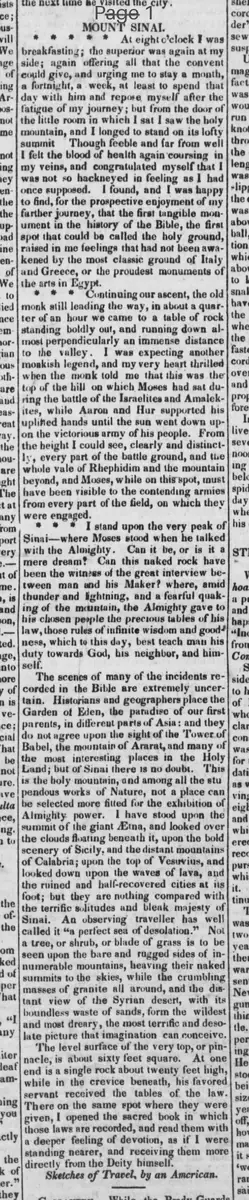
At eight o'clock I was breakfasting; the superior was again at my side; again offering all that the convent could give, and urging me to stay a month, a fortnight, a week, at least to spend that day with him and repose myself after the fatigue of my journey; but from the door of the little room in which I sat I saw the holy mountain, and I longed to stand on its lofty summit. Though feeble and far from well I felt the blood of health again coursing in my veins, and congratulated myself that I was not so hackneyed in feeling as I had once supposed. I found, and I was happy to find, for the prospective enjoyment of my further journey, that the first tangible monument in the history of the Bible, the first spot that could be called the holy ground, raised in me feelings that had not been awakened by the most classic ground of Italy and Greece, or the proudest monuments of the arts in Egypt.
Continuing our ascent, the old monk still leading the way, in about a quarter of an hour we came to a table of rock standing boldly out, and running down almost perpendicularly an immense distance to the valley. I was expecting another monkish legend, and my very heart thrilled when the monk told me that this was the top of the hill on which Moses had sat during the battle of the Israelites and Amalekites, while Aaron and Hur supported his uplifted hands until the sun went down upon the victorious army of his people. From the height I could see, clearly and distinctly, every part of the battle ground, and the whole vale of Rephidim and the mountain beyond, and Moses, while on this spot, must have been visible to the contending armies from every part of the field, on which they were engaged.
I stand upon the very peak of Sinai—where Moses stood when he talked with the Almighty. Can it be, or is it a mere dream! Can this naked rock have been the witness of the great interview between man and his Maker? where, amid thunder and lightning, and a fearful quaking of the mountain, the Almighty gave to his chosen people the precious tables of his law, those rules of infinite wisdom and goodness, which to this day, best teach man his duty towards God, his neighbor, and himself.
The scenes of many of the incidents recorded in the Bible are extremely uncertain. Historians and geographers place the Garden of Eden, the paradise of our first parents, in different parts of Asia: and they do not agree upon the site of the Tower of Babel, the mountain of Ararat, and many of the most interesting places in the Holy Land; but of Sinai there is no doubt. This is the holy mountain, and among all the stupendous works of Nature, not a place can be selected more fitted for the exhibition of Almighty power. I have stood upon the summit of the giant Etna, and looked over the clouds floating beneath it, upon the bold scenery of Sicily, and the distant mountains of Calabria; upon the top of Vesuvius, and looked down upon the waves of lava, and the ruined and half-recovered cities at its foot; but they are nothing compared with the terrific solitudes and bleak majesty of Sinai. An observing traveller has well called it "a perfect sea of desolation." Not a tree, or shrub, or blade of grass is to be seen upon the bare and rugged sides of innumerable mountains, heaving their naked summits to the skies, while the crumbling masses of granite all around, and the distant view of the Syrian desert, with its boundless waste of sands, form the wildest and most dreary, the most terrific and desolate picture that imagination can conceive.
The level surface of the very top, or pinnacle, is about sixty feet square. At one end is a single rock about twenty feet high, while in the crevice beneath, his favored servant received the tables of the law. There on the same spot where they were given, I opened the sacred book in which those laws are recorded, and read them with a deeper feeling of devotion, as if I were standing nearer, and receiving them more directly from the Deity himself.
Sketches of Travel, by an American.
At eight o'clock I was breakfasting; the superior was again at my side; again offering all that the convent could give, and urging me to stay a month, a fortnight, a week, at least to spend that day with him and repose myself after the fatigue of my journey; but from the door of the little room in which I sat I saw the holy mountain, and I longed to stand on its lofty summit. Though feeble and far from well I felt the blood of health again coursing in my veins, and congratulated myself that I was not so hackneyed in feeling as I had once supposed. I found, and I was happy to find, for the prospective enjoyment of my further journey, that the first tangible monument in the history of the Bible, the first spot that could be called the holy ground, raised in me feelings that had not been awakened by the most classic ground of Italy and Greece, or the proudest monuments of the arts in Egypt.
Continuing our ascent, the old monk still leading the way, in about a quarter of an hour we came to a table of rock standing boldly out, and running down almost perpendicularly an immense distance to the valley. I was expecting another monkish legend, and my very heart thrilled when the monk told me that this was the top of the hill on which Moses had sat during the battle of the Israelites and Amalekites, while Aaron and Hur supported his uplifted hands until the sun went down upon the victorious army of his people. From the height I could see, clearly and distinctly, every part of the battle ground, and the whole vale of Rephidim and the mountain beyond, and Moses, while on this spot, must have been visible to the contending armies from every part of the field, on which they were engaged.
I stand upon the very peak of Sinai—where Moses stood when he talked with the Almighty. Can it be, or is it a mere dream! Can this naked rock have been the witness of the great interview between man and his Maker? where, amid thunder and lightning, and a fearful quaking of the mountain, the Almighty gave to his chosen people the precious tables of his law, those rules of infinite wisdom and goodness, which to this day, best teach man his duty towards God, his neighbor, and himself.
The scenes of many of the incidents recorded in the Bible are extremely uncertain. Historians and geographers place the Garden of Eden, the paradise of our first parents, in different parts of Asia: and they do not agree upon the site of the Tower of Babel, the mountain of Ararat, and many of the most interesting places in the Holy Land; but of Sinai there is no doubt. This is the holy mountain, and among all the stupendous works of Nature, not a place can be selected more fitted for the exhibition of Almighty power. I have stood upon the summit of the giant Etna, and looked over the clouds floating beneath it, upon the bold scenery of Sicily, and the distant mountains of Calabria; upon the top of Vesuvius, and looked down upon the waves of lava, and the ruined and half-recovered cities at its foot; but they are nothing compared with the terrific solitudes and bleak majesty of Sinai. An observing traveller has well called it "a perfect sea of desolation." Not a tree, or shrub, or blade of grass is to be seen upon the bare and rugged sides of innumerable mountains, heaving their naked summits to the skies, while the crumbling masses of granite all around, and the distant view of the Syrian desert, with its boundless waste of sands, form the wildest and most dreary, the most terrific and desolate picture that imagination can conceive.
The level surface of the very top, or pinnacle, is about sixty feet square. At one end is a single rock about twenty feet high, while in the crevice beneath, his favored servant received the tables of the law. There on the same spot where they were given, I opened the sacred book in which those laws are recorded, and read them with a deeper feeling of devotion, as if I were standing nearer, and receiving them more directly from the Deity himself.
Sketches of Travel, by an American.
What sub-type of article is it?
Journey Narrative
Essay
What themes does it cover?
Religious
Moral Virtue
Nature
What keywords are associated?
Mount Sinai
Moses
Ten Commandments
Biblical History
Sinai Desert
Travel Narrative
Holy Land
What entities or persons were involved?
Sketches Of Travel, By An American.
Literary Details
Title
Mount Sinai.
Author
Sketches Of Travel, By An American.
Subject
Ascent Of Mount Sinai And Biblical Reflections
Form / Style
Descriptive Travel Prose
Key Lines
I Stand Upon The Very Peak Of Sinai—Where Moses Stood When He Talked With The Almighty.
This Is The Holy Mountain, And Among All The Stupendous Works Of Nature, Not A Place Can Be Selected More Fitted For The Exhibition Of Almighty Power.
There On The Same Spot Where They Were Given, I Opened The Sacred Book In Which Those Laws Are Recorded, And Read Them With A Deeper Feeling Of Devotion, As If I Were Standing Nearer, And Receiving Them More Directly From The Deity Himself.