Thank you for visiting SNEWPapers!
Sign up free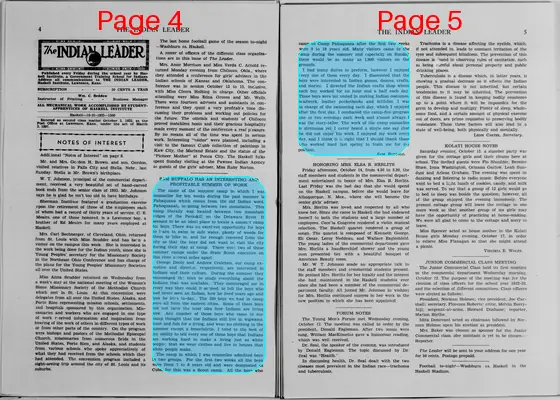
The Indian Leader
Lawrence, Douglas County, Kansas
What is this article about?
Sam Buffalo, a Native American, describes his enjoyable summer as a counselor at Camp Pahaquana, a Scout camp on the Delaware River, where he taught 200 city boys about modern Indian life through crafts, stories, swimming, and camp activities under directors George Dooly and Andrew Creichen.
Merged-components note: Continuation of Sam Buffalo's summer work story from page 4 to page 5, based on sequential reading order and matching narrative.
Clippings
1 of 2
OCR Quality
Full Text
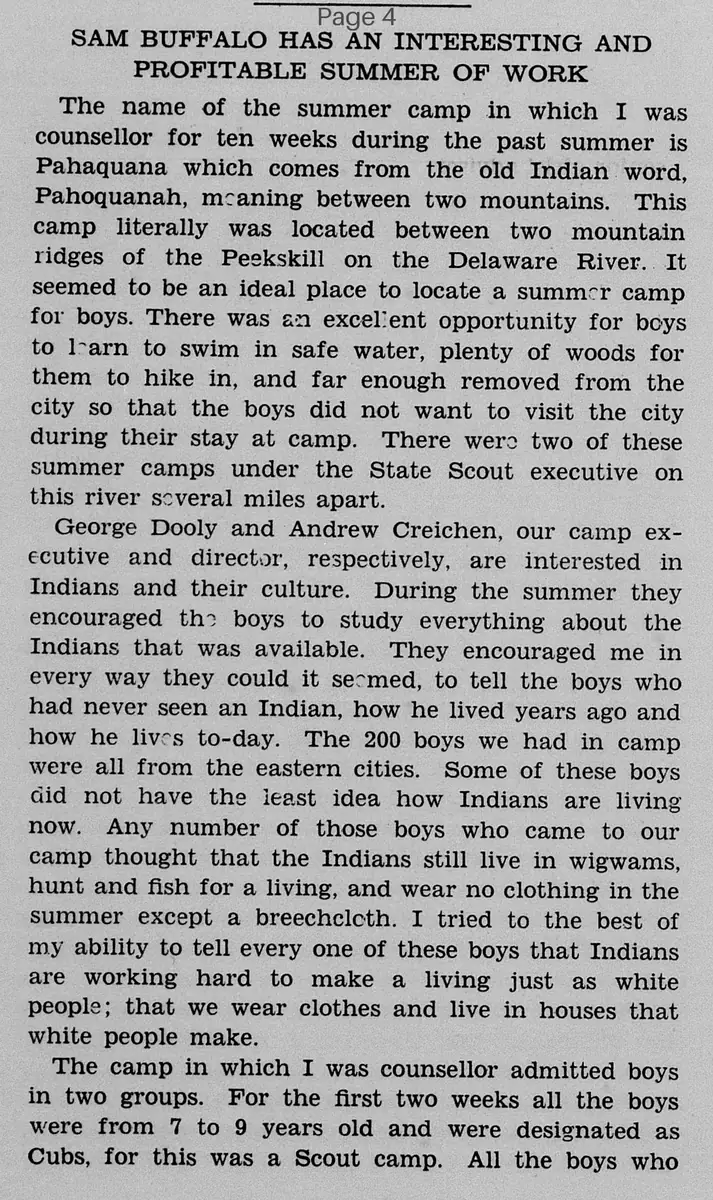
The name of the summer camp in which I was counsellor for ten weeks during the past summer is Pahaquana which comes from the old Indian word, Pahoquanah, meaning between two mountains. This camp literally was located between two mountain ridges of the Peekskill on the Delaware River. It seemed to be an ideal place to locate a summer camp for boys. There was an excellent opportunity for boys to learn to swim in safe water, plenty of woods for them to hike in, and far enough removed from the city so that the boys did not want to visit the city during their stay at camp. There were two of these summer camps under the State Scout executive on this river several miles apart.
George Dooly and Andrew Creichen, our camp executive and director, respectively, are interested in Indians and their culture. During the summer they encouraged the boys to study everything about the Indians that was available. They encouraged me in every way they could it seemed, to tell the boys who had never seen an Indian, how he lived years ago and how he lives to-day. The 200 boys we had in camp were all from the eastern cities. Some of these boys did not have the least idea how Indians are living now. Any number of those boys who came to our camp thought that the Indians still live in wigwams, hunt and fish for a living, and wear no clothing in the summer except a breechclout. I tried to the best of my ability to tell every one of these boys that Indians are working hard to make a living just as white people; that we wear clothes and live in houses that white people make.
The camp in which I was counsellor admitted boys in two groups. For the first two weeks all the boys were from 7 to 9 years old and were designated as Cubs, for this was a Scout camp. All the boys who
came to Camp Pahaquana after the first two weeks were 9 to 18 years old. Many visitors came to the camp during the summer and especially on Sunday there would be as many as 1,000 visitors on the grounds.
I had many duties to perform, however I enjoyed every one of them every day. I discovered that the boys were interested in Indian games, dances, crafts, and stories. I directed the Indian crafts shop where each boy worked for an hour and a half each day.
These boys were interested in making Indian costumes, beadwork, leather pocketbooks and billfolds. I was in charge of the swimming each day, which I enjoyed after the first day. I conducted the camp-fire program one or two evenings each week and almost always I was the story-teller. The work of the camp counsellor is strenuous yet I never heard a single one say that he did not enjoy his work. I enjoyed my work every day, and I think it is right that I should thank those who worked hard last spring to train me for my position.
SAM BUFFALO.
What sub-type of article is it?
What themes does it cover?
What keywords are associated?
What entities or persons were involved?
Where did it happen?
Story Details
Key Persons
Location
Camp Pahaquana, Between Two Mountain Ridges Of The Peekskill On The Delaware River
Event Date
Past Summer
Story Details
Sam Buffalo served as a counselor at a boys' Scout camp, teaching urban children about contemporary Native American life and culture through daily activities, crafts, swimming instruction, and storytelling, while enjoying his duties and appreciating his training.