Thank you for visiting SNEWPapers!
Sign up free
Editorial
September 5, 1963
Minneapolis Spokesman
Minneapolis, Hennepin County, Minnesota
What is this article about?
The editorial opposes the revival of an all-Negro political party proposal ahead of a Washington civil rights rally, arguing it promotes segregation, defeats political goals, harms voting rights efforts, and undermines integration by focusing on race over merit.
Clipping
OCR Quality
98%
Excellent
Full Text
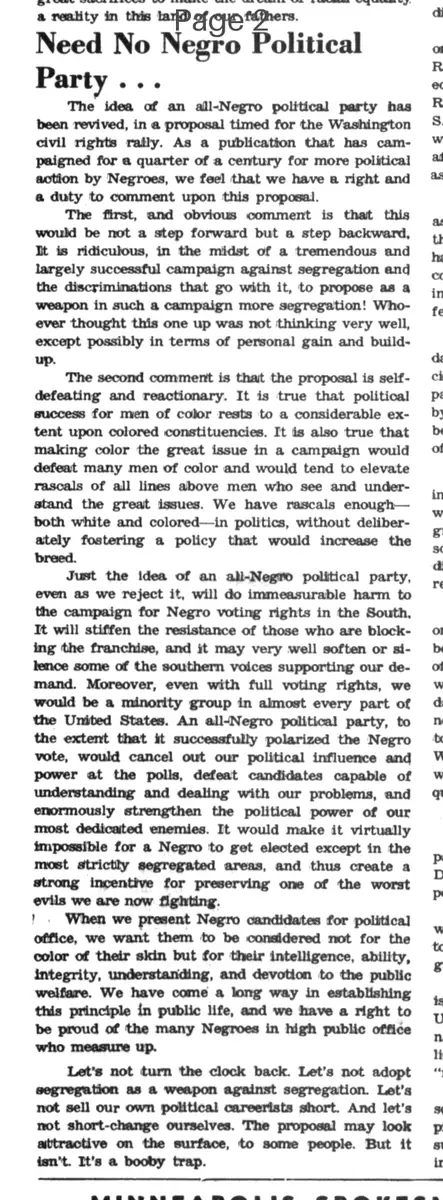
Need No Negro Political Party . . .
The idea of an all-Negro political party has been revived, in a proposal timed for the Washington civil rights rally. As a publication that has campaigned for a quarter of a century for more political action by Negroes, we feel that we have a right and a duty to comment upon this proposal.
The first, and obvious comment is that this would be not a step forward but a step backward. It is ridiculous, in the midst of a tremendous and largely successful campaign against segregation and the discriminations that go with it, to propose as a weapon in such a campaign more segregation! Whoever thought this one up was not thinking very well except possibly in terms of personal gain and build-up.
The second comment is that the proposal is self-defeating and reactionary. It is true that political success for men of color rests to a considerable extent upon colored constituencies. It is also true that making color the great issue in a campaign would defeat many men of color and would tend to elevate rascals of all lines above men who see and understand the great issues. We have rascals enough—both white and colored—in politics, without deliberately fostering a policy that would increase the breed.
Just the idea of an all-Negro political party, even as we reject it, will do immeasurable harm to the campaign for Negro voting rights in the South. It will stiffen the resistance of those who are blocking the franchise, and it may very well soften or silence some of the southern voices supporting our demand. Moreover, even with full voting rights, we would be a minority group in almost every part of the United States. An all-Negro political party, to the extent that it successfully polarized the Negro vote, would cancel out our political influence and power at the polls, defeat candidates capable of understanding and dealing with our problems, and enormously strengthen the political power of our most dedicated enemies. It would make it virtually impossible for a Negro to get elected except in the most strictly segregated areas, and thus create a strong incentive for preserving one of the worst evils we are now fighting.
When we present Negro candidates for political office, we want them to be considered not for the color of their skin but for their intelligence, ability, integrity, understanding, and devotion to the public welfare. We have come a long way in establishing this principle in public life, and we have a right to be proud of the many Negroes in high public office who measure up.
Let's not turn the clock back. Let's not adopt segregation as a weapon against segregation. Let's not sell our own political careerists short. And let's not short-change ourselves. The proposal may look attractive on the surface, to some people. But it isn't. It's a booby trap.
The idea of an all-Negro political party has been revived, in a proposal timed for the Washington civil rights rally. As a publication that has campaigned for a quarter of a century for more political action by Negroes, we feel that we have a right and a duty to comment upon this proposal.
The first, and obvious comment is that this would be not a step forward but a step backward. It is ridiculous, in the midst of a tremendous and largely successful campaign against segregation and the discriminations that go with it, to propose as a weapon in such a campaign more segregation! Whoever thought this one up was not thinking very well except possibly in terms of personal gain and build-up.
The second comment is that the proposal is self-defeating and reactionary. It is true that political success for men of color rests to a considerable extent upon colored constituencies. It is also true that making color the great issue in a campaign would defeat many men of color and would tend to elevate rascals of all lines above men who see and understand the great issues. We have rascals enough—both white and colored—in politics, without deliberately fostering a policy that would increase the breed.
Just the idea of an all-Negro political party, even as we reject it, will do immeasurable harm to the campaign for Negro voting rights in the South. It will stiffen the resistance of those who are blocking the franchise, and it may very well soften or silence some of the southern voices supporting our demand. Moreover, even with full voting rights, we would be a minority group in almost every part of the United States. An all-Negro political party, to the extent that it successfully polarized the Negro vote, would cancel out our political influence and power at the polls, defeat candidates capable of understanding and dealing with our problems, and enormously strengthen the political power of our most dedicated enemies. It would make it virtually impossible for a Negro to get elected except in the most strictly segregated areas, and thus create a strong incentive for preserving one of the worst evils we are now fighting.
When we present Negro candidates for political office, we want them to be considered not for the color of their skin but for their intelligence, ability, integrity, understanding, and devotion to the public welfare. We have come a long way in establishing this principle in public life, and we have a right to be proud of the many Negroes in high public office who measure up.
Let's not turn the clock back. Let's not adopt segregation as a weapon against segregation. Let's not sell our own political careerists short. And let's not short-change ourselves. The proposal may look attractive on the surface, to some people. But it isn't. It's a booby trap.
What sub-type of article is it?
Partisan Politics
Social Reform
Suffrage
What keywords are associated?
Negro Political Party
Civil Rights Rally
Segregation
Voting Rights
Political Integration
Negro Candidates
Editorial Details
Primary Topic
Opposition To All Negro Political Party
Stance / Tone
Strongly Opposed, Viewing It As Backward And Self Defeating
Key Arguments
Proposal Promotes Segregation Amid Anti Segregation Campaign
Self Defeating By Elevating Rascals Over Capable Candidates
Harms Negro Voting Rights Efforts In The South
As A Minority, It Would Cancel Out Political Influence
Candidates Should Be Judged On Merit, Not Color