Thank you for visiting SNEWPapers!
Sign up free
Editorial
July 22, 1833
Event 1 of 2
Phenix Gazette
Alexandria, Virginia
What is this article about?
An 1833 Alexandria Gazette editorial critiques the misuse of outdated Federalist and Democratic party labels in U.S. politics, highlighting inconsistencies among leaders and measures. A second segment debates nullification and state rights with the Richmond Whig, advocating constitutional remedies over secession and defending the Union.
Clipping
OCR Quality
95%
Excellent
Full Text
This is Event 1 of 2. The full text below covers all events in this component.
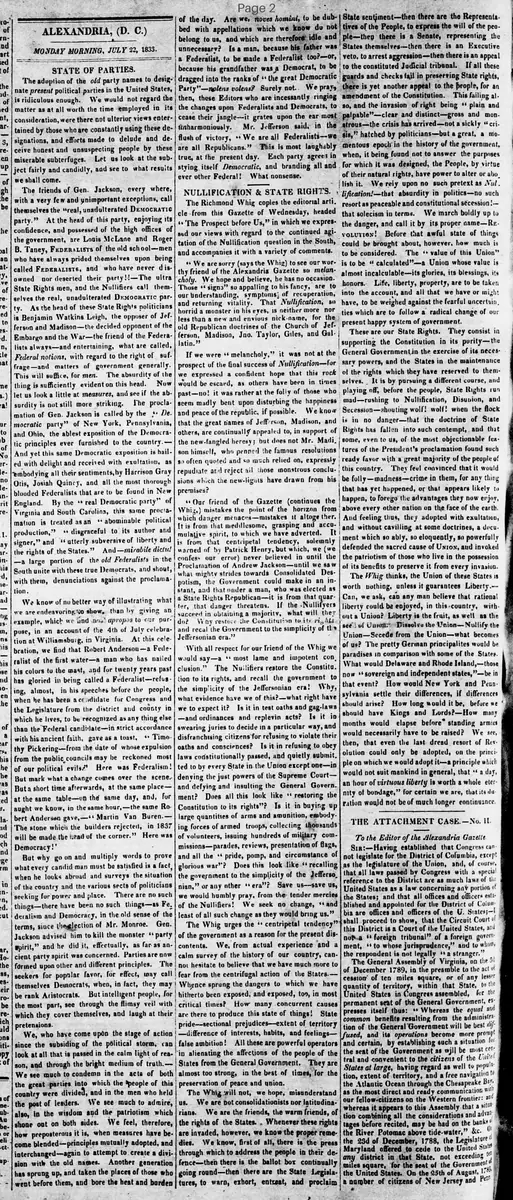
ALEXANDRIA, (D. C.)
MONDAY MORNING, JULY 22, 1833
STATE OF PARTIES.
The adoption of the old party names to designate present political parties in the United States, is ridiculous enough. We would not regard the matter as at all worth the time employed in its consideration, were there not ulterior views entertained by those who are constantly using these designations, and efforts made to delude and deceive honest and unsuspecting people by these miserable subterfuges. Let us look at the subject fairly and candidly, and see to what results we shall come.
The friends of Gen. Jackson, every where, with a very few and unimportant exceptions, call themselves the "real, unadulterated Democratic party." At the head of this party, enjoying its confidence, and possessed of the high offices of the government, are Louis McLane and Roger B. Taney, Federalists of the old school—men who have always prided themselves upon being called Federalists, and who have never disowned nor deserted their party!!—The ultra State Rights men, and the Nullifiers call themselves the real, unadulterated Democratic party. As the head of these State Rights politicians is Benjamin Watkins Leigh, the opposer of Jefferson and Madison—the decided opponent of the Embargo and the War—the friend of the Federalists always—and entertaining, what are called, Federal notions, with regard to the right of suffrage—and matters of government generally.
This will suffice, for men. The absurdity of the thing is sufficiently evident on this head. Now let us look a little at measures, and see if the absurdity is not still more striking. The proclamation of Gen. Jackson is called by the "Democratic party" of New York, Pennsylvania, and Ohio, the ablest exposition of the Democratic principles ever furnished to the country.—And yet this same Democratic exposition is hailed with delight and received with exultation, as embodying all their sentiments, by Harrison Gray Otis, Josiah Quincy, and all the most thorough blooded Federalists that are to be found in New England. By the "real Democratic party" of Virginia and South Carolina, this same proclamation is treated as an "abominable political production," "disgraceful to its author and signer," and "utterly subversive of liberty and the rights of the States." And—mirabile dictu!—a large portion of the old Federalists in the South unite with these true Democrats, and shout, with them, denunciations against the proclamation.
We know of no better way of illustrating what we are endeavoring to show, than by giving an example, which we find no less apropos to our purpose, in an account of the 4th of July celebration at Williamsburg, in Virginia. At this celebration, we find that Robert Anderson—a Federalist of the first water—a man who has nailed his colors to the mast, and for twenty years past has gloried in being called a Federalist—refusing, almost, in his speeches before the people, when he has been a candidate for Congress and the Legislature from the district and county in which he lives, to be recognized as any thing else than the Federal candidate—in strict accordance with his ancient faith, gave as a toast, "Timothy Pickering—from the date of whose expulsion from the public councils may be reckoned most of our political evils?" Here was Federalism! But mark what a change comes over the scene.—But a short time afterwards, at the same place—at the same table—on the same day, and, for aught we know, in the same hour,—the same Robert Anderson gave,—"Martin Van Buren.—The stone which the builders rejected, in 1828 will be made the head of the corner." Here was Democracy!
But why go on and multiply words to prove what every candid man must be satisfied is a fact when he looks abroad and surveys the situation of the country and the various sects of politicians seeking for power and place. There are no such things—there have been no such things—as Federalism and Democracy, in the old sense of the terms, since the election of Mr. Monroe. Gen. Jackson advised him to kill the monster "party spirit," and he did it, effectually, as far as ancient party spirit was concerned. Parties are now formed upon other and different principles. The seekers for popular favor, or effect, may call themselves Democrats, when, in fact, they may be rank Aristocrats. But intelligent people, for the most part, see through the flimsy veil with which they cover themselves, and laugh at their pretensions.
We, who have come upon the stage of action since the subsiding of the political storm, can look at all that is passed in the calm light of reason, and through the bright medium of truth.—We see much to condemn in the acts of both the great parties, into which the people of this country were divided, and in the men who held the post of leaders. We see much to admire, also, in the wisdom and the patriotism which shone out on both sides. We feel, therefore, how preposterous it is, when measures have become blended—principles mutually adopted, and interchanged—again to attempt to create a division with the old names. Another generation has sprung up, and taken the places of those who went before them, and bore the heat and burden of the day. Are we, mere homines, to be dubbed with appellations which we know do not belong to us, and which are therefore idle and unnecessary? Is a man, because his father was a Federalist, to be made a Federalist too?—or, because his grandfather was a Democrat, to be dragged into the ranks of "the great Democratic Party"—nolens volens? Surely not. We pray, then, these Editors who are incessantly ringing the changes upon Federalists and Democrats, to cease their jangle—it grates upon the ear most unharmoniously. Mr. Jefferson said, in the flush of victory, "We are all Federalists—we are all Republicans." This is most laughably true, at the present day. Each party agrees in styling itself Democratic, and branding all and every other Federal! What nonsense.
NULLIFICATION & STATE RIGHTS.
The Richmond Whig copies the editorial article from this Gazette of Wednesday, headed "The Prospect before Us," in which we expressed our views with regard to the continued agitation of the Nullification question in the South, and accompanies it with a variety of comments.
"We are sorry (says the Whig) to see our worthy friend of the Alexandria Gazette so melancholy. We hope and believe, he has no occasion. Those "signs" so appalling to his fancy, are to our understanding, symptoms of recuperation, and returning vitality. That Nullification, so horrid a monster in his eyes, is neither more nor less than a new and envious nick-name, for the old Republican doctrines of the Church of Jefferson, Madison, Jno. Taylor, Giles, and Gallatin."
If we were "melancholy," it was not at the prospect of the final success of Nullification—for we expressed a confident hope that this rock would be escaped, as others have been in times past—no! it was rather at the folly of those who seem madly bent upon disturbing the happiness and peace of the republic, if possible. We know that the great names of Jefferson, Madison, and others, are continually appealed to, in support of the new-fangled heresy; but does not Mr. Madison himself, who penned the famous resolutions so often quoted and so much relied on, expressly repudiate and reject all those monstrous conclusions which the new-lights have drawn from his premises?
"Our friend of the Gazette (continues the Whig,) mistakes the point of the horizon from which danger menaces—mistakes it altogether. It is from that meddlesome, grasping and accumulative spirit, to which we have adverted. It is from that centripetal tendency, solemnly warned of by Patrick Henry, but which, we (we confess our error) never believed in until the Proclamation of Andrew Jackson—until we saw what mighty strides towards Consolidated Despotism, the Government could make in an instant, and that under a man, who was elected as a State Rights Republican—it is from that quarter, that danger threatens. If the Nullifyers succeed in obtaining a majority, what will they do? Why restore the Constitution to its rights and recall the Government to the simplicity of the Jeffersonian era."
With all respect for our Friend of the Whig we would say—a "most lame and impotent conclusion." The Nullifiers restore the Constitution to its rights, and recall the government to the simplicity of the Jeffersonian era! Why, what evidence have we of this?—what right have we to expect it? Is it in test oaths and gag-laws—and ordinances and replevin acts? Is it in swearing juries to decide in a particular way, and disfranchising citizens for refusing to violate their oaths and consciences? Is it in refusing to obey laws constitutionally passed, and quietly submitted to by every State in the Union except one—in denying the just powers of the Supreme Court—and defying and insulting the General Government? Does all this look like "restoring the Constitution to its rights"? Is it in buying up large quantities of arms and ammunition, embodying forces of armed troops, collecting thousands of volunteers, issuing hundreds of military commissions—parades, reviews, presentation of flags, and all the "pride, pomp, and circumstance of glorious war"? Does this look like "recalling the government to the simplicity of the Jeffersonian," or any other "era"? Save us—save us, we would humbly pray, from the tender mercies of the Nullifiers! We seek no change, "and least of all such change as they would bring us."
The Whig urges the "centripetal tendency" of the government as a reason for the present discontents. We, from actual experience and a calm survey of the history of our country, cannot hesitate to believe that we have much more to fear from the centrifugal action of the States.—Whence sprung the dangers to which we have hitherto been exposed, and exposed, too, in most critical times? How many concurrent causes are there to produce this state of things! State pride—sectional prejudices—extent of territory—difference of interests, habits, and feelings—false ambition! All these are powerful operators in alienating the affections of the people of the States from the General Government. They are almost too strong, in the best of times, for the preservation of peace and union.
The Whig will not, we hope, misunderstand us. We are not consolidationists nor latitudinarians. We are the friends, the warm friends, of the rights of the States. Whenever these rights are invaded, however, we know the proper remedies. We know, first of all, there is the press through which to address the people in their defence—then there is the ballot box continually going round—then there are the State Legislatures, to warn, exhort, entreat, and proclaim State sentiment—then there are the Representatives of the People, to express the will of the people—then there is a Senate, representing the States themselves—then there is an Executive veto, to arrest aggression—then there is an appeal to the constituted Judicial tribunal. If all these guards and checks fail in preserving State rights, there is yet another appeal to the people, or an amendment of the Constitution. This failing also, and the invasion of right being "plain and palpable"—clear and distinct—gross and monstrous—the crisis has arrived—not a sickly "crisis," hatched by politicians—but a great, a momentous epoch in the history of the government when, it being found not to answer the purposes for which it was designed, the People, by virtue of their natural rights, have power to alter or abolish it. We rely upon no such pretext as Nullification!—that absurdity in politics—no such resort as peaceable and constitutional secession!—that solecism in terms. We march boldly up to the danger, and call it by its proper name—Revolution! Before that awful state of things could be brought about, however, how much is to be considered. The "value of this Union" is to be "calculated"—a Union whose value is almost incalculable—its glories, its blessings, its honors. Life, liberty, property, are to be taken into the account, and all that we have or might have, to be weighed against the fearful uncertainties which are to follow a radical change of our present happy system of government.
These are our State Rights. They consist in supporting the Constitution in its purity—the General Government in the exercise of its necessary powers, and the States in the maintenance of the rights which they have reserved to themselves. It is by pursuing a different course, and playing off, before the people, State Rights run mad—rushing to Nullification, Disunion, and Secession—shouting wolf! wolf! when the flock is in no danger—that the doctrine of State Rights has fallen into such contempt, and that some, even to us, of the most objectionable features of the President's proclamation found such ready favor with a great majority of the people of this country. They feel convinced that it would be folly—madness—crime in them, for any thing that has yet happened, or that appears likely to happen, to forego the advantages they now enjoy, above every other nation on the face of the earth. And feeling thus, they adopted with exultation, and without cavilling at some doctrines, a document which so ably, so eloquently, so powerfully defended the sacred cause of Union, and invoked the patriotism of those who live in the possession of its benefits to preserve it from every invasion.
The Whig thinks, the Union of these States is worth nothing, unless it guarantees Liberty.—Can, we ask, can any man believe that rational liberty could be enjoyed, in this country, without a Union? Liberty is the fruit, as well as the seed of Union: Dissolve the Union—Nullify the Union—Secede from the Union—what becomes of us? The pretty German principalities would be paradises in comparison with some of the States. What would Delaware and Rhode Island,—those now "sovereign and independent states,"—be in that event? How would New York and Pennsylvania settle their differences, if differences should arise? How long would it be, before we should have Kings and Lords?—How many months would elapse before standing armies would necessarily have to be raised? We see, then, that even the last dread resort of Revolution could only be adopted, on the principle on which we would adopt it—a principle which would not suit mankind in general, that "a day, an hour of virtuous liberty is worth a whole eternity of bondage," for certain we are, that its duration would not be of much longer continuance.
MONDAY MORNING, JULY 22, 1833
STATE OF PARTIES.
The adoption of the old party names to designate present political parties in the United States, is ridiculous enough. We would not regard the matter as at all worth the time employed in its consideration, were there not ulterior views entertained by those who are constantly using these designations, and efforts made to delude and deceive honest and unsuspecting people by these miserable subterfuges. Let us look at the subject fairly and candidly, and see to what results we shall come.
The friends of Gen. Jackson, every where, with a very few and unimportant exceptions, call themselves the "real, unadulterated Democratic party." At the head of this party, enjoying its confidence, and possessed of the high offices of the government, are Louis McLane and Roger B. Taney, Federalists of the old school—men who have always prided themselves upon being called Federalists, and who have never disowned nor deserted their party!!—The ultra State Rights men, and the Nullifiers call themselves the real, unadulterated Democratic party. As the head of these State Rights politicians is Benjamin Watkins Leigh, the opposer of Jefferson and Madison—the decided opponent of the Embargo and the War—the friend of the Federalists always—and entertaining, what are called, Federal notions, with regard to the right of suffrage—and matters of government generally.
This will suffice, for men. The absurdity of the thing is sufficiently evident on this head. Now let us look a little at measures, and see if the absurdity is not still more striking. The proclamation of Gen. Jackson is called by the "Democratic party" of New York, Pennsylvania, and Ohio, the ablest exposition of the Democratic principles ever furnished to the country.—And yet this same Democratic exposition is hailed with delight and received with exultation, as embodying all their sentiments, by Harrison Gray Otis, Josiah Quincy, and all the most thorough blooded Federalists that are to be found in New England. By the "real Democratic party" of Virginia and South Carolina, this same proclamation is treated as an "abominable political production," "disgraceful to its author and signer," and "utterly subversive of liberty and the rights of the States." And—mirabile dictu!—a large portion of the old Federalists in the South unite with these true Democrats, and shout, with them, denunciations against the proclamation.
We know of no better way of illustrating what we are endeavoring to show, than by giving an example, which we find no less apropos to our purpose, in an account of the 4th of July celebration at Williamsburg, in Virginia. At this celebration, we find that Robert Anderson—a Federalist of the first water—a man who has nailed his colors to the mast, and for twenty years past has gloried in being called a Federalist—refusing, almost, in his speeches before the people, when he has been a candidate for Congress and the Legislature from the district and county in which he lives, to be recognized as any thing else than the Federal candidate—in strict accordance with his ancient faith, gave as a toast, "Timothy Pickering—from the date of whose expulsion from the public councils may be reckoned most of our political evils?" Here was Federalism! But mark what a change comes over the scene.—But a short time afterwards, at the same place—at the same table—on the same day, and, for aught we know, in the same hour,—the same Robert Anderson gave,—"Martin Van Buren.—The stone which the builders rejected, in 1828 will be made the head of the corner." Here was Democracy!
But why go on and multiply words to prove what every candid man must be satisfied is a fact when he looks abroad and surveys the situation of the country and the various sects of politicians seeking for power and place. There are no such things—there have been no such things—as Federalism and Democracy, in the old sense of the terms, since the election of Mr. Monroe. Gen. Jackson advised him to kill the monster "party spirit," and he did it, effectually, as far as ancient party spirit was concerned. Parties are now formed upon other and different principles. The seekers for popular favor, or effect, may call themselves Democrats, when, in fact, they may be rank Aristocrats. But intelligent people, for the most part, see through the flimsy veil with which they cover themselves, and laugh at their pretensions.
We, who have come upon the stage of action since the subsiding of the political storm, can look at all that is passed in the calm light of reason, and through the bright medium of truth.—We see much to condemn in the acts of both the great parties, into which the people of this country were divided, and in the men who held the post of leaders. We see much to admire, also, in the wisdom and the patriotism which shone out on both sides. We feel, therefore, how preposterous it is, when measures have become blended—principles mutually adopted, and interchanged—again to attempt to create a division with the old names. Another generation has sprung up, and taken the places of those who went before them, and bore the heat and burden of the day. Are we, mere homines, to be dubbed with appellations which we know do not belong to us, and which are therefore idle and unnecessary? Is a man, because his father was a Federalist, to be made a Federalist too?—or, because his grandfather was a Democrat, to be dragged into the ranks of "the great Democratic Party"—nolens volens? Surely not. We pray, then, these Editors who are incessantly ringing the changes upon Federalists and Democrats, to cease their jangle—it grates upon the ear most unharmoniously. Mr. Jefferson said, in the flush of victory, "We are all Federalists—we are all Republicans." This is most laughably true, at the present day. Each party agrees in styling itself Democratic, and branding all and every other Federal! What nonsense.
NULLIFICATION & STATE RIGHTS.
The Richmond Whig copies the editorial article from this Gazette of Wednesday, headed "The Prospect before Us," in which we expressed our views with regard to the continued agitation of the Nullification question in the South, and accompanies it with a variety of comments.
"We are sorry (says the Whig) to see our worthy friend of the Alexandria Gazette so melancholy. We hope and believe, he has no occasion. Those "signs" so appalling to his fancy, are to our understanding, symptoms of recuperation, and returning vitality. That Nullification, so horrid a monster in his eyes, is neither more nor less than a new and envious nick-name, for the old Republican doctrines of the Church of Jefferson, Madison, Jno. Taylor, Giles, and Gallatin."
If we were "melancholy," it was not at the prospect of the final success of Nullification—for we expressed a confident hope that this rock would be escaped, as others have been in times past—no! it was rather at the folly of those who seem madly bent upon disturbing the happiness and peace of the republic, if possible. We know that the great names of Jefferson, Madison, and others, are continually appealed to, in support of the new-fangled heresy; but does not Mr. Madison himself, who penned the famous resolutions so often quoted and so much relied on, expressly repudiate and reject all those monstrous conclusions which the new-lights have drawn from his premises?
"Our friend of the Gazette (continues the Whig,) mistakes the point of the horizon from which danger menaces—mistakes it altogether. It is from that meddlesome, grasping and accumulative spirit, to which we have adverted. It is from that centripetal tendency, solemnly warned of by Patrick Henry, but which, we (we confess our error) never believed in until the Proclamation of Andrew Jackson—until we saw what mighty strides towards Consolidated Despotism, the Government could make in an instant, and that under a man, who was elected as a State Rights Republican—it is from that quarter, that danger threatens. If the Nullifyers succeed in obtaining a majority, what will they do? Why restore the Constitution to its rights and recall the Government to the simplicity of the Jeffersonian era."
With all respect for our Friend of the Whig we would say—a "most lame and impotent conclusion." The Nullifiers restore the Constitution to its rights, and recall the government to the simplicity of the Jeffersonian era! Why, what evidence have we of this?—what right have we to expect it? Is it in test oaths and gag-laws—and ordinances and replevin acts? Is it in swearing juries to decide in a particular way, and disfranchising citizens for refusing to violate their oaths and consciences? Is it in refusing to obey laws constitutionally passed, and quietly submitted to by every State in the Union except one—in denying the just powers of the Supreme Court—and defying and insulting the General Government? Does all this look like "restoring the Constitution to its rights"? Is it in buying up large quantities of arms and ammunition, embodying forces of armed troops, collecting thousands of volunteers, issuing hundreds of military commissions—parades, reviews, presentation of flags, and all the "pride, pomp, and circumstance of glorious war"? Does this look like "recalling the government to the simplicity of the Jeffersonian," or any other "era"? Save us—save us, we would humbly pray, from the tender mercies of the Nullifiers! We seek no change, "and least of all such change as they would bring us."
The Whig urges the "centripetal tendency" of the government as a reason for the present discontents. We, from actual experience and a calm survey of the history of our country, cannot hesitate to believe that we have much more to fear from the centrifugal action of the States.—Whence sprung the dangers to which we have hitherto been exposed, and exposed, too, in most critical times? How many concurrent causes are there to produce this state of things! State pride—sectional prejudices—extent of territory—difference of interests, habits, and feelings—false ambition! All these are powerful operators in alienating the affections of the people of the States from the General Government. They are almost too strong, in the best of times, for the preservation of peace and union.
The Whig will not, we hope, misunderstand us. We are not consolidationists nor latitudinarians. We are the friends, the warm friends, of the rights of the States. Whenever these rights are invaded, however, we know the proper remedies. We know, first of all, there is the press through which to address the people in their defence—then there is the ballot box continually going round—then there are the State Legislatures, to warn, exhort, entreat, and proclaim State sentiment—then there are the Representatives of the People, to express the will of the people—then there is a Senate, representing the States themselves—then there is an Executive veto, to arrest aggression—then there is an appeal to the constituted Judicial tribunal. If all these guards and checks fail in preserving State rights, there is yet another appeal to the people, or an amendment of the Constitution. This failing also, and the invasion of right being "plain and palpable"—clear and distinct—gross and monstrous—the crisis has arrived—not a sickly "crisis," hatched by politicians—but a great, a momentous epoch in the history of the government when, it being found not to answer the purposes for which it was designed, the People, by virtue of their natural rights, have power to alter or abolish it. We rely upon no such pretext as Nullification!—that absurdity in politics—no such resort as peaceable and constitutional secession!—that solecism in terms. We march boldly up to the danger, and call it by its proper name—Revolution! Before that awful state of things could be brought about, however, how much is to be considered. The "value of this Union" is to be "calculated"—a Union whose value is almost incalculable—its glories, its blessings, its honors. Life, liberty, property, are to be taken into the account, and all that we have or might have, to be weighed against the fearful uncertainties which are to follow a radical change of our present happy system of government.
These are our State Rights. They consist in supporting the Constitution in its purity—the General Government in the exercise of its necessary powers, and the States in the maintenance of the rights which they have reserved to themselves. It is by pursuing a different course, and playing off, before the people, State Rights run mad—rushing to Nullification, Disunion, and Secession—shouting wolf! wolf! when the flock is in no danger—that the doctrine of State Rights has fallen into such contempt, and that some, even to us, of the most objectionable features of the President's proclamation found such ready favor with a great majority of the people of this country. They feel convinced that it would be folly—madness—crime in them, for any thing that has yet happened, or that appears likely to happen, to forego the advantages they now enjoy, above every other nation on the face of the earth. And feeling thus, they adopted with exultation, and without cavilling at some doctrines, a document which so ably, so eloquently, so powerfully defended the sacred cause of Union, and invoked the patriotism of those who live in the possession of its benefits to preserve it from every invasion.
The Whig thinks, the Union of these States is worth nothing, unless it guarantees Liberty.—Can, we ask, can any man believe that rational liberty could be enjoyed, in this country, without a Union? Liberty is the fruit, as well as the seed of Union: Dissolve the Union—Nullify the Union—Secede from the Union—what becomes of us? The pretty German principalities would be paradises in comparison with some of the States. What would Delaware and Rhode Island,—those now "sovereign and independent states,"—be in that event? How would New York and Pennsylvania settle their differences, if differences should arise? How long would it be, before we should have Kings and Lords?—How many months would elapse before standing armies would necessarily have to be raised? We see, then, that even the last dread resort of Revolution could only be adopted, on the principle on which we would adopt it—a principle which would not suit mankind in general, that "a day, an hour of virtuous liberty is worth a whole eternity of bondage," for certain we are, that its duration would not be of much longer continuance.
What sub-type of article is it?
Partisan Politics
Constitutional
What keywords are associated?
Party Names
Federalists
Democrats
Jackson Proclamation
Political Absurdity
State Rights
Nullifiers
What entities or persons were involved?
Gen. Jackson
Louis Mclane
Roger B. Taney
Benjamin Watkins Leigh
Harrison Gray Otis
Josiah Quincy
Robert Anderson
Timothy Pickering
Martin Van Buren
Mr. Monroe
Mr. Jefferson
Editorial Details
Primary Topic
Misuse Of Old Federalist And Democratic Party Labels
Stance / Tone
Critical Of Outdated Party Divisions And Calls For Cessation
Key Figures
Gen. Jackson
Louis Mclane
Roger B. Taney
Benjamin Watkins Leigh
Harrison Gray Otis
Josiah Quincy
Robert Anderson
Timothy Pickering
Martin Van Buren
Mr. Monroe
Mr. Jefferson
Key Arguments
Old Party Names Like Federalist And Democrat Are Ridiculous And Deceptive In Current Politics.
Jackson's Supporters Include Former Federalists Like Mclane And Taney.
State Rights Men And Nullifiers Also Claim To Be The True Democrats, Led By Federalist Leaning Leigh.
Jackson's Proclamation Is Praised By Democrats In Some States But Condemned By Others And New England Federalists.
Example Of Robert Anderson Toasting Both Federalist Pickering And Democrat Van Buren.
Parties Have Changed Since Monroe's Era; Old Spirit Is Dead.
New Generation Should Not Be Bound By Old Labels.
Editors Should Stop Using Old Terms; All Are Now Federalists And Republicans Per Jefferson.