Thank you for visiting SNEWPapers!
Sign up free
Literary
October 21, 1801
The National Intelligencer And Washington Advertiser
Washington, District Of Columbia
What is this article about?
Concluding biography of William Godwin, detailing his 1794 novel Caleb Williams, pamphlet against Lord Eyre's charge, 1795 revised edition of Political Justice with changes on property, politics, marriage, and sincerity; 1796 essays The Enquirer; marriage to Mary Wollstonecraft in 1797, her death, and his 1798 Memoirs of her life, emphasizing his philosophical consistency and character.
Clipping
OCR Quality
98%
Excellent
Full Text
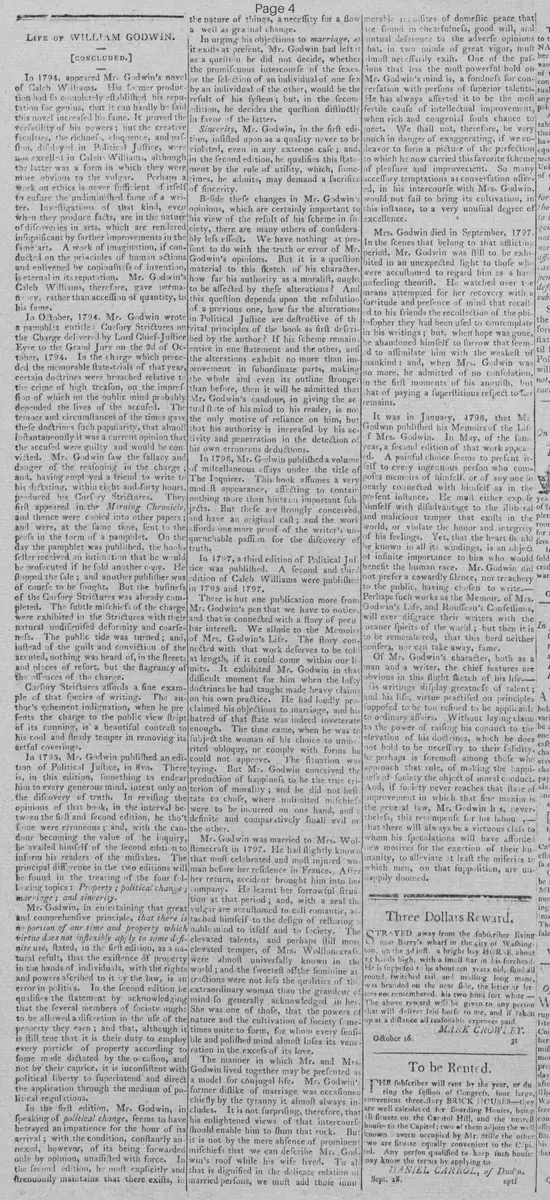
LIFE OF WILLIAM GODWIN.
[Concluded.]
In 1794, appeared Mr. Godwin's novel of Caleb Williams. His former production had so completely established his reputation for genius, that it can hardly be said this novel increased his fame. It proved the versatility of his powers; but the creative faculties, the richness, eloquence, and passion, displayed in Political Justice, were not excelled in Caleb Williams, although the latter was a form in which they were more obvious to the vulgar. Perhaps a work on ethics is never sufficient in itself to ensure the undiminished fame of a writer. Investigations of that kind, even when they produce facts, are in the nature of discoveries in arts, which are rendered insignificant by farther improvements in the same art. A work of imagination, if conducted on the principles of human actions and enlivened by copiousness of invention, is eternal in its reputation. Mr. Godwin's Caleb Williams, therefore, gave permanency, rather than accession of quantity, to his fame.
In October, 1794, Mr. Godwin wrote a pamphlet entitled Cursory Strictures on the Charge delivered by Lord Chief-Justice Eyre to the Grand Jury on the 2d of October, 1794. In the charge which preceded the memorable state-trials of that year, certain doctrines were broached relative to the crime of high treason, on the impression of which on the public mind probably depended the lives of the accused. The temper and circumstances of the times gave these doctrines such popularity, that almost instantaneously it was a current opinion that the accused were guilty and would be convicted. Mr. Godwin saw the fallacy and danger of the reasoning in the charge; and, having employed a friend to write to his dictating, within eight-and-forty hours, produced his Cursory Strictures. They first appeared in the Morning Chronicle, and thence were copied into other papers; and were, at the same time, sent to the press in the form of a pamphlet. On the day the pamphlet was published, the bookseller received an intimation that he would be prosecuted if he sold another copy. He stopped the sale; and another publisher was of course to be sought. But the business of the Cursory Strictures was already completed. The subtle mischiefs of the charge were exhibited in the Strictures with their natural undisguised deformity and coarseness. The public tide was turned: and, instead of the guilt and conviction of the accused, nothing was heard of, in the streets and places of resort, but the flagrancy of the offences of that charge.
Cursory Strictures affords a fine example of that species of writing. The author's vehement indignation, when he presents the charge to the public view stripped of its cunning, is a beautiful contrast to his cool and steady temper in removing its artful coverings.
In 1795, Mr. Godwin published an edition of Political Justice, in 8vo. There is, in this edition, something to endear him to every generous mind, intent only on the discovery of truth. In revising the opinions of that book, in the interval between the first and second edition, he thought one were erroneous; and, with the candour becoming the value of the inquiry he availed himself of the second edition to inform his readers of the mistakes. The principal difference in the two editions will be found in the treating of the four following topics: Property; political change; marriage; and sincerity.
Mr. Godwin, in entertaining that great and comprehensive principle, that there is no portion of our time and property which virtue does not inflexibly apply to some definite use, stated, in the first edition, as a natural result, that the existence of property in the hands of individuals, with the rights and powers ascribed to it by the law, is an error in politics. In the second edition he qualifies the statement by acknowledging that the several members of society ought to be allowed a discretion in the use of the property they earn; and that, although it is still true that it is their duty to employ every particle of property according to some mode dictated by the occasion, and not by their caprice, it is inconsistent with political liberty to superintend and direct the application through the medium of political regulations.
In the first edition, Mr. Godwin, in speaking of political change, seems to have betrayed an impatience for the hour of its arrival; with the condition, constantly annexed, however, of its being forwarded only by opinion, unassisted with force. In the second edition, he most explicitly and strenuously maintains that there exists, in the nature of things, a necessity for a slow as well as gradual change.
In urging his objections to marriage, as it exists at present, Mr. Godwin had left it as a question he did not decide, whether the promiscuous intercourse of the sexes, or the selection of an individual of one sex by an individual of the other, would be the result of his system; but, in the second edition, he decides the question distinctly in favor of the latter.
Sincerity, Mr. Godwin, in the first edition, insisted upon as a quality never to be violated, even in any extreme case; and, in the second edition, he qualifies this statement by the rule of utility, which, sometimes, he admits, may demand a sacrifice of sincerity.
Besides these changes in Mr. Godwin's opinions, which are certainly important to his view of the result of his scheme in society, there are many others of considerably less effect. We have nothing at present to do with the truth or error of Mr. Godwin's opinions. But it is a question material to this sketch of his character, how far his authority as a moralist, ought to be affected by these alterations? And this question depends upon the resolution of a previous one, how far the alterations in Political Justice are destructive of the vital principles of the book as first described by the author? If his scheme remain entire in one statement and the other, and the alterations exhibit no more than improvement in subordinate parts, making the whole and even its outline stronger than before, then it will be admitted that Mr. Godwin's candour, in giving the actual state of his mind to his reader, is not the only motive of reliance on him, but that his authority is increased by his activity and penetration in the detection of his own erroneous deductions.
In 1796, Mr. Godwin published a volume of miscellaneous essays under the title of The Enquirer. This book assumes a very modest appearance, affecting to contain nothing more than hints on important subjects. But these are strongly conceived, and have an original cast; and the work affords one more proof of the writer's unquenchable passion for the discovery of truth.
In 1797, a third edition of Political Justice was published. A second and third edition of Caleb Williams were published in 1795 and 1797.
There is but one publication more from Mr. Godwin's pen that we have to notice, and that is connected with a story of peculiar interest. We allude to the Memoirs of Mrs. Godwin's Life. The story connected with that work deserves to be told at length, if it could come within our limits. It exhibited Mr. Godwin in that difficult moment for him when the lofty doctrines he had taught made heavy claims on his own practice. He had loudly proclaimed his objections to marriage, and his hatred of that state was indeed inveterate enough. The time came, when he was to subject the woman of his choice to unmerited obloquy, or comply with forms he could not approve. The situation was trying. But Mr. Godwin conceived the production of happiness to be the true criterion of morality; and he did not hesitate to choose, where unlimited mischiefs were to be incurred on one hand, and a definite and comparatively small evil on the other.
Mr. Godwin was married to Mrs. Wollstonecraft in 1797. He had slightly known that most celebrated and most injured woman before her residence in France. After her return, accident brought him into her company. He learnt her sorrowful situation at that period: and, with a zeal that the vulgar are accustomed to call romantic, attached himself to the design of restoring a noble mind to itself and to society. The elevated talents, and perhaps still more elevated temper, of Mrs. Wollstonecraft were almost universally known in the world; and the sweetest of the feminine attractions were not less the qualities of this extraordinary woman than the grandeur of mind so generally acknowledged in her. She was one of those, that the powers of nature and the cultivation of society sometimes unite to form, for whom every ensible and polished mind almost loses its veneration in the excess of its love.
The manner in which Mr. and Mrs. Godwin lived together may be presented as a model for conjugal life. Mr. Godwin's former dislike of marriage was occasioned chiefly by the tyranny it almost always includes. It is not surprising, therefore, that his enlightened views of that intercourse should enable him to shun that rock. But it is not by the mere absence of prominent mischiefs that we can describe Mr. Godwin's roof while his wife lived. To all that is dignified in the delicate relation of married persons, we must add those innumerable trifles of domestic peace that are found in cheerfulness, good will, and mutual deference to the adverse opinions that, in two minds of great vigor, must almost necessarily exist. One of the passions that has the most powerful hold on Mr. Godwin's mind is, a fondness for conversation with persons of superior talents. He has always asserted it to be the most fertile cause of intellectual improvement, when rich and congenial souls chance to meet. We shall not, therefore, be very much in danger of exaggerating, if we endeavor to form a picture of the perfection to which he now carried this favorite scheme of pleasure and improvement. So many accessory temptations as conversation offered, in his intercourse with Mrs. Godwin, would not fail to bring its cultivation, in this instance, to a very unusual degree of excellence.
Mrs. Godwin died in September, 1797. In the scenes that belong to that afflicting period, Mr. Godwin was still to be exhibited in an unexpected light to those who were accustomed to regard him as a hard unfeeling theorist. He watched over the means attempted for her recovery with a fortitude and presence of mind that recalled to his friends the recollection of the philosopher they had been used to contemplate in his writings; but, when hope was gone, he abandoned himself to sorrow that seemed to assimilate him with the weakest of mankind: and, when Mrs. Godwin was no more, he admitted of no consolation in the first moments of his anguish, but that of paying a superstitious respect to her remains.
It was in January, 1798, that Mr. Godwin published his Memoirs of the Life of Mrs. Godwin. In May, of the same year, a second edition of that work appeared. A painful choice seems to present itself to every ingenuous person who composes memoirs of himself, or of any one so nearly connected with himself as in the present instance. He must either expose himself with disadvantage to the illiberal and malicious temper that exists in the world, or violate the honor and integrity of his feelings. Yet, that the heart should be known in all its windings, is an object of infinite importance to him who would benefit the human race. Mr. Godwin did not prefer a cowardly silence, nor treachery to the public, having chosen to write. Perhaps such works as the Memoirs of Mrs. Godwin's Life, and Rousseau's Confessions, will ever disgrace their writers with the meaner spirits of the world; but then it is to be remembered, that this herd neither confers, nor can take away, fame.
Of Mr. Godwin's character, both as a man and a writer, the chief features are obvious in this slight sketch of his life. His writings display greatness of talent; and his life, virtue practised on principles supposed to be too refined to be applicable to ordinary affairs. Without laying claim to the power of raising his conduct to the elevation of his doctrines, which he does not hold to be necessary to their solidity, he perhaps is foremost among those who approach that rule, of making the happiness of society the object of moral conduct. And, if society never reaches that state of improvement in which that fine maxim is the general law, Mr. Godwin has, nevertheless, this recompense for his labors—that there will always be a virtuous class to whom his speculations will have afforded new motives for the exertion of their humanity, to alleviate at least the miseries to which men, on that supposition, are unhappily doomed.
What sub-type of article is it?
Essay
What themes does it cover?
Political
Moral Virtue
Liberty Freedom
What keywords are associated?
William Godwin
Political Justice
Caleb Williams
Mary Wollstonecraft
Cursory Strictures
The Enquirer
Memoirs
Marriage Objections
Philosophical Revisions
Moral Philosophy
Literary Details
Title
Life Of William Godwin. [Concluded.]
Subject
Biographical Sketch Of William Godwin's Later Works, Revisions, Marriage, And Character
Form / Style
Biographical Essay In Prose
Key Lines
A Work Of Imagination, If Conducted On The Principles Of Human Actions And Enlivened By Copiousness Of Invention, Is Eternal In Its Reputation.
The Public Tide Was Turned: And, Instead Of The Guilt And Conviction Of The Accused, Nothing Was Heard Of, In The Streets And Places Of Resort, But The Flagrancy Of The Offences Of That Charge.
Mr. Godwin's Candour, In Giving The Actual State Of His Mind To His Reader, Is Not The Only Motive Of Reliance On Him, But That His Authority Is Increased By His Activity And Penetration In The Detection Of His Own Erroneous Deductions.
The Manner In Which Mr. And Mrs. Godwin Lived Together May Be Presented As A Model For Conjugal Life.
He Perhaps Is Foremost Among Those Who Approach That Rule, Of Making The Happiness Of Society The Object Of Moral Conduct.