Thank you for visiting SNEWPapers!
Sign up free
Editorial
September 5, 1811
Virginia Argus
Richmond, Virginia
What is this article about?
Editorial debates whether the US should go to war with Britain over demands for tribute, citing recent judicial decisions, vessel captures under piratic orders, and British naval preparations for American waters, urging defense of commerce and rejection of tribute.
Clipping
OCR Quality
98%
Excellent
Full Text
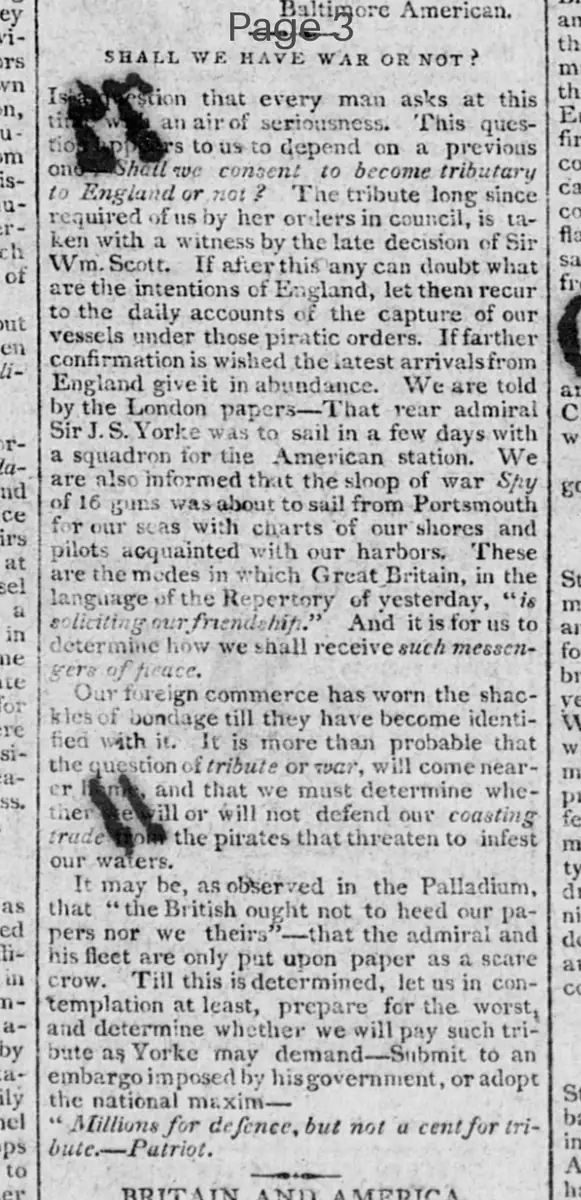
SHALL WE HAVE WAR OR NOT?
It is a question that every man asks at this time with an air of seriousness. This question to us appears to depend on a previous one—Shall we consent to become tributary to England or not? The tribute long since required of us by her or lords in council, is taken with a witness by the late decision of Sir Wm. Scott. If after this any can doubt what are the intentions of England, let them recur to the daily accounts of the capture of our vessels under those piratic orders. If farther confirmation is wished the latest arrivals from England give it in abundance. We are told by the London papers—That rear admiral Sir J. S. Yorke was to sail in a few days with a squadron for the American station. We are also informed that the sloop of war Sly of 16 guns was about to sail from Portsmouth for our seas with charts of our shores and pilots acquainted with our harbors. These are the modes in which Great Britain, in the language of the Repertory of yesterday, "is soliciting our friendship." And it is for us to determine how we shall receive such messengers of peace.
Our foreign commerce has worn the shackles of bondage till they have become identified with it. It is more than probable that the question of tribute or war, will come nearer home, and that we must determine whether we will or will not defend our coasting trade from the pirates that threaten to infest our waters.
It may be, as observed in the Palladium, that "the British ought not to heed our papers nor we theirs"—that the admiral and his fleet are only put upon paper as a scare crow. Till this is determined, let us in contemplation at least, prepare for the worst, and determine whether we will pay such tribute as Yorke may demand—Submit to an embargo imposed by his government, or adopt the national maxim—
"Millions for defence, but not a cent for tribute."—Patriot.
It is a question that every man asks at this time with an air of seriousness. This question to us appears to depend on a previous one—Shall we consent to become tributary to England or not? The tribute long since required of us by her or lords in council, is taken with a witness by the late decision of Sir Wm. Scott. If after this any can doubt what are the intentions of England, let them recur to the daily accounts of the capture of our vessels under those piratic orders. If farther confirmation is wished the latest arrivals from England give it in abundance. We are told by the London papers—That rear admiral Sir J. S. Yorke was to sail in a few days with a squadron for the American station. We are also informed that the sloop of war Sly of 16 guns was about to sail from Portsmouth for our seas with charts of our shores and pilots acquainted with our harbors. These are the modes in which Great Britain, in the language of the Repertory of yesterday, "is soliciting our friendship." And it is for us to determine how we shall receive such messengers of peace.
Our foreign commerce has worn the shackles of bondage till they have become identified with it. It is more than probable that the question of tribute or war, will come nearer home, and that we must determine whether we will or will not defend our coasting trade from the pirates that threaten to infest our waters.
It may be, as observed in the Palladium, that "the British ought not to heed our papers nor we theirs"—that the admiral and his fleet are only put upon paper as a scare crow. Till this is determined, let us in contemplation at least, prepare for the worst, and determine whether we will pay such tribute as Yorke may demand—Submit to an embargo imposed by his government, or adopt the national maxim—
"Millions for defence, but not a cent for tribute."—Patriot.
What sub-type of article is it?
War Or Peace
Foreign Affairs
What keywords are associated?
War Or Tribute
British Aggression
American Defense
Vessel Captures
Naval Preparations
Coasting Trade
What entities or persons were involved?
England
Sir Wm. Scott
Sir J. S. Yorke
Great Britain
Editorial Details
Primary Topic
Whether To Consent To British Tribute Or Go To War
Stance / Tone
Urging Preparation For Defense And Rejection Of Tribute
Key Figures
England
Sir Wm. Scott
Sir J. S. Yorke
Great Britain
Key Arguments
War Depends On Consenting To Become Tributary To England
British Tribute Enforced By Sir Wm. Scott's Decision
England's Intentions Shown By Captures Of Us Vessels Under Piratic Orders
Rear Admiral Sir J. S. Yorke To Sail With Squadron To American Station
Sloop Of War Sly Preparing To Sail To Us Seas With Charts And Pilots
Defend Coasting Trade From British Pirates
Prepare For Worst Rather Than Pay Tribute Or Submit To Embargo
Adopt Maxim: Millions For Defence, But Not A Cent For Tribute