Thank you for visiting SNEWPapers!
Sign up free
Editorial
October 21, 1915
The Mirror
Stillwater, Washington County, Minnesota
What is this article about?
This editorial from the O.P. News discusses the purpose of prison journalism as a medium for inmates to express thoughts, desires, and achievements, aiming to inform the public about prison conditions and humanize prisoners beyond their crimes, promoting mutual understanding and penal reform.
Clipping
OCR Quality
98%
Excellent
Full Text
Established 1887
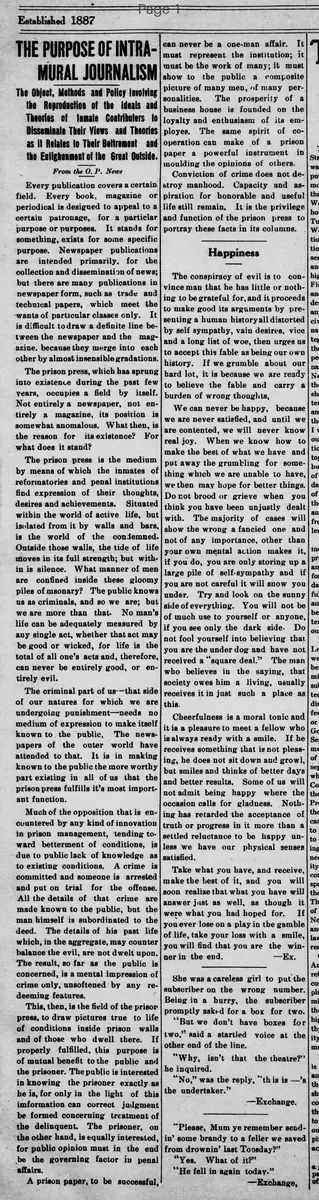
THE PURPOSE OF INTRA-MURAL JOURNALISM
The Object, Methods and Policy Involving the Reproduction of the Ideals and Theories of Inmate Contributors to Disseminate Their Views and Theories as it Relates to Their Betterment and the Enlightenment of the Great Outside.
From the O. P. News
Every publication covers a certain field. Every book, magazine or periodical is designed to appeal to a certain patronage, for a particular purpose or purposes. It stands for something, exists for some specific purpose. Newspaper publications are intended primarily, for the collection and dissemination of news; but there are many publications in newspaper form, such as trade and technical papers, which meet the wants of particular classes only. It is difficult to draw a definite line between the newspaper and the magazine, because they merge into each other by almost insensible gradations.
The prison press, which has sprung into existence during the past few years, occupies a field by itself. Not entirely a newspaper, not entirely a magazine, its position is somewhat anomalous. What then, is the reason for its existence? For what does it stand?
The prison press is the medium by means of which the inmates of reformatories and penal institutions find expression of their thoughts, desires and achievements. Situated within the world of active life, but isolated from it by walls and bars, is the world of the condemned. Outside those walls, the tide of life moves in its full strength; but within is silence. What manner of men are confined inside these gloomy piles of masonry? The public knows us as criminals, and so we are; but we are more than that. No man's life can be adequately measured by any single act, whether that act may be good or wicked, for life is the total of all one's acts and, therefore, can never be entirely good, or entirely evil.
The criminal part of us--that side of our natures for which we are undergoing punishment--needs no medium of expression to make itself known to the public. The newspapers of the outer world have attended to that. It is in making known to the public the more worthy part existing in all of us that the prison press fulfills its most important function.
Much of the opposition that is encountered by any kind of innovation in prison management, tending toward betterment of conditions, is due to public lack of knowledge as to existing conditions. A crime is committed and someone is arrested and put on trial for the offense. All the details of that crime are made known to the public, but the man himself is subordinated to the deed. The details of his past life which, in the aggregate, may counterbalance the evil, are not dwelt upon. The result, so far as the public is concerned, is a mental impression of crime only, unsoftened by any redeeming features.
This, then, is the field of the prison press, to draw pictures true to life of conditions inside prison walls and of those who dwell there. If properly fulfilled, this purpose is of mutual benefit to the public and the prisoner. The public is interested in knowing the prisoner exactly as he is, for only in the light of this information can correct judgment be formed concerning treatment of the delinquent. The prisoner, on the other hand, is equally interested, for public opinion must in the end be the governing factor in penal affairs.
A prison paper, to be successful,
What sub-type of article is it?
Crime Or Punishment
Social Reform
What keywords are associated?
Prison Press
Inmate Expression
Penal Reform
Public Enlightenment
Prison Conditions
What entities or persons were involved?
Inmates
Public
Prison Press
O. P. News
Editorial Details
Primary Topic
Purpose Of Prison Journalism
Stance / Tone
Advocacy For Inmate Expression And Public Enlightenment
Key Figures
Inmates
Public
Prison Press
O. P. News
Key Arguments
- prison press allows inmates to express thoughts, desires, and achievements beyond their criminal acts.
- public views prisoners only through crime details, lacking knowledge of their full lives.
- informing the public about prison conditions counters opposition to reforms.
- mutual benefit: public gains accurate understanding for better penal treatment; prisoners influence public opinion.
- life cannot be judged by a single act; prison press highlights worthy aspects of inmates.