Thank you for visiting SNEWPapers!
Sign up free
Story
July 22, 1962
Atlanta Daily World
Atlanta, Fulton County, Georgia
What is this article about?
In 1962, forty U.S. Army scientists at Fort Detrick developed artificial super bacteria for biological warfare, combining hereditary traits like toxin production and antibiotic resistance, based on prior genetic discoveries.
Clipping
OCR Quality
98%
Excellent
Full Text
ATLANTA DAILY WORLD
Sunday, July 22, 1962
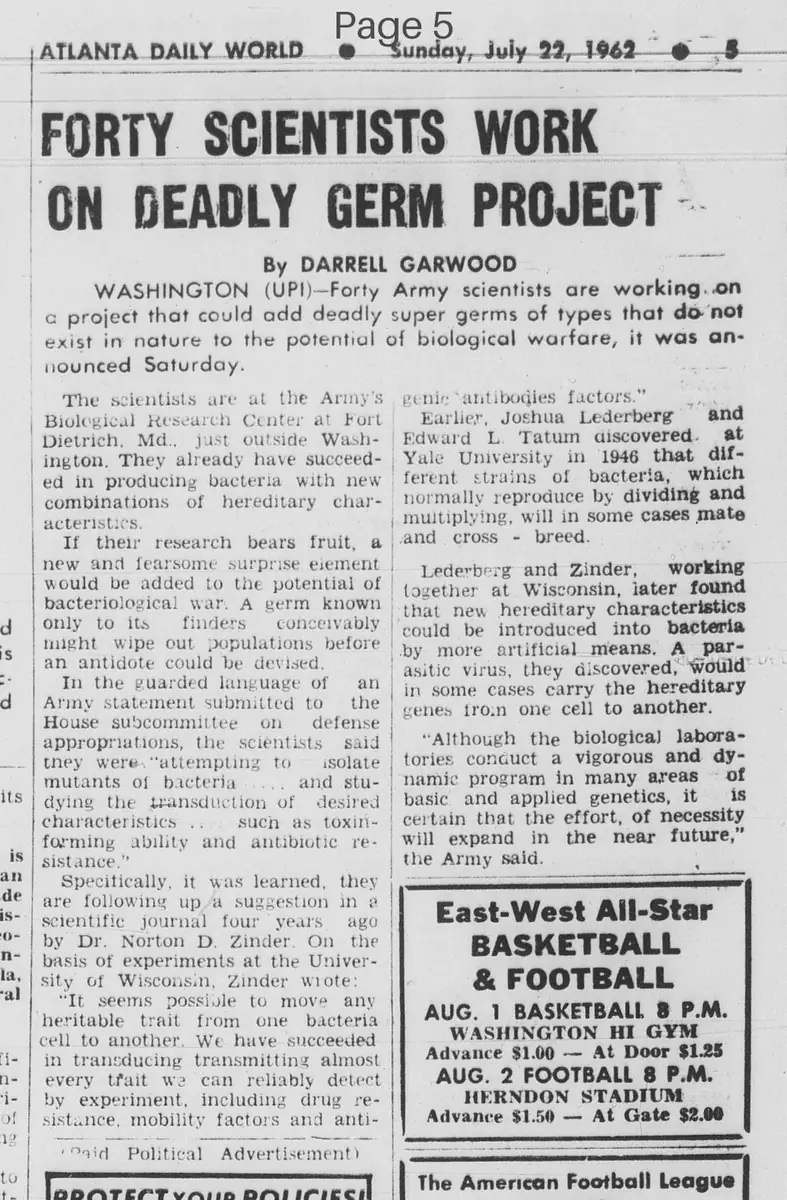
FORTY SCIENTISTS WORK
ON DEADLY GERM PROJECT
By DARRELL GARWOOD
WASHINGTON (UPI)-Forty Army scientists are working on a project that could add deadly super germs of types that do not exist in nature to the potential of biological warfare, it was announced Saturday.
The scientists are at the Army's Biological Research Center at Fort Dietrich, Md. just outside Washington. They already have succeeded in producing bacteria with new combinations of hereditary characteristics.
If their research bears fruit, a new and fearsome surprise element would be added to the potential of bacteriological war. A germ known only to its finders conceivably might wipe out populations before an antidote could be devised.
In the guarded language of an Army statement submitted to the House subcommittee on defense appropriations, the scientists said they were "attempting to isolate mutants of bacteria and studying the transduction of desired characteristics .. such as toxin-forming ability and antibiotic resistance."
Specifically, it was learned, they are following up a suggestion in a scientific journal four years ago by Dr. Norton D. Zinder. On the basis of experiments at the University of Wisconsin, Zinder wrote: "It seems possible to move any heritable trait from one bacteria cell to another We have succeeded in transducing (transmitting) almost every trait we can reliably detect by experiment, including drug resistance, mobility factors and antigenic (antibody) factors."
Earlier, Joshua Lederberg and Edward L. Tatum discovered, at Yale University in 1946 that different strains of bacteria, which normally reproduce by dividing and multiplying, will in some cases mate and cross-breed.
Lederberg and Zinder, working together at Wisconsin, later found that new hereditary characteristics could be introduced into bacteria by more artificial means. A parasitic virus, they discovered, would in some cases carry the hereditary genes from one cell to another.
"Although the biological laboratories conduct a vigorous and dynamic program in many areas of basic and applied genetics, it is certain that the effort, of necessity will expand in the near future," the Army said.
Sunday, July 22, 1962
FORTY SCIENTISTS WORK
ON DEADLY GERM PROJECT
By DARRELL GARWOOD
WASHINGTON (UPI)-Forty Army scientists are working on a project that could add deadly super germs of types that do not exist in nature to the potential of biological warfare, it was announced Saturday.
The scientists are at the Army's Biological Research Center at Fort Dietrich, Md. just outside Washington. They already have succeeded in producing bacteria with new combinations of hereditary characteristics.
If their research bears fruit, a new and fearsome surprise element would be added to the potential of bacteriological war. A germ known only to its finders conceivably might wipe out populations before an antidote could be devised.
In the guarded language of an Army statement submitted to the House subcommittee on defense appropriations, the scientists said they were "attempting to isolate mutants of bacteria and studying the transduction of desired characteristics .. such as toxin-forming ability and antibiotic resistance."
Specifically, it was learned, they are following up a suggestion in a scientific journal four years ago by Dr. Norton D. Zinder. On the basis of experiments at the University of Wisconsin, Zinder wrote: "It seems possible to move any heritable trait from one bacteria cell to another We have succeeded in transducing (transmitting) almost every trait we can reliably detect by experiment, including drug resistance, mobility factors and antigenic (antibody) factors."
Earlier, Joshua Lederberg and Edward L. Tatum discovered, at Yale University in 1946 that different strains of bacteria, which normally reproduce by dividing and multiplying, will in some cases mate and cross-breed.
Lederberg and Zinder, working together at Wisconsin, later found that new hereditary characteristics could be introduced into bacteria by more artificial means. A parasitic virus, they discovered, would in some cases carry the hereditary genes from one cell to another.
"Although the biological laboratories conduct a vigorous and dynamic program in many areas of basic and applied genetics, it is certain that the effort, of necessity will expand in the near future," the Army said.
What sub-type of article is it?
Historical Event
Curiosity
Extraordinary Event
What themes does it cover?
Exploration
Catastrophe
Triumph
What keywords are associated?
Biological Warfare
Super Germs
Bacterial Research
Genetic Transduction
Fort Detrick
What entities or persons were involved?
Darrell Garwood
Norton D. Zinder
Joshua Lederberg
Edward L. Tatum
Where did it happen?
Fort Detrick, Md.
Story Details
Key Persons
Darrell Garwood
Norton D. Zinder
Joshua Lederberg
Edward L. Tatum
Location
Fort Detrick, Md.
Event Date
July 22, 1962
Story Details
Forty Army scientists at Fort Detrick are working to create deadly super germs by isolating bacterial mutants and transducing traits like toxin-forming ability and antibiotic resistance, building on discoveries by Zinder, Lederberg, and Tatum.