Thank you for visiting SNEWPapers!
Sign up free
Whig Republican
Lexington, Holmes County, Mississippi
What is this article about?
William Winans writes to Levi C. Harris, confirming his presence at the 1810 Vincennes conference between Gen. William H. Harrison and Tecumseh. He defends Harrison's bravery, patriotism, and political integrity against slanders during the 1840 presidential campaign, affirming Harrison's fitness for presidency.
Merged-components note: These three sequential components form a single continuous letter to the editor from William Winans regarding General Harrison.
Clipping
OCR Quality
Full Text
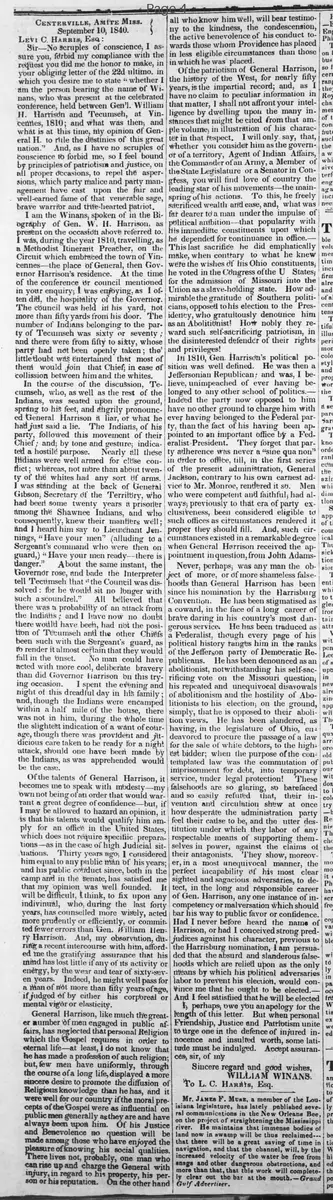
September 10, 1840.
Levi C. Harris, Esq:
Sir—No scruples of conscience, I assure you, forbid my compliance with the request you did me the honor to make, in your obliging letter of the 22d ultimo, in which you desire me to state "whether I am the person bearing the name of Winans, who was present at the celebrated conference, held between Gen'l. William H. Harrison and Tecumseh, at Vincennes, 1810; and what was then, and what is at this time, my opinion of General H. to rule the destinies of this great nation." And, as I have no scruples of conscience to forbid me, so I feel bound by principles of patriotism and justice, on all proper occasions, to repel the aspersions, which party malice and party management have cast upon the fair and well-earned fame of that venerable sage, brave warrior and true-hearted patriot.
I am the Winans, spoken of in the Biography of Gen. W. H. Harrison, as present on the occasion above referred to. I was, during the year 1810, travelling, as a Methodist Itinerant Preacher, on the Circuit which embraced the town of Vincennes—the place of General, then Governor Harrison's residence. At the time of the conference or council mentioned in your enquiry; I was enjoying, as I often did, the hospitality of the Governor. The council was held in his yard, not more than fifty yards from his door. The number of Indians belonging to the party of Tecumseh was sixty or seventy: and there were from fifty to sixty, whose party had not been openly taken; though little doubt was entertained that most of them would join that Chief: in case of collision between him and the whites.
In the course of the discussion, Tecumseh, who, as well as the rest of the Indians, was seated upon the ground, sprang to his feet, and angrily pronounced General Harrison a liar, or what he had just said a lie. The Indians, of his party, followed this movement of their Chief; and, by tone and gesture, indicated a hostile purpose. Nearly all these Indians were well armed for close conflict: whereas, not more than about twenty of the whites had any sort of arms.
I was standing at the back of General Gibson; Secretary of the Territory, who had been some twenty years a prisoner among the Shawnee Indians, and who consequently, knew their manners well: and I heard him say to Lieutenant Jennings, "Have your men" (alluding to a Sergeant's command who were then on guard,) "Have your men ready—there is danger."
About the same instant, the Governor rose, and bade the Interpreter tell Tecumseh that "the Council was dissolved: for he would sit no longer with such a scoundrel."
All believed that there was a probability of an attack from the Indians: and I have now no doubt there would have been, had not the position of Tecumseh and the other Chiefs been such with the Sergeant's guard, as to render it almost certain that they would fall in the onset.
No man could have acted with more cool, deliberate bravery than did Governor Harrison on this trying occasion. I spent the evening and night of this dreadful day in his family; and, though the Indians were encamped within a half mile of the house, there was not in him, during the whole time the slightest indication of a want of courage, though there was provident and judicious care taken to be ready for a night attack, should one have been made by the Indians, as was apprehended would be the case.
Of the talents of General Harrison, it becomes me to speak with modesty—my own not being of an order that would warrant a great degree of confidence; but, if I may be allowed to hazard an opinion, it is that his talents would qualify him amply for an office in the United States, which does not require specific preparations—as in the case of high Judicial situations. Thirty years ago, I considered him equal to any public man of his years; and his public conduct since, both in the camp and in the senate, has satisfied me that my opinion was well founded. It will be difficult, I think, to fix upon any individual, who, during the last forty years, has counselled more wisely, acted more prudently or efficiently, or committed fewer errors than Gen. William Henry Harrison. And, my observation, during a recent intercourse with him, afforded me the gratifying assurance that his mind has lost little if any of its activity or energy, by the wear and tear of sixty-seven years. Indeed, he might well pass for a man of not more than fifty years of age, if judged of by either his corporeal or mental vigor or elasticity.
General Harrison, like much the greater number of men engaged in public affairs, has neglected that personal Religion which the Gospel requires in order to eternal life—at least, I do not know that he has made a profession of such religion; but, few men have uniformly, through the course of a long life, displayed a more sincere desire to promote the diffusion of Religious knowledge than he has, and it were well for our country if the moral precepts of the Gospel were as influential on public men generally as they are and have always been upon him. Of his Justice and Benevolence no question will be made among those who have enjoyed the pleasure of knowing his social qualities. There lives not, probably, one man who can rise up and charge the General with injury, in regard to his property, his person or his reputation. On the other hand
all who know him well, will bear testimony to the kindness, the condescension, the active benevolence of his conduct towards those whom Providence has placed in less eligible circumstances than those in which he was placed.
Of the patriotism of General Harrison, the history of the West, for nearly fifty years, is the impartial record; and, as I have no claim to peculiar information in that matter, I shall not affront your intelligence by dwelling upon the many instances that might be cited from that ample volume, in illustration of his character in that respect. I will only say, that whether you consider him as the governor of a territory, Agent of Indian Affairs, the Commander of an Army, a Member of the State Legislature or a Senator in Congress, you will find love of country the leading star of his movements—the main-spring of his actions. To this, he freely sacrificed wealth and ease, and, what was far dearer to a man under the impulse of political ambition—that popularity with his immediate constituents upon which he depended for continuance in office.
This last sacrifice he did emphatically make, when contrary to what he knew were the wishes of his Ohio constituents, he voted in the Congress of the U States, for the admission of Missouri into the Union as a slave-holding state. How admirable the gratitude of Southern politicians, opposed to his election to the Presidency, who gratuitously denounce him as an Abolitionist! How nobly they reward such self-sacrificing patriotism, in the disinterested defender of their rights and privileges!
In 1810, Gen. Harrison's political position was well defined. He was then a Jeffersonian Republican: and was, I believe, unimpeached of ever having belonged to any other school of politics. Indeed the party now opposed to him have no other ground to charge him with ever having belonged to the Federal party, than the fact of his having been appointed to an important office by a Federalist President. They forget that party adherence was never a "sine qua non" in order to office, till, in the first series of the present administration. General Jackson, contrary to his own earnest advice to Mr. Monroe, rendered it so. Men who were competent and faithful, had always, previously to that era of party exclusiveness, been considered eligible to such offices as circumstances rendered it proper they should fill. And, such circumstances existed in a remarkable degree when General Harrison received the appointment in question, from John Adams.
Never, perhaps, was any man the object of more, or of more shameless falsehoods than General Harrison has been since his nomination by the Harrisburg Convention. He has been stigmatised as a coward, in the face of a long career of brave daring in his country's most dangerous service. He has been traduced as a Federalist, though every page of his political history ranges him in the ranks of the Jefferson party of Democratic Republicans. He has been denounced as an abolitionist, notwithstanding his self-sacrificing vote on the Missouri question; his repeated and unequivocal disavowals of abolitionism and the hostility of Abolitionists to his election; on the ground, simply, that he is opposed to their abolition views. He has been slandered, as having, in the legislature of Ohio, endeavored to procure the passage of a law for the sale of white debtors, to the highest bidder; when the purpose of the contemplated law was the commutation of imprisonment for debt, into temporary service, under legal protection! These falsehoods are so glaring, so barefaced and so easily refuted that, their invention and circulation shew at once how desperate the administration party feel their cause to be, and the utter destitution under which they labor of any respectable means of supporting themselves in power, against the claims of their antagonists. They show, moreover, in a most unequivocal manner, the perfect incapability of his most clear sighted and sagacious adversaries, to detect, in the long and responsible career of Gen. Harrison, any one instance of incompetency or malversation which should bar his way to public favor or confidence.
Had I never before heard the name of Harrison, or had I conceived strong prejudices against his character, previous to the Harrisburg nomination, I am persuaded that the absurd and slanderous falsehoods which are relied upon as the only means by which his political adversaries labor to prevent his election, would convince me that he ought to be elected. And I feel satisfied that he will be elected
I perhaps owe you an apology for the length of this letter. But when personal Friendship, Justice and Patriotism unite to urge one in the defence of injured innocence and insulted worth, some latitude must be indulged. Accept assurances,
sir, of my
Sincere regard and good wishes.
WILLIAM WINANS:
To L. C. Harris, Esq.
What sub-type of article is it?
What themes does it cover?
What keywords are associated?
What entities or persons were involved?
Letter to Editor Details
Author
William Winans
Recipient
Levi C. Harris, Esq.
Main Argument
william winans affirms he is the winans present at the 1810 vincennes conference and defends gen. harrison's bravery, talents, patriotism, and political integrity against partisan slanders, concluding he is eminently qualified to lead the nation as president.
Notable Details
- eyewitness account of tecumseh calling harrison a liar and near-attack at 1810 council
- harrison's cool bravery and preparations against indian threat
- vote for missouri as slave state despite constituent opposition
- refutation of charges of cowardice, federalism, abolitionism, and debtor sale law