Thank you for visiting SNEWPapers!
Sign up free
Southern Christian Advocate
Charleston, Charleston County, South Carolina
What is this article about?
Two 19th-century religious texts: 'The Living Sacrifice,' an essay by Rev. John Worthington on self-resignation as central to Christian duty and godliness (1830); and a Methodist catechism for instructing enslaved Black people in basic Christian beliefs, covering God, creation, sin, Christ, judgment, duties, creed, and sacraments.
Merged-components note: These two sequential components form a single coherent catechism for Methodist missionaries instructing negroes, starting with the preface in the first and chapters in the second.
Clipping
OCR Quality
Full Text
This is Event 1 of 2. The full text below covers all events in this component.
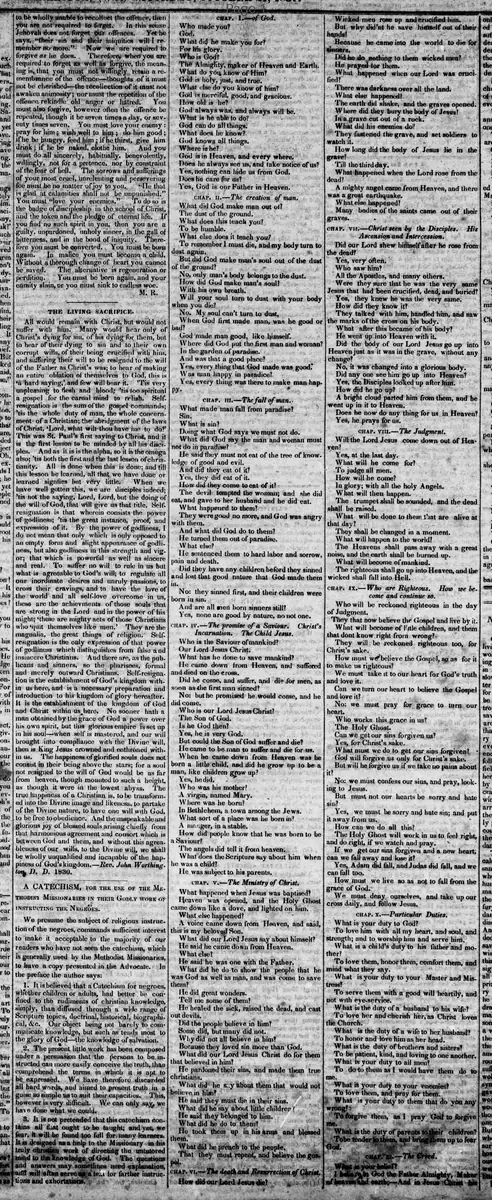
All would remain with Christ, but would not suffer with him. Many would hear only of Christ's dying for sin, of his dying for them, but to hear of their dying to sin and to their own corrupt wills, of their being crucified with him, and suffering their will to be resigned to the will of the Father as Christ's was; to hear of making an entire oblation of themselves to God, this is 'hard saying,' and few will bear it. 'Tis very unpleasing to flesh and blood; 'tis too spiritual a gospel for the carnal mind to relish. Self-resignation is the sum of the gospel commands; 'tis the whole duty of man, the whole concernment of a Christian; the abridgment of the laws of Christ. "Lord, what wilt thou have me to do?" This was St. Paul's first saying to Christ, and it is the first lesson to be minded by all his disciples. And as it is the alpha, so it is the omega also; 'tis both the first and the last lesson of Christianity. All is done when this is done; and till this lesson be learned, all that we have done or learned signifies but very little. When we have well gotten this, we are disciples indeed; 'tis not the saying, Lord, Lord, but the doing of the will of God, that will give us that title. Self-resignation is that wherein consists the power of godliness; 'tis the great instance, proof, and expression of it. By the power of godliness, I do not mean that only which is only opposed to an empty form and slight appearance of godliness, but also godliness in this strength and vigor; that which is powerful as well as sincere and real. To suffer no will to rule in us but what is agreeable to God's will; to regulate all our inordinate desires and unruly passions, to cross their cravings, and to have the love of the world and all self-love overcome in us, these are the achievements of those souls that are strong in the Lord and in the power of his might; these are mighty acts of those Christians who quit themselves like men. They are the magnalia, the great things of religion. Self-resignation is the only expression of that power of godliness which distinguishes from false and insincere Christians. And there are, as the publicans and sinners, so the pharisees, formal and merely outward Christians. Self-resignation is the establishment of God's kingdom within us here, and is a necessary preparation and introduction to his kingdom of glory hereafter. It is the establishment of the kingdom of God and Christ within us here. No sooner hath a man obtained by the grace of God a power over his own spirit, but this glorious empire is set up in his soul—when self is mastered, and our will brought into compliance with the Divine will, then is King Jesus crowned and enthroned within us. The happiness of glorified souls does not consist in their being above the stars; for a soul not resigned to the will of God would be as far from heaven, though mounted to such a height, as though it were in the lowest abyss. The true happiness of a Christian is, to be transformed into the Divine image and likeness, to partake of the Divine nature, to have one will with God, to be free to obedience. And the unspeakable and glorious joy of blessed souls arising chiefly from that harmonious agreement and consort which is between God and them, and without this agreeableness of our wills to the Divine will, we shall be wholly unqualified and incapable of the happiness of God's kingdom.—Rev. John Worthington, D. D. 1830.
A CATECHISM, FOR THE USE OF THE METHODIST MISSIONARIES IN THEIR GODLY WORK OF INSTRUCTING THE NEGROES.
We presume the subject of religious instruction of the negroes, commands sufficient interest to make it acceptable to the majority of our readers who have not seen the catechism, which is generally used by the Methodist Missionaries, to have a copy presented in the Advocate. In the preface the author says:
1. It is believed that a Catechism for negroes, whether children or adults, had better be confined to the rudiments of christian knowledge, simply, than diffused through a wide range of Scripture topics, doctrinal, historical, biographical, &c. Our object being not barely to communicate knowledge, but such as tends most to the glory of God—the knowledge of salvation.
2. The present little work has been composed under a persuasion that the persons to be instructed can more easily conceive the truth, than comprehend the terms in which it is apt to be expressed. We have therefore discarded all hard words, and aimed to present truth in a guise so simple as to suit their capacities. This, however is very difficult. We can only say, we have done what we could.
3. It is not pretended that this catechism contains all that ought to be taught; and yet, we fear, it will be found too full for many learners. It is designed as a help to the Missionary in his truly christian work of directing the untutored mind to the knowledge of God. The questions and answers may sometimes need explanation, and will often serve as a text for farther instructions and exhortations.
CHAP. I. Of God.
Who made you?
God.
Who is God?
The Almighty, maker of Heaven and Earth.
What do you know of Him?
God is holy, just, and true: forgives sin.
What else do you know of him?
How old is he?
God has always been.
What is he able to do?
God can do all things.
Where is he?
God is in Heaven, and every where.
Does he always see us, and take notice of us?
Yes, nothing can hide us from God.
Does he care for us?
Yes.
God knows all things.
What does he know?
CHAP. I.—The creation of man.
What did God make man out of?
The dust of the ground.
What does this teach you?
To be humble.
What else does it teach you?
To remember I must die, and my body turn to dust again.
But did God make man's soul out of the dust of the ground?
No, only man's body belongs to the dust.
How did God make man's soul?
With his own breath.
Will your soul turn to dust with your body when you die?
No. My soul can't turn to dust.
When God first made man, was he good or bad?
God made man good, like himself.
Where did God put the first man and woman?
In the garden of paradise.
And was that a good place?
Yes, every thing that God made was good.
Was man happy in paradise?
Yes, every thing was there to make man happy.
CHAP. II.—The fall of man.
What made man fall from paradise?
Sin.
What is sin?
Doing what God says we must not do.
What did God say the man and woman must not do in paradise?
He said they must not eat of the tree of knowledge of good and evil.
And did they eat of it?
Yes, they did eat of it.
How did they come to eat of it?
The devil tempted the woman; and she did eat, and gave to her husband and he did eat.
What happened to them?
They were good no more, and God was angry with them.
And what did God do to them?
He turned them out of paradise.
What else?
He sentenced them to hard labor and sorrow, pain and death.
Did they have any children before they sinned and lost that good nature that God made them in?
No: they sinned first, and their children were born in sin.
And are all men born sinners still?
Yes, none are good by nature, no not one.
CHAP. III.—The promise of a Saviour. Christ's Incarnation. The Child Jesus.
Who is the Saviour of mankind?
Our Lord Jesus Christ.
What has he done to save mankind?
He came down from Heaven, and suffered and died on the cross.
Did he come, and suffer, and die for men, as soon as the first man sinned?
No: but he promised he would come, and he did come.
Who is our Lord Jesus Christ?
The Son of God.
Is he God then?
Yes, he is very God.
But could the Son of God suffer and die?
He came to be man to suffer and die for us.
When he came down from Heaven was he born a little child, and did he grow up to be a man, like children grow up?
Yes, he did.
Who was his mother?
A virgin, named Mary.
Where was he born?
In Bethlehem, a town among the Jews.
What sort of a place was he born in?
A manger, in a stable.
How did people know that he was born to be a Saviour?
The angels did tell it from heaven.
What does the Scripture say about him when he was a child?
He was subject to his parents.
CHAP. IV.—The Ministry of Christ.
What happened when Jesus was baptised?
Heaven was opened, and the Holy Ghost came down like a dove, and lighted on him.
What else happened?
A voice came down from Heaven, and said, this is my beloved Son.
What did our Lord Jesus say about himself?
He said he came down from Heaven.
What else?
He said he was one with the Father.
What did he do to show the people that he was God as well as man, and was come to save them?
He did great wonders.
Tell me some of them?
He healed the sick, raised the dead, and cast out devils.
Did the people believe in him?
Some did, but many did not.
Why did not all believe in him?
Because they loved sin more than God.
What did our Lord Jesus Christ do for them that believed in him?
He pardoned their sins, and made them true christians.
What did he say about them that would not believe in him?
He said they must die in their sins.
What did he say about little children?
He said they belonged to him.
What did he do to them?
He took them up in his arms and blessed them.
What did he preach to the people?
That they must repent, and believe the gospel.
CHAP. V.—The death and Resurrection of Christ.
How did our Lord Jesus die?
Wicked men rose up and crucified him.
But, why didn't he save himself out of their hands?
Because he came into the world to die for sinners.
Did he do nothing to them wicked men?
He prayed for them.
What happened when our Lord was crucified?
There was darkness over all the land.
What else happened?
The earth did shake, and the graves opened.
Where did they bury the body of Jesus?
In a grave cut out of a rock.
What did his enemies do?
They fastened the grave, and set soldiers to watch it.
How long did the body of Jesus lie in the grave?
Till the third day.
What happened when the Lord rose from the dead?
A mighty angel came from Heaven, and there was a great earthquake.
What else happened?
Many bodies of the saints came out of their graves.
CHAP. VI.—Christ seen by the Disciples. His Ascension and Intercession.
Did our Lord shew himself after he rose from the dead?
Yes, very often.
Who saw him?
All the Apostles, and many others.
Were they sure that he was the very same Jesus that had been crucified, dead, and buried?
Yes, they knew he was the very same.
How did they know it?
They talked with him, handled him, and saw the marks of the cross on his body.
What after this became of his body?
He went up into Heaven with it.
Did the body of our Lord Jesus go up into Heaven just as it was in the grave, without any change?
No, it was changed into a glorious body.
Did any one see him go up into Heaven?
Yes, the Disciples looked up after him.
How did he go up?
A bright cloud parted him from them, and he went up in it to Heaven.
Does he now do any thing for us in Heaven?
Yes, he prays for us.
CHAP. VII.—The Judgment.
Will the Lord Jesus come down out of Heaven?
Yes, at the last day.
What will he come for?
To judge all men.
How will he come?
In glory; with all the holy Angels.
What will then happen?
The trumpet shall be sounded, and the dead shall be raised.
What will be done to them that are alive at that day?
They shall be changed in a moment.
What will happen to the world?
The Heavens shall pass away with a great noise, and the earth shall be burned up.
What will become of mankind?
The righteous shall go up into Heaven, and the wicked shall fall into Hell.
CHAP. VIII.—Who are Righteous. How we become and continue so.
Who will be reckoned righteous in the day of Judgment?
They that now believe the Gospel and live by it.
What will become of little children, and them that don't know right from wrong?
They will be reckoned righteous too, for Christ's sake.
How must we believe the Gospel, so as for it to make us righteous?
We must take it to our heart as God's truth and love it.
Can we turn our heart to believe the Gospel and love it?
No: we must pray for grace to turn our heart.
Who works this grace in us?
The Holy Ghost.
Can we get our sins forgiven?
Yes, for Christ's sake.
What must we do to get our sins forgiven?
God will forgive us only for Christ's sake.
But will he forgive us if we take no pains about it?
No: we must confess our sins, and pray, looking to Jesus.
But must not our hearts be sorry and hate sin?
Yes, we must be sorry and hate sin; and put it away from us.
How can we do all this?
The Holy Ghost will work in us to feel right and do right, if we watch and pray.
If we get our sins forgiven and a new heart; can we fall away and lose it?
Yes, Adam did fall, and Judas did fall, and we can fall too.
How must we live so as not to fall from the grace of God?
We must deny ourselves, and take up our cross daily, and follow Jesus.
CHAP. IX.—Particular Duties.
What is your duty to God?
To love him with all my heart, and soul, and strength; and to worship him and serve him.
What is a child's duty to his father and mother?
To love them, honor them, comfort them, and mind what they say.
What is your duty to your Master and Mistress?
To serve them with a good will heartily, and not with eye-service.
What is the duty of a husband to his wife?
To love her and cherish her, as Christ loves the Church.
What is the duty of a wife to her husband?
To honor and love him as her head.
What is the duty of brothers and sisters?
To be patient, kind, and loving to one another.
What is your duty to all men?
To do to them as I would have them do to me.
What is your duty to your enemies?
To love them, and pray for them.
What is your duty to them that do you any wrong?
To forgive them, as I pray God to forgive me.
What is the duty of parents to their children?
To be tender to them, and bring them up to fear God.
The Creed.
What is your belief of God?
I believe in God the Father Almighty, Maker of heaven and earth; And in Jesus Christ his only begotten Son, our Lord; who was conceived by the Holy Ghost, born of the Virgin Mary, suffered under Pontius Pilate, was crucified, dead, and buried; the third day he rose from the dead; he ascended into Heaven; and sitteth on the right hand of God the Father Almighty; from thence he shall come to judge the quick and the dead. I believe in the Holy Ghost; the holy Catholic church; the communion of saints; the forgiveness of sins; the resurrection of the body; and the life everlasting.
You believe in God the Father, and the Son, and the Holy Ghost, are these three God or one God only?
The Father, and the Son, and the Holy Ghost are one God.
Can you tell how these three are one?
No: we cannot find out God.
How then can you believe it is so?
Because God says it is so.
You believe that the Son of God was conceived by the Holy Ghost, and born of the Virgin Mary; can you tell how that could be?
No: but God knows: nothing is hard for him.
Who was Pontius Pilate?
The Governor, that let the Jews crucify Jesus.
What do you mean by the Catholic Church?
It means the Church of Christ.
Who belong to this Church?
All true Christians.
CHAP. X.—The Sacraments.
1. What is Baptism?
'Tis a sign of the grace of God that makes us Christians.
2. Does Baptism make us Christians?
No: water can't make us christians: grace makes us christians.
3. Who works that grace in us to make us Christians?
The Holy Ghost.
4. What do you promise, when you come to be baptised?
I promise to renounce the Devil, and the world, and the flesh, so that I will not follow them into any sin.
What other promise do you make?
I promise to keep God's holy will and commandments.
How can you keep these promises?
Only by God's grace.
Ought little children to be baptised?
Yes, they belong to Christ.
5. What is the Sacrament of the Lord's Supper taken for?
In remembrance of our Lord Jesus Christ, who died for us.
What does the bread of the holy Sacrament shew to us?
The body of Christ broken for us.
What does the cup shew to us?
The blood of Christ shed for us.
Who ought to take this Sacrament?
All christian people.
How often ought we to take it?
As often as we can.
How ought we to take it?
With an humble loving heart, sorry for sin.
6. Is it not very wicked for people to take the Sacrament when they live in known sin; and, in particular, if they have any quarrel or grudge against another?
Yes: if we take the Sacrament so, we make it bad for us.
What sub-type of article is it?
What themes does it cover?
What keywords are associated?
What entities or persons were involved?
Literary Details
Title
The Living Sacrifice.
Author
Rev. John Worthington, D. D. 1830.
Key Lines