Thank you for visiting SNEWPapers!
Sign up free
Literary
May 26, 1878
Daily Globe
Saint Paul, Ramsey County, Minnesota
What is this article about?
Posey Brice, a sickly glassworker from Indiana, arrives in California seeking health on a mesa. Hosted by the Brandts, he works to build a home for his wife Loisy and son, sends money for their travel, fears abandonment when they don't arrive, but they reunite after her illness delayed them.
Clipping
OCR Quality
98%
Excellent
Full Text
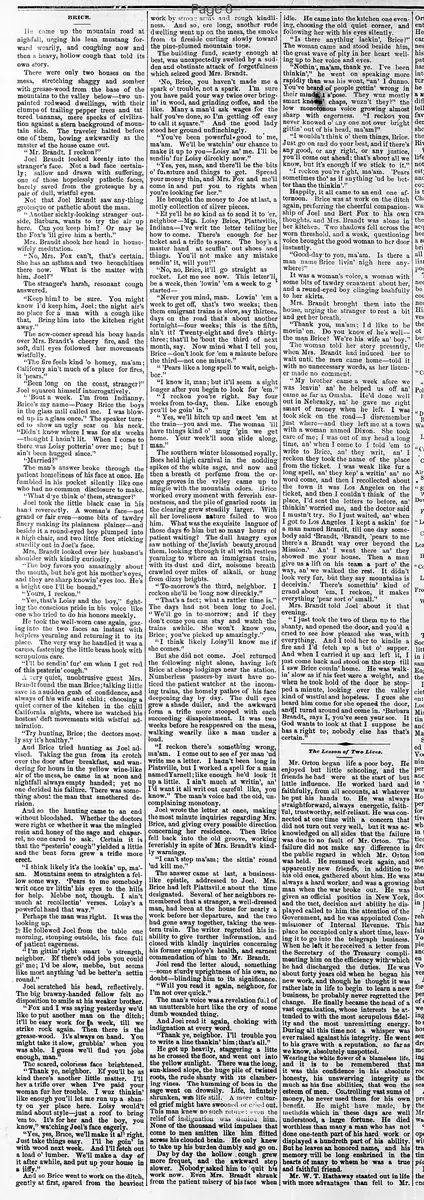
BRICE.
He came up the mountain road at nightfall, urging his lean mustang forward wearily, and coughing now and then a heavy, hollow cough that told its own story.
There were only two houses on the mesa, stretching shaggy and somber with grease-wood from the base of the mountains to the valley below—two unpainted redwood dwellings, with their clumps of trailing pepper trees and tattered bananas, mere specks of civilization against a stern background of mountain side. The traveler halted before one of them, bowing awkwardly as the master of the house came out.
"Mr. Brandt, I reckon?"
Joel Brandt looked keenly into the stranger's face. Not a bad face, certainly; sallow and drawn with suffering, one of those hopelessly pathetic faces, barely saved from the grotesque by a pair of dull, wistful eyes.
Not that Joel Brandt saw anything grotesque or pathetic about the man.
"Another sickly-looking stranger outside, Barbara, wants to try the air up here. Can you keep him? Or maybe the Fox's'll give him a berth."
Mrs. Brandt shook her head in housewifely meditation.
"No. Mrs. Fox can't, that's certain. She has an asthma and two bronchitises there now. What is the matter with him, Joel?"
The stranger's harsh, resonant cough answered.
"Keep him? To be sure. You might know I'd keep him, Joel; the night air's no place for a man with a cough like that. Bring him into the kitchen right away."
The new-comer spread his bony hands over Mrs. Brandt's cheery fire, and the soft, dull eyes followed her movements wistfully.
"The fire feels kind o' homey, ma'am; Californy ain't much of a place for fires, it 'pears."
"Been long on the coast, stranger?"
Joel squared himself interrogatively.
"'Bout a week. I'm from Indianny. Brice's my name—Posey Brice the boys in the glass mill called me. I was blowed up in a glass once." The speaker turned to show an ugly scar on his neck.
"Didn't know where I was for six weeks—thought I hadn't lit. When I come to there was Loisy potterin' over me; but I ain't been hugged since."
"Married?"
The man's answer broke through the patient homeliness of his face at once. He fumbled in his pocket silently like one who had no common disclosure to make.
"What d'ye think o' them, stranger?"
Joel took the little black case in his hand reverently. A woman's face—not grand or fair even—some bits of tawdry finery making its plainness plainer—and beside it a round-eyed boy plumped into a high chair, and two little feet sticking sturdily out in Joel's face.
Mrs. Brandt looked over her husband's shoulder with kindly curiosity.
"The boy favors you amazingly about the mouth, but he's got his mother's eyes, and they are sharp knowin' eyes too. He's a bright one I'll be bound. Yours, I reckon."
"Yes, that's Loisy and the boy," fighting the conscious pride in his voice like one who tried to do his honors meekly.
He took the well-worn case again, gazing into the two faces an instant with helpless yearning and returning it to its place. The very way he handled it was a caress, fastening the little brass hook with scrupulous care.
"I'll be sendin' fur 'em when I get red of this pesterin' cough."
A very quiet, unobtrusive guest Mrs. Brandt found the man Brice; talking little save in a sudden gush of confidence, and always of his wife and child; choosing a quiet corner of the kitchen in the chill California nights, where he watched his hostess' deft movements with wistful admiration.
"Try hunting, Brice; the doctors mostly say it's healthy."
And Brice tried hunting as Joel advised. Taking the gun from its crotch over the door after breakfast, and wandering for hours in the yellow wine-like air of the mesa, he came in at noon and nightfall always empty handed; yet no one derided his failure. There was something about the man that smothered derision.
And so the hunting came to an end without bloodshed. Whether the doctors were right or whether it was the mingled resin and honey of the sage and chaparral, no one cared to ask. Certain it is that the "pesterin' cough" yielded a little and the bent form grew a trifle more erect.
"I think likely it's the lookin' up, ma'am. Mountains seem to straighten a fellow some way. 'Pears to me somebody writ once uv liftin' his eyes to the hills for help. Mebbe not, though. I ain't much at recolectin' verses. Loisy's a powerful hand that way."
Perhaps the man was right. It was the looking up.
He followed Joel from the table one morning, stopping outside, his face full of patient eagerness.
"I'm gittin' right smart o' strength, neighbor. Ef there's odd jobs you could gi' me; I'd be slow, mebbe, but seein's like most anything 'ud be better'n settin' round."
Joel scratched his head, reflectively. The big brawny-handed fellow felt no disposition to smile at his weaker brother.
"Fox and I was saying yesterday we'd like to put another man on the ditch: it'll be easy work fur a week, till we strike rock again. Then there is the grease-wood. It's always on hand. You might take it slow, grubbin' when you was able. I guess we'll find you jobs enough, man."
The scared, colorless face brightened.
"Thank ye, neighbor. Ef you'll be as kind there's another little matter. I'll hev a trifle over when I've paid your woman fur her trouble. I wuz thinkin' like enough you'll let me run up a shanty on yer place here. Loisy wouldn't mind about style—just a roof to bring 'em to. It's for her and the boy, you know," watching Joel's face eagerly.
"Yes, yes, Brice, we'll make it all right. Just take things easy. I'll be goin' in with wood next week. And I'll fetch out a load o' lumber. We'll make a day of it after awhile, and put up your house in a jiffy."
And so Brice went to work on the ditch, gently at first, spared from the heaviest work by strong arms and rough kindness. And so, ere long, another rude dwelling went up on the mesa, the smoke from its fireside curling slowly toward the pine-plumed mountain tops.
The building fund, scanty enough at best, was unexpectedly swelled by a sudden and obstinate attack of forgetfulness which seized good Mrs. Brandt.
"No, Brice, you haven't made me a spark o' trouble, not a spark. I'm sure you have paid your way twice over bringing in wood, and grinding coffee, and the like. Many a man'd ask wages for the half you've done, so I'm getting off easy to call it square." And the good lady stood her ground unflinchingly.
"You've been powerful good to me, ma'am. We'll be watchin' our chance to make it up to you—Loisy an' me. I'll be sendin' fur Loisy direckly now."
"Yes, yes, man, and there'll be the bits o' furniture and things to get. Spread your money thin, and Mrs. Fox and me'll come in and put you to rights when you're looking for her."
He brought the money to Joel at last, a motley collection of silver pieces.
"Ef ye'll be so kind as to send it to her, neighbor—Mrs. Loisy Brice, Plattsville, Indiana—I've writ the letter telling her how to come. There's enough for her ticket and a trifle to spare. The boy's a master hand at scuttlin' out shoes and things. You'll not make any mistake sending it, will you?"
"No, no, Brice, it'll go straight as a rocket. Let me see now. This letter'll be a week, then 'lowin' 'em a week to get started—"
"Never you mind, man. 'Lowin' 'em a week to get off, that's two weeks; then them emigrant trains is slow, say thirteen days on the road that's about another fortnight—four weeks; this is the fifth, ain't it? Twenty-eight and five's thirty-three: that'll be 'bout the third of next month, say. Now mind what I tell you Brice—don't look for 'em a minute before the third—not one minute."
"'Pears like a long spell to wait, neighbor."
"I know it, man; but it'll seem a sight longer after you begin to look for 'em."
"I reckon you're right. Say four weeks from to-day, then. Like enough you'll be goin' in."
"Yes, we'll hitch up and meet 'em at the train—you and me. The women'll have things kind o' snug 'gin we get home. Your week'll soon slide along, man."
The southern winter blossomed royally. Bees held high carnival in the nodding spikes of the white sage, and now and then a breath of perfume from the orange groves in the valley came up to mingle with the mountain odors. Brice worked every moment with feverish earnestness, and the pile of gnarled roots in the clearing grew steadily larger. With all her loveliness nature failed to woo him. What was the exquisite languor of those days to him but so many hours of patient waiting? The dull hungry eyes saw nothing of the lavish beauty around them, looking through it all with restless yearning to where an immigrant train, with its dust and dirt, noisome breath crawled over miles of alkali, or hung from dizzy heights.
"To-morrow's the third, neighbor. I reckon she'll be 'long now direckly."
"That's a fact; what a rattler time is."
The days had not been long to Joel.
"We'll go in to-morrow; and if they don't come you can stay and watch the trains awhile. She won't know you, Brice; you've picked up amazingly."
"I think likely Loisy'll know me if she comes."
But she did not come. Joel returned the following night alone, having left Brice at cheap lodgings near the station. Numberless passers-by must have noticed the patient watcher at the incoming trains, the homely pathos of his face deepening day by day. The dull eyes grew a shade duller, and the awkward form a trifle more stooped with each succeeding disappointment. It was two weeks before he reappeared on the mesa, walking wearily like a man under a load.
"I reckon there's something wrong, ma'am. I come out to see ef yer man 'ud write me a letter. I hadn't been long in Plattsville, but I worked a spell for a man named Yarnell; like enough he'd look it up a little. I ain't much at writin', an' I'd want it all writ out careful like, you know." The man's voice had the old, uncomplaining monotony.
Joel wrote the letter at once, making the most minute inquiries regarding Mrs. Brice, and giving every possible direction concerning her residence. Then Brice fell back into the old groove, working feverishly in spite of Mrs. Brandt's kindly warnings.
"I can't stop ma'am; the sittin' round 'ud kill me."
The answer came at last, a business-like epistle, addressed to Joel. Mrs. Brice had left Plattsville about the time designated. Several of her neighbors remembered that a stranger, a well-dressed man, had been at the house for nearly a week before her departure, and the two had gone away together, taking the western train. The writer regretted his inability to give further information, and closed with kindly inquiries concerning his former employee's health, and earnest commendation of him to Mr. Brandt.
Joel read the letter aloud, something—some sturdy uprightness of his own, no doubt—blinding him to its significance.
"Will you read it again, neighbor, for I'm not over quick."
The man's voice was a revelation full of an unutterable hurt like the cry of some dumb wounded thing.
And Joel read it again, choking with indignation at every word.
"Thank ye, neighbor. I'll trouble you to write a line thankin' him; that's all."
He got up heavily, staggering a little as he crossed the floor, and went out into the yellow sunlight. There was the long, sun-kissed slope, the huge pile of twisted roots, the rude shanty with its clambering vines. The humming of bees in the sage went on drowsily. Life, infinitely shrunken, was life still. A more cultured grief might have swooned or cried out. This man knew no such refuge: even the relief of indignation was denied him. None of the thousand wild impulses that come to men smitten like him flitted across his clouded brain. He only knew to take up his burden dumbly and go on.
Day by day the hollow cough grew more frequent, and the awkward step slower. Nobody asked him to quit his work now. Even Mrs. Brandt shrank from the patient misery of his face when idle. He came into the kitchen one evening, choosing the old quiet corner, and following her with his eyes silently.
"Is there anything lackin', Brice?"
The woman came and stood beside him, the great wave of pity in her heart welling up to her voice and eyes.
"Nothin', ma'am, thank ye. I've been thinkin'," he went on speaking more rapidly than was his wont, "an' I dunno. You've heard of people gettin' wrong in their mind I's'pose. They wuz mostly smart knowin' chaps, wuzn't they?" the low monotonous voice growing almost sharp with eagerness. "I reckon you never knowed o' any one not over bright gittin' out of his head, ma'am?"
"I wouldn't think o' them things, Brice. Just go on and do your best, and if there's any good, or any right, or any justice, you'll come out ahead; that's about all we know, but it's enough if we stick to it."
"I reckon you're right, ma'am. 'Pears sometimes tho as if anything 'ud be better than the thinkin'."
Happily, it all came to an end one afternoon. Brice was at work on the ditch again, preferring the cheerful companionship of Joel and Bert Fox to his own thoughts, and Mrs. Brandt was alone in her kitchen. Two shadows fell across the worn threshold, and a weak, questioning voice brought the good woman to her door instantly.
"Good-day to you, ma'am. Is there a man name Brice livin' nigh here anywhere?"
It was a woman's voice, a woman with some bits of tawdry ornament about her, and a round-eyed boy clinging bashfully to her skirts.
Mrs. Brandt brought them into the house, urging the stranger to rest a bit and get her breath.
"Thank you, ma'am; I'd like to be movin' on. Do you know ef he's well—the man Brice? We're his wife an' boy."
The woman told her story presently, when Mrs. Brandt had induced her to wait until the men came home—told it with no unnecessary words, as her listener made no comment.
"My brother came a week afore we was leavin' an' he helped us off an' came as far as Omaha. He'd done well out in Nebrasky, an' he gave me right smart o' money when he left. I was took sick on the road—I disremember just wherc—and they left me at a town with a woman named Dixon. She took care of me; I was out of my head a long time, an' when I come to I told 'em to write to Brice, an' they writ, an' I reckon they took the name of the place from the ticket. I was weak like fur a long spell, an' they kep' a writin' an' no word come, and then I recollected about the town it was Los Angeles on the ticket, and then I couldn't think of the place I'd sent the letters to before, an' thinkin' worried me, and the doctor said I mustn't try. So I just waited, an' when I got to Los Angeles I kept a askin' for a man named Brandt, till one day somebody said 'Brandt, 'Brandt, 'pears to me there's a Brandt way over beyond the Mission.' An' I went there an' they showed me your house. Then a man give us a lift on his team a part o' the way, an' we walked the rest. It didn't look very fur, but they say mountains is deceivin'. There's somethin' kind of grand about 'em, I reckon, it makes everything 'pear sort o' small."
Mrs. Brandt told Joel about it that evening.
"I just took the two of them up to the shanty, and opened the door, and you'd a cried to see how pleased she was with everything. And I told her to kindle a fire and I'd fetch up a bit o' supper. And when I carried it up and left it, I just come back and stood on the step till I saw Brice comin' home. He was walkin' slow as if his feet were a weight, and when he took hold of the door he stopped a minute, looking over the valley kind of wistful and hopeless. I guess she heard him come for she opened the door, and I turned around and come in. Barbara Brandt, says I, you've seen yerself. It God wants to look at that I suppose he has a right to; nobody else has that's certain."
He came up the mountain road at nightfall, urging his lean mustang forward wearily, and coughing now and then a heavy, hollow cough that told its own story.
There were only two houses on the mesa, stretching shaggy and somber with grease-wood from the base of the mountains to the valley below—two unpainted redwood dwellings, with their clumps of trailing pepper trees and tattered bananas, mere specks of civilization against a stern background of mountain side. The traveler halted before one of them, bowing awkwardly as the master of the house came out.
"Mr. Brandt, I reckon?"
Joel Brandt looked keenly into the stranger's face. Not a bad face, certainly; sallow and drawn with suffering, one of those hopelessly pathetic faces, barely saved from the grotesque by a pair of dull, wistful eyes.
Not that Joel Brandt saw anything grotesque or pathetic about the man.
"Another sickly-looking stranger outside, Barbara, wants to try the air up here. Can you keep him? Or maybe the Fox's'll give him a berth."
Mrs. Brandt shook her head in housewifely meditation.
"No. Mrs. Fox can't, that's certain. She has an asthma and two bronchitises there now. What is the matter with him, Joel?"
The stranger's harsh, resonant cough answered.
"Keep him? To be sure. You might know I'd keep him, Joel; the night air's no place for a man with a cough like that. Bring him into the kitchen right away."
The new-comer spread his bony hands over Mrs. Brandt's cheery fire, and the soft, dull eyes followed her movements wistfully.
"The fire feels kind o' homey, ma'am; Californy ain't much of a place for fires, it 'pears."
"Been long on the coast, stranger?"
Joel squared himself interrogatively.
"'Bout a week. I'm from Indianny. Brice's my name—Posey Brice the boys in the glass mill called me. I was blowed up in a glass once." The speaker turned to show an ugly scar on his neck.
"Didn't know where I was for six weeks—thought I hadn't lit. When I come to there was Loisy potterin' over me; but I ain't been hugged since."
"Married?"
The man's answer broke through the patient homeliness of his face at once. He fumbled in his pocket silently like one who had no common disclosure to make.
"What d'ye think o' them, stranger?"
Joel took the little black case in his hand reverently. A woman's face—not grand or fair even—some bits of tawdry finery making its plainness plainer—and beside it a round-eyed boy plumped into a high chair, and two little feet sticking sturdily out in Joel's face.
Mrs. Brandt looked over her husband's shoulder with kindly curiosity.
"The boy favors you amazingly about the mouth, but he's got his mother's eyes, and they are sharp knowin' eyes too. He's a bright one I'll be bound. Yours, I reckon."
"Yes, that's Loisy and the boy," fighting the conscious pride in his voice like one who tried to do his honors meekly.
He took the well-worn case again, gazing into the two faces an instant with helpless yearning and returning it to its place. The very way he handled it was a caress, fastening the little brass hook with scrupulous care.
"I'll be sendin' fur 'em when I get red of this pesterin' cough."
A very quiet, unobtrusive guest Mrs. Brandt found the man Brice; talking little save in a sudden gush of confidence, and always of his wife and child; choosing a quiet corner of the kitchen in the chill California nights, where he watched his hostess' deft movements with wistful admiration.
"Try hunting, Brice; the doctors mostly say it's healthy."
And Brice tried hunting as Joel advised. Taking the gun from its crotch over the door after breakfast, and wandering for hours in the yellow wine-like air of the mesa, he came in at noon and nightfall always empty handed; yet no one derided his failure. There was something about the man that smothered derision.
And so the hunting came to an end without bloodshed. Whether the doctors were right or whether it was the mingled resin and honey of the sage and chaparral, no one cared to ask. Certain it is that the "pesterin' cough" yielded a little and the bent form grew a trifle more erect.
"I think likely it's the lookin' up, ma'am. Mountains seem to straighten a fellow some way. 'Pears to me somebody writ once uv liftin' his eyes to the hills for help. Mebbe not, though. I ain't much at recolectin' verses. Loisy's a powerful hand that way."
Perhaps the man was right. It was the looking up.
He followed Joel from the table one morning, stopping outside, his face full of patient eagerness.
"I'm gittin' right smart o' strength, neighbor. Ef there's odd jobs you could gi' me; I'd be slow, mebbe, but seein's like most anything 'ud be better'n settin' round."
Joel scratched his head, reflectively. The big brawny-handed fellow felt no disposition to smile at his weaker brother.
"Fox and I was saying yesterday we'd like to put another man on the ditch: it'll be easy work fur a week, till we strike rock again. Then there is the grease-wood. It's always on hand. You might take it slow, grubbin' when you was able. I guess we'll find you jobs enough, man."
The scared, colorless face brightened.
"Thank ye, neighbor. Ef you'll be as kind there's another little matter. I'll hev a trifle over when I've paid your woman fur her trouble. I wuz thinkin' like enough you'll let me run up a shanty on yer place here. Loisy wouldn't mind about style—just a roof to bring 'em to. It's for her and the boy, you know," watching Joel's face eagerly.
"Yes, yes, Brice, we'll make it all right. Just take things easy. I'll be goin' in with wood next week. And I'll fetch out a load o' lumber. We'll make a day of it after awhile, and put up your house in a jiffy."
And so Brice went to work on the ditch, gently at first, spared from the heaviest work by strong arms and rough kindness. And so, ere long, another rude dwelling went up on the mesa, the smoke from its fireside curling slowly toward the pine-plumed mountain tops.
The building fund, scanty enough at best, was unexpectedly swelled by a sudden and obstinate attack of forgetfulness which seized good Mrs. Brandt.
"No, Brice, you haven't made me a spark o' trouble, not a spark. I'm sure you have paid your way twice over bringing in wood, and grinding coffee, and the like. Many a man'd ask wages for the half you've done, so I'm getting off easy to call it square." And the good lady stood her ground unflinchingly.
"You've been powerful good to me, ma'am. We'll be watchin' our chance to make it up to you—Loisy an' me. I'll be sendin' fur Loisy direckly now."
"Yes, yes, man, and there'll be the bits o' furniture and things to get. Spread your money thin, and Mrs. Fox and me'll come in and put you to rights when you're looking for her."
He brought the money to Joel at last, a motley collection of silver pieces.
"Ef ye'll be so kind as to send it to her, neighbor—Mrs. Loisy Brice, Plattsville, Indiana—I've writ the letter telling her how to come. There's enough for her ticket and a trifle to spare. The boy's a master hand at scuttlin' out shoes and things. You'll not make any mistake sending it, will you?"
"No, no, Brice, it'll go straight as a rocket. Let me see now. This letter'll be a week, then 'lowin' 'em a week to get started—"
"Never you mind, man. 'Lowin' 'em a week to get off, that's two weeks; then them emigrant trains is slow, say thirteen days on the road that's about another fortnight—four weeks; this is the fifth, ain't it? Twenty-eight and five's thirty-three: that'll be 'bout the third of next month, say. Now mind what I tell you Brice—don't look for 'em a minute before the third—not one minute."
"'Pears like a long spell to wait, neighbor."
"I know it, man; but it'll seem a sight longer after you begin to look for 'em."
"I reckon you're right. Say four weeks from to-day, then. Like enough you'll be goin' in."
"Yes, we'll hitch up and meet 'em at the train—you and me. The women'll have things kind o' snug 'gin we get home. Your week'll soon slide along, man."
The southern winter blossomed royally. Bees held high carnival in the nodding spikes of the white sage, and now and then a breath of perfume from the orange groves in the valley came up to mingle with the mountain odors. Brice worked every moment with feverish earnestness, and the pile of gnarled roots in the clearing grew steadily larger. With all her loveliness nature failed to woo him. What was the exquisite languor of those days to him but so many hours of patient waiting? The dull hungry eyes saw nothing of the lavish beauty around them, looking through it all with restless yearning to where an immigrant train, with its dust and dirt, noisome breath crawled over miles of alkali, or hung from dizzy heights.
"To-morrow's the third, neighbor. I reckon she'll be 'long now direckly."
"That's a fact; what a rattler time is."
The days had not been long to Joel.
"We'll go in to-morrow; and if they don't come you can stay and watch the trains awhile. She won't know you, Brice; you've picked up amazingly."
"I think likely Loisy'll know me if she comes."
But she did not come. Joel returned the following night alone, having left Brice at cheap lodgings near the station. Numberless passers-by must have noticed the patient watcher at the incoming trains, the homely pathos of his face deepening day by day. The dull eyes grew a shade duller, and the awkward form a trifle more stooped with each succeeding disappointment. It was two weeks before he reappeared on the mesa, walking wearily like a man under a load.
"I reckon there's something wrong, ma'am. I come out to see ef yer man 'ud write me a letter. I hadn't been long in Plattsville, but I worked a spell for a man named Yarnell; like enough he'd look it up a little. I ain't much at writin', an' I'd want it all writ out careful like, you know." The man's voice had the old, uncomplaining monotony.
Joel wrote the letter at once, making the most minute inquiries regarding Mrs. Brice, and giving every possible direction concerning her residence. Then Brice fell back into the old groove, working feverishly in spite of Mrs. Brandt's kindly warnings.
"I can't stop ma'am; the sittin' round 'ud kill me."
The answer came at last, a business-like epistle, addressed to Joel. Mrs. Brice had left Plattsville about the time designated. Several of her neighbors remembered that a stranger, a well-dressed man, had been at the house for nearly a week before her departure, and the two had gone away together, taking the western train. The writer regretted his inability to give further information, and closed with kindly inquiries concerning his former employee's health, and earnest commendation of him to Mr. Brandt.
Joel read the letter aloud, something—some sturdy uprightness of his own, no doubt—blinding him to its significance.
"Will you read it again, neighbor, for I'm not over quick."
The man's voice was a revelation full of an unutterable hurt like the cry of some dumb wounded thing.
And Joel read it again, choking with indignation at every word.
"Thank ye, neighbor. I'll trouble you to write a line thankin' him; that's all."
He got up heavily, staggering a little as he crossed the floor, and went out into the yellow sunlight. There was the long, sun-kissed slope, the huge pile of twisted roots, the rude shanty with its clambering vines. The humming of bees in the sage went on drowsily. Life, infinitely shrunken, was life still. A more cultured grief might have swooned or cried out. This man knew no such refuge: even the relief of indignation was denied him. None of the thousand wild impulses that come to men smitten like him flitted across his clouded brain. He only knew to take up his burden dumbly and go on.
Day by day the hollow cough grew more frequent, and the awkward step slower. Nobody asked him to quit his work now. Even Mrs. Brandt shrank from the patient misery of his face when idle. He came into the kitchen one evening, choosing the old quiet corner, and following her with his eyes silently.
"Is there anything lackin', Brice?"
The woman came and stood beside him, the great wave of pity in her heart welling up to her voice and eyes.
"Nothin', ma'am, thank ye. I've been thinkin'," he went on speaking more rapidly than was his wont, "an' I dunno. You've heard of people gettin' wrong in their mind I's'pose. They wuz mostly smart knowin' chaps, wuzn't they?" the low monotonous voice growing almost sharp with eagerness. "I reckon you never knowed o' any one not over bright gittin' out of his head, ma'am?"
"I wouldn't think o' them things, Brice. Just go on and do your best, and if there's any good, or any right, or any justice, you'll come out ahead; that's about all we know, but it's enough if we stick to it."
"I reckon you're right, ma'am. 'Pears sometimes tho as if anything 'ud be better than the thinkin'."
Happily, it all came to an end one afternoon. Brice was at work on the ditch again, preferring the cheerful companionship of Joel and Bert Fox to his own thoughts, and Mrs. Brandt was alone in her kitchen. Two shadows fell across the worn threshold, and a weak, questioning voice brought the good woman to her door instantly.
"Good-day to you, ma'am. Is there a man name Brice livin' nigh here anywhere?"
It was a woman's voice, a woman with some bits of tawdry ornament about her, and a round-eyed boy clinging bashfully to her skirts.
Mrs. Brandt brought them into the house, urging the stranger to rest a bit and get her breath.
"Thank you, ma'am; I'd like to be movin' on. Do you know ef he's well—the man Brice? We're his wife an' boy."
The woman told her story presently, when Mrs. Brandt had induced her to wait until the men came home—told it with no unnecessary words, as her listener made no comment.
"My brother came a week afore we was leavin' an' he helped us off an' came as far as Omaha. He'd done well out in Nebrasky, an' he gave me right smart o' money when he left. I was took sick on the road—I disremember just wherc—and they left me at a town with a woman named Dixon. She took care of me; I was out of my head a long time, an' when I come to I told 'em to write to Brice, an' they writ, an' I reckon they took the name of the place from the ticket. I was weak like fur a long spell, an' they kep' a writin' an' no word come, and then I recollected about the town it was Los Angeles on the ticket, and then I couldn't think of the place I'd sent the letters to before, an' thinkin' worried me, and the doctor said I mustn't try. So I just waited, an' when I got to Los Angeles I kept a askin' for a man named Brandt, till one day somebody said 'Brandt, 'Brandt, 'pears to me there's a Brandt way over beyond the Mission.' An' I went there an' they showed me your house. Then a man give us a lift on his team a part o' the way, an' we walked the rest. It didn't look very fur, but they say mountains is deceivin'. There's somethin' kind of grand about 'em, I reckon, it makes everything 'pear sort o' small."
Mrs. Brandt told Joel about it that evening.
"I just took the two of them up to the shanty, and opened the door, and you'd a cried to see how pleased she was with everything. And I told her to kindle a fire and I'd fetch up a bit o' supper. And when I carried it up and left it, I just come back and stood on the step till I saw Brice comin' home. He was walkin' slow as if his feet were a weight, and when he took hold of the door he stopped a minute, looking over the valley kind of wistful and hopeless. I guess she heard him come for she opened the door, and I turned around and come in. Barbara Brandt, says I, you've seen yerself. It God wants to look at that I suppose he has a right to; nobody else has that's certain."
What sub-type of article is it?
Prose Fiction
What themes does it cover?
Moral Virtue
Friendship
Death Mortality
What keywords are associated?
Short Story
Family Separation
Illness Recovery
California Mesa
Patient Waiting
Reunion
Kindness
Perseverance
Literary Details
Title
Brice.
Key Lines
"The Fire Feels Kind O' Homey, Ma'am; Californy Ain't Much Of A Place For Fires, It 'Pears."
"I'll Be Sendin' Fur 'Em When I Get Red Of This Pesterin' Cough."
"I Think Likely It's The Lookin' Up, Ma'am. Mountains Seem To Straighten A Fellow Some Way."
"I Reckon There's Something Wrong, Ma'am."
"Good Day To You, Ma'am. Is There A Man Name Brice Livin' Nigh Here Anywhere?"