Thank you for visiting SNEWPapers!
Sign up free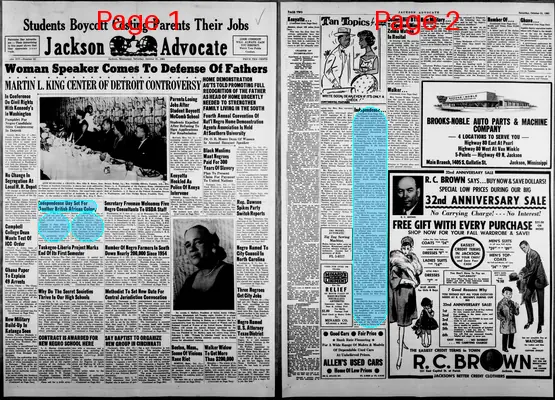
Jackson Advocate
Jackson, Hinds County, Mississippi
What is this article about?
Uganda is set for internal self-government on March 1, 1962, and full independence on October 9, 1962, following the London constitutional conference. The agreement, reached amid negotiations and breakdowns, grants autonomy to Buganda and addresses issues like lost counties, with key figures including Iain Macleod, Kabaka Mutesa II, and Benedicto Kiwanuka.
Merged-components note: Continuation of Independence Day story across pages.
Clippings
1 of 2
OCR Quality
Full Text
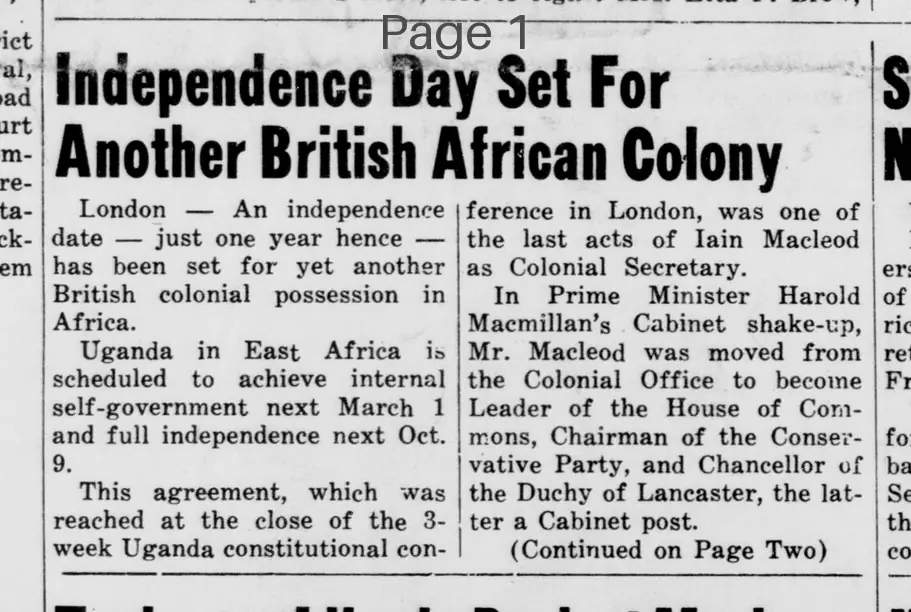
London - An independence date - just one year hence has been set for yet another British colonial possession in Africa.
Uganda in East Africa is scheduled to achieve internal self-government next March 1 and full independence next Oct. 9.
This agreement, which was reached at the close of the 3-week Uganda constitutional conference in London, was one of the last acts of Iain Macleod as Colonial Secretary.
In Prime Minister Harold Macmillan's Cabinet shake-up, Mr. Macleod was moved from the Colonial Office to become Leader of the House of Commons, Chairman of the Conservative Party, and Chancellor of the Duchy of Lancaster, the latter a Cabinet post.
(Continued on Page Two)
Independence... (Continued from Page One)
The Uganda constitutional issues were not settled without hard bargaining and at least one conference breakdown. A Colonial Office statement emphasized that the independence timetable would depend on working out "the necessary discussions and arrangements."
Remaining to be worked out in detail is how the Kingdom of Buganda, one of the integral parts of Uganda, will elect its representatives to the federal Parliament.
Buganda's King, or Kabaka, Mutesa II, known in Britain as "King Freddie," has argued for separate sovereignty for his land. His government, however, has agreed to join the Uganda federation in return for a considerable measure of autonomy.
The special position of the rulers of the other component territories of Ankole, Toro, and Bunyoro also was taken into account in the London negotiations, which ended Monday night.
Another unsettled issue is the disposition of the six "lost counties" of Bunyoro, given to Buganda long ago as a reward for services rendered to Britain. A committee of privy councilors probably will examine this problem.
Uganda, about the size of the United Kingdom but with a population of less than 7,000,000, has been a British protectorate since 1890.
Benedicto Kiwanuka, Uganda Chief Minister and Leader of the Democratic Party, termed the Lancaster House conference "a tremendous success for democracy."
He indicated some reservations about the concessions to Buganda, but welcomed the general plan and timetable for independence.
He was particularly pleased that the Buganda Lukiko (Parliament) had been brought willingly into the new Legislative Council, and would be largely elected, rather than composed of tribal chieftains.
It was Mr. Kiwanuka and his followers who walked out last week in protest against an alleged agreement between Mr. Macleod and the Kabaka outside the parley chambers.
Two delegates did not return to the conference after walking out. One was the Prime Minister of Bunyoro, Z. H. Kwebiha.
The leader of the Uganda opposition party, Milton Obote, of the Uganda People's Congress, however, said the outcome of the conference provided "a basis for a smooth but nonetheless rapid advance to independence."
Mr. Kiwanuka is regarded as a likely choice for first Prime Minister of Uganda after next April's general elections.
Sir Patrick Renison, in a nationwide broadcast Sunday, confessed to feeling "very much dispirited and frustrated" after the breakdown of round-table constitutional talks on a coalition government.
The coalition government would have taken over internal self-rule of the British colony as a prelude to future independence.
What sub-type of article is it?
What keywords are associated?
What entities or persons were involved?
Where did it happen?
Foreign News Details
Primary Location
Uganda
Event Date
Internal Self Government Next March 1 And Full Independence Next Oct. 9
Key Persons
Outcome
agreement on independence timetable depending on further discussions; autonomy for buganda; issues like lost counties to be examined by committee; conference breakdown and walkouts resolved
Event Details
The Uganda constitutional conference in London concluded with an agreement for internal self-government on March 1 and independence on October 9, reached after hard bargaining, a breakdown, and walkouts. Buganda's Kabaka Mutesa II secured autonomy within the federation. Remaining issues include Buganda's parliamentary representation and the six lost counties of Bunyoro. Uganda has been a British protectorate since 1890.