Thank you for visiting SNEWPapers!
Sign up free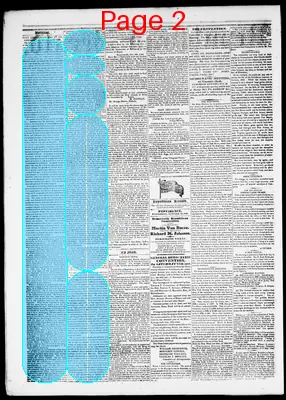
Literary
October 21, 1840
Republican Herald
Providence, Providence County, Rhode Island
What is this article about?
This article introduces and excerpts a chapter from Alexis de Tocqueville's 'Democracy in America,' analyzing how democratic institutions promote manufacturing and commerce, potentially creating a new aristocracy via division of labor that degrades workers while elevating owners. It urges intellectual self-improvement among laborers to counter these effects.
Clipping
OCR Quality
95%
Excellent
Full Text
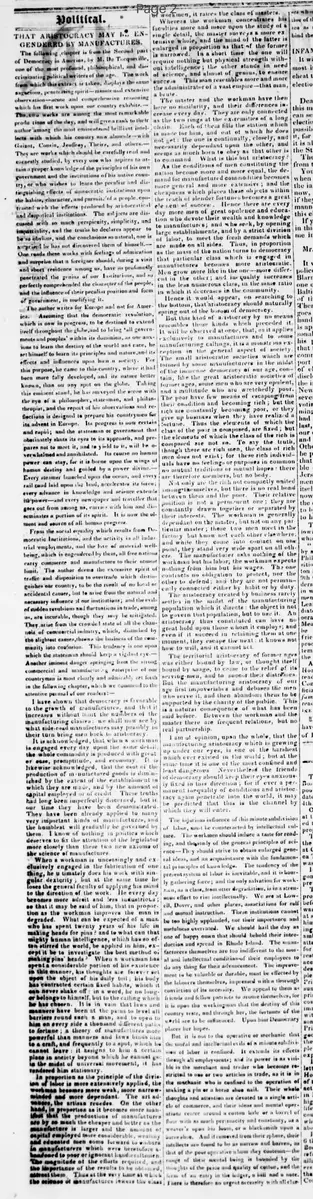
GENDERED BY MANUFACTURE
The following chapter is from the second part of Democracy in America, by M. De Tocqueville, one of the most profound, philosophical, and discriminating political writers of the age. The work from which this extract is taken, displays the same sagacious, penetrating spirit—minute and extensive observation—acute and comprehensive reasoning which his first work upon our country exhibits.
The two works are among the most remarkable productions of the day, and will give a rank to their author among the most eminent and brilliant intellects with which his country now abounds—with Guizot, Cousin, Jeffrey, Thiers, and others.
They are works which should be carefully read and earnestly studied, by every one who aspires to attain a proper knowledge of the principles of his own government and the institutions of his native country, or who wishes to learn the peculiar and distinguishing effects of democratic institutions upon the habits, character, and pursuits of a people, contrasted with the effects produced by aristocratical and despotical institutions. The subjects are discussed with so much perspicuity, simplicity, and impartiality, and the truths he declares appear to be so obvious, and the conclusions so natural, one is surprised he has not discovered them of himself.
One reads these works with feelings of admiration and surprise that a foreigner should, during a visit and short residence among us, have so profoundly penetrated the genius of our institutions, and so perfectly comprehended the character of the people, and the influence of their peculiar position and form of government, in modifying it.
The author writes for Europe and not for America. Assuming that the democratic revolution, which is now in progress, to be destined to extend itself throughout the globe, and to bring all governments and peoples within its dominion, as one anxious to learn the destiny of the world and race, he set himself to learn its principles and nature, and its effects and influences upon human society. For this purpose, he came to this country, where it had been more fully developed, and its nature better known, than on any spot on the globe. Taking this eminent stand, he has surveyed the scene with the eye of a philosopher, statesman, and philanthropist, and the report of his observations and reflections is designed to prepare his countrymen for its advent in Europe. Its progress is now certain and rapid; and the statesman or government that obstinately shuts its eyes to its approach, and prepares not to meet it, and to yield to it, will be overwhelmed and annihilated. Its course no human power can stay, for it is borne upon the wings of human destiny and guided by a power divine.
Every steamer launched upon the ocean, and every rail road laid upon the land, accelerates its force; every advance in knowledge and science extends its power—and every newspaper and traveller that goes out from among us, carries with him and disseminates a portion of its spirit. It is now the element and source of all human progress.
From this social equality which results from Democratic Institutions, and the activity in all industrial employments, and the love of material well-being, which is engendered by them, all free nations carry commerce and manufacture to their utmost limit. The author deems the excessive spirit of trade and disposition to overtrade which distinguishes our country, to be the result of no local or accidental causes, but to arise from the natural and necessary influence of our institutions; and the evils of sudden revulsions and fluctuations in trade, among us, are incurable, though they may be mitigated.
They arise from the crowded state of all the channels of commercial industry, which, disturbed by the slightest causes, throws the business of the community into confusion. This tendency is one upon which the statesman should keep a vigilant eye.
Another imminent danger springing from the strong commercial and manufacturing enterprise of our countrymen is most clearly and admirably set forth in the following chapter, which we commend to the attentive perusal of our readers:
I have shown that democracy is favorable to the growth of manufactures, and that it increases without limit the numbers of the manufacturing classes. We shall now see by what side-road manufactures may possibly in their turn bring men back to aristocracy.
It is acknowledged, that when a workman is unengaged every day upon the same detail, the whole commodity is produced with great ease, promptitude, and economy. It is likewise acknowledged, that the cost of the production of manufactured goods is diminished by the extent of the establishment in which they are made, and by the amount of capital employed or of credit. These truths had long been imperfectly discerned, but in our time they have been demonstrated.
They have been already applied to many very important kinds of manufactures, and the humblest will gradually be governed by them. I know of nothing in politics which deserves to fix the attention of the legislator more closely than these two new axioms of the science of manufacture.
When a workman is unceasingly and exclusively engaged in the fabrication of one thing, he ultimately does his work with singular dexterity; but at the same time he loses the general faculty of applying his mind to the direction of the work. He every day becomes more adroit and less industrious; that it may be said of him, that in proportion as the workman improves the man is degraded. What can be expected of a man who has spent twenty years of his life in making heads for pins? and to what can that mighty human intelligence, which has so often stirred the world, be applied in him, except it be to investigate the best method of making pins' heads? When a workman has spent considerable portion of his existence in this manner, his thoughts are forever set upon the object of his daily toil; his body has contracted certain fixed habits, which it can never shake off: in a word, he no longer belongs to himself, but to the calling which he has chosen. It is in vain that laws and manners have been at the pains to level all barriers round such a man, and to open to him on every side a thousand different paths to fortune; a theory of manufactures more powerful than manners and laws binds him to a craft, and frequently to a spot, which he cannot leave: it assigns to him a certain place in society beyond which he cannot go: in the midst of universal movement, it has rendered him stationary.
In proportion as the principle of the division of labor is more extensively applied, the workman becomes more weak, more narrow-minded and more dependent. The art advances, the artisan recedes. On the other hand, in proportion as it becomes more manifest that the productions of manufactures are by so much the cheaper and better as the manufacture is larger and the amount of capital employed more considerable, wealthy and educated men come forward to embark in manufactures which were heretofore abandoned to poor or ignorant handicraftsmen.
The magnitude of the efforts required, and the importance of the results to be obtained, attract them. Thus at the very base at which the science of manufacture levels the class of workmen, it raises the class of masters.
Whereas the workman concentrates his faculties more and more upon the study of a single detail, the master surveys a more extensive whole, and the mind of the latter is enlarged in proportion as that of the former is narrowed. In a short time the one will require nothing but physical strength without intelligence; the other stands in need of science, and almost of genius, to ensure success. This man resembles more and more the administrator of a vast empire—that man, a brute.
The master and the workman have then here no similarity, and their differences increase every day. They are only connected as the two rings at the extremities of a long chain. Each of them fills the station which is made for him, and out of which he does not get: the one is continually, closely, and necessarily dependent upon the other, and seems as much born to obey as that other is to command. What is this but aristocracy?
As the conditions of men constituting the nation become more and more equal, the demand for manufactured commodities becomes more general and more extensive; and the cheapness which places these objects within the reach of slender fortunes becomes a great element of success. Hence there are every day more men of great opulence and education who devote their wealth and knowledge to manufactures; and who seek, by opening large establishments, and by a strict division of labor, to meet the fresh demands which are made on all sides. Thus, in proportion as the mass of the nation turns to democracy that particular class which is engaged in manufactures becomes more aristocratic.
Men grow more like in the one—more different in the other; and inequality increases in the less numerous class, in the same ratio in which it decreases in the community.
Hence it would appear, on searching to the bottom, that aristocracy should naturally spring out of the bosom of democracy. But this kind of aristocracy by no means resembles those kinds which preceded it. It will be observed at once, that, as it applies exclusively to manufactures and to some manufacturing callings, it is a monstrous exception in the general aspect of society. The small aristocratic societies which are formed by some manufacturers in the midst of the immense democracy of our age, contain, like the great aristocratic societies of former ages, some men who are very opulent, and a multitude who are wretchedly poor. The poor have few means of escaping from their condition and becoming rich; but the rich are constantly becoming poor, or they give up business when they have realized a fortune. Thus the elements of which the class of the poor is composed, are fixed; but the elements of which the class of the rich is composed are not so. To say the truth, though there are rich men, the class of rich men does not exist; for these rich individuals have no feelings or purposes in common no mutual traditions or mutual hopes: there are therefore members, but no body.
Not only are the rich not compactly united among themselves, but there is no real bond between them and the poor. Their relative position is not a permanent one; they are constantly drawn together or separated by their interests. The workman is generally dependent on the master, but not on any particular master; those two men meet in the factory but know not each other elsewhere: and while they come into contact on one point, they stand very wide apart on all others. The manufacturer asks nothing of the workman but his labor; the workman expects nothing from him but his wages. This one contracts no obligation to protect, nor the other to defend; and they are not permanently connected either by habit or by duty. The aristocracy created by business rarely settles in the midst of the manufacturing population which it directs: the object is not to govern that population, but to use it. An aristocracy thus constituted can have no great hold upon those whom it employs; and even if it succeed in retaining them at one moment, they escape the next. It knows not how to will, and it cannot act.
The territorial aristocracy of former ages was either bound by law, or thought itself bound by usage, to come to the relief of its serving-men, and to succor their distresses. But the manufacturing aristocracy of our age first impoverishes and debases the men who serve it, and then abandons them to be supported by the charity of the public. This is a natural consequence of what has been said before. Between the workman and the master there are frequent relations, but no real partnership.
I am of opinion, upon the whole, that the manufacturing aristocracy which is growing up under our eyes, is one of the harshest which ever existed in the world: but at the same time it is one of the most confined and least dangerous. Nevertheless the friends of democracy should keep their eyes anxiously fixed in this direction; for if ever a permanent inequality of conditions and aristocracy again penetrate into the world, it may be predicted that this is the channel by which they will enter.
The injurious influence of this minute subdivision of labor, must be counteracted by intellectual culture. The workmen should induce a taste for reading, and the study of the general principles of science—They should strive to obtain enlarged general ideas, and an acquaintance with the fundamental principles of knowledge. The tendency of the present system of labor is inevitable, and it is hourly gathering force; and the only salvation for workingmen, as a class, from utter degradation, is in a strenuous effort to rise intellectually. We see at Lowell, Dover, and other places, associations for self and mutual instruction. These institutions cannot be too highly applauded, nor their importance and usefulness overrated. We should hail the day as one of happy omen that should behold their introduction and spread in Rhode Island. The manufacturers themselves are too indifferent to the moral and intellectual condition of their employees to do anything for their advancement. The improvement to be valuable or durable, must be effected by the laborers themselves, impressed with a thorough conviction of its necessity. We appeal to them as friends and fellow patriots to arouse themselves, for it is upon the workingman that the destiny of this country rests, and through her, the fortunes of the world are to be influenced. Upon him Democracy places her hopes.
But it is not to the operative or mechanic that the moral and intellectual evils of a minute subdivision of labor is confined. It extends its effects through all employments; and its power is as visible in the merchant and trader who becomes restricted to one or two articles in trade, as it is in the mechanic who is confined to the operation of making a pin or a horse shoe nail. Their whole thoughts and attention are devoted to a single article of commerce, and their ideas and mental operations centre around a cotton bale or a barrel of flour with as much pertinacity and constancy, as a weaver's upon his loom, or a blacksmith upon a horse shoe. And if removed from their sphere, their intellects are found to be as narrow and barren, as that of the poor operative whom they contemn—the range of their mental being is bounded by the price and quality of cotton, and the form of an entry in the ledger, a bill and a note. There is therefore an urgent necessity with all classes whose employment is restricted to a daily routine of the like operations, to lift themselves, as often as may be, above the absorbing cares which bind their minds to the circle of their labors.
What sub-type of article is it?
Essay
What themes does it cover?
Political
Commerce Trade
Liberty Freedom
What keywords are associated?
Democracy
Manufactures
Aristocracy
Division Of Labor
Intellectual Improvement
Workingmen
Tocqueville
What entities or persons were involved?
M. De Tocqueville
Literary Details
Title
Gendered By Manufacture
Author
M. De Tocqueville
Subject
Effects Of Democratic Institutions On Manufactures And Society
Form / Style
Philosophical Essay On Political Economy
Key Lines
What Can Be Expected Of A Man Who Has Spent Twenty Years Of His Life In Making Heads For Pins? And To What Can That Mighty Human Intelligence, Which Has So Often Stirred The World, Be Applied In Him, Except It Be To Investigate The Best Method Of Making Pins' Heads?
In Proportion As The Workman Improves The Man Is Degraded.
What Is This But Aristocracy?
The Manufacturing Aristocracy Which Is Growing Up Under Our Eyes, Is One Of The Harshest Which Ever Existed In The World: But At The Same Time It Is One Of The Most Confined And Least Dangerous.
Upon Him Democracy Places Her Hopes.