Thank you for visiting SNEWPapers!
Sign up free
Commercial
May 26, 1897
The Ely Miner
Ely, Saint Louis County, Minnesota
What is this article about?
R. G. Dun & Co.'s weekly trade review from New York on May 22 highlights unmistakable improvement signs: increased commercial loans, excess interior money receipts of $1,500,000, growing manufacturing and produce demand. Wheat fell 3.5 cents, cotton to 7 1/16 cents; iron business up, wool sales increasing. Failures: 248 in US (vs 277 last year), 37 in Canada (vs 28).
Clipping
OCR Quality
95%
Excellent
Full Text
HOPEFUL SIGNS.
Unmistakable Evidences of Improvement in Trade Centers.
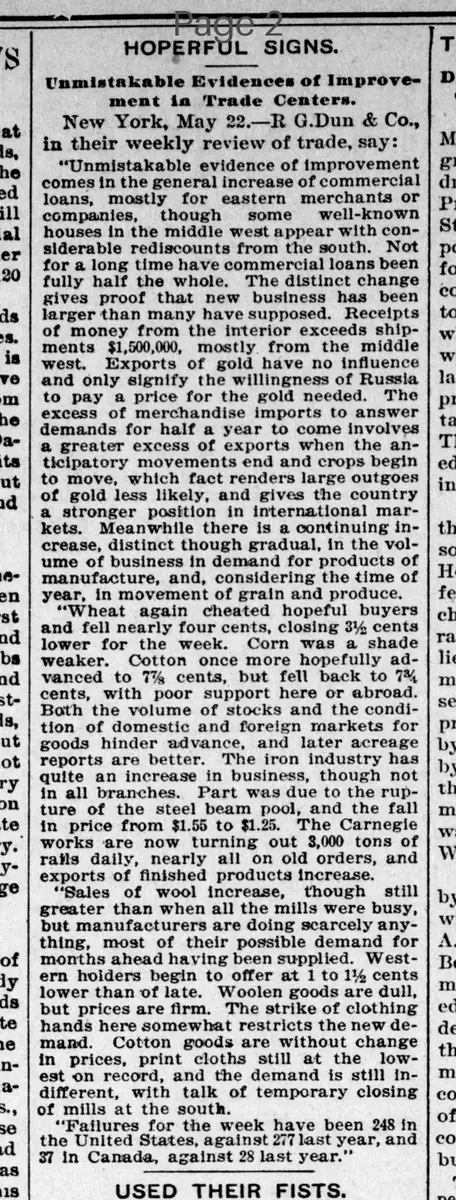
New York, May 22.—R. G. Dun & Co., in their weekly review of trade, say: 'Unmistakable evidence of improvement comes in the general increase of commercial loans, mostly for eastern merchants or companies, though some well-known houses in the middle west appear with considerable rediscounts from the south. Not for a long time have commercial loans been fully half the whole. The distinct change gives proof that new business has been larger than many have supposed. Receipts of money from the interior exceeds shipments $1,500,000, mostly from the middle west. Exports of gold have no influence and only signify the willingness of Russia to pay a price for the gold needed. The excess of merchandise imports to answer demands for half a year to come involves a greater excess of exports when the anticipatory movements end and crops begin to move, which fact renders large outgoes of gold less likely, and gives the country a stronger position in international markets. Meanwhile there is a continuing increase, distinct though gradual, in the volume of business in demand for products of manufacture, and, considering the time of year, in movement of grain and produce.
'Wheat again cheated hopeful buyers and fell nearly four cents, closing 3½ cents lower for the week. Corn was a shade weaker. Cotton once more hopefully advanced to 7⅝ cents, but fell back to 7⅓ cents, with poor support here or abroad. Both the volume of stocks and the condition of domestic and foreign markets for goods hinder advance, and later acreage reports are better. The iron industry has quite an increase in business, though not in all branches. Part was due to the rupture of the steel beam pool, and the fall in price from $1.55 to $1.25. The Carnegie works are now turning out 3,000 tons of rails daily, nearly all on old orders, and exports of finished products increase.
'Sales of wool increase, though still greater than when all the mills were busy, but manufacturers are doing scarcely anything, most of their possible demand for months ahead having been supplied. Western holders begin to offer at 1 to 1½ cents lower than of late. Woolen goods are dull, but prices are firm. The strike of clothing hands here somewhat restricts the new demand. Cotton goods are without change in prices. Print cloths still at the lowest on record, and the demand is still indifferent, with talk of temporary closing of mills at the south.
'Failures for the week have been 248 in the United States, against 277 last year, and 37 in Canada, against 28 last year.'
Unmistakable Evidences of Improvement in Trade Centers.
New York, May 22.—R. G. Dun & Co., in their weekly review of trade, say: 'Unmistakable evidence of improvement comes in the general increase of commercial loans, mostly for eastern merchants or companies, though some well-known houses in the middle west appear with considerable rediscounts from the south. Not for a long time have commercial loans been fully half the whole. The distinct change gives proof that new business has been larger than many have supposed. Receipts of money from the interior exceeds shipments $1,500,000, mostly from the middle west. Exports of gold have no influence and only signify the willingness of Russia to pay a price for the gold needed. The excess of merchandise imports to answer demands for half a year to come involves a greater excess of exports when the anticipatory movements end and crops begin to move, which fact renders large outgoes of gold less likely, and gives the country a stronger position in international markets. Meanwhile there is a continuing increase, distinct though gradual, in the volume of business in demand for products of manufacture, and, considering the time of year, in movement of grain and produce.
'Wheat again cheated hopeful buyers and fell nearly four cents, closing 3½ cents lower for the week. Corn was a shade weaker. Cotton once more hopefully advanced to 7⅝ cents, but fell back to 7⅓ cents, with poor support here or abroad. Both the volume of stocks and the condition of domestic and foreign markets for goods hinder advance, and later acreage reports are better. The iron industry has quite an increase in business, though not in all branches. Part was due to the rupture of the steel beam pool, and the fall in price from $1.55 to $1.25. The Carnegie works are now turning out 3,000 tons of rails daily, nearly all on old orders, and exports of finished products increase.
'Sales of wool increase, though still greater than when all the mills were busy, but manufacturers are doing scarcely anything, most of their possible demand for months ahead having been supplied. Western holders begin to offer at 1 to 1½ cents lower than of late. Woolen goods are dull, but prices are firm. The strike of clothing hands here somewhat restricts the new demand. Cotton goods are without change in prices. Print cloths still at the lowest on record, and the demand is still indifferent, with talk of temporary closing of mills at the south.
'Failures for the week have been 248 in the United States, against 277 last year, and 37 in Canada, against 28 last year.'
What sub-type of article is it?
Economic
Market Condition
Prices
What keywords are associated?
Trade Improvement
Commercial Loans
Wheat Prices
Cotton Market
Iron Industry
Wool Sales
Business Failures
What entities or persons were involved?
R. G. Dun & Co.
Carnegie Works
Russia
Where did it happen?
New York
Commercial Details
Location
New York
Event Date
May 22
Commodities
Wheat
Corn
Cotton
Iron
Wool
Print Cloths
Key Figures
R. G. Dun & Co.
Carnegie Works
Russia
Notable Details
Commercial Loans Increase
Receipts Exceed Shipments $1,500,000
Wheat Fell 3.5 Cents
Cotton At 7 1/16 Cents
Iron Price Fall From $1.55 To $1.25
Carnegie 3,000 Tons Rails Daily
Wool Sales Increase
Failures 248 Us Vs 277 Last Year
37 Canada Vs 28 Last Year