Thank you for visiting SNEWPapers!
Sign up free
Literary
July 22, 1918
Casper Daily Tribune
Casper, Natrona County, Wyoming
What is this article about?
Alexander Graham Bell explores the untapped science of measuring odors and recounts how a chemist's detection of tellurium's unique smell in sulfuric acid waste led to the discovery of selenium, a new element resembling black sealing wax that conducts electricity in crystalline form.
Clipping
OCR Quality
98%
Excellent
Full Text
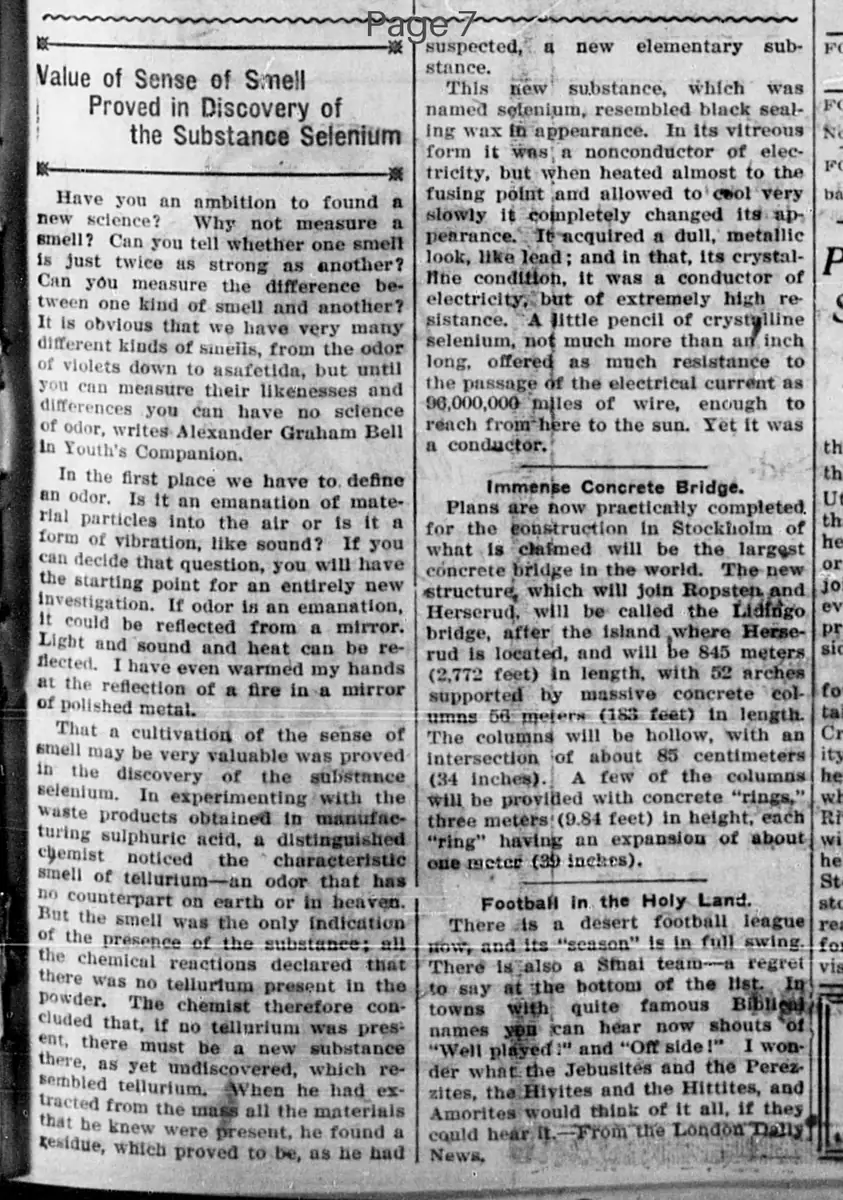
Value of Sense of Smell Proved in Discovery of the Substance Selenium
Have you an ambition to found a new science? Why not measure a smell? Can you tell whether one smell is just twice as strong as another? Can you measure the difference between one kind of smell and another?
It is obvious that we have very many different kinds of smells, from the odor of violets down to asafetida, but until you can measure their likenesses and differences you can have no science of odor, writes Alexander Graham Bell in Youth's Companion.
In the first place we have to define an odor. Is it an emanation of material particles into the air or is it a form of vibration, like sound? If you can decide that question, you will have the starting point for an entirely new investigation. If odor is an emanation, it could be reflected from a mirror. Light and sound and heat can be reflected. I have even warmed my hands at the reflection of a fire in a mirror of polished metal.
That a cultivation of the sense of smell may be very valuable was proved in the discovery of the substance selenium. In experimenting with the waste products obtained in manufacturing sulphuric acid, a distinguished chemist noticed the characteristic smell of tellurium—an odor that has no counterpart on earth or in heaven.
But the smell was the only indication of the presence of the substance; all the chemical reactions declared that there was no tellurium present in the powder. The chemist therefore concluded that, if no tellurium was present, there must be a new substance there, as yet undiscovered, which resembled tellurium.
When he had extracted from the mass all the materials that he knew were present, he found a residue, which proved to be, as he had suspected, a new elementary substance.
This new substance, which was named selenium, resembled black sealing wax in appearance. In its vitreous form it was a nonconductor of electricity, but when heated almost to the fusing point and allowed to cool very slowly it completely changed its appearance. It acquired a dull, metallic look, like lead: and in that, its crystalline condition, it was a conductor of electricity, but of extremely high resistance. A little pencil of crystalline selenium, not much more than an inch long, offered as much resistance to the passage of the electrical current as 96,000,000 miles of wire, enough to reach from here to the sun. Yet it was a conductor.
Have you an ambition to found a new science? Why not measure a smell? Can you tell whether one smell is just twice as strong as another? Can you measure the difference between one kind of smell and another?
It is obvious that we have very many different kinds of smells, from the odor of violets down to asafetida, but until you can measure their likenesses and differences you can have no science of odor, writes Alexander Graham Bell in Youth's Companion.
In the first place we have to define an odor. Is it an emanation of material particles into the air or is it a form of vibration, like sound? If you can decide that question, you will have the starting point for an entirely new investigation. If odor is an emanation, it could be reflected from a mirror. Light and sound and heat can be reflected. I have even warmed my hands at the reflection of a fire in a mirror of polished metal.
That a cultivation of the sense of smell may be very valuable was proved in the discovery of the substance selenium. In experimenting with the waste products obtained in manufacturing sulphuric acid, a distinguished chemist noticed the characteristic smell of tellurium—an odor that has no counterpart on earth or in heaven.
But the smell was the only indication of the presence of the substance; all the chemical reactions declared that there was no tellurium present in the powder. The chemist therefore concluded that, if no tellurium was present, there must be a new substance there, as yet undiscovered, which resembled tellurium.
When he had extracted from the mass all the materials that he knew were present, he found a residue, which proved to be, as he had suspected, a new elementary substance.
This new substance, which was named selenium, resembled black sealing wax in appearance. In its vitreous form it was a nonconductor of electricity, but when heated almost to the fusing point and allowed to cool very slowly it completely changed its appearance. It acquired a dull, metallic look, like lead: and in that, its crystalline condition, it was a conductor of electricity, but of extremely high resistance. A little pencil of crystalline selenium, not much more than an inch long, offered as much resistance to the passage of the electrical current as 96,000,000 miles of wire, enough to reach from here to the sun. Yet it was a conductor.
What sub-type of article is it?
Essay
What keywords are associated?
Selenium
Sense Of Smell
Tellurium
Scientific Discovery
Odor Science
Alexander Graham Bell
What entities or persons were involved?
Alexander Graham Bell In Youth's Companion
Literary Details
Title
Value Of Sense Of Smell Proved In Discovery Of The Substance Selenium
Author
Alexander Graham Bell In Youth's Companion
Subject
On The Value Of The Sense Of Smell In Scientific Discovery
Form / Style
Prose Essay On Olfaction And Chemistry
Key Lines
Have You An Ambition To Found A New Science? Why Not Measure A Smell? Can You Tell Whether One Smell Is Just Twice As Strong As Another? Can You Measure The Difference Between One Kind Of Smell And Another?
That A Cultivation Of The Sense Of Smell May Be Very Valuable Was Proved In The Discovery Of The Substance Selenium.
But The Smell Was The Only Indication Of The Presence Of The Substance; All The Chemical Reactions Declared That There Was No Tellurium Present In The Powder.