Thank you for visiting SNEWPapers!
Sign up free
Literary
September 5, 1860
The Hillsborough Recorder
Hillsboro, Orange County, North Carolina
What is this article about?
Two women gossip about Alice and Atwood Leighton's unexpected move from city to country life, attributing it to her temperament or selfishness. Years later, it's revealed that Alice selflessly helped her husband conquer hereditary alcoholism by isolating him from temptations on the plantation, enabling his triumphant return to law practice.
Clipping
OCR Quality
95%
Excellent
Full Text
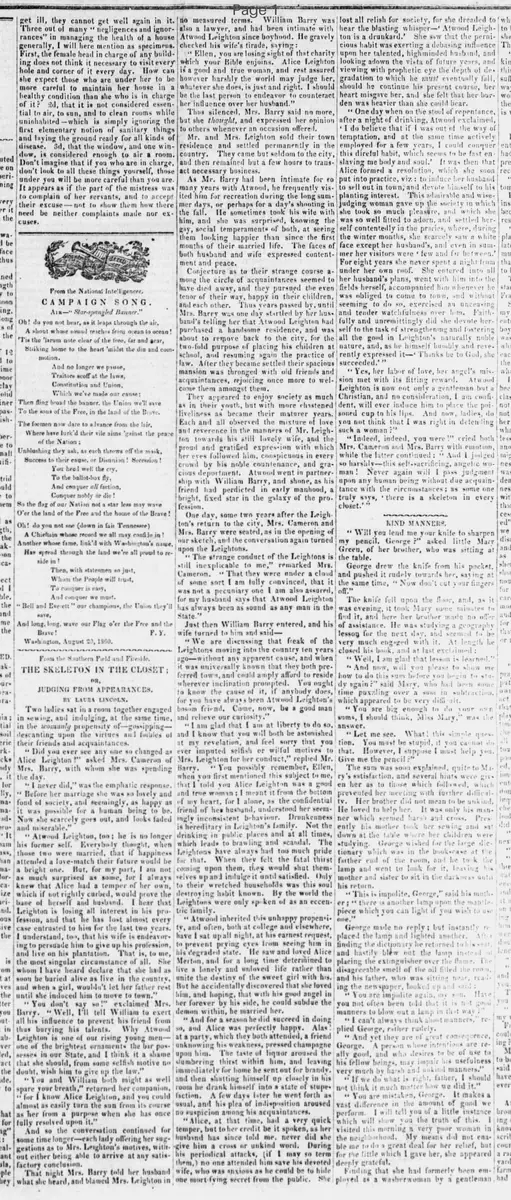
From the Southern Field and Fireside.
THE SKELETON IN THE CLOSET:
OR,
JUDGING FROM APPEARANCES.
BY LAURA LINCOLN.
Two ladies sat in a room together engaged in sewing, and indulging, at the same time, in the womanly propensity of gossiping—descanting upon the virtues and foibles of their friends and acquaintances.
"Did you ever see any one so changed as Alice Leighton?" asked Mrs. Cameron of Mrs. Barry, with whom she was spending the day.
"I never did," was the emphatic response.
"Before her marriage she was so lovely and fond of society, and seemingly as happy as it was possible for a human being to be. Now she scarcely goes out, and looks faded and miserable."
"Atwood Leighton, too: he is no longer his former self. Everybody thought, when those two were married, that if happiness attended a love-match their future would be a bright one. But, on my part, I am not as much surprised as some, for I always knew that Alice had a temper of her own, which if not rightly curbed, would prove the bane of herself and husband. I hear that Leighton is losing all interest in his profession, and that he has lost almost every case entrusted to him for the last two years. I understand, too, that his wife is endeavoring to persuade him to give up his profession, and live on his plantation. That is, to me, the most singular circumstance of all. She whom I have heard declare that she had as soon be buried alive as live in the country, and when a girl, wouldn't let her father rest until she induced him to move to town."
"You don't say so!" exclaimed Mrs. Barry. "Well, I'll tell William to exert all his influence to prevent his friend from thus burying his talents. Why Atwood Leighton is one of our rising young men—one of the brightest ornaments the bar possesses in our State, and I think it a shame that she should, from some selfish motive no doubt, wish him to give up the law."
"You and William both might as well spare your breath," returned her companion, "for I know Alice Leighton, and you could almost as easily turn the sun from its course as her from a purpose when she has once fully resolved upon it."
And so the conversation continued for some time longer—each lady offering her suggestions as to Mrs. Leighton's motives, without either being able to arrive at any satisfactory conclusion.
That night Mrs. Barry told her husband what she heard, and blamed Mrs. Leighton in no measured terms. William Barry was also a lawyer, and had been intimate with Atwood Leighton since boyhood. He gravely checked his wife's tirade, saying:
"Ellen, you are losing sight of that charity which your Bible enjoins. Alice Leighton is a good and true woman, and rest assured however harshly the world may judge her, whatever she does, is just and right. I should be the last person to endeavor to counteract her influence over her husband."
Thus silenced, Mrs. Barry said no more, but she thought, and expressed her opinion to others whenever an occasion offered.
Mr. and Mrs. Leighton sold their town residence and settled permanently in the country. They came but seldom to the city, and then remained but a few hours to transact necessary business.
As Mr. Barry had been intimate for so many years with Atwood, he frequently visited him for recreation during the long summer days, or perhaps for a day's shooting in the fall. He sometimes took his wife with him, and she was surprised, knowing the gay, social temperaments of both, at seeing them looking happier than since the first months of their married life. The faces of both husband and wife expressed contentment and peace.
Conjecture as to their strange course among the circle of acquaintances seemed to have died away, and they pursued the even tenor of their way, happy in their children, and each other. Thus years passed by, until Mrs. Barry was one day startled by her husband's telling her that Atwood Leighton had purchased a handsome residence, and was about to remove back to the city, for the two-fold purpose of placing his children at school, and resuming again the practice of law. After they became settled their spacious mansion was thronged with old friends and acquaintances, rejoicing once more to welcome them amongst them.
They appeared to enjoy society as much as in their youth, but with more chastened liveliness as became their maturer years. Each and all observed the mixture of love and reverence in the manners of Mr. Leighton towards his still lovely wife, and the proud and gratified expression with which her eyes followed him, conspicuous in every crowd by his noble countenance, and gracious deportment. Atwood went in partnership with William Barry, and shone, as his friend had predicted in early manhood, a bright, fixed star in the galaxy of the profession.
One day, some two years after the Leighton's return to the city, Mrs. Cameron and Mrs. Barry were seated, as in the opening of our sketch, and the conversation again turned upon the Leightons.
"The strange conduct of the Leightons is still inexplicable to me," remarked Mrs. Cameron. "That they were under a cloud of some sort I am fully convinced, that it was not a pecuniary one I am also assured, for my husband says that Atwood Leighton has always been as sound as any man in the State."
Just then William Barry entered, and his wife turned to him and said—
"We are discussing that freak of the Leightons moving into the country ten years ago—without any apparent cause, and when it was universally known that they both preferred town, and could amply afford to reside wherever inclination prompted. You ought to know the cause of it, if anybody does, for you have always been Atwood Leighton's bosom friend. Come, now, be a good man and relieve our curiosity."
"I am glad that I am at liberty to do so, and I know that you will both be astonished at my revelation, and feel sorry that you ever imputed selfish or wilful motives to Mrs. Leighton for her conduct," replied Mr. Barry. "You possibly remember, Ellen, when you first mentioned this subject to me, that I told you Alice Leighton was a good and true woman: I meant it from the bottom of my heart, for I alone, as the confidential friend of her husband, understood her seemingly inconsistent behaviour. Drunkenness is hereditary in Leighton's family. Not the drinking in public places and at all times, which leads to brawling and scandal. The Leightons have always had too much pride for that. When they felt the fatal thirst coming upon them, they would shut themselves up and indulge it until satisfied. Only to their wretched households was this soul-destroying habit known. By the world the Leightons were only spoken of as an eccentric family.
"Atwood inherited this unhappy propensity, and often, both at college and elsewhere, have I sat up all night, at his earnest request, to prevent prying eyes from seeing him in his degraded state. He saw and loved Alice Merton, and for a long time determined to live a lonely and unloved life rather than unite the destiny of the sweet girl with his. But he accidentally discovered that she loved him, and hoping, that with his good angel in her forever by his side, he could subdue the demon within, he married her.
"And for a season he did succeed in doing so, and Alice was perfectly happy. Alas! at a party, which they both attended, a friend unknowing his weakness, pressed champagne upon him. The taste of liquor aroused the slumbering thirst within him, and leaving immediately for home he sent out for brandy, and then shutting himself up closely in his room he drank himself into a state of stupefaction. A few days later he went forth as usual, and his plea of indisposition aroused no suspicion among his acquaintances.
"Alice, at that time, had a very quick temper, but to her credit be it spoken, as her husband has since told me, never did she give him a cross or unkind word. During his periodical attacks, (if I may so term them,) no one attended him save his devoted wife, who was as anxious as he could be to hide one mortifying secret from the public. She lost all relish for society, for she dreaded to hear the blasting whisper—'Atwood Leighton is a drunkard.' She saw that the pernicious habit was exerting a debasing influence upon her talented, high-minded husband, and looking adown the vista of future years, and viewing with prophetic eye the depth of degradation to which he must eventually fall, should he continue his present course, her heart misgave her, and she felt that her burden was heavier than she could bear.
"One day when on the stool of repentance, after a night of drinking, Atwood exclaimed, 'I do believe that if I was out of the way of temptation, and at the same time actively employed for a few years, I could conquer this direful habit, which seems to be fast enslaving me body and soul.' It was then that Alice formed a resolution, which she soon put into practice, viz.: to induce her husband to sell out in town, and devote himself to his planting interest. This admirable and wise-judging woman gave up the society in which she took so much pleasure, and which she was so well fitted to adorn, and settled herself contentedly in the prairies, where, during the winter months, she scarcely saw a white face except her husband's, and even in summer her visitors were 'few and far between.' For eight years she never spent a night from under her own roof. She entered into all her husband's plans, went with him into the fields herself, accompanied him whenever he was obliged to come to town, and without seeming to do so, exercised an unceasing and tender watchfulness over him. Faithfully and unremittingly did she devote herself to the task of strengthening and fostering all the good in Leighton's naturally noble nature, and, as he himself humbly and reverently expressed it—'Thanks be to God, she succeeded.'"
"Yes, her labor of love, her angel's mission met with its fitting reward. Atwood Leighton is now not only a gentleman but a Christian, and no consideration, I am confident, will ever induce him to place the poisoned cup to his lips. And now, ladies, do you not think that I was right in defending such a woman?"
"Indeed, indeed, you were!" cried both Mrs. Cameron and Mrs. Barry with emotion, while the latter continued: "And I judged so harshly—this self-sacrificing, angelic woman! Never again will I pass judgment upon any human being without due acquaintance with the circumstances; as some one truly says, there is a skeleton in every closet.'"
THE SKELETON IN THE CLOSET:
OR,
JUDGING FROM APPEARANCES.
BY LAURA LINCOLN.
Two ladies sat in a room together engaged in sewing, and indulging, at the same time, in the womanly propensity of gossiping—descanting upon the virtues and foibles of their friends and acquaintances.
"Did you ever see any one so changed as Alice Leighton?" asked Mrs. Cameron of Mrs. Barry, with whom she was spending the day.
"I never did," was the emphatic response.
"Before her marriage she was so lovely and fond of society, and seemingly as happy as it was possible for a human being to be. Now she scarcely goes out, and looks faded and miserable."
"Atwood Leighton, too: he is no longer his former self. Everybody thought, when those two were married, that if happiness attended a love-match their future would be a bright one. But, on my part, I am not as much surprised as some, for I always knew that Alice had a temper of her own, which if not rightly curbed, would prove the bane of herself and husband. I hear that Leighton is losing all interest in his profession, and that he has lost almost every case entrusted to him for the last two years. I understand, too, that his wife is endeavoring to persuade him to give up his profession, and live on his plantation. That is, to me, the most singular circumstance of all. She whom I have heard declare that she had as soon be buried alive as live in the country, and when a girl, wouldn't let her father rest until she induced him to move to town."
"You don't say so!" exclaimed Mrs. Barry. "Well, I'll tell William to exert all his influence to prevent his friend from thus burying his talents. Why Atwood Leighton is one of our rising young men—one of the brightest ornaments the bar possesses in our State, and I think it a shame that she should, from some selfish motive no doubt, wish him to give up the law."
"You and William both might as well spare your breath," returned her companion, "for I know Alice Leighton, and you could almost as easily turn the sun from its course as her from a purpose when she has once fully resolved upon it."
And so the conversation continued for some time longer—each lady offering her suggestions as to Mrs. Leighton's motives, without either being able to arrive at any satisfactory conclusion.
That night Mrs. Barry told her husband what she heard, and blamed Mrs. Leighton in no measured terms. William Barry was also a lawyer, and had been intimate with Atwood Leighton since boyhood. He gravely checked his wife's tirade, saying:
"Ellen, you are losing sight of that charity which your Bible enjoins. Alice Leighton is a good and true woman, and rest assured however harshly the world may judge her, whatever she does, is just and right. I should be the last person to endeavor to counteract her influence over her husband."
Thus silenced, Mrs. Barry said no more, but she thought, and expressed her opinion to others whenever an occasion offered.
Mr. and Mrs. Leighton sold their town residence and settled permanently in the country. They came but seldom to the city, and then remained but a few hours to transact necessary business.
As Mr. Barry had been intimate for so many years with Atwood, he frequently visited him for recreation during the long summer days, or perhaps for a day's shooting in the fall. He sometimes took his wife with him, and she was surprised, knowing the gay, social temperaments of both, at seeing them looking happier than since the first months of their married life. The faces of both husband and wife expressed contentment and peace.
Conjecture as to their strange course among the circle of acquaintances seemed to have died away, and they pursued the even tenor of their way, happy in their children, and each other. Thus years passed by, until Mrs. Barry was one day startled by her husband's telling her that Atwood Leighton had purchased a handsome residence, and was about to remove back to the city, for the two-fold purpose of placing his children at school, and resuming again the practice of law. After they became settled their spacious mansion was thronged with old friends and acquaintances, rejoicing once more to welcome them amongst them.
They appeared to enjoy society as much as in their youth, but with more chastened liveliness as became their maturer years. Each and all observed the mixture of love and reverence in the manners of Mr. Leighton towards his still lovely wife, and the proud and gratified expression with which her eyes followed him, conspicuous in every crowd by his noble countenance, and gracious deportment. Atwood went in partnership with William Barry, and shone, as his friend had predicted in early manhood, a bright, fixed star in the galaxy of the profession.
One day, some two years after the Leighton's return to the city, Mrs. Cameron and Mrs. Barry were seated, as in the opening of our sketch, and the conversation again turned upon the Leightons.
"The strange conduct of the Leightons is still inexplicable to me," remarked Mrs. Cameron. "That they were under a cloud of some sort I am fully convinced, that it was not a pecuniary one I am also assured, for my husband says that Atwood Leighton has always been as sound as any man in the State."
Just then William Barry entered, and his wife turned to him and said—
"We are discussing that freak of the Leightons moving into the country ten years ago—without any apparent cause, and when it was universally known that they both preferred town, and could amply afford to reside wherever inclination prompted. You ought to know the cause of it, if anybody does, for you have always been Atwood Leighton's bosom friend. Come, now, be a good man and relieve our curiosity."
"I am glad that I am at liberty to do so, and I know that you will both be astonished at my revelation, and feel sorry that you ever imputed selfish or wilful motives to Mrs. Leighton for her conduct," replied Mr. Barry. "You possibly remember, Ellen, when you first mentioned this subject to me, that I told you Alice Leighton was a good and true woman: I meant it from the bottom of my heart, for I alone, as the confidential friend of her husband, understood her seemingly inconsistent behaviour. Drunkenness is hereditary in Leighton's family. Not the drinking in public places and at all times, which leads to brawling and scandal. The Leightons have always had too much pride for that. When they felt the fatal thirst coming upon them, they would shut themselves up and indulge it until satisfied. Only to their wretched households was this soul-destroying habit known. By the world the Leightons were only spoken of as an eccentric family.
"Atwood inherited this unhappy propensity, and often, both at college and elsewhere, have I sat up all night, at his earnest request, to prevent prying eyes from seeing him in his degraded state. He saw and loved Alice Merton, and for a long time determined to live a lonely and unloved life rather than unite the destiny of the sweet girl with his. But he accidentally discovered that she loved him, and hoping, that with his good angel in her forever by his side, he could subdue the demon within, he married her.
"And for a season he did succeed in doing so, and Alice was perfectly happy. Alas! at a party, which they both attended, a friend unknowing his weakness, pressed champagne upon him. The taste of liquor aroused the slumbering thirst within him, and leaving immediately for home he sent out for brandy, and then shutting himself up closely in his room he drank himself into a state of stupefaction. A few days later he went forth as usual, and his plea of indisposition aroused no suspicion among his acquaintances.
"Alice, at that time, had a very quick temper, but to her credit be it spoken, as her husband has since told me, never did she give him a cross or unkind word. During his periodical attacks, (if I may so term them,) no one attended him save his devoted wife, who was as anxious as he could be to hide one mortifying secret from the public. She lost all relish for society, for she dreaded to hear the blasting whisper—'Atwood Leighton is a drunkard.' She saw that the pernicious habit was exerting a debasing influence upon her talented, high-minded husband, and looking adown the vista of future years, and viewing with prophetic eye the depth of degradation to which he must eventually fall, should he continue his present course, her heart misgave her, and she felt that her burden was heavier than she could bear.
"One day when on the stool of repentance, after a night of drinking, Atwood exclaimed, 'I do believe that if I was out of the way of temptation, and at the same time actively employed for a few years, I could conquer this direful habit, which seems to be fast enslaving me body and soul.' It was then that Alice formed a resolution, which she soon put into practice, viz.: to induce her husband to sell out in town, and devote himself to his planting interest. This admirable and wise-judging woman gave up the society in which she took so much pleasure, and which she was so well fitted to adorn, and settled herself contentedly in the prairies, where, during the winter months, she scarcely saw a white face except her husband's, and even in summer her visitors were 'few and far between.' For eight years she never spent a night from under her own roof. She entered into all her husband's plans, went with him into the fields herself, accompanied him whenever he was obliged to come to town, and without seeming to do so, exercised an unceasing and tender watchfulness over him. Faithfully and unremittingly did she devote herself to the task of strengthening and fostering all the good in Leighton's naturally noble nature, and, as he himself humbly and reverently expressed it—'Thanks be to God, she succeeded.'"
"Yes, her labor of love, her angel's mission met with its fitting reward. Atwood Leighton is now not only a gentleman but a Christian, and no consideration, I am confident, will ever induce him to place the poisoned cup to his lips. And now, ladies, do you not think that I was right in defending such a woman?"
"Indeed, indeed, you were!" cried both Mrs. Cameron and Mrs. Barry with emotion, while the latter continued: "And I judged so harshly—this self-sacrificing, angelic woman! Never again will I pass judgment upon any human being without due acquaintance with the circumstances; as some one truly says, there is a skeleton in every closet.'"
What sub-type of article is it?
Prose Fiction
What themes does it cover?
Moral Virtue
Temperance
Social Manners
What keywords are associated?
Short Story
Alcoholism
Marriage Sacrifice
Social Judgment
Temperance
Redemption
Gossip
What entities or persons were involved?
By Laura Lincoln.
Literary Details
Title
The Skeleton In The Closet: Or, Judging From Appearances.
Author
By Laura Lincoln.
Key Lines
"Ellen, You Are Losing Sight Of That Charity Which Your Bible Enjoins. Alice Leighton Is A Good And True Woman, And Rest Assured However Harshly The World May Judge Her, Whatever She Does, Is Just And Right."
"Drunkenness Is Hereditary In Leighton's Family."
"She Lost All Relish For Society, For She Dreaded To Hear The Blasting Whisper—'Atwood Leighton Is A Drunkard.'"
"Thanks Be To God, She Succeeded."
"Never Again Will I Pass Judgment Upon Any Human Being Without Due Acquaintance With The Circumstances; As Some One Truly Says, There Is A Skeleton In Every Closet.'"